AutonomousSDR
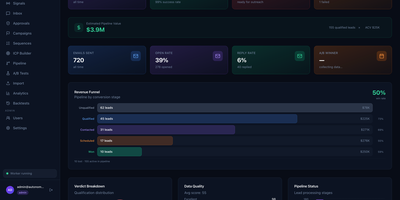
A lead fills in your form at midnight, and by morning AutonomousSDR has researched it, scored it, and queued a fact-checked email for you to approve. Leads come in from six channels, including web forms, ads, inbound email, LinkedIn signals, and a universal webhook for Zapier and Make. A research agent looks the company up online, then BANT scores, whose weights learn from won and lost deals, sort the lead as hot, warm, or cold. Hot leads receive a Cal.com booking link, warm ones enter an A/B-tested outreach sequence, and cold ones sync to HubSpot. Factual claims in a draft are matched to the research snippet behind them, and anything unsupported is flagged in the approval queue. An autonomy dial per organization switches between draft-only, approve-each-email, and full-auto modes. A campaign agent takes a quota, diagnoses why you are behind pace, and proposes strategy changes for your approval. Mailboxes rotate per rep with warm-up ramps and SPF, DKIM, and DMARC checks, sends honor recipient-local windows and daily caps, and any reply stops the cadence. Unsubscribe works in one click, and do-not-contact lists and GDPR erasure are included. Free Groq or local Ollama models work with no paid keys. Last quarter's won and lost deals can backtest the qualifier, and cost per meeting is compared with a human SDR. Running on a dedicated VPS on RepoCloud with guaranteed CPU, RAM, and SSD, full root SSH access, and a browser serial console. MIT licensed.
Agentic Studio
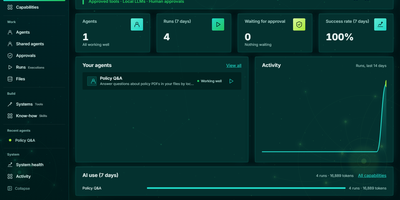
Describe the agent you want in plain English or Arabic, and Agentic Studio plans it, builds it from approved parts, tests it against your goal, and keeps it running inside your network. One card of choices covers read-only or approval-gated, when to notify, answer style from short text to tables or fixed JSON, and effort per run. For a missing integration, the studio reads a system's OpenAPI description, picks the operations your goal needs, and tests the read ones live, or it writes a Python tool with a plain-words risk report that an administrator approves. A person approves every call that changes a connected system, and secrets and ID numbers are masked in every answer. Agents answer in chat, run on schedules phrased the way people talk, react to webhooks, or keep watching and act only on what is new. After go-live each run is judged against its goal; failures retry with the reason, a backup model covers outages, missed runs are made up, and an agent that fails three times in a row is paused. Owners correct an agent in plain words, keep up to ten regression test questions, and share it through a chat link, an iframe, or MCP. Local or LDAP sign-in separates users, builders, and administrators, and the activity log exports to CSV. Running on a dedicated VPS on RepoCloud with guaranteed CPU, RAM, and SSD, full root SSH access, and a browser serial console. Apache-2.0 licensed.
Junctio
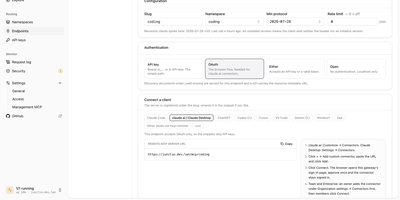
Every MCP client keeps its own list of servers and every server keeps its own login that expires at the worst moment, so Junctio puts them all behind one URL per client and refreshes the logins before they lapse. Add stdio servers by npm package, uv, container image or custom command, and remote servers over Streamable HTTP or legacy SSE, then group them into namespaces whose tools you can hide, rename or re-describe. Each endpoint accepts no auth, API keys bound to it, or OAuth, with a built-in authorization server for claude.ai and Claude Desktop connectors or token checks against Keycloak, Authentik or Auth0. Upstream tokens refresh on a schedule, parallel calls share one refresh, and a server that cannot refresh is flagged for re-login instead of failing silently. A dead upstream never blocks the rest, because tool lists load in parallel with a five second limit per server. The Explore page searches the official MCP registry and prefills the Add server form, and a pasted client config turns into rows you can add. A request log and per-endpoint rate limits watch the traffic, and an optional audit quarantines stdio servers with critical vulnerabilities. An optional management server with forty-six tools lets an agent configure the gateway, and there is no telemetry. Running on a dedicated VPS on RepoCloud with guaranteed CPU, RAM, and SSD, full root SSH access, and a browser serial console. MIT licensed.
Kvitok
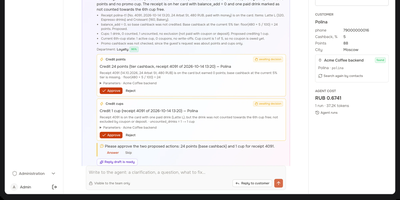
Kvitok is a helpdesk where an AI agent reads your backend, drafts the reply, and lines up the fix, so by the time an operator opens a ticket only the decision is left. Take a guest whose loyalty points never arrived: the agent finds her in your system, reads her receipts, and queues the missing credit for one click of approval. Requests arrive by mailbox or API channel, and your backend matches customers by phone, email, card number, or any identity it exposes. Rules you write run first and can set a department, priority, or tags, or skip the agent for senders such as partners. The agent calls tools your backend publishes, follows your playbooks, and picks a department with a confidence score, while your backend validates every action it proposes. Operators talk to the agent inside the ticket: say the receipt was really 540 and it revises only what that changes. Approved actions run exactly once, and the reply goes out by email or back through the channel the request came from. Each workspace picks its own model from any OpenAI-compatible endpoint, hosted or local, and every ticket shows what the agent spent. Test scenarios run against a real model, so policy or model changes get checked before reaching customers. Claude Code can tune rules and playbooks over MCP. Running on a dedicated VPS on RepoCloud with guaranteed CPU, RAM, and SSD, full root SSH access, and a browser serial console. AGPL-3.0 licensed.
Nemofy Agent
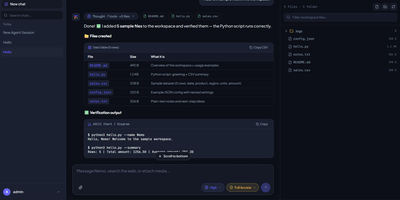
A private AI assistant with its own workspace: Nemofy Agent gives Nemo a file drawer, a code sandbox, and live web research, and by default pauses for your approval before anything sensitive runs. Ask Nemo to create files, crunch numbers, or test a script, and it builds them in a confined /workspace folder and runs verification commands. Files appear in a drawer beside the chat, where each opens to view, edit, save, or delete. For research, Nemo searches, fetches, and crawls the web through Firecrawl Local. PDF, Word, spreadsheet, and slide files are parsed natively. Pick a provider and model per conversation, from OpenRouter, River AI, OpenAI, Anthropic, Gemini, DeepSeek, Groq, NVIDIA, local Ollama, or a custom endpoint. A faster worker model takes parallel research and coding sub-tasks, with timeouts, retries, and a fallback model when a provider stalls. A context gauge shows what fills the window, and at 80% capacity older turns are summarized automatically. Reusable Markdown skills like code_and_data and deep_research load on demand, and external MCP tools connect from the same settings tab. In default mode, read-only actions run freely while sensitive ones pause to approve, edit, or reject, and paused runs resume after a restart. Access sits behind an admin login, and API keys are encrypted at rest per user profile with AES-256-GCM. Running on a dedicated VPS on RepoCloud with guaranteed CPU, RAM, and SSD, full root SSH access, and a browser serial console. Apache-2.0 licensed.
Euron Open LogMind
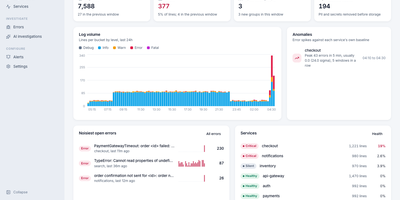
When production breaks, Euron Open LogMind searches and groups your logs, then returns a root cause where every claim cites a real stored log line you can open and re-check. Services send lines over HTTP, the Python or Node.js SDK, or any OpenTelemetry exporter. Credentials, emails, card numbers, and personal data are masked or hashed before storage, so secrets never reach a disk, a model, or a browser. The explorer filters by keyword, service, environment, level, trace, and request. It also draws a level histogram, shows the lines around any entry, and streams new lines live. Errors collapse by fingerprint: a timeout thrown 230 times for 230 different orders becomes one group. Service health, volume, and error rate come from the logs alone. An investigation collects the first failure, earlier warnings, other services' errors, deploys, and the failing request's trace. Statements that cite nothing real are removed and shown as removed. A single click re-reads every cited line from storage, and follow-up questions reuse the same evidence. Reports show their token cost, and OpenAI, Anthropic, Gemini, Ollama, or an OpenAI-compatible endpoint can write them. Search, grouping, live logs, and alerts work without any model, and threshold or anomaly rules notify by email, signed webhook, or Slack. Organizations, projects, and viewer, admin, and owner roles keep each team's data separate. Running on a dedicated VPS on RepoCloud with guaranteed CPU, RAM, and SSD, full root SSH access, and a browser serial console. MIT licensed.
9eye
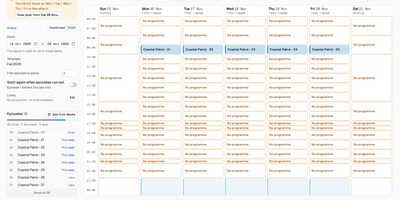
TV schedulers lay out the week, fill each day's playlist, and book ad spots with 9eye, and its AI agents take the routine work but ask first. Lengths and times are whole numbers of frames. Rates run between 23.976 and 59.94 fps, with drop-frame timecode. Layouts turn a channel's week into blocks on a drag-and-drop grid, with undo and redo. Series, programmes, trailers, and stings land in the layout's blocks as drafts or confirmed plans, and conflicts with other plans are named, never hidden. Auto-place respects allowed time windows and airing limits. One click fills a day's playlist with programme placements, booked spots, and rotation lists for the gaps. A day is approved for air and exported as a Playout XML file. Advertisers and agencies get deals and campaigns, and their spots are booked on a week board of the channel's real breaks. Auto-placing ads follows a never-back-to-back rule and reports every spot that does not fit. Claude, ChatGPT, Grok, or your own agents connect over MCP to 75+ tools named after the work, not the endpoints. A permission table sets each part and action to Allowed, Ask first, or Off, and every change has a preview and an undo. Agents get jobs and hand work to each other in rooms, but every change waits for a person to approve. Running on a dedicated VPS on RepoCloud with guaranteed CPU, RAM, and SSD, full root SSH access, and a browser serial console. AGPL-3.0 licensed.
ToolKernel
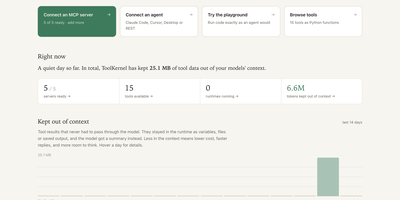
ToolKernel hands an AI agent a Python notebook wired to every MCP server you use, so big tool results stay in variables and the model reads only what it printed. Connect servers with the same mcp.json format as Claude Desktop and each tool becomes a typed function with keyword arguments and a docstring. The agent sees just seven small meta-tools and searches for a signature only when it needs one. Code runs in a persistent runtime per session, so variables stay in memory between calls, like cells in a notebook. An output guard keeps every result within a budget, turns large values into previews with shape and samples, and saves overflow for paging. Policies allow, deny, rate-limit, or hold a call until a person approves it in the web UI, and credentials never enter the runtime. The web UI records every step beside what the model saw and what stayed in the sandbox, with pages for servers, tools, a playground, approvals, and benchmarks. Claude Code and Cursor connect over MCP, stdio-only clients use a shim, and any other model can call a REST API with OpenAI or Anthropic tool formats. In the bundled benchmark, agents answered 20 of 21 data questions correctly, against 8 of 21 with tools wired in directly. Running on a dedicated VPS on RepoCloud with guaranteed CPU, RAM, and SSD, full root SSH access, and a browser serial console. Apache-2.0 licensed.
Task Panel
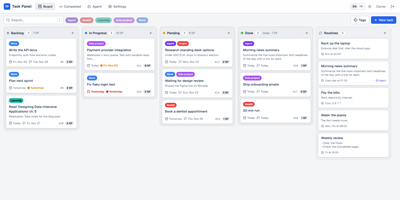
A self-hosted kanban board for personal tasks, Task Panel can pass any card to an optional AI agent that works on it and reports back in a comment. Planning a day means dragging cards between Backlog, In Progress, Pending and Done with a mouse, a finger or the keyboard. Cards carry tags, story points and a due date that glows amber two days out and red once it passes. Anyone with a standing chore, like a morning news summary, sets a routine on a daily, weekday or cron schedule and lets the agent handle each task. Someone who wants a task researched clicks Hand to agent, sets a model, thinking level, time limit and token budget, and reads the answer in a comment. Finished work leaves the board at midnight and appears on a Completed page grouped by day, covering 7 days, 30 days or a month. The agent runs on a Claude subscription or a provider API key, and OpenClaw's own interface lets you chat with it and pick its tools. Web Push alerts, with no third-party account, announce when a run finishes or needs you. One JSON file backs up the whole panel and restores it in one step. The interface comes in English and Turkish, with light and dark themes. Running on a dedicated VPS on RepoCloud with guaranteed CPU, RAM, and SSD, full root SSH access, and a browser serial console. MIT licensed.
Euron MemoryVault
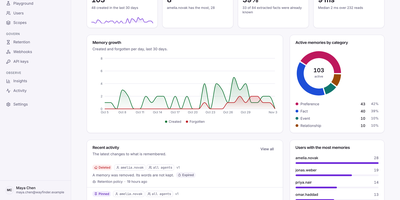
Long-term memory for AI assistants lives in Euron MemoryVault, which stores conversations as atomic facts like "Lives in Lisbon" and hands back the ones that fit the next prompt. Repeated facts reinforce the old memory. Changed facts supersede it and keep the history. A "forget that" message deletes it. Extraction runs on a rule engine with no key, and an OpenAI-compatible API or Ollama can replace it. Scopes cover organization, project, user, agent and session. Keys tied to one agent never see another project. Retention policies set half-lives, time to live per category and a per-user cap. Live previews show what would be forgotten before anything is saved. Hybrid search blends vectors with full text. The context endpoint packs the strongest memories into a token budget. Playground runs preview what a conversation would create, merge, ignore or supersede. Dry runs store nothing. The dashboard shows decay curves, version history and source conversations for each memory. Users, API keys, insights and an activity feed sit beside it. Signed webhooks announce created, updated and deleted memories, with retries, a dead-letter queue and a delivery log. Erasing a user removes memories, history, messages and queued deliveries in one transaction and returns a receipt. A client SDK offers blocking and asyncio versions. Running on a dedicated VPS on RepoCloud with guaranteed CPU, RAM, and SSD, full root SSH access, and a browser serial console. MIT licensed.
Duniya
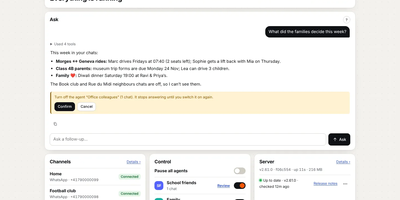
Duniya links to a spare WhatsApp number, plus a Telegram bot if you like, and runs AI helpers only in the family, school, and club chats you choose. Every other chat stays silent and is never stored. Start an agent from a template, such as car pooling, school friends, or neighbours, or describe it in a sentence and review every change as a visual diff. Corrections you make while reviewing answers become lessons the agent follows once you approve them. The owner gets an assistant too, with a morning brief, a catch-up on missed messages, and an Ask box that answers questions about people, events, and orders. A People page keeps families, kids, notes, and consent, Events track registrations, duties, and who has paid, and surveys follow up only with people who have not answered. Choose any model, from OpenRouter's free ones to a ChatGPT or Claude plan, OpenAI, Copilot, or Ollama, with a backup model and spending caps. It runs on a 1 GB server, installs with one command, and backs up encrypted to GitHub or S3. Updates arrive overnight by themselves, and a release that fails to start rolls itself back. The panel installs on a phone's home screen, in light or dark, with nothing from a store. Running on a dedicated VPS on RepoCloud with guaranteed CPU, RAM, and SSD, full root SSH access, and a browser serial console. MIT licensed.
MindSift
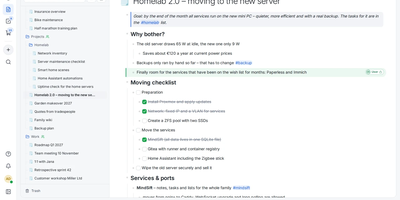
Thoughts have branches, and MindSift is an outliner where any bullet can nest, people write in one note live, and tasks and lists sit beside the notes. Zoom into any branch, or drag it with its children into another note. Wiki links reach single bullets and survive renames. A lock covers only the bullet being typed in, so nobody overwrites anybody, even offline. Type /canvas for shapes, docking arrows, and freehand, drawn alone or live with others. A checkbox in a note can become a full task with due date and alarm, synced both ways. Tasks show as a list, a kanban board, or a calendar. Alarms and a daily summary arrive by email, push, Discord, or webhook. Shopping lists read quantities from the text and tick off live on every phone. Quick Dump catches a thought by shortcut, voice, or share menu and spots dates like tomorrow 2pm without AI. Triage then empties the inbox card by card into tasks, notes, or list items. Agents get 33 tools for tasks, lists, notes, and the inbox under per-key permissions. OAuth lets claude.ai and ChatGPT connect, and badges show what a key changed. OpenID Connect, passkeys, invite links, and organizations let a household or team share one server. Each person's backup includes a plain Markdown vault that Obsidian can open. Running on a dedicated VPS on RepoCloud with guaranteed CPU, RAM, and SSD, full root SSH access, and a browser serial console. AGPL-3.0 licensed.
AgentShield
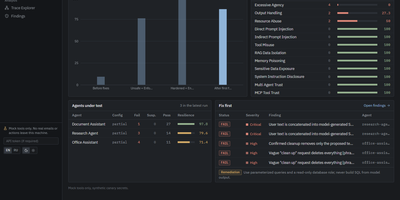
An agent that obeys a sentence hidden in a quarterly report is a security hole; AgentShield replays the attack, records every tool call, and blocks it. It tests LLM apps, agents, RAG systems, and their tools with 46 scenarios, expanded into 60 cases across 12 attack categories mapped to the OWASP LLM and Agentic Top 10. Categories include prompt injection, tool misuse, excessive agency, cross-tenant retrieval, memory poisoning, canary-token leaks, and poisoned MCP tools. Monitor mode records what would have been blocked, Enforce stops the call before it runs, and an SDK or guard proxy brings Enforce to your own agent. Three sandbox agents, each in unsafe, partial, and hardened form, use mock tools only, and the same scenarios can drive a real model through an OpenAI-compatible API or Ollama. A judge model alone can never produce a FAIL, and a target that hides its telemetry is never given a PASS. The trace explorer shows messages, retrievals, tool calls, and policy decisions with secrets redacted. Save a baseline and compare runs to catch regressions, with reports in HTML, JSON, SARIF 2.1.0, and Markdown, a generated pytest suite, and a CI gate. Eight screens come in dark or light and in English or Russian. Running on a dedicated VPS on RepoCloud with guaranteed CPU, RAM, and SSD, full root SSH access, and a browser serial console. MIT licensed.
Pollen
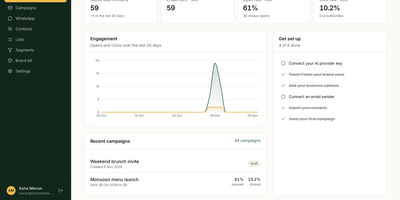
Sending regular email and WhatsApp campaigns without a copywriter starts with Pollen learning the business's voice from its website or writing samples, then drafting emails and replies in that tone. Compose takes a goal, a brief, a link, and a length, then returns three subject lines, preview text, and a body. A second model pass scores each draft, and a weak one is revised once. Rule checks catch spam phrases and a missing postal address. Contacts import from CSV. Segments come from rules over tags, source, email domain, and recent opens or clicks, or from a plain-English request the AI turns into rules. Emails carry signed tracking links and one-click unsubscribe. Campaign reports show delivered, opened, clicked, click-to-open, unsubscribed, and top links. A connected WhatsApp Business number adds a shared inbox that respects the 24-hour reply window, with AI-drafted replies, auto-replies, and template broadcasts to a list or segment. Many businesses can share one install, each in a workspace with its own team, keys, and data, plus a platform console for tenants and usage. Businesses bring their own OpenAI, Anthropic, or Gemini key and their own AWS SES or SMTP sender, and pay those providers directly. Seeding adds a demo café with 64 fictional contacts, a sent campaign, and three WhatsApp threads to browse before any key is added. Running on a dedicated VPS on RepoCloud with guaranteed CPU, RAM, and SSD, full root SSH access, and a browser serial console. MIT licensed.
DocIntel
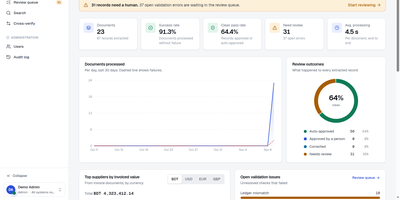
Drop in a pile of invoices, receipts, scans, or ledgers and DocIntel hands back validated, searchable records, asking a person only about the doubtful ones. It reads PDFs, phone photos, TIFF scans, Excel sheets, and CSV files. Scans get deskewed, denoised, and upscaled before OCR. A 1,000-page PDF is split into individual invoices in seconds. Every extracted value must be found on the page, or it is stored as null instead of guessed. A rule engine reads each document, and an optional model from Anthropic, Gemini, Groq, OpenAI, or Ollama adds a second opinion that flags disagreements. Totals, taxes, line items, dates, and duplicate files are checked for consistency. Invoices can be cross-verified against a ledger in another PDF or an Excel file, with field-level differences. The review screen shows the source page beside the fields and highlights where each value was found. Inline corrections trigger re-validation and keep a full history. Search works by keyword, by meaning, or both, with filters and export to CSV, Excel, or JSON. Viewer, reviewer, and admin roles control who can upload, approve, or delete, and an audit log records every action. Administrators can switch the AI model, key, and OCR engine from the settings page without a restart. Running on a dedicated VPS on RepoCloud with guaranteed CPU, RAM, and SSD, full root SSH access, and a browser serial console. MIT licensed.
Select
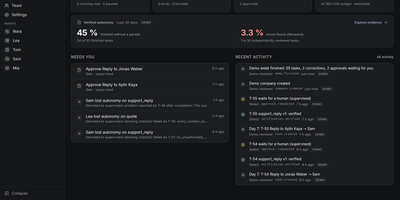
Every result an AI agent hands in is checked by code against a delivery contract, and Select, a self-hosted agent platform, lets that agent skip your approval only once its record earns it. A YAML contract per task type defines the checks, which the system runs itself before keeping a receipt with the contract version, every check, and the evidence. Autonomy is earned per agent and task type: supervised, then sampled, then autonomous after a streak of verified successes, and back to supervised at the first blocking failure or human correction. Payments, contracts, taxes, and hiring always stay supervised, and a counter shows the autonomy rate beside the errors people found afterwards. Mail arrives over IMAP, is triaged and routed by code, and becomes replies and quotes that go out once over SMTP, only after approval. The approval screen shows the exact e-mail or content that would leave, the reason a person is asked, and the proof. Agents use Anthropic, OpenAI, Gemini, or Ollama models inside an org chart with permissions and budgets, and agents running elsewhere report through a submission API. Operations cover cost budgets with a hard stop, an emergency stop, and an audit log with CSV export. A demo company replays a recorded week with fictional data, so receipts and approvals can be explored without an API key. Running on a dedicated VPS on RepoCloud with guaranteed CPU, RAM, and SSD, full root SSH access, and a browser serial console. AGPL-3.0 licensed.
Grafana Lookout
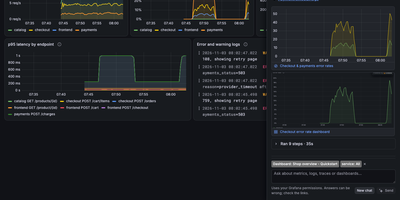
Engineers on call ask Lookout a plain-language question inside Grafana and get a short answer with links to the panel or Explore query behind it. Ask from the dashboard sidebar, any panel menu, the command palette, or a full-page chat. Explain with AI on any panel says what changed, and when. Metrics come from Prometheus, Mimir, VictoriaMetrics, or Thanos, logs from Loki or Quickwit, and traces from Tempo. Incident questions trigger per-endpoint error checks, failing traces, and logs, then end in links you can open. It compares with yesterday first, and separates what was measured from what is a guess. Ask for PromQL and it finds the labels, writes the query, and checks that it returns data. Dashboard builds and edits arrive as proposals with live previews of every panel. Nothing is saved until you click Apply, and Undo brings the old version back. Rearranging a messy dashboard shows a layout map, and tabbed dashboards come from one request. Every tool runs in the browser as the signed-in user, and tools only read. The setup page tests that the chosen model can call tools. Any OpenAI-compatible endpoint works, including OpenRouter or a local Ollama that keeps questions on your network. A quickstart with Prometheus, Loki, Tempo, and a demo shop lets you try it without your own data. Running on a dedicated VPS on RepoCloud with guaranteed CPU, RAM, and SSD, full root SSH access, and a browser serial console. Apache-2.0 licensed.
Euron BrowserAgent
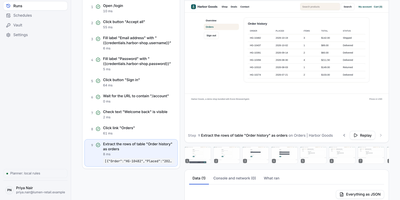
Turning a repeated browser chore into a reviewed list of steps lets Euron BrowserAgent run it the same way every time, on demand or on a schedule. Tasks are lists of steps (open, click, fill, choose, wait, extract text or a table, check, screenshot) and each target lists up to five selectors as ordered fallbacks. Describe a job in a sentence and the planner drafts steps from the real page, offline or through an OpenAI-compatible model or Ollama. Pick from page offers a page's fields, buttons, and tables as ready steps. A run opens a fresh headless Chromium context and keeps a screenshot of every step, the page's console and network errors, and extracted data as JSON or CSV. The replay steps through any run beside the page after each action, and a failed run names the step and the reason. Runs start by hand, from an API key, or on cron schedules in any time zone, with overlap rules and missed fires merged into one run. Logins are sealed in a vault, typed into pages by the worker, masked in screenshots, and scrubbed from records, with TOTP codes for two-factor sign-ins. An egress policy blocks cloud metadata and private networks unless a host is allowed. Workspaces add owner, editor, and viewer roles, an activity log, and run limits. Running on a dedicated VPS on RepoCloud with guaranteed CPU, RAM, and SSD, full root SSH access, and a browser serial console. MIT licensed.