
Myriad
Myriad gathers your games, music, anime, and social posts from eleven platforms into one self-hosted homepage that has a resident character of its own. Connect GitHub, Steam, Bilibili, NetEase Cloud Music, and seven more platforms, and every account lands in one database that the report cards and library read. Report cards, a music player, weather, friend links, and recent activity fill a homepage you arrange on a grid or a free sticker canvas. The library shelves the collections as games, anime, films, books, and music, and clicking a report card plays a three-act portrait: your persona there, your taste, and your highlights. Her layered 2.5D portrait blinks, mouths each reply, and shifts expression in the browser, and a long press opens her panel anywhere on the site. In Chat she stays in character; in Help she plans, asks you to confirm, then acts inside the permissions you granted. The studio turns notes into a static Hugo blog, and the built-in reader follows your RSS, Notion, and RSSHub subscriptions. Tapps run sandboxed as pages or homepage widgets, and the Playground previews one from a single typed sentence before you install or export it. Follow other sites over ActivityPub, pair QQ, Telegram, or Discord bots that answer mentions in group chats, and keep registration and module visibility under your own switches. Running on a dedicated VPS on RepoCloud with guaranteed CPU, RAM, and SSD, full root SSH access, and a browser serial console. AGPL-3.0 licensed.
Bookshelf
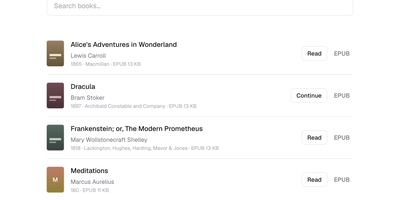
Bookshelf turns a folder of EPUBs and PDFs you already own into a private library you can browse and read from any browser, at home or on your own server. Drop books into a folder, run the sync, and the shelf appears with covers extracted, titles searchable, and accents forgiven, so typing Bronte finds Brontë. Each reader in the house gets a profile that remembers their place in every book, and picking a book up on your phone resumes where the laptop left it, with a Continue button waiting on the shelf. EPUBs open chapter by chapter instead of downloading the whole archive, and PDFs stream in small ranged reads, so even a large scanned book opens quickly. Choose a two-page spread, a single page, or continuous scroll, then set paper, sepia, or night tints for longer sessions. E-readers join through the OPDS catalog, which lets a Kobo or Kindle-side client browse and download from the same shelf. There is no database to run and no account system to manage; the library is plain files you can back up with the volume. Running on a dedicated VPS on RepoCloud with guaranteed CPU, RAM, and SSD, full root SSH access, and a browser serial console. MIT licensed.
Issued
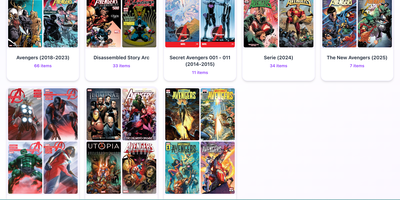
Issued is a self-hosted comic library server: point it at the folder of CBZ, CBR, CB7, and PDF comics already sitting on your server and the whole collection becomes browsable and readable from any device. Point it at your existing folders and it keeps your folder structure exactly as it is, scanning automatically when new issues appear and generating cover thumbnails so you can see what a file is before opening it. Read in the browser with the built-in web reader on desktop or mobile, with light and dark themes, or connect reader apps such as Panels, Chunky, KyBook, and Moon+ Reader through the standard OPDS catalog at /opds/. OPDS-PSE 1.2 page streaming lets compatible apps read individual pages as JPEGs without downloading whole archives, and OpenSearch discovery lets clients find library search automatically. Edit metadata in place using ComicInfo.xml data, mark series as ongoing to spot new issues, totals, and possible gaps, and use Continue Reading and Last Added views to resume the latest issue in progress or start the next unread one. An optional reader password protects browser access, and one Docker command on port 8181, with unrar included for CBR files, gets the whole library online. Running on a dedicated VPS on RepoCloud with guaranteed CPU, RAM, and SSD, full root SSH access, and a browser serial console. MIT licensed.
OvertChat
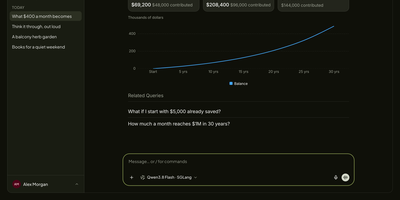
Your household gets one private chat front door for the models you already run, local or hosted, with voice, search, and coding agents included from the same server. Point it at Ollama, vLLM, llama.cpp, SGLang, or LM Studio, then add OpenAI, Anthropic, Gemini, DeepSeek, Bedrock, or OpenRouter beside them. Models that support tools can answer with charts, tables, forms, and follow-up buttons instead of plain paragraphs. Ask for a live conversation and speak, hear the reply, cut in mid-sentence, and keep going; Parakeet handles recognition and Kokoro speaks back on CPU or GPU. Documents open beside the chat for drafting and revising Markdown, code, web pages, SVG, and Mermaid diagrams. Attach spreadsheets, PDFs, images, Word, Excel, CSV, or source files and run Python on them in an offline sandbox that returns charts, cleaned data, or finished documents. Search the web through bundled SearXNG or Brave, read pages with inline citations, connect MCP servers, and set thinking controls per local model. Replies keep streaming after you close the tab, full-text search finds old answers, and read-only links share a conversation. Coding agents run on your machines or over SSH and stay reachable from browser, desktop, Android, or iOS. Running on a dedicated VPS on RepoCloud with guaranteed CPU, RAM, and SSD, full root SSH access, and a browser serial console. MIT licensed.
LogForge
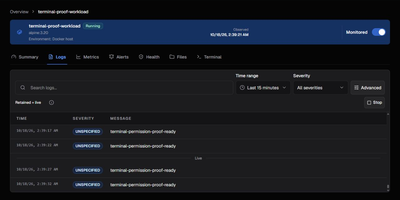
LogForge puts container logs, metrics, events, alerts, and guarded fixes behind one self-hosted web UI for Docker. The overview gathers container health, status, logs, metrics, Docker events, and file access for its host, so a sick container gets inspected without juggling docker commands across terminals. Logs stream in real time, interactive terminals open into running containers, and collected logs, metrics, and events are stored for later review and trend checks. Alert rules watch logs, metrics, and container events, and one-click templates cover stability, performance, log, and security signals. Fired rules notify through Email, Slack, Teams, Discord, Telegram, Gotify, or webhooks, and alert history records acknowledgements plus delivery attempts. A rule can also act: restart, stop, start, kill, or run a script, throttled by cooldowns, rate limits, backoff, and verification delays so automation cannot thrash a host. Other Docker hosts join through mTLS-protected agent enrollment, letting one console watch a small fleet. Running on a dedicated VPS on RepoCloud with guaranteed CPU, RAM, and SSD, full root SSH access, and a browser serial console. Apache-2.0 licensed.
GitHub Release Monitor
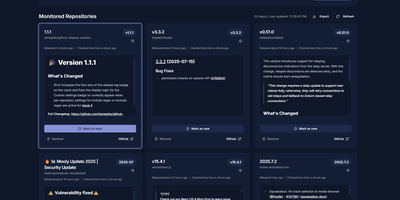
GitHub Release Monitor turns release day into a notification instead of a discovery, watching GitHub, GitLab, Codeberg, and self-hosted Forgejo repositories in the background and reporting each new release to the channels you already read. Your watchlist is the whole interface. Add the projects your stack depends on, and scheduled checks compare what is published against what you have seen. Email carries the full notes over SMTP. Apprise carries them further, to Discord, Telegram, Slack, and dozens of other services, either one message per release or bundled into a digest for each check. Filtering happens at two levels. Global rules decide which release types count, and any repository can override them with its own channels, its own include and exclude regular expressions on tags, and its own choice of alpha, beta, or release candidate lines. A pattern the current engine no longer supports is flagged in settings rather than silently passing nothing. The list itself is portable JSON, ready to export from one install and import into another. When the alerts stop, the diagnostics page separates suspicion from evidence by testing forge connectivity, SMTP, and Apprise in one place. Accounts protect the app, dark mode and nineteen languages shape it, and the layout works on a phone. Running on a dedicated VPS on RepoCloud with guaranteed CPU, RAM, and SSD, full root SSH access, and a browser serial console. AGPL-3.0 licensed.
ghstats
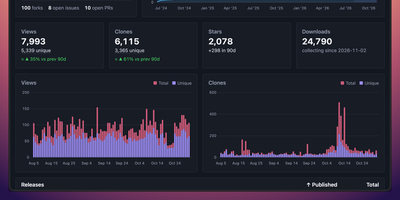
GitHub forgets your traffic after fourteen days; ghstats remembers it for years. This self-hosted dashboard polls the GitHub API every hour and keeps views, clones, stars, forks, issues, and pull requests for every repository in its own database, long after the built-in traffic tab has rolled over. Open a repository to see its charts for stars, clones, and views next to top referrers and popular paths, filter the list by owner, name, forks, or archived status, and include private repositories when your token allows it. Public stats pages and portfolios reuse the same numbers through a JSON API, embeddable SVG badges for views, clones, and star velocity, and cards ranking your top repositories or showing star history across projects. Release download counts accumulate as daily snapshots too, so a launch spike stays visible months later. The whole service is one small Docker image on port 8080 with a single file for storage, easy to back up and easy to move. Running on a dedicated VPS on RepoCloud with guaranteed CPU, RAM, and SSD, full root SSH access, and a browser serial console. MIT licensed.
Upvote RSS
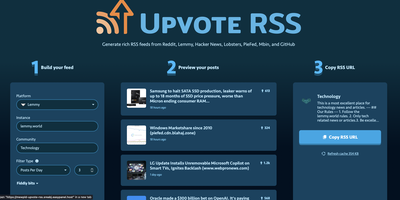
The antidote to doomscrolling: Upvote RSS turns Reddit, Hacker News, Lemmy, Lobsters, PieFed, Mbin, and trending GitHub repositories into calm, filtered RSS feeds. The MIT-licensed PHP app's killer feature is intelligent filtering: beyond simple score thresholds, the "posts per day" filter analyzes a community's recent history and computes the score cutoff that yields your target volume - say, exactly three r/technology posts daily - while a percentage-based threshold mode stays consistent as communities grow. Feeds are rich, not bare links: parsed full-article content via Readability (with optional Readability.js, Mercury, or Browserless for JavaScript-heavy pages), embedded videos and image galleries, top-voted comments with pinned-moderator filtering, scores, reading-time estimates, and optional AI summaries through Ollama, OpenAI, Gemini, Anthropic, Mistral, DeepSeek, or any OpenAI-compatible endpoint - with automatic provider fallback. A web UI builds the feed URL interactively with live preview; paste the result into any RSS reader. Reddit support includes custom domains like old.reddit.com plus NSFW filtering and blurring. Caching via filesystem, Redis, or APCu keeps repeated fetches cheap and avoids re-running paid summarizations.

OpenVoiceUI
OpenVoiceUI is the voice-first front end for a self-hosted AI agent that lives entirely on your own hardware; you talk, it answers out loud, and it builds live pages on screen while the conversation runs. Hold a hands-free conversation with wake word, push-to-talk, and the ability to interrupt, or switch to text when the room is quiet. Speech recognition runs in the browser for free or through Deepgram, Groq Whisper, or your own Whisper server, while nine speech providers from local Supertonic to ElevenLabs give the agent its voice, cloned voices included. As it talks, the agent opens live canvas pages, dashboards, galleries, reports, and tools, and files them on an OS-style desktop you can reopen from the start menu. Ask for music and it generates songs with a built-in player and playlists; ask for images and it creates those too, alongside an audio clip maker and a soundboard. Profiles swap the agent's persona, voice, and model provider, animated faces react while it speaks, and sub-agents and workspace files stay visible in the admin dashboard. The agent itself runs in the OpenClaw gateway with your choice of model provider, so your keys, conversations, and files never leave your server. Running on a dedicated VPS on RepoCloud with guaranteed CPU, RAM, and SSD, full root SSH access, and a browser serial console. MIT licensed.
Warpdrive
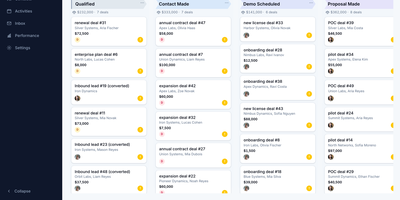
Warpdrive is a self-hosted sales CRM that gives business-development teams the complete Pipedrive workflow, pipelines, deal timelines, and two-way Gmail, on infrastructure they own outright. Drag deals across a Kanban board with custom stages while per-stage weighted totals, rotting-deal warnings, and saved filters keep the forecast honest without a weekly cleanup meeting. Every deal opens into one workspace where activities, notes, files, emails, and the full change history share a single timeline, with participants, followers, labels, and lost reasons attached. People and organizations carry custom fields, firmographics, and org-to-org relationships, and a leads inbox plus CSV import with an undo step keeps new data from corrupting the book. Contact enrichment from Apollo, RocketReach, and GetProspect fills empty people and organization fields, and every enriched value waits behind an explicit review step before it lands. Two-way Gmail sync threads every message onto its deal and contact automatically, and templates, signatures, merge fields, scheduled sends, and open tracking live in the same inbox. Boards, inboxes, and notifications update in real time across the team, while funnel and activity stats show exactly where deals stall and who is carrying the pipeline. An MCP server lets AI assistants query the pipeline and log activity under the same permissions, and role-based access keeps every seat scoped to its own work. Running on a dedicated VPS on RepoCloud with guaranteed CPU, RAM, and SSD, full root SSH access, and a browser serial console. MIT licensed.
UWAS
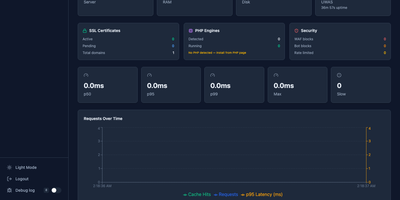
One 18 MB Go binary does the job of Apache, Nginx, Varnish, Caddy, and cPanel combined. Point UWAS at your /var/www directory and it auto-detects sites, provisions Let's Encrypt certificates, enables HTTP/3 via QUIC, and activates a two-tier caching engine with L1 memory shards and L2 disk storage, all before you write a single line of configuration. The React 19 admin dashboard provides 42 management pages for domains, PHP versions, databases, cron jobs, DNS records, file management, backup and restore, SFTP users, and uptime monitoring with real-time SSE updates. PHP sites run through FastCGI with connection pooling and full .htaccess compatibility, so WordPress, Laravel, and legacy applications work without migration effort. The built-in WAF catches SQL injection, XSS, path traversal, and shell exploits, while per-domain rate limiting and bandwidth caps protect against abuse. Reverse proxy mode supports five load balancing algorithms, circuit breakers, canary deployments, and mirroring for blue-green rollouts. Git deploy clones your repository, runs the build, checks health, and restarts the service with rollback on failure. An MCP server lets AI agents manage domains, cache, and deployments through natural language. The Nginx and Apache migration CLI converts existing configurations to UWAS format automatically. Deploy on a dedicated VPS on RepoCloud with guaranteed CPU, RAM, and SSD, full root SSH access, and a browser serial console. AGPL-3.0 licensed.
Airbroke
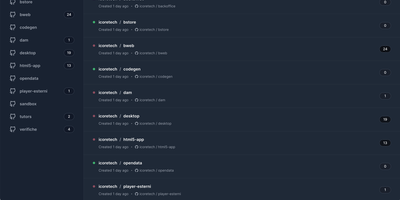
Engineering teams use Airbroke to catch application exceptions in one self-hosted error tracker where they can triage issues, replay failing requests, and debug without a per-event bill. Your existing Airbrake or Sentry clients point at its compatible HTTP collector endpoints, so instrumented applications keep reporting with no new SDK to adopt, and every occurrence lands in storage where the footprint stays small even under heavy ingestion. The web interface groups errors into issues you can triage, bookmark important occurrences for follow-up, and read occurrence charts that show whether a bug is a one-off or a slow-building wave. When an HTTP exception looks suspicious, you can replay the original request directly or copy a generated cURL command that reproduces it exactly, turning vague log complaints into debuggable cases. An AI assistant answers questions about issues in context, an MCP API lets LLM agents query your error data programmatically, and multiple OAuth providers secure sign-in for the team. It runs as a small service needing only a database, a single core, and a few hundred megabytes of memory. Running on a dedicated VPS on RepoCloud with guaranteed CPU, RAM, and SSD, full root SSH access, and a browser serial console. MIT licensed.

OrcaQ
For developers and database administrators who want a full database IDE inside the browser without installing separate desktop clients on every machine, OrcaQ provides a unified workspace for PostgreSQL, MySQL, MariaDB, Oracle, SQLite, Cloudflare D1, Turso, and Redis. Engineers organize connections into named workspaces with SSH bastion tunneling, granular SSL configuration, and color-coded environment tags whose strict mode requires explicit confirmation before executing destructive mutations against production databases. The Quick Query data grid lets users filter, sort, paginate, and edit table rows inline while jumping across foreign-key relationships and inspecting table DDL metadata. When writing complex multi-statement SQL, the Raw SQL Editor provides context-aware autocomplete, query variables, nested script folders, and visual EXPLAIN execution plan analysis. Database architects can render interactive entity-relationship diagrams for single tables or entire schemas, compare two database schemas side by side to generate safe migration scripts, and manage Redis keys across string, hash, list, set, and sorted-set structures in a dedicated workbench. PostgreSQL administrators also gain a visual role-permission matrix, real-time instance health monitoring for active sessions, locks, and replication lag, native backup and restore job tracking, and an optional AI Orca Agent that drafts queries and detects anomalies while requiring human approval before any data modification runs. Running on a dedicated VPS on RepoCloud with guaranteed CPU, RAM, and SSD, full root SSH access, and a browser serial console. MIT licensed.
PaperPull
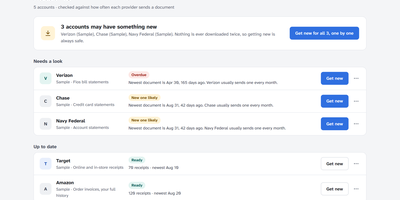
Years of bank statements, pay stubs and receipts sit scattered across dozens of websites, each demanding a login and offering one PDF at a time. PaperPull fetches that whole history for you: sign in yourself in a real browser window, answer the two-factor prompt, and it downloads statements, receipts, pay statements, W-2s and tax forms from 73 supported providers including Chase, Amex, ADP, Amazon, Walmart, Vanguard and Verizon. The tool only ever downloads; it never pays a bill, moves money or changes a setting, and that read-only promise is enforced by construction rather than by policy. Every archive is checked for freshness and for holes in the middle, so a series that looks current but quietly skipped three months is flagged by name, with per-account cadence learned from your own documents. Receipts become one long spreadsheet of every item you have ever bought across every store, with prices and dates, while transactions are read out of statement PDFs into workbook rows that are verified against each statement's printed beginning and ending balances. New documents can flow straight into a Paperless-ngx consume folder, everything runs under a password you choose on your own network, and no cloud account is involved anywhere. Running on a dedicated VPS on RepoCloud with guaranteed CPU, RAM, and SSD, full root SSH access, and a browser serial console. AGPL-3.0 licensed.
Qeli
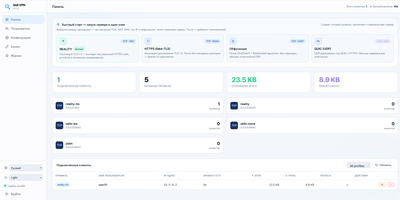
Qeli is a self-hosted VPN built for networks where ordinary VPN protocols get recognized and blocked, disguising its traffic as ordinary web traffic while keeping the classic full-tunnel experience. Where WireGuard, OpenVPN, and IKEv2 carry fingerprints that deep packet inspection has learned to spot, Qeli answers with five wire modes: plain, TLS mimicry, ChaCha20 obfuscation behind WebSocket fronting, REALITY, and a flagship mode that carries the private stream inside a genuine HTTP/2 request within a real TLS 1.3 exchange. A probe without a valid token never learns the difference, because the server bridges it to the configured public target site. The handshake is hybrid post-quantum, X25519 plus ML-KEM-768, with a ChaCha20-Poly1305 data plane, and the tunnel itself behaves like the VPNs people already know: full-tunnel or split routing, OS-level DNS, and per-app include or exclude rules on Windows, macOS, and Android. A one-command installer on a clean Debian or Ubuntu server asks for a profile and a port, writes the NAT configuration, creates the first users, and prints ready-to-paste connection links. The web panel then issues qeli:// links and QR codes per person behind an Argon2id login, so onboarding a phone is a camera scan instead of a config file. Clients cover Linux, Windows, macOS, Android, and Keenetic and OpenWrt routers, and published lab benchmarks average around 1220 Mbit/s across all twelve profiles. Running on a dedicated VPS on RepoCloud with guaranteed CPU, RAM, and SSD, full root SSH access, and a browser serial console. AGPL-3.0 licensed.
AutoMorph
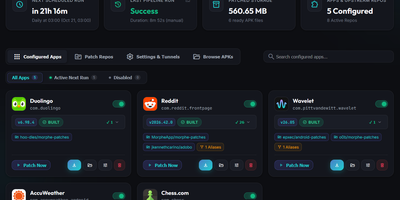
Patching the same Android apps by hand every time a patch repository updates is a chore with your name on it, and AutoMorph is the self-hosted patcher that takes the chore over and rebuilds your apps on schedule. It monitors patch repositories such as ReVanced, Morphe, and community repos for updates, downloads base APKs automatically with Google Play first and APKCombo, Uptodown, and APKPure as fallbacks, and applies your chosen patches without you touching a command line. The Add Package wizard walks you from a package name through suggested repositories, patch selection with per-patch options, and aliases that map same-role patches across repositories so two repos stop fighting over the same job. Builds run once a day at a time you choose, or start manually from the web portal while live build logs stream to your browser. The Patcher Control Center shows every tracked app's version, patch status, and download links, and email alerts carry direct download links whenever a patch succeeds. Distribution goes further: one-tap Obtainium import by QR code or deep link, plus an F-Droid compatible feed for Obtainium and Neo Store, deliver updates straight to your phone, and a custom keystore keeps them seamless. A low-spec mode trims heap and thread limits for small servers, retention settings clean up old builds, and Pangolin, Tailscale Funnel, or Cloudflare Tunnels expose the portal over HTTPS. Running on a dedicated VPS on RepoCloud with guaranteed CPU, RAM, and SSD, full root SSH access, and a browser serial console. MIT licensed.
Tunnel Panel
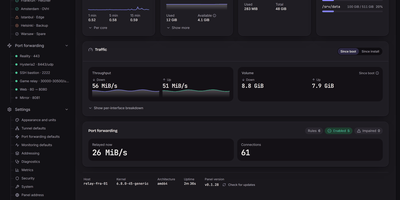
Tunnel Panel manages GRE tunnels and port forwarding on Linux servers from a web panel that previews every change before it runs and verifies the result against the kernel. Create GRE, GRETAP, IP6GRE, and IP6GRETAP tunnels and see the exact commands, unit file, and rollback before anything is applied. The far end configures itself from a pairing code, as text or QR, with the sides flipped automatically so the two ends cannot disagree by a typo. Native ICMP probing with hysteresis keeps a single dropped packet from flapping a tunnel between down and back, and when ICMP is filtered the panel knocks over TCP and says so instead of crying wolf. Forward any TCP or UDP port, or a whole range, with round-robin, source-hash, or weighted balancing across destinations, and a backend that stops answering its health knock leaves the ruleset until it recovers. Watch every connection crossing the relay, who connected, which destination took them, and how much has moved, and set traffic limits per tunnel, rule, or destination. When something breaks, diagnostics reach a verdict with evidence and a suggested fix, backed by a streaming manual probe and a path-MTU search that offers to apply its findings. The panel reads your kernel's relay limits, recommends values from the host's memory and cores, and refuses changes that would lock you out of your own server. Running on a dedicated VPS on RepoCloud with guaranteed CPU, RAM, and SSD, full root SSH access, and a browser serial console. AGPL-3.0 licensed.
EverShelf
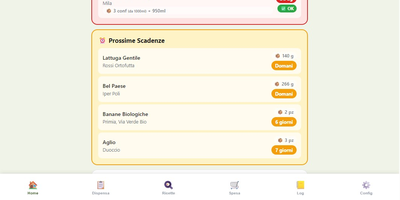
That yogurt hiding behind the ketchup expired three weeks ago, and the flour you bought "just in case" has been sitting in the pantry since last winter. EverShelf replaces mental guesswork with a structured inventory system that tracks every item across pantry, fridge, freezer, and custom locations with precise quantities, expiry dates, and consumption patterns. Scan barcodes with your phone camera to add products instantly, or let the Gemini AI identify items from a photo and estimate shelf life based on storage location. The dashboard surfaces expired items and upcoming expirations with color-coded urgency badges, while anomaly detection flags suspicious quantities and consumption predictions that deviate from your history. Opened products get reduced shelf-life calculations; vacuum-sealed items get extended dates automatically. The recipe engine generates context-aware meal suggestions from your current inventory, prioritizing ingredients approaching expiry so nothing goes to waste; each recipe includes step-by-step cooking mode with text-to-speech narration and timer integration. A smart shopping list auto-populates when stock hits zero and syncs bidirectionally with the Bring! app, with AI-estimated prices per item and consumption forecasts showing when you will need to restock. For Home Assistant users, a native HACS integration provides 22 sensors, expiry calendars, bidirectional todo-list sync, and voice assistant support for adding items hands-free. A dedicated Kiosk mode optimizes the interface for wall-mounted tablets with BLE scale integration. Running on a dedicated VPS on RepoCloud with guaranteed CPU, RAM, and SSD, full root SSH access, and a browser serial console. MIT licensed.