WonderCMS
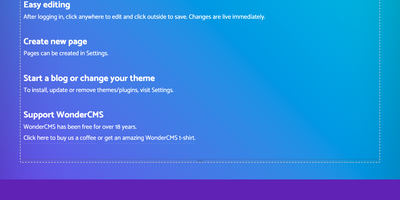
Click, type, publish: WonderCMS turns every page of your website into its own editor. Log in, click any text on the live page, type, and click away to save. A new page takes one click: type an address that does not exist yet, click, and a blank page opens ready for writing. Pages and subpages can be reordered, hidden from the menu with an eye icon, or made private, and each keeps its own title, keywords, and description. Any page can be the home page, and editable blocks keep a footer, sidebar, or banner in sync across the site. An optional plugin adds a visual editor with a formatting toolbar. Themes and plugins install, update, disable, and remove from Settings, including blog, SEO, and privacy-minded statistics modules. The Files tab uploads images, documents, audio, and video to link from any page. The login address is one you choose and answers with a 404, ten wrong passwords pause attempts for fifteen minutes, and a password change ends every session. One click downloads a ZIP backup of the whole site, and a daily update check offers a one-click update with a backup button right above it. Setup means unzipping and uploading five files, and the first visit creates the site and shows the admin password. Moving to a new folder, subfolder, or domain needs no reconfiguration. Running on a dedicated VPS on RepoCloud with guaranteed CPU, RAM, and SSD, full root SSH access, and a browser serial console. MIT licensed.

MiroTalk C2C
MiroTalk C2C is a self-hosted WebRTC cam-to-cam calling server that turns one private link into an encrypted one-to-one video call in the browser, with nothing for guests to download or sign up for. Create a room, pick how you want to join, and share the room ID: the other person opens it and you are face to face with video, audio, and screen sharing between desktops and phones. Push-to-talk and best-quality toggles sit next to camera, microphone and video quality controls in the in-call settings, and session time stays visible so lengthy calls never surprise you. Replace your background with the built-in Off, Blur, or Image modes processed locally in your browser, and show your camera as a picture-in-picture bubble in a corner of a shared screen so presentations keep a human face. The meeting is private by design: you choose the room and how you join before entering, and media stays encrypted between participants. Host it with the official Docker image on your own infrastructure to keep media and signaling under your control, embed calls into your own products with the direct room join and REST API, and use ngrok support for quick testing. Running on a dedicated VPS on RepoCloud with guaranteed CPU, RAM, and SSD, full root SSH access, and a browser serial console. AGPL-3.0 licensed.
OpenManga
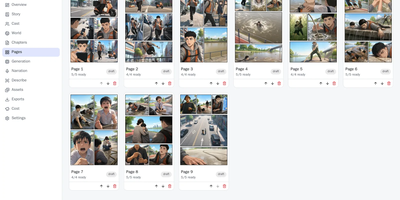
A written story becomes a manga chapter, manhwa episode, vertical webtoon, or narrated YouTube recap in OpenManga, with the same characters and places recognisable from the first panel to the last. It starts when AI splits a pasted story into cast, locations, chapters, scenes, and panel specs. You approve the reference portraits, turnarounds, outfits, and location sheets once, and every later panel is drawn against them. In the page editor you move panels, bubbles, captions, and sound effects, paint masks for targeted edits, compare art versions, and run a vision check on each panel. A production run prices the remaining work before it starts, respects a per-project budget cap, and can use half-price provider batches. The same run carries the project through artwork, narration, thumbnail, video, and YouTube text. Kokoro voices the narration locally, or you can cut it from your own recording. Exports cover print PDFs with KDP trim sizes, layered PSDs, CBZ, EPUB, webtoon strips, MP4, and Shorts. Supply your own keys for OpenAI, Gemini, Anthropic, DeepSeek, Meta Muse, OpenRouter, or ElevenLabs, or use paste mode with no key at all. Invite editors, comment on panels, share reader links, or let ChatGPT or Claude drive projects over MCP. Sign-up is closed until the admin opens it, and local narration wants about 8 GB of RAM. Running on a dedicated VPS on RepoCloud with guaranteed CPU, RAM, and SSD, full root SSH access, and a browser serial console. Apache-2.0 licensed.
LanQin Email
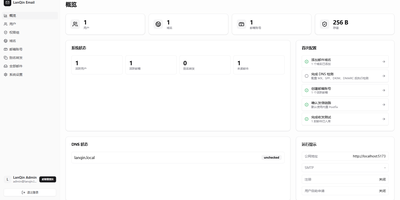
Running your own mail server usually means assembling five services and praying over DNS records; LanQin Email ships the whole stack in one container. Readers switch between mailboxes, search, label, star, and file messages into folders, then compose with a rich-text editor that handles fonts, colors, code blocks, attachments, emoji, and scheduled sending. Contacts, signatures, inbox rules with automatic forwarding, sender blacklists, and mail statistics make it a daily client rather than a demo. Administrators run the postal side from the same panel: add domains and generate DKIM keys, follow the DNS record checklist the system verifies for you, create mailboxes, set delivery aliases and catch-all addresses, and audit every message on the server. Accounts sign in with passwords or OAuth single sign-on, protected by TOTP two-factor codes and bot checks, while permission groups cap attachment size, sending rate, and mailbox count per user. Users can even request their own mailbox and wait for approval instead of filing a ticket. For programs, an Open API with bearer tokens sends mail idempotently and reports delivered, bounced, complained, rejected, and deferred events back through webhooks. External Gmail and Outlook accounts can be aggregated over IMAP, and a client-configuration page shows every IMAP, POP3, and SMTP setting in one place. A multi-container layout remains for debugging the stack piece by piece. Running on a dedicated VPS on RepoCloud with guaranteed CPU, RAM, and SSD, full root SSH access, and a browser serial console. GPL-3.0 licensed.
WPMgr
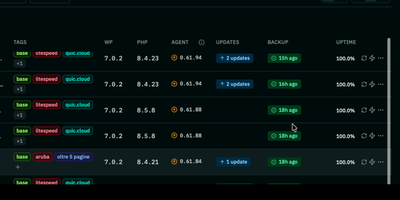
One dashboard for every WordPress site you look after: that is WPMgr, a self-hosted control panel that replaces dozens of separate wp-admin tabs with a fleet view you own. Enroll a site by URL, paste a one-time code into its agent plugin, and the connection flips live on its own. From there the daily grind changes shape. Backups stream straight out of PHP with no mysqldump and no shell access, chunked and deduplicated, scheduled per site, and restorable as a whole site or just the database. Updates stop being a weekend ritual: preview the run dry, apply it across the fleet, and let the automatic snapshot and health check roll back a bad release before a client notices. Uptime probes split DNS, TLS, and time-to-first-byte, flag certificates about to expire, and open exactly one incident per outage instead of a storm of alerts. The Sites grid leads with a fresh screenshot of every homepage, so the dead site is visible before the client calls. Core files get diffed against official WordPress.org checksums, brute-force logins meet escalating lockouts, and an IP firewall fires before other plugins load. Page caching, Redis object cache, image optimization, and per-site email fill the remaining gaps, and every command between dashboard and agent is signed so nothing can be forged in transit. Running on a dedicated VPS on RepoCloud with guaranteed CPU, RAM, and SSD, full root SSH access, and a browser serial console. AGPL-3.0 licensed.
Homeio
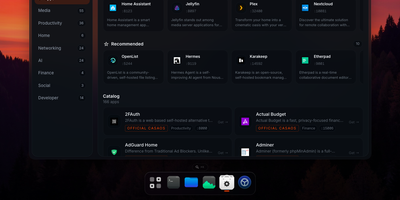
Homeio turns a Linux box into a desktop you open in a browser tab, with draggable windows, a dock, a lock screen, and a command palette sitting on top of your Docker apps, files, and disks. The App Store installs Docker Compose stacks from the CasaOS catalog or your own store sources, and each app's ports, volumes, environment variables, and compose file stay editable before and after install. Containers you started elsewhere still appear with live CPU and memory stats, streaming logs with keyword filters, and one-click restarts. The file manager uploads with progress, previews images, audio, video, and PDFs, edits text in a built-in code editor, mounts USB drives and SMB shares, and shares folders over Samba. A real login shell lives in the Terminal window, with exec access into any container, so routine fixes never need a separate SSH client. Cron-style scheduled tasks restart apps, pull images, or run backups on a timer, and scheduled archives of the database, files, and compose stacks restore from the same interface. Tailscale puts the whole desktop on your private network, while Cloudflare Tunnel can publish a single app on a public hostname with its DNS record created for you. Live metrics stream to widgets and the status bar, and notifications flag crashed containers, filling disks, and failed tasks. Running on a dedicated VPS on RepoCloud with guaranteed CPU, RAM, and SSD, full root SSH access, and a browser serial console. AGPL-3.0 licensed.
Quire Ink
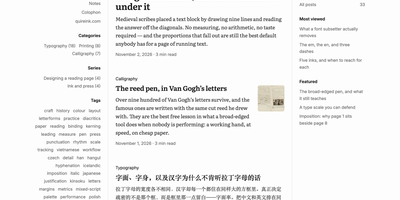
Quire Ink is a long-term blog for a single writer, with a built-in MCP server so an AI assistant can draft, schedule and publish posts on your behalf. You write in the browser with an autosaving Markdown editor that handles tables, footnotes, callouts, maths, galleries and video, and it keeps every revision. Pressing Publish sends the post to your site, your RSS feed, your newsletter subscribers and, if you switch it on, Mastodon, with no algorithm or ads in between. Readers get a pen of their own. They highlight in five inks, underline in pencil or ring a word, and the marks stay in their browser with no account. Four reading themes (plain paper, source code, newspaper and notebook), six light and dark palettes and a paginated book mode restyle the whole site from the admin. Connected over MCP, Claude or another assistant can read your traffic, clear spam, rearrange the front page and build a theme that passes the same checks as Settings. Posts from WordPress, Ghost, Substack and Medium arrive with images and old links intact, and one button exports everything as plain Markdown. Comments need no account. The admin works on a phone, in eleven languages. Running on a dedicated VPS on RepoCloud with guaranteed CPU, RAM, and SSD, full root SSH access, and a browser serial console. AGPL-3.0 licensed.
SEO OS
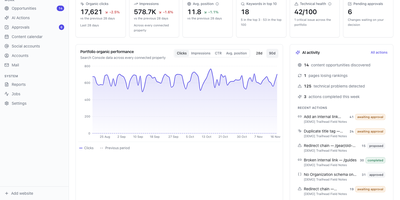
Instead of juggling a crawler, a rank tracker and a folder of spreadsheets, SEO OS audits your websites, proposes fixes, applies the ones you approve and measures whether they worked. Its crawler honors robots.txt, follows redirects and canonicals, avoids crawl traps and can render JavaScript. Sixty-one technical rules grade crawlability, indexability, metadata, content, links, structured data and security, each finding with evidence and a recommendation. Scores come with their factors, weights and a sentence explaining each one. Keyword reports flag striking-distance queries, CTR gaps, content decay and cannibalization, ranked by an explainable opportunity score. A content engine declines to create pages an existing one could cover, and a 14-stage pipeline takes approved ideas from research to publication. Internal-link suggestions come from PageRank over the site's link graph, with orphan detection and anchor-text auditing. GEO readiness scores pages across eleven machine-readability dimensions, while AI-visibility tracking checks whether assistants mention or cite the brand. Social listening watches Reddit, Hacker News and Bluesky for people describing the problem a site solves and drafts disclosed replies for approval. An approval queue groups changes by risk and shows each exact diff with the agent's reasoning, and adapters for WordPress, Git, Shopify, Webflow and webhooks apply only what you approve. Applied changes open experiments that report likely positive, inconclusive or likely negative, steering the next recommendations. Running on a dedicated VPS on RepoCloud with guaranteed CPU, RAM, and SSD, full root SSH access, and a browser serial console. MIT licensed.
Operational
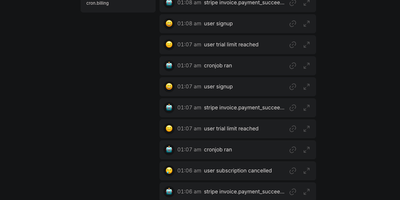
Operational watches your product for the moments that matter, signups, payments, failed webhooks and cron jobs, and pushes the important ones to your phone as they happen. Your code sends structured events with a name and a JSON payload through a simple API, using the official Node.js or PHP SDKs or the WordPress plugin, and every event lands in a searchable feed organized by project and category. Mark an event notify and it becomes a push notification on your phone through the installable web app, while everything else waits quietly in the feed for when you actually want to look. Related events nest inside each other as contexts, so a failed checkout can carry its payment attempt, gateway response and retry history in one expandable bundle instead of forty scattered log lines. Events can carry action buttons that trigger your webhooks, letting you approve a refund, restart a job or retry a delivery from the notification itself. Teammates share projects with their own accounts, a test mode lets you rehearse integrations without polluting the real feed, and a built-in MCP server exposes your events to AI tools. Running on a dedicated VPS on RepoCloud with guaranteed CPU, RAM, and SSD, full root SSH access, and a browser serial console. AGPL-3.0 licensed.
Medama
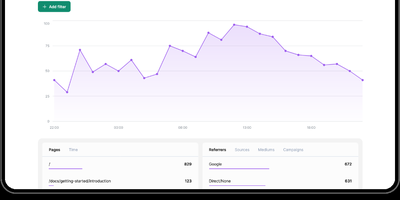
Track website traffic and conversion funnels with sub-second precision while guaranteeing visitors total anonymity with Medama, a privacy-first web analytics platform operating without cookies, IP storage, or consent banners. Site owners embed a sub-kilobyte tracking script into web headers to record page views, session duration, referrers, screen resolutions, browser user agents, and geographic countries anonymously. Built-in caching header mechanisms determine unique daily visitors without generating persistent hashes or storing cross-site identifiers that violate privacy regulations. The web dashboard visualizes hourly traffic trends with interactive area charts and provides multi-dimensional data tables breaking down top-performing pages, search engine referrers, operating systems, and campaign UTM parameters. Developers can instrument custom click events and page attributes using simple HTML data attributes to measure conversions, document downloads, button interactions, and user subscription states. Administrators manage multiple websites from a single interface, configure curated anti-spam blocklists using Firehol and Tor exit node feeds, and monitor server CPU, memory, and disk usage in real time. Full OpenAPI specification endpoints allow teams to export analytics data directly into internal business intelligence pipelines and custom executive dashboards. Running on a dedicated VPS on RepoCloud with guaranteed CPU, RAM, and SSD, full root SSH access, and a browser serial console. Apache-2.0 licensed.
Infinite OS
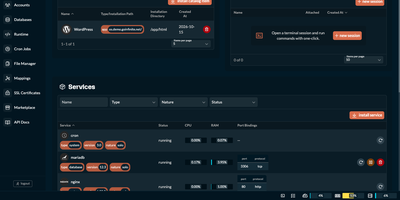
Infinite OS packs a complete hosting environment into a single Docker container, and you decide what it hosts after it starts. From the dashboard you add the runtimes, databases, domains, and applications that a normal image would have forced you to choose at build time. Open the Marketplace and WordPress, n8n, or dozens of other applications install in a few clicks, dependencies and services included, with a hostname and route created automatically. PHP, Node.js, Bun, Python, Ruby, and Java runtimes install on demand beside databases and workers, so one project runs its whole stack inside one environment. Public domains get free TLS certificates automatically, and changing the primary domain once updates the web server, PHP, and database records to match. The built-in web terminal needs no SSH setup, and a coding agent such as OpenCode can work there with the project files, runtimes, and databases within reach. A file manager, cron scheduler, PHP version switching, and per-route rate, bandwidth, and connection limits cover the daily work of running sites from the browser. Team accounts give each person their own login, and nearly every dashboard action has a matching CLI command and REST API call for scripting. Each project gets its own container with its own filesystem and services, so unrelated sites stay isolated while several lightweight environments share one machine. Running on a dedicated VPS on RepoCloud with guaranteed CPU, RAM, and SSD, full root SSH access, and a browser serial console. EPL 2.0 licensed.
ClassicPress
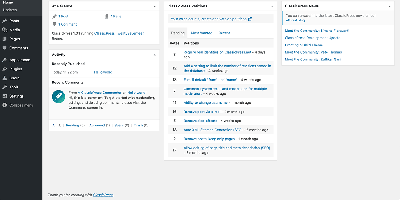
WordPress without Gutenberg: ClassicPress, the community-led fork, keeps the TinyMCE classic editor as the default and strips the block editor and Full Site Editing out of core entirely. The result is roughly half WordPress's size - obsolete libraries like jQueryUI, Thickbox, and Flash support are gone, replaced by native HTML5 elements and modern alternatives like SortableJS - which translates to a measurably faster admin and a leaner attack surface. Forked from WordPress 6.2, it remains compatible with the vast plugin and theme ecosystem targeting that lineage (anything not requiring blocks generally works, helped by a blocks-compatibility mode), and the PHP-first WordPress API developers have used for over a decade works unchanged - no React required to extend your CMS. The fork adds its own improvements: built-in media categories and tags with bulk editing, revision management that lets you prune database bloat, native HTML5 dialogs for accessible touch-friendly menus, and recent releases bring APCu object-cache support, vanilla-JS core widgets, and performant translations. Governance is democratic and community-driven rather than corporate. For content sites, business sites, and blogs where the classic editing workflow is the feature, ClassicPress is stability as a philosophy.
ProcessWire
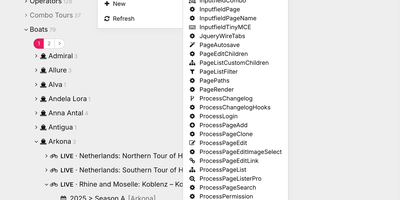
ProcessWire shapes a website around your content instead of the other way around: define your own fields, group them into templates, and manage every page from a tree that mirrors the structure of your site. Any field can sit on any template, from text and numbers to images, files, page references, and repeatable groups with show-if and required-if dependencies. Templates are ordinary files you write however you like, so a page can render HTML, JSON, XML, or an RSS feed with no theming layer in the way. Editors work in a fixed-header admin with light and dark modes, a keyboard-driven search, and a rich text editor that accepts dragged-and-dropped images, while chosen fields can also be edited in place on the live page with a double-click. Lister builds filtered page lists across any field with the columns you pick. Images can be resized, cropped, rotated, and given a focus area for automatic crops. Multi-language text fields, language-specific URLs, and a translation tool for template strings let one page serve several audiences. Role-based access control sets view, edit, and create rights per template, optional two-factor authentication protects logins, and the Modules screen installs and configures plugins. A core upgrade means replacing the wire directory. Running on a dedicated VPS on RepoCloud with guaranteed CPU, RAM, and SSD, full root SSH access, and a browser serial console. MPL-2.0 licensed.
Flyimg
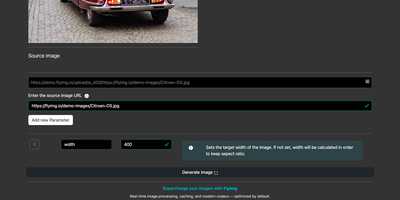
Flyimg generates every image size a website needs at request time, turning one original into resized, cropped, and compressed variants through a simple URL. Append options like width, height, crop, and quality to a request, and the service fetches the source image, transforms it, and serves the result, storing it in cache so the next request is answered instantly. Output defaults to AVIF for browsers that support it, with WebP and MozJPEG compression available for lean JPEG delivery, plus PNG and GIF when the source calls for them. Signed URLs keep strangers from using your server as a free image proxy, and domain restrictions limit which sources the service will fetch from. One Docker container gives a website or application a complete image pipeline: originals stay in whatever storage already holds them, and every thumbnail, banner, and product shot is produced at request time in exactly the dimensions the layout needs. Cache headers and repeat serving keep bandwidth costs predictable as traffic grows. Running on a dedicated VPS on RepoCloud with guaranteed CPU, RAM, and SSD, full root SSH access, and a browser serial console. AGPL-3.0 licensed.
Apache OpenMeetings
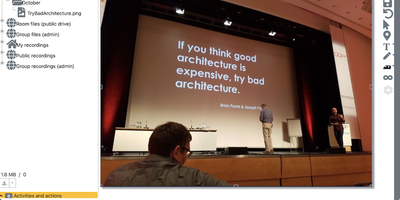
Apache OpenMeetings puts the whole meeting in the browser: cameras, a shared whiteboard, the agenda document, and recording controls, all running on your own server. Participants join rooms with audio and video, audio only, or video only, choose camera resolutions and devices, and present by sharing a screen or a single window at selectable quality. Moderators control the floor person by person: who may draw on the whiteboard, present, share or record the screen, mute others, or speak while everyone else stays muted. Multiple whiteboards hold drawings, text, clip art, and imported documents in PDF, office, and image formats, rescaling to fit every participant's screen, and boards can be saved into the drag-and-drop file explorer for the next session. Every meeting can be recorded with all audio streams exactly as heard, then downloaded as MP4 or played back in the integrated player, and the built-in calendar schedules rooms and sends invitations. Breakout rooms split classes and workshops into groups, polls gather decisions live, private and group chat runs beside the video, and telephone users can dial into rooms through the Asterisk SIP integration. Running on a dedicated VPS on RepoCloud with guaranteed CPU, RAM, and SSD, full root SSH access, and a browser serial console. Apache-2.0 licensed.
Omeka S
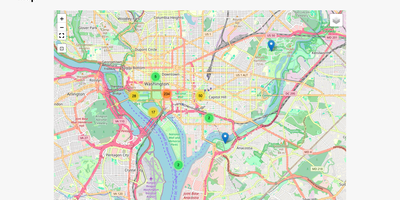
One shared pool of items and media, many independently themed exhibit sites: Omeka S publishes digitized collections for libraries, museums, archives, and universities. Resource templates define which properties an item shows, which data types each accepts, and which fields are required or private, drawing on the built-in Dublin Core, Bibliographic Ontology, and Friend of a Friend vocabularies or any vocabulary an administrator imports. Items can link to other items, so a novel points to its author and the author's record lists every work linked back to it. Media arrive as uploads, URLs, HTML, oEmbed, IIIF, or YouTube. A page editor stacks blocks for HTML, media embeds, browse previews, IIIF images, and maps, a navigation tree arranges menus by dragging, and every site picks its own responsive theme and resource page layout. The Mapping module pins items on interactive maps and adds map blocks and a map browse page. CSV Import loads items, item sets, media, and users from CSV, TSV, or ODS files, importers bring over Omeka Classic and Zotero content, and Collecting forms let visitors contribute files or text for moderators to approve. Roles run from Global Administrator through Supervisor, Editor, Reviewer, and Author to Researcher, with separate permissions per site. A REST API under /api lets other tools read and write resources. Running on a dedicated VPS on RepoCloud with guaranteed CPU, RAM, and SSD, full root SSH access, and a browser serial console. GPL-3.0 licensed.
SOGo
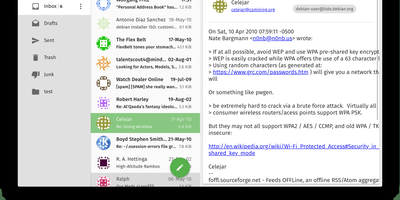
SOGo adds shared calendars, address books, and a modern webmail interface to your existing Dovecot, Postfix, or Cyrus mail setup, turning familiar infrastructure into a full Exchange competitor. Rather than replacing your IMAP and SMTP servers, SOGo layers collaboration on top of them, becoming the missing link between raw mail delivery and what users actually expect from a workplace communication platform. The ActiveSync implementation synchronizes email, contacts, calendars, and tasks natively with iPhones, Android devices, and Windows without requiring users to manually configure CalDAV endpoints. CalDAV and CardDAV compliance ensures Apple Calendar, Thunderbird (via the official SOGo Connector extension), GNOME Evolution, and Android via DAVx5 all connect without plugins or workarounds. The web interface uses AngularJS Material design with responsive layouts, offering folder management, drag-and-drop calendar scheduling, contact groups, resource booking, and delegation. Shared calendars support free-busy lookups, iMIP event invitations, and per-user ACL permissions for fine-grained access across organizational units. Built on Objective-C with the GNUstep foundation, SOGo delivers exceptional performance: hundreds of concurrent ActiveSync connections from mobile devices alongside webmail and calendar traffic with sub-second response times. With 2,095+ stars and 116 releases, the project has proven its stability in production environments supporting thousands of users. The Docker deployment runs alongside PostgreSQL and memcached.
Froxlor
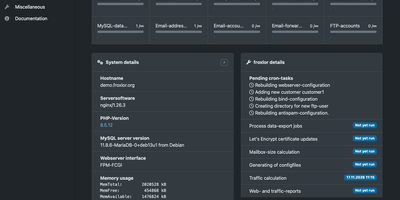
Froxlor lets an administrator host many customers on Debian and Ubuntu servers, with resellers, resource limits, and every service managed from one browser panel. Customers get their own panel for domains, subdomains, email, FTP accounts, and MySQL databases, and resellers receive a pool of resources to hand out. Domains can run on Apache 2.4 or Nginx, use a PHP-FPM configuration chosen per domain, and bind to specific IPv4 addresses, IPv6 addresses, or ports. Let's Encrypt certificates are issued and renewed from the panel, customers can store their own certificate per domain, and Nginx domains can enable HTTP/3. Email addresses, forwarders, and catchall mailboxes run on Postfix and Dovecot, and Rspamd spam filtering is tuned for each email account. Bind9 or PowerDNS serves the DNS zones, and ProFTPd provides FTP accounts with their own directories. Customers can add SSH keys for shell access, protect directories with passwords, set path options, and export their data. Traffic for HTTP, FTP, and mail is collected per customer and charted by month, and several MySQL servers can be assigned to customers. A JSON API with per-user keys, a console tool, and a CSV domain importer cover automation, and the interface can be themed. A configuration page shows ready-made service templates for the chosen distribution and exports the selection as JSON for use on another server. Running on a dedicated VPS on RepoCloud with guaranteed CPU, RAM, and SSD, full root SSH access, and a browser serial console. GPL-2.0-or-later licensed.