
OpenSquilla
Claiming 60-80% token cost reduction compared to flat single-model deployments and backed by 6,500+ GitHub stars, OpenSquilla delivers an intelligent AI agent runtime where a local ML classifier evaluates every turn on message length, code blocks, keyword patterns, and semantic embeddings before routing it to the optimal model tier from C0 through C3. The pluggable provider layer connects natively to TokenRhythm, OpenRouter, OpenAI, Anthropic, Ollama, DeepSeek, Gemini, DashScope, Moonshot, Mistral, Groq, Zhipu, SiliconFlow, vLLM, LM Studio, and additional compatible backends with primary-plus-fallback selection. The four-tier cognitive memory architecture spans working, episodic, semantic, and raw layers with vector-semantic and BM25 retrieval powered by on-device ONNX embeddings that never leave your infrastructure. Security isolation operates at the syscall level via Bubblewrap on Linux and Seatbelt on macOS, complemented by policy-based execution controls and prompt injection protections. The unified TurnRunner executes identically across the Vue-based control console Web UI, terminal CLI, and chat channel integrations including Slack and Discord, ensuring consistent tool dispatch, retry logic, and decision logging regardless of entry point. Built-in skills cover deep research, multi-search-engine queries, document generation for DOCX, PPTX, XLSX, and PDF formats, GitHub integration, cron scheduling, and bounded subagent delegation. Per-agent workspaces with durable session storage provide transcript replay, context state management, and per-call cost tracking with automatic quota enforcement. Running on a dedicated VPS on RepoCloud with guaranteed CPU, RAM, and SSD, full root SSH access, and a browser serial console. Apache-2.0 licensed.
Kubero
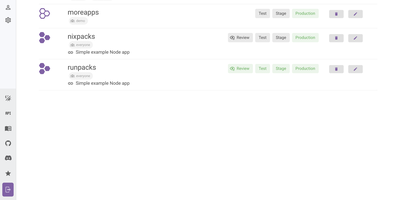
With over 4,300 GitHub stars and a v3 release adding built-in user management, team views, and multi-language support, Kubero has established itself as the most feature-complete open-source Heroku alternative running natively on Kubernetes. The platform operates as a Kubernetes operator with two containers — kubero-ui and the operator — storing all state in etcd without an external database. Developers push code via Git integration with GitHub, GitLab, Bitea, or Gitea, and Kubero automatically builds using Buildpacks, Nixpacks, Runpacks, or Dockerfiles, then deploys to the configured domain with SSL via cert-manager. CI/CD pipelines support up to four staging environments — review, test, staging, and production — with per-stage environment variable isolation and ephemeral review apps that spin up on pull request open and tear down on close. The template catalog includes over 170 pre-configured applications like WordPress, Grafana, and PostgreSQL deployable in one click, while managed add-ons provide highly available PostgreSQL, Redis, MySQL, Kafka, CouchDB, Elasticsearch, and MongoDB alongside your applications. Security features include Trivy vulnerability scanning, GitHub and OAuth2 single sign-on, basic auth, and a role-based permission system with API tokens. The NestJS backend with Vue.js and Vuetify frontend provides application metrics, real-time logs, a built-in web console for container access, scheduled cronjob management, and deployment notifications via Discord, Slack, or webhooks. Running on a dedicated VPS on RepoCloud with guaranteed CPU, RAM, and SSD, full root SSH access, and a browser serial console. GPL-3.0 licensed.
MillionSend
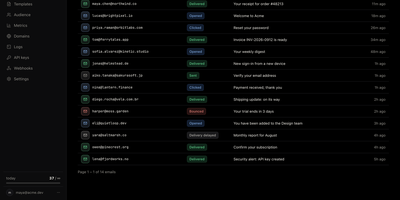
MillionSend is an open-source email platform you run yourself that sends transactional and marketing mail through your own AWS SES account behind a Resend-compatible API. Every message you send becomes a row in the dashboard, and every row opens into a timeline of SES events with the raw payload and the SMTP diagnostic when something bounces. Daily metrics chart sent, delivered, opened, clicked, bounced, and complained volumes against SES thresholds, and broadcasts stop on their own at five percent bounces or 0.1 percent complaints before Amazon can pause your account. Contacts live once for the whole team with custom properties and subscribe state, while segments and topics decide exactly who receives each broadcast. You compose broadcasts from reusable templates with per-contact merge fields, schedule them ahead, and cancel them while they wait. Applications that only speak SMTP send through the relay on port 2587 with an API key as the password, and HTTP integrations use idempotency keys, request logs with secrets redacted, and signed webhooks with a delivery history. Guided domain setup handles DKIM records, hard bounces and complaints are suppressed automatically, and every recipient gets an RFC 8058 one-click unsubscribe. Receiving and agent-ready inboxes are included in beta for mail sent to your verified domains. Running on a dedicated VPS on RepoCloud with guaranteed CPU, RAM, and SSD, full root SSH access, and a browser serial console. AGPL-3.0 licensed.
Sourcebot
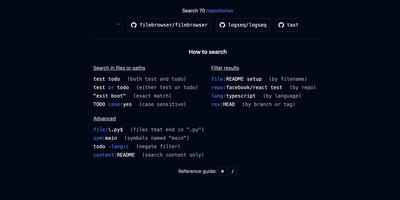
Point Sourcebot at your GitHub, GitLab, Bitbucket, Azure DevOps, Gerrit, or Gitea repositories and get regex, symbol, and filtered search results in under a second across thousands of repos and branches. Backed by Y Combinator with production deployments at NVIDIA, Shutterstock, SeatGeek, Arista, and Red Hat, the Zoekt-powered engine deploys as a single Docker container with zero external data transmission. Ask Sourcebot connects reasoning models like Claude Opus to your entire codebase, enabling natural language questions that return structured answers grounded with inline citations and navigable code snippets, backed by automatic tool calls that search code, follow references, and read files across all indexed repositories. Ask connectors extend this to Jira, Slack, Linear, and Confluence via MCP, pulling external context alongside code for debugging and documentation. IDE-level code navigation provides goto definition and find all references across repository boundaries without local cloning. The built-in file explorer renders any indexed file with syntax highlighting, breadcrumb navigation, and git blame showing per-line commit attribution. An analytics dashboard tracks daily, weekly, and monthly search activity. Permission syncing from GitHub and GitLab enforces access control lists so users only see repositories they are authorized to access. Running on a dedicated VPS on RepoCloud with guaranteed CPU, RAM, and SSD, full root SSH access, and a browser serial console. Other licensed.
MindsDB
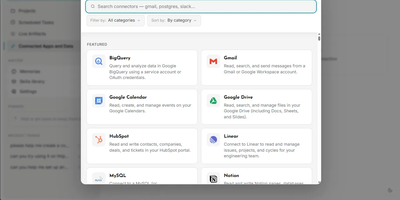
Backed by 39,500+ GitHub stars and over 339 releases, MindsDB delivers the open-source federated query engine that gives AI agents a single SQL interface to read, join, and aggregate across 200+ live data sources without any ETL pipelines or data movement. The Connect-Unify-Respond architecture wires up Postgres, MySQL, MongoDB, Snowflake, BigQuery, ClickHouse, Redshift, Databricks, Salesforce, Shopify, Slack, S3, GCS, Azure Blob, and dozens more through self-contained Python handler packages merged in the open from the community. Knowledge Bases fuse structured tables with vectorized unstructured data from PDFs, emails, support tickets, and documents using hybrid search combining vector similarity with keyword matching for retrieval-augmented generation. Jobs execute queries on configurable schedules refreshing Knowledge Bases nightly or syncing derived tables hourly, while Triggers fire on data changes to automatically vectorize new rows into the appropriate store. The SQL-compatible query language extends standard SQL with constructs for creating models, defining agents, managing workflows, and searching unstructured data. The built-in web editor at port 47334 provides interactive SQL authoring, while the MySQL-compatible API at port 47335 and PostgreSQL API at port 47336 connect any database client directly. An MCP Server integration exposes MindsDB to AI assistants, and the Python SDK enables programmatic access from application code. Docker deployment runs with a single command exposing all APIs immediately. Running on a dedicated VPS on RepoCloud with guaranteed CPU, RAM, and SSD, full root SSH access, and a browser serial console. MIT licensed.
Open Executive
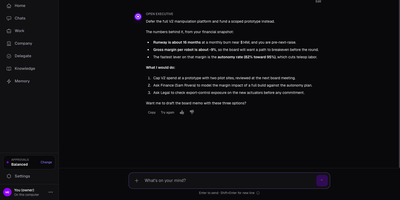
One executive voice, backed by nine specialist agents, answers business questions from your own documents instead of generic management advice. Ask if a product line should be built or deferred and the reply cites your financial snapshot, roadmap, and legal notes, then lists the numbers behind the call and the next steps. The Agent Council covers strategy, finance, people, legal, operations, marketing, product, sales, and board communications, and each agent accepts its own instructions and model. A company profile stores mission, target customer, and competitors. Departments and Goals track owners, weekly check-ins, and at-risk or off-track status. Knowledge accepts PDF, Word, Excel, CSV, Markdown, and text files, and can sync from Google Drive, OneDrive, Confluence, or Notion. Memory records decisions and what the company has learned, and a built-in scheduler surfaces follow-ups and alerts on its own. The same executive answers in Slack, Discord, Telegram, Google Chat, Gmail, Outlook, or any MCP client, with spend approval thresholds that govern how it works with people. Founders get a chief of staff, small teams a fractional advisor, and board prep a head start before the next investor update. Demo companies are bundled for a quick tour. Running on a dedicated VPS on RepoCloud with guaranteed CPU, RAM, and SSD, full root SSH access, and a browser serial console. Apache-2.0 licensed.
Mira
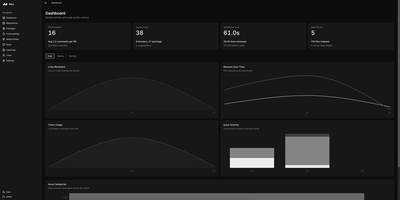
The fastest tool on the public Martian Code Review Bench at 77 seconds per PR with competitive F1 scores — while every higher-scoring competitor takes 5 to 14 times longer — Mira is the fully open-source AI code reviewer that ships the entire feature surface other tools gate behind per-seat subscriptions: indexed PR reviews with full-repo context, streaming walkthroughs posted within seconds, inline vulnerability scanning from hourly OSV.dev polls, org-wide package inventory answering "which repos use [email protected]?" in one query, interactive dependency graphs with blast-radius SVG rendering via ReactFlow, a learning loop that synthesizes rules from rejected comments and human review patterns on merged PRs, and cost telemetry showing actual spend per repo and per model. Unlike CodeRabbit, Greptile, and GitHub Copilot code review which are SaaS-only with per-seat pricing, Mira runs as a single Docker image on your infrastructure with your LLM key through OpenRouter (fronting Anthropic, OpenAI, Google Gemini, DeepSeek) or direct to Ollama and vLLM for fully air-gapped deployments. The engine indexes Python, TypeScript, Go, Rust, Java, C/C++, C#, Swift, Kotlin, Scala, and PHP with per-file symbol extraction, enabling multi-file reasoning across diffs rather than isolated line-by-line review. Integrates with GitHub, GitLab, and Forgejo via webhook with full feature parity. Running on a dedicated VPS on RepoCloud with guaranteed CPU, RAM, and SSD, full root SSH access, and a browser serial console. Apache 2.0 licensed.
OpenViking
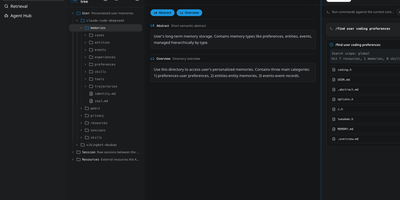
OpenViking is a self-hosted context database that gives AI agents persistent, structured memory by organizing knowledge, skills, and session history into a hierarchical virtual filesystem accessible through the viking:// URI protocol. Instead of dumping everything into a flat vector store and hoping semantic search finds the right chunks, agents navigate their context with familiar commands like ls, tree, and find, locating exactly the information they need through deterministic paths combined with semantic search. Every resource is automatically processed into three layers: a 100-token L0 abstract for quick filtering, a 2,000-token L1 overview for content navigation, and the full L2 detail loaded only when confirmed necessary. This tiered approach cuts token consumption by 83 to 96 percent compared to conventional RAG while improving task completion rates by 15 to 49 percent on benchmark tests. The built-in memory self-iteration loop automatically analyzes task execution and user feedback, updating agent memory directories so the system continuously learns and improves. You can connect to any LLM provider, including Ollama for fully local inference, OpenAI, or compatible gateways. The Web Studio UI at the /studio endpoint provides visual browsing of the entire context filesystem, and the REST API on port 1933 supports programmatic access. Deploy via Docker, Kubernetes with the included Helm chart, or as a standalone service. Running on a dedicated VPS on RepoCloud with guaranteed CPU, RAM, and SSD, full root SSH access, and a browser serial console. AGPL-3.0 licensed.

LynxDB
LynxDB is a single-binary log analytics database that ingests logs once into indexed columnar storage, so you can query the same events repeatedly without re-reading raw files or standing up a JVM stack. Pipe kubectl output or local files straight into the LynxFlow query engine for ad hoc investigation, or run the persistent server and let shippers deliver logs through Elasticsearch bulk, OpenTelemetry OTLP, Splunk HEC, syslog, and raw HTTP ingest paths. LynxFlow pipelines parse JSON, regex, key-value, CSV, and other formats at read time, then extend fields, filter with typed predicates, aggregate with stats, join CTEs, and rank results, all in one explicit grammar with time-series helpers for buckets, percentiles, gap filling, and trend lines. Full-text search runs on an FST dictionary, roaring bitmap postings, and bloom filters that skip cold segments, and materialized views keep partial aggregates ready so dashboards rewrite onto rollups automatically. Convert Sigma detections into LynxFlow queries for security hunting, tail live results as new logs arrive, and tier older data out to S3. Individual analysts use it to dissect local application logs, and platform teams run it as a cluster for shared observability with the Web UI and REST API open to everyone. Running on a dedicated VPS on RepoCloud with guaranteed CPU, RAM, and SSD, full root SSH access, and a browser serial console. Apache-2.0 licensed.
sandboxd
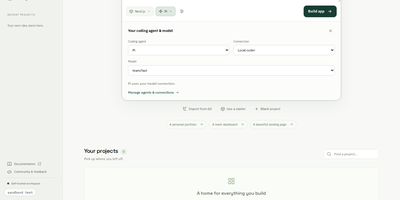
Describe an app in one sentence and sandboxd, a self-hosted AI app builder, has a coding agent build it in an isolated sandbox and hand back a live preview URL. Start from a blank prompt, a React, Next.js, Express, or FastAPI starter, or an imported public Git repo. Refine it in one persistent chat beside Preview, Code, Terminal, and Git tabs. Pick OpenCode, Pi, or Claude Code. Point OpenCode or Pi at local or remote OpenAI-compatible and Anthropic-compatible endpoints, LiteLLM gateways included. A proxy injects provider keys on the wire, so nothing secret lands in a sandbox. Did the agent get it wrong? Every task is checkpointed first, so one click reverts the turn. Snapshots, forks, and named versions keep known-good points to branch from. Edit files in the browser, review file-by-file diffs, commit, and push. Secrets are write-only and encrypted per app. Idle sandboxes sleep and wake on the next request. One modest server can host per-user previews, coding playgrounds, or an agent platform. The app library installs 80+ curated open-source apps, such as Ghost, n8n, Gitea, and Grafana, each in its own sandbox. Every console action is also a /v1 HTTP call with an OpenAPI spec. Upgrades back up the database, health-check the new version, and roll back on failure. Running on a dedicated VPS on RepoCloud with guaranteed CPU, RAM, and SSD, full root SSH access, and a browser serial console. MIT licensed.
Open Connector
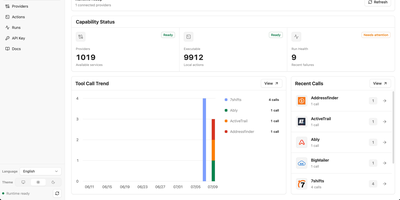
With over 5,000 GitHub stars since its June 2026 launch, OOMOL OpenConnector bridges the gap between AI agents and the real world by handling the authentication nightmare that stops LLMs from calling external APIs safely. The runtime connects to more than 1,000 SaaS providers — GitHub, Gmail, Notion, Slack, Microsoft, HubSpot, Google Workspace, and hundreds more — through 10,000+ prebuilt typed Actions that agents can discover and execute without ever touching raw credentials. OAuth2 flows, API key rotation, custom credentials, and no-auth providers are all managed centrally with AES-encrypted storage, scoped runtime tokens, and configurable action allowlists and blocklists that enforce least-privilege access. Agents interact through five access surfaces: the Model Context Protocol endpoint at /mcp for Claude and other MCP-capable hosts, a full REST API at /v1 for programmatic control, an auto-generated OpenAPI specification for code generation, a TypeScript SDK for application integration, and the oo CLI for local agent relay. The built-in Web Console provides browser-based administration for configuring OAuth apps, managing connections, inspecting action schemas, and reviewing execution logs with redacted inputs. Deploy via Docker Compose with SQLite for single-server setups, run from source on Node.js 22+, or push to Cloudflare Workers with D1 and R2 for edge deployment. Running on a dedicated VPS on RepoCloud with guaranteed CPU, RAM, and SSD, full root SSH access, and a browser serial console. Apache 2.0 licensed.
Obsei
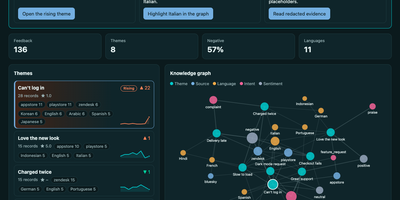
Before any AI model reads a single customer message, Obsei has already stripped out the names, email addresses, card numbers, and ID numbers hiding inside it. Obsei pulls in what customers are saying from App Store and Google Play reviews, Zendesk, Freshdesk, and Intercom tickets, GitHub issues, surveys, YouTube comments, Bluesky, RSS feeds, SQL databases, and even Gong call transcripts. Every record is pseudonymised on the way in and stored in an encrypted database that never phones home. Then the labelling starts: sentiment, intent, language, and your own custom questions, each answered with a confidence score by a zero-shot classifier running locally on your machine, or by an LLM you choose through your own keys. Answers the model is unsure about are escalated to a stronger model or queued for a human instead of being silently wrong. Related complaints roll up into stable themes with week-by-week trends, and anything mentioned by fewer than five people stays hidden, so individuals cannot be picked out of a chart. When a theme spikes, alerts and digests land in Slack, and individual findings can be routed straight into Jira, Linear, or GitHub issues. Your analysts browse it all in the built-in Studio, and your AI agents can ask questions over MCP and get cited, redacted evidence back, with any action they propose waiting for your approval. Running on a dedicated VPS on RepoCloud with guaranteed CPU, RAM, and SSD, full root SSH access, and a browser serial console. Apache-2.0 licensed.
Minimax Music UI
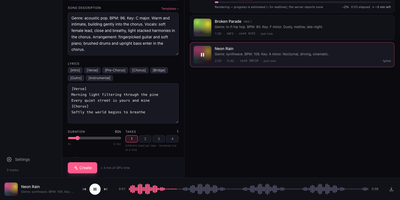
Minimax Music UI turns a self-hosted MiniMax-Music3 model into a private song factory, giving you a Suno-style studio where you describe a track, add lyrics, and watch finished songs appear in your own library. The Create panel works in Simple or Custom mode: write a style description covering genre, BPM, key, vocals, and arrangement, then shape words in a lyrics editor with one-tap [Verse], [Chorus], [Bridge], and [Instrumental] section chips. One submit can queue up to four takes at 5 to 360 seconds each, and the render queue shows queued, rendering, and done states with elapsed time, cancel, and retry, surviving a server restart without losing your place. When you run the bundled inference server, you can even press play on a track that is still rendering and hear the waveform grow in real time. A magic wand rewrites rough ideas into structured music captions, and a second wand drafts original lyrics sized to your chosen duration, both through any OpenAI-compatible model you point it at. Finished renders land in a searchable library with cover art, seeds, and render times, ready to download as WAV, reuse as a template, or open in a detail panel with the prompt and lyrics. A sticky waveform player with seek and keyboard shortcuts keeps music going while you work, and an optional access token locks the whole studio down. Running on a dedicated VPS on RepoCloud with guaranteed CPU, RAM, and SSD, full root SSH access, and a browser serial console. MIT licensed.
Huly
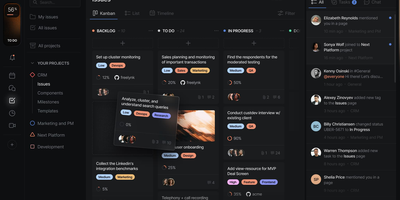
With 27,000 GitHub stars and 349 releases shipping multiple times per week, Huly replaces four separate SaaS subscriptions — Linear for issue tracking, Notion for documents, Slack for team chat, and Motion for time-blocking — with a single self-hosted platform that charges nothing per seat. The issue tracker provides projects, sprints, roadmaps, custom workflows, and Kanban views with bi-directional GitHub and GitLab synchronization that keeps issues and pull requests in lockstep across both systems. Collaborative documents use CRDT-based real-time editing for wikis, meeting notes, and technical specs with nested page hierarchies and rich embedding. Team messaging delivers channels, direct messages, threaded conversations, reactions, and pinned messages in a Slack-equivalent interface that lives alongside your project context. The time-blocking planner schedules tasks into calendar slots with drag-and-drop, integrating directly with your issue backlog so nothing falls through cracks. A virtual office module provides audio and video rooms for standups and pair programming with external guest access. HR features handle team management, office hours, and PTO tracking. The architecture runs 30+ microservices on CockroachDB for ACID-compliant storage, Elasticsearch for full-text search, MinIO for file attachments, and Redpanda for event streaming. Desktop apps ship for macOS, Windows, and Linux alongside mobile apps for iOS and Android. Running on a dedicated VPS on RepoCloud with guaranteed CPU, RAM, and SSD, full root SSH access, and a browser serial console. EPL-2.0 licensed.
ComfyUI
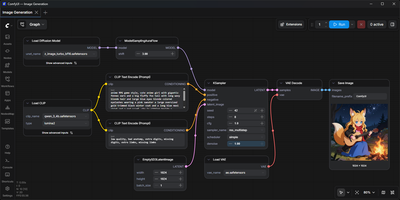
With over 126,000 GitHub stars and adoption across professional studios, research labs, and independent creators, ComfyUI has become the most widely used node-based interface for generative AI workflows — supporting image, video, audio, and 3D content creation through a single visual canvas. The graph editor natively supports Stable Diffusion 1.5, SDXL, SD3.5, Flux.1, Flux.2, HunyuanDiT, Lumina Image 2.0, HiDream, Qwen Image, and Pixart for image generation, plus Wan 2.1 and 2.2, LTX-Video, HunyuanVideo 1.5, CogVideoX, and Mochi for video, ACE-Step and Stable Audio for audio, and Hunyuan3D 2.0 for 3D models. Built-in tools handle inpainting, outpainting, ControlNet conditioning, LoRA and Hypernetwork loading, ESRGAN upscaling, area composition, model merging, and GLIGEN spatial control without writing code. The execution engine implements asynchronous queue processing with partial graph re-execution, running only changed nodes between iterations, and smart VRAM management that offloads models on GPUs with as little as 1 GB of memory. API nodes optionally connect to closed-source models through Comfy API while the core runs fully offline. Reusable subgraphs and App Mode expose complex workflows as simplified interfaces for non-technical users. The V3 custom node schema enables stateless execution with async support and process isolation. The TypeScript and Vue frontend ships as a PyPI package with stable releases every two weeks. Workflows save as JSON and embed in generated PNG, WebP, and FLAC files for reproducibility. Running on a dedicated VPS on RepoCloud with guaranteed CPU, RAM, and SSD, full root SSH access, and a browser serial console. GPL v3.0 licensed.
hy2scale
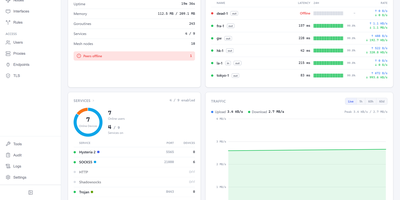
A handful of cheap servers in different countries become one routed network with a browser dashboard on top. Nodes link directly through Hysteria 2 QUIC tunnels with no coordination server, and traffic can leave through any node, several hops deep. The overview dashboard, topology graph, node list, and world map show latency, uptime, and live rates for every peer. Each node can also serve SOCKS5, HTTP, Shadowsocks, Trojan, L2TP/IPsec, IKEv2, OpenVPN, and WireGuard clients, and the VPN servers run in userspace without extra privileges. Policy sets route traffic by user, source, destination, domain, country, or ASN, and each user can get a fixed exit, quality failover, or aggregated paths. Traffic limits with periodic resets, upload and download rate caps, and expiry dates control how much each account can use. Hole punching connects nodes behind NAT, and peers can carry several addresses. A built-in certificate authority manages TLS certificates. An audit log records every connection, and ping, traceroute, throughput tests, and a terminal sit on the Tools page. Backup and restore, signed in-app upgrades, and an interface in English, Chinese, and Korean round out the admin side. Running on a dedicated VPS on RepoCloud with guaranteed CPU, RAM, and SSD, full root SSH access, and a browser serial console. GPL-3.0 licensed.
ThoughtDAG
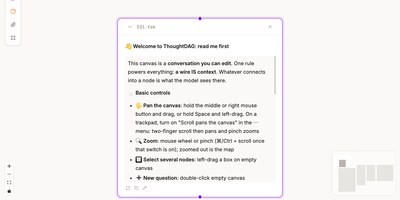
ThoughtDAG turns a long AI conversation from a scroll you cannot rearrange into a map you can edit, branch, and reconnect. Every question and answer becomes a node on an infinite canvas, and the wires between nodes are not decoration: they decide exactly what context the model sees next. Follow a promising thread, park a side question on its own branch, or cut a wire when an early assumption starts poisoning later answers, all without deleting the work that led there. Zoom out to read the shape of an investigation, then zoom back in to full answers, attachments, and highlighted passages. Drop in documents and files as material nodes, ask questions from them, and preview precisely what will be sent before a model runs. Past coding agent sessions can be opened as read-only graph mirrors, so a discussion that started in a terminal can be inspected, cited, and continued on the canvas. Memory lives in readable dossiers that collect decisions and open questions per topic, with sources attached, and relevant dossiers join new questions when you ask. Export a backup, a Markdown context chain, or a thought map that shares the structure of your thinking without dumping the whole transcript. Running on a dedicated VPS on RepoCloud with guaranteed CPU, RAM, and SSD, full root SSH access, and a browser serial console. MIT licensed.
AgentMesh
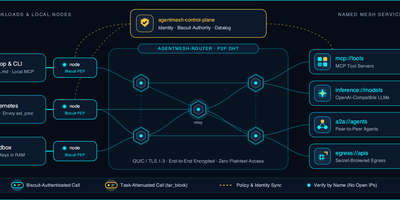
A node beside each AI agent gives your fleet a private network where agents publish tools and models, discover what other nodes offer, and call those services under policy you control. Nothing is reachable by default, because a node exposes no service until its configuration says so, and no node may call a service your mesh policy has not granted. Identity comes from your own identity provider, since a node enrolls with an OpenID Connect or bootstrap token and receives a short-lived credential bound to its own key that peers can verify offline. Nodes connect directly when they can and relay through well-known routers when NAT or firewalls say no, so the same mesh stretches across laptops, containers, clusters, and phones. The node beside your agent exposes the mesh as a local MCP server and an OpenAI-compatible endpoint, so model requests route to whichever node serves that model. The control plane verifies who is joining, issues the credentials, and holds the grants, which are evaluated on service names rather than network addresses. For small deployments, a single binary bundles the control plane, a router, and a web console, so a private mesh for your agents runs on one modest host. A shared developer testnet lets you rehearse the whole enrollment and calling flow in minutes before standing up infrastructure of your own. Running on a dedicated VPS on RepoCloud with guaranteed CPU, RAM, and SSD, full root SSH access, and a browser serial console. Apache-2.0 licensed.