Developer links
AgentMesh
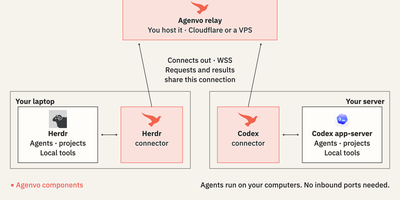
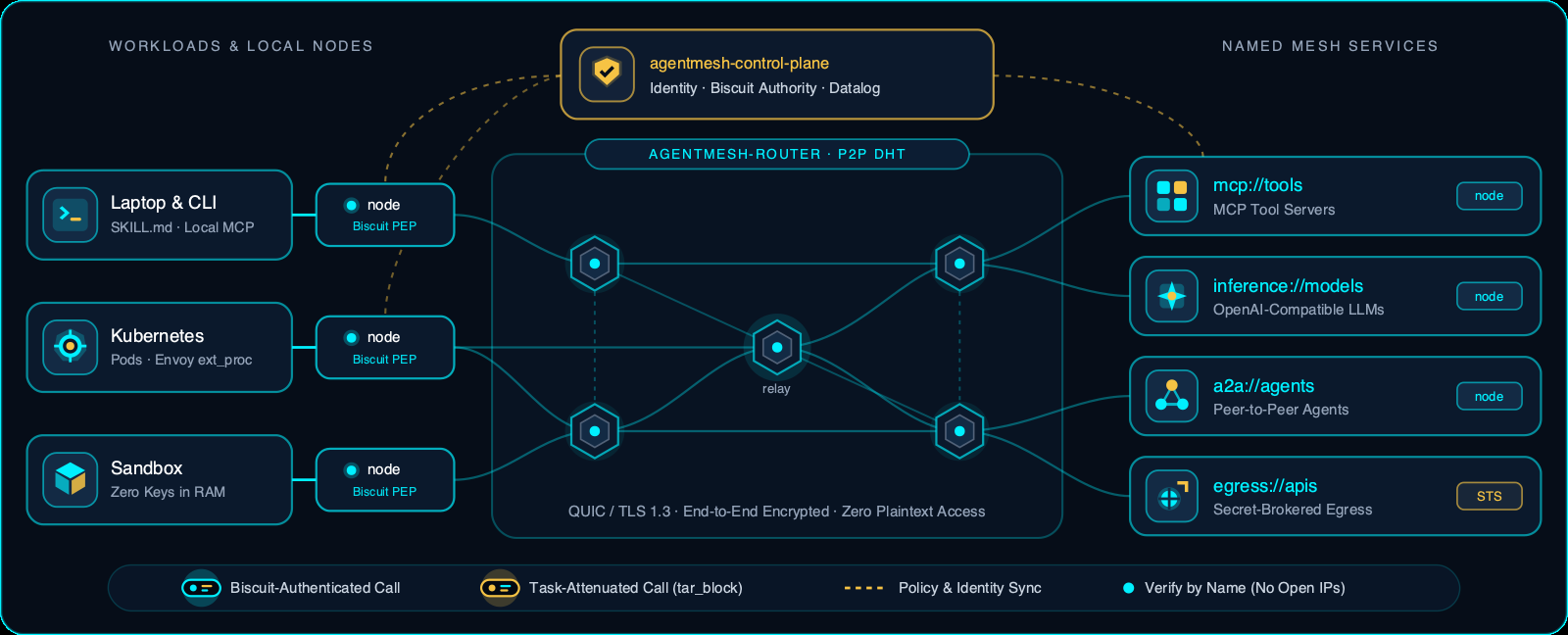
A node beside each AI agent gives your fleet a private network where agents publish tools and models, discover what other nodes offer, and call those services under policy you control. Nothing is reachable by default, because a node exposes no service until its configuration says so, and no node may call a service your mesh policy has not granted. Identity comes from your own identity provider, since a node enrolls with an OpenID Connect or bootstrap token and receives a short-lived credential bound to its own key that peers can verify offline. Nodes connect directly when they can and relay through well-known routers when NAT or firewalls say no, so the same mesh stretches across laptops, containers, clusters, and phones. The node beside your agent exposes the mesh as a local MCP server and an OpenAI-compatible endpoint, so model requests route to whichever node serves that model. The control plane verifies who is joining, issues the credentials, and holds the grants, which are evaluated on service names rather than network addresses. For small deployments, a single binary bundles the control plane, a router, and a web console, so a private mesh for your agents runs on one modest host. A shared developer testnet lets you rehearse the whole enrollment and calling flow in minutes before standing up infrastructure of your own. Running on a dedicated VPS on RepoCloud with guaranteed CPU, RAM, and SSD, full root SSH access, and a browser serial console. Apache-2.0 licensed.
Benefits
- Agents reach beyond one machine
- Tools and models published on any node become callable across the mesh under your policy. An agent on a laptop can use a GPU model or a database tool hosted in your cluster.
- Nothing reachable by default
- Nodes expose no services until configuration allows it, and calls are granted per service name, never by address. The mesh starts closed and opens only where your policy says so.
- Identity from your provider
- Enrollment uses your OpenID Connect provider or a bootstrap token, exchanged for a short-lived credential bound to the node's own key. Peers verify identity offline without phoning home.
- NAT is not a wall
- Nodes connect directly when possible and relay through routers when firewalls or NAT intervene. The same mesh covers laptops, containers, Kubernetes clusters, and phones without public addresses for every participant.
Features
- Control plane and routers
- The control plane verifies enrollments, issues signed credentials, and holds calling policy, while routers relay traffic between unreachable nodes and host the discovery table every node consults.
- Local MCP, model endpoints
- Each node exposes the mesh to its agent as an MCP server on localhost and an OpenAI-compatible API. Model requests route to whichever node currently serves that model.
- All-in-one small deployments
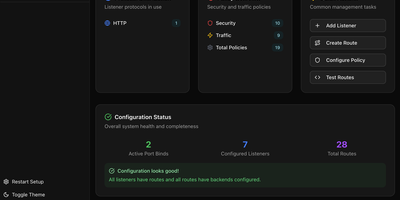
- The agentmesh-one binary bundles control plane, router, and web console for laptops and small hosts. A shared developer testnet offers a zero-setup way to learn the enrollment flow.
- Policy on service names
- Grants are evaluated on what a service is called, never on IP addresses, so moving a backend between hosts does not rewrite policy. Default is deny; exposure is always explicit.