LAN-Orangutan
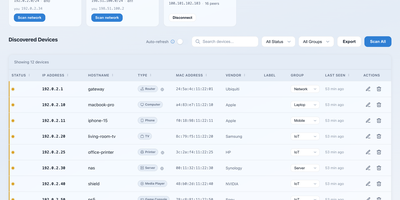
Most home and office networks quietly accumulate dozens of devices nobody can name, and LAN Orangutan answers the basic questions about all of them: what is connected, what changed since yesterday, and what should not be there at all. It scans one or several networks with nmap and merges in the host ARP table, resolving MAC addresses, manufacturers, hostnames, and device types so a phone, printer, TV, and server each show up as themselves rather than as bare IP addresses. You label devices, file them into your own groups and locations, and attach notes that survive every rescan, turning a one-off scan into a maintained inventory. Snapshots freeze the network at a moment in time, and comparing two of them shows exactly which devices appeared, vanished, or moved to a new address. Mark the devices you expect, and the dashboard flags newcomers and missing hardware, with webhook notifications to Telegram, Discord, Slack, ntfy, or Home Assistant when something changes. Tailscale peers appear next to local devices, so the laptop on your tailnet and the printer downstairs live in the same list. Risky exposures such as Telnet or FTP get flagged, scans show live progress you can cancel, and a password you create on first open guards the whole dashboard. Running on a dedicated VPS on RepoCloud with guaranteed CPU, RAM, and SSD, full root SSH access, and a browser serial console. MIT licensed.
LLDAP
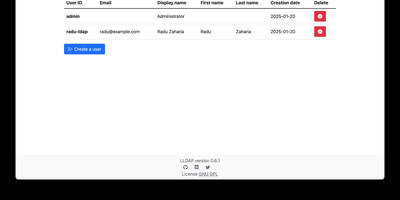
LLDAP is a lightweight user directory that lets all your self-hosted apps share one set of accounts and passwords. It speaks just enough LDAP for Nextcloud, Jellyfin, Gitea, GitLab, Grafana, Home Assistant, Proxmox VE, Vaultwarden, and many more to authenticate users against a single source of truth, with ready-made example configurations for more than 80 services. Day-to-day administration happens in a web interface where you create users, set passwords, upload avatars, build groups, and add members from a dropdown. Regular users can sign in to edit their own profile, and once SMTP is configured they can request a password-reset link by email instead of pinging the admin. Custom attributes (text, numbers, dates, or JPEG photos) are defined on the user and group schema pages, which unlocks integrations that expect fields such as uidNumber or homeDirectory, including Linux logins through PAM. Three built-in groups keep privileges tidy: lldap_admin for full control, lldap_password_manager for password resets, and lldap_strict_readonly for read-only service accounts. Group membership is exposed through memberOf filters, LDAPS secures connections when you expose the port, and a GraphQL API plus a bootstrap script let you manage users, groups, and attributes declaratively from JSON files. Pair it with Authelia, Authentik, or Keycloak when you also want single sign-on and multi-factor prompts. Running on a dedicated VPS on RepoCloud with guaranteed CPU, RAM, and SSD, full root SSH access, and a browser serial console. GPL-3.0 licensed.
PicoShare
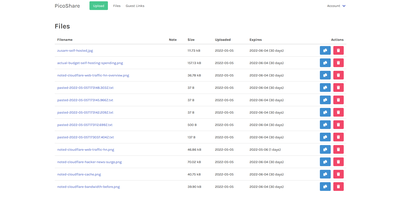
PicoShare is a minimalist file-sharing service you host yourself: upload any file and get a direct download link that anyone can open, with no ads, no signups, and no size or format restrictions. Send a client a 4 GB video or a raw photo archive and they download the exact bytes you uploaded, because PicoShare never resizes or re-encodes media while sharing. Every upload can carry an expiration, from a day to never, and an optional private note that only you can see. When other people need to send files to you, create a guest link instead of asking for email attachments: guests upload through the link with no account, and you set the maximum file size, the total number of uploads, and an expiry date for each link. The files list shows everything you have shared with sizes, upload dates, and expirations, and every entry offers one-click link copying and deletion. A single shared secret guards the admin side, and all data lives in one SQLite database file that you can back up or replicate to cloud storage automatically. Run it as one small Docker container on your own domain and your download links stay yours. Running on a dedicated VPS on RepoCloud with guaranteed CPU, RAM, and SSD, full root SSH access, and a browser serial console. AGPL-3.0 licensed.
13ft
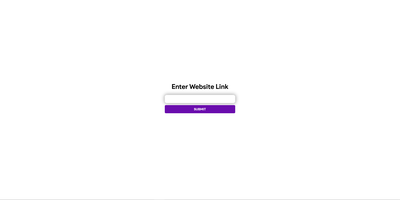
One article should not require a subscription, an account, and your tracking consent. 13ft is a self-hosted alternative to the defunct 12ft.io that fetches web articles the way a search-engine crawler receives them, then shows you the clean page without paywall walls, ad clutter, and pop-up nonsense attached. Paste a link into the single input, or better, install the companion bookmarklet: one click on any article page rewrites the address to your own server, and the reading copy comes back from infrastructure you control. Because it is yours, there is no third-party service logging every article you read, no central site that can be taken down and strand the habit, and nobody selling a premium tier of unblocking. It handles the stubborn cases with a loading page and multiple fallback retrieval methods that kick in when the first approach fails, ships localised interface strings in several languages, and the whole thing is one small application that runs from a container and sits politely behind a reverse proxy. Casual readers reclaim the occasional long-form piece; researchers and archivists get a reproducible way to fetch the same copy a search index saw. Running on a dedicated VPS on RepoCloud with guaranteed CPU, RAM, and SSD, full root SSH access, and a browser serial console. MIT licensed.
Zitadel
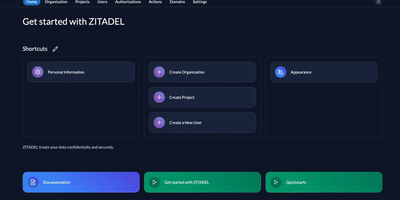
Securing a SaaS product, running B2B onboarding, or replacing Auth0 and Keycloak with a stack they own - teams needing more than basic auth reach for ZITADEL, an open-source identity and access management platform built in Go. Its multi-tenancy model is the differentiator: a strict Instance, Organization, Project hierarchy isolates data and scopes policy at each level, with identity brokering (pre-built templates for Google, GitHub, Microsoft, Apple, plus generic OIDC, OAuth, SAML, and LDAP), domain discovery that routes users to the right organization by email domain, and delegated management so customers administer their own users and roles. Authentication covers OpenID Connect (certified, including device authorization and token exchange), SAML 2.0 as both IdP and SP, SCIM, FIDO2 passkeys for phishing-resistant passwordless login, and MFA via OTP, email, SMS, and U2F; machine-to-machine flows support JWT profile, PATs, and client credentials. The architecture is event-sourced - every mutation is an immutable event, yielding a complete audit trail - with relational projections for queries and no external session store, so it scales horizontally. API-first with gRPC and REST, extensible via Actions webhooks, and the same codebase self-hosted (Docker Compose or Helm on PostgreSQL) as in the cloud.
ControlR
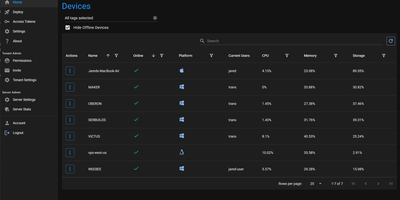
Helping someone fix their computer should not start with a phone call full of instructions nobody can follow: ControlR puts every machine you look after into one browser tab. Install the agent on Windows, Mac, or Linux machines once, and they appear in your device grid with their status ready for action. Open a remote desktop session and see and control the screen as if you were sitting there, drop into a cross-platform PowerShell terminal when a fix is faster typed than clicked, browse the file system to fetch a log or drop off a file, or just open chat when a quick question is all that is needed. Devices are organized with tags, and access follows them: a technician sees the machines their tags cover, while roles decide who can install agents, manage installer keys, administer the tenant, or reach every device. Agent logs stream to the server in real time, which turns bug reports into something you can actually read. Run one tenant for your own fleet, or enable public registration and let each new account become its own isolated tenant, with the database keeping every tenant's devices and users apart. Sensitive settings can arrive through Docker Secrets instead of environment variables, and the whole server runs from a single compose file. Running on a dedicated VPS on RepoCloud with guaranteed CPU, RAM, and SSD, full root SSH access, and a browser serial console. MIT licensed.
Kokoro FastAPI
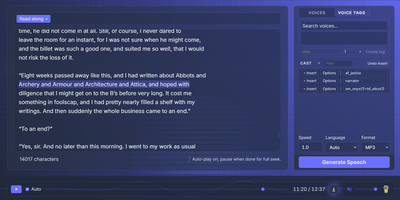
Kokoro-FastAPI turns text into natural-sounding speech across eight languages by serving the 82-million-parameter Kokoro-82M model through an OpenAI-compatible REST API, so any existing OpenAI SDK client can generate audio by just changing the base URL. With over 5,300 GitHub stars since December 2024, the fully Dockerized FastAPI server covers American English, British English, Spanish, French, Hindi, Italian, Japanese, Brazilian Portuguese, and Mandarin Chinese with language-specific phoneme processing. Inline voice mixing blends multiple profiles using weighted ratios like af_bella(2)+af_heart(1), automatically normalizing weights and caching combined voicepacks as PyTorch tensor files for reuse. Audio streams in real time over HTTP with configurable chunk sizes, or generates complete files in MP3, WAV, OPUS, FLAC, AAC, or PCM formats with speed control from 0.25x to 4.0x. Per-word timestamped captions with speaker-tagged voice labels enable subtitle generation for podcasts, audiobooks, and accessibility workflows. Pre-built Docker images support NVIDIA GPU acceleration via CUDA, experimental AMD GPU inference via ROCm, and CPU-only deployment on linux/amd64 and linux/arm64 architectures, with Apple Silicon MPS support available through direct UV execution. The integrated web interface at port 8880 provides browser-based speech generation, while the Swagger UI at /docs exposes the full API reference. Debug endpoints report system statistics for monitoring inference load. Running on a dedicated VPS on RepoCloud with guaranteed CPU, RAM, and SSD, full root SSH access, and a browser serial console. Apache 2.0 licensed.
Frappe Helpdesk
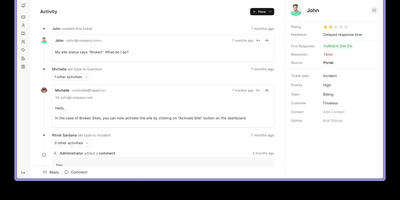
With over 3,200 GitHub stars, 900 forks, and backing from the team behind ERPNext, Frappe Helpdesk delivers a modern, streamlined alternative to Zendesk and Freshdesk with unlimited agents, no per-seat pricing, and full source code access under the AGPL-3.0 license. Built on the Frappe Framework with a Python backend and Vue 3 frontend using Frappe UI, the application collects customer inquiries from email, web forms, and the customer portal into a centralized ticketing queue with complete conversation history and threaded replies. Customizable SLA rules define response and resolution timelines by ticket type or team, triggering automatic alerts and escalations when deadlines approach or are missed. Assignment rules route incoming tickets to the appropriate agents based on priority, issue type, or workload balancing, while manual reassignment and transfer between teams remains available at any time. The customer self-service portal lets users submit tickets, track status, and search a knowledge base of published help articles that reduce repetitive support requests. Agents access saved reply templates for consistent, rapid responses to common queries. Custom fields, configurable workflows, and saved views adapt the interface to match each organization's support process. Real-time updates via WebSocket push ticket changes instantly to all connected agents. The PWA-compatible interface provides mobile access without a native app. Frappe Framework compatibility spans versions 15 and 16. Running on a dedicated VPS on RepoCloud with guaranteed CPU, RAM, and SSD, full root SSH access, and a browser serial console. AGPL-3.0 licensed.
DefectDojo
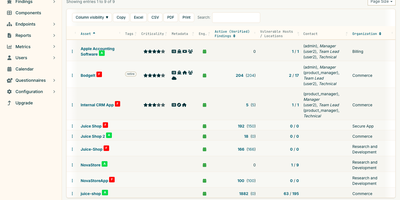
Security scanners each report in their own format, and DefectDojo is the self-hosted platform that imports those reports and keeps a single, triaged list of findings. Reports in mixed formats? More than 350 built-in parsers read output from Burp Suite, ZAP, Trivy, Tenable Nessus, SonarQube, Snyk, and Checkmarx, and Generic Findings Import covers tools without a parser through CSV or JSON files. The same scan every night? Reimport adds new findings, can close the ones that vanished, and reopens the ones that return, while deduplication ties repeat detections inside an asset to their original. Decisions already made? False positive, out of scope, and risk accepted statuses survive reimport, so nobody triages the same noise twice. A deadline on every fix? Severity-based SLA countdowns flag breaches and can notify the users assigned to each asset, and full risk acceptances carry notes, files, and an expiry date that returns findings to active by default. Many teams, many applications? Organizations, assets, engagements, and tests mirror how security work is organized, with permissions that cascade downward. Pipelines that should report themselves? The REST API and CI/CD engagements import results automatically, and findings push to Jira as tickets. Someone outside security wants a summary? Dashboards track metrics, and a widget-based report builder produces HTML reports that print to PDF. Running on a dedicated VPS on RepoCloud with guaranteed CPU, RAM, and SSD, full root SSH access, and a browser serial console. BSD-3-Clause licensed.
Tududi
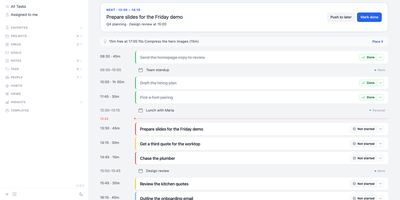
Tududi is a self-hosted planner that turns a pile of tasks into a plan for the day, keeping projects, notes, goals, and habits on a server you control. One Add box files an Inbox item, Task, Note, or Project and understands natural-language dates, recurrence, tags, projects, and people, so "every first monday #home" becomes a recurring task without opening a form. The Today page switches between planning mode, with a timeline or list beside your calendar and optional AI help to sketch the day, and doing mode, with a Next card and a hint when a free slot fits a small task. Tasks have subtasks and live in projects and areas, projects link to season or year goals, and saved views, project templates, and optional Eisenhower and Kanban boards organize the work. Habits support build or quit goals with streaks, a strength score, and a history grid, while notes offer linked pages, backlinks, and mermaid diagrams. Households and teams share projects with read-only or read-write access, assign tasks to people, and follow an Everyone board; members without email sign in through one-time links. Telegram captures tasks and can send daily summaries, CalDAV syncs with reminder apps, OIDC handles single sign-on, and an MCP server lets Claude or Cursor manage tasks. AI stays off until you enable it and add a provider; local models work too. Running on a dedicated VPS on RepoCloud with guaranteed CPU, RAM, and SSD, full root SSH access, and a browser serial console. MIT licensed.

Genealogy
Genealogy turns scattered family records into a living, browsable family tree that relatives can explore together and keep growing. Each person gets a full profile with parents, partners, children, and siblings, and couples are first-class records too, so remarriages, separations, and blended families are represented honestly instead of being forced into a single marriage box. Photos can be uploaded in batches, watermarked, and browsed in a carousel on the profile, while documents attach the scans and certificates that back up each fact. Events build a timeline overview for every person, so births, marriages, moves, and milestones read as a story rather than a spreadsheet. Several branches can live side by side: separate trees are organized as teams with owners, managers, editors, and read-only members, ownership can be transferred, and invitations keep research private to the family. Personal settings follow each user, including language, timezone, and a light or dark theme on any screen size. A built-in backup manager runs manual or scheduled daily backups with cleanup and email confirmation, and a log viewer surfaces slow queries and errors before they surprise you. Running on a dedicated VPS on RepoCloud with guaranteed CPU, RAM, and SSD, full root SSH access, and a browser serial console. MIT licensed.
Ghostfolio
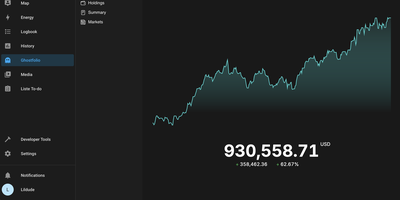
Stocks, ETFs, crypto, bonds, precious metals, and cash across every account and currency, in one privacy-first dashboard: Ghostfolio is open-source wealth management software. The deliberate design decision is no brokerage linking: positions enter by manual entry, CSV import, or the REST API, so your holdings never pass through a data aggregator. Performance is measured as return on average investment across Today, WTD, MTD, YTD, 1Y, 5Y, and Max timeframes, with benchmark comparison against indices like the S&P 500, dividend tracking, and allocation breakdowns by asset class, region, and sector. A static X-ray analysis flags concentration and other portfolio risks, and a FIRE calculator projects progress toward financial independence. Multi-currency support converts holdings using historical exchange rates, market data comes from Yahoo Finance and CoinGecko among other pluggable providers, and everything exports back out as CSV or JSON. Built with Angular and NestJS on PostgreSQL and Redis, shipped as Docker images for amd64 and ARM, with a mobile-first PWA interface, dark mode, and a distraction-free Zen mode. AGPL-licensed.
Bolt.diy
Prompt, run, edit, and deploy full-stack Node.js applications from a browser tab: Bolt.diy is the official open-source version of Bolt.new's AI coding agent. Its foundation is StackBlitz's WebContainer technology - a sandboxed in-browser Node.js environment where the AI controls the whole stack: filesystem, npm, dev servers, terminal, and browser console. That means the agent does not just generate code; it installs dependencies, runs Vite or Next.js, reads errors, and fixes them. The defining difference from Bolt.new is model choice per prompt: 19+ providers including OpenAI, Anthropic, Gemini, DeepSeek, Groq, Mistral, Amazon Bedrock, and local models via Ollama or LMStudio, extensible through the Vercel AI SDK. Development ergonomics include live preview, a diff view of AI changes, codebase search, file locking to prevent generation conflicts, 15+ starter templates (React, Vue, Next.js, Astro, Svelte, Expo), and MCP support for external tools. Projects integrate with Git and Supabase, and deploy in one click to Vercel, Netlify, or GitHub Pages.
Warmbly
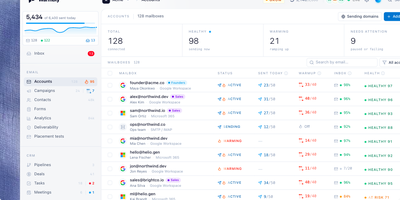
Cold outreach dies in the spam folder long before a prospect reads it, and Warmbly is the open-source platform that keeps your mailboxes warm, capped, and credible while campaigns run from the accounts you already own. Connect Google Workspace, Microsoft 365, or any SMTP and IMAP mailbox, and Warmbly checks SPF and DMARC records, scores mailbox health, then warms each account gradually, starting near 10 messages a day and ramping toward a 40-per-day ceiling instead of blasting from day one. Campaigns run as multi-step sequences spread across many mailboxes, with per-mailbox daily caps, minimum spacing between sends, and weekday sending windows, so volume grows without one account absorbing all the risk. Opens, clicks, bounces, and complaints stream into a deliverability view with suppression handling, while every reply from every mailbox lands in one unified inbox your whole team can work in real time. A built-in CRM tracks contacts, pipelines, deals, tasks, and meetings next to the conversations that created them. Visual playbooks react the moment a reply, booking, bounce, or warmup dip arrives: branch on intent or confidence, let an AI step read the reply and act only with the actions you allow, open the deal, post to Slack, update HubSpot or Pipedrive, and test the whole path on a canvas before it goes live. Running on a dedicated VPS on RepoCloud with guaranteed CPU, RAM, and SSD, full root SSH access, and a browser serial console. Apache-2.0 licensed.
Cezar
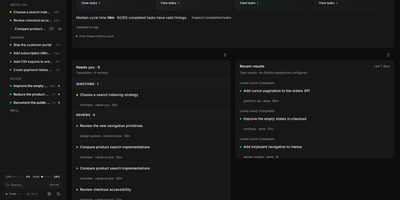
Close the laptop; the agents keep shipping. Cezar is an open-source control center that runs Claude Code, Codex, OpenCode, Copilot, and eight other coding agents in parallel on your own server, around the clock. Every task gets an isolated git worktree, so a dozen agents edit the same repository at once without colliding, and overflow waits in a queue. You watch each run live: the agent's text, its tool calls, token counts, and reported cost stream into one cockpit covering all your projects. The workspace dashboard separates what needs your answer, what is running, and what finished, and the usage view totals spend and tokens per project so a runaway task shows up in dollars, not surprises. Repeatable playbooks are plain Markdown skill files, chained into short YAML workflows that can mix a different agent per step, add checks and gates, and open pull requests; nothing merges on its own. Hand it a GitHub issue in one click, connect Jira or Linear to launch from your tracker, and schedule recurring maintenance with automations. Flip Autonomous and a run stops asking questions and just finishes; run the same task two or three times and keep the best diff. State lives in plain files, no database, and the responsive interface works from your phone. Running on a dedicated VPS on RepoCloud with guaranteed CPU, RAM, and SSD, full root SSH access, and a browser serial console. MIT licensed.
Eclaire
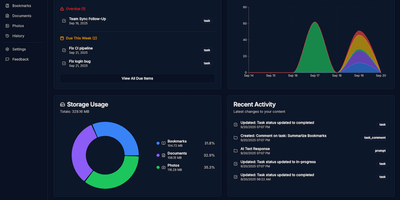
Built to consolidate fragmented digital life into a private personal cloud, Eclaire centralizes tasks, notes, documents, photos, and web bookmarks into a unified workspace powered by local artificial intelligence. Users can save web articles to generate clean Markdown copies and searchable PDF archives, automatically bypassing clutter and dead links. The integrated document ingestion engine extracts tabular data from spreadsheets, performs optical character recognition across uploaded receipts and handwritten images, and indexes multi-page PDF manuals for rapid full-text search. Conversational assistant panels allow operators to interrogate their accumulated library using natural language, asking for cross-document summaries, research timelines, or action items extracted from meeting transcripts. Background workers prioritize asynchronous indexing queues, categorizing image libraries with visual object tags and managing recurring task deadlines with automated Telegram alert notifications. External automation flows can interact directly with the unified storage layer via an OpenAI-compatible REST API, allowing mobile shortcuts and custom scripts to ingest bookmarks and dictate notes remotely. Running on a dedicated VPS on RepoCloud with guaranteed CPU, RAM, and SSD, full root SSH access, and a browser serial console. MIT licensed.
Netronome
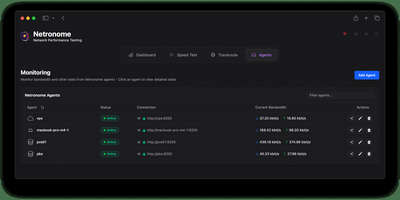
Netronome is a self-hosted network monitoring platform that runs scheduled internet speed tests, watches packet loss and DNS resolvers, and reports bandwidth and health data from every server you point it at. Run tests against Speedtest.net, your own iperf3 servers, or public and custom LibreSpeed servers, choosing the exact endpoint from a list sorted with the nearest first. Put tests on a recurring schedule and read the history charts to catch an ISP that sags every evening or a connection that never delivers the speed on the invoice. Install the companion agent on each machine and watch live upload and download rates, traffic by hour, day, and month, processor and memory load, disk space, and temperatures in one place. Trace routes hop by hop, keep packet loss percentages in view, and confirm your DNS resolvers answer fast and return the records you expect. Set thresholds for download and upload speed, ping, packet loss, disk space, CPU, memory, and temperature, and route alerts to Discord, Telegram, Slack, email, ntfy, Gotify, Pushover, or a webhook. The server, the web interface, and the agent ship as one program, and agents connect over HTTP with an optional API key or inside a Tailscale network. Running on a dedicated VPS on RepoCloud with guaranteed CPU, RAM, and SSD, full root SSH access, and a browser serial console. GPL-2.0 licensed.
ExpenseOwl
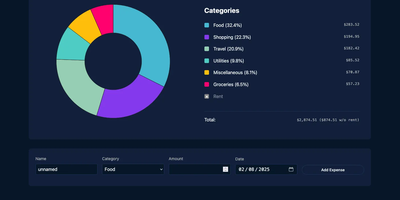
Log a date, amount, and category; get a clean monthly pie chart and a cashflow strip showing income, expenses, and net balance - ExpenseOwl is expense tracking stripped to what actually matters. The MIT-licensed Go application deliberately is not a budgeting system - no envelopes, no accounts, no double-entry, no bank sync - because its author found tools like Firefly III and Actual too heavy for the simple question "where did this month's money go?" The dashboard makes that question fast: click a pie slice to exclude fixed costs like rent and see discretionary spending clearly, then drill into a chronological table view to inspect or delete individual transactions. Recurring transactions handle salaries and subscriptions automatically, optional tags add a second classification axis, and settings cover custom categories, currency symbol, and a configurable month start date for non-calendar pay cycles. CSV import migrates data from virtually any other tool, and CSV export keeps your data portable. It ships as a self-contained binary and multi-architecture Docker image with zero internet interaction, stores data in flat JSON files by default (PostgreSQL optional), and installs as a PWA on phones. Single-user by design; pair it with an authenticating reverse proxy if exposed publicly.