OpenNotebookLM
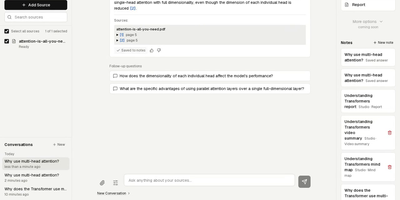
OpenNotebookLM is a self-hosted research workspace that reads your sources with you, answering questions only from the material you gave it and showing the passage behind every claim. Import papers, spreadsheets, recordings, web pages, PDF links, YouTube videos or playlists, Markdown folders, Obsidian vaults, and Git repositories, then select which sources the chat may use as evidence. Stream answers with follow-up questions, hover any numbered citation to inspect the supporting passage and page, and let the app flag citations that look unsupported before you trust them. The Studio turns the same sources into cited reports in briefing, study guide, FAQ, or timeline formats, expandable mind maps you can pan and question, two-host audio overviews in deep dive, brief, critique, or debate styles, narrated slides exportable to PowerPoint, and tables whose cells carry their own citations. Generate flashcards and timed quizzes from what you read, mark cards for review, and resume saved progress later. Save cited answers and Studio outputs as notes, convert notes back into searchable sources, and export almost anything: conversations, projects, mind maps as SVG, flashcards as Anki text, audio as MP3. Share projects with viewer or editor roles, keep conversations private per person, and bring Claude, OpenAI, any OpenAI-compatible provider, or a local Ollama model, with extraction, OCR, Whisper transcription, and Kokoro audio synthesis running on your own server. Running on a dedicated VPS on RepoCloud with guaranteed CPU, RAM, and SSD, full root SSH access, and a browser serial console. MIT licensed.
Apache HertzBeat
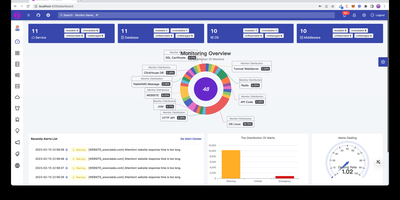
Instead of deploying proprietary background agents across dozens of target nodes, engineers rely on Apache HertzBeat to monitor real-time infrastructure health, metrics gathering, threshold alerting, and public status pages from a central operations platform. Operations teams can poll hundreds of target services without deploying proprietary background daemons, gathering performance data across Linux hosts, Kubernetes clusters, SQL databases, and network switches using native connection protocols. Engineers can define custom monitoring targets directly within the web dashboard by composing declarative YAML templates that specify polling intervals, parsing expressions, and metric extraction rules. The centralized alert engine processes inbound threshold events, suppresses cascading alert storms during maintenance windows, and dispatches actionable incident notifications to Discord channels, Slack rooms, Telegram groups, and webhook endpoints. Telemetry streams flow into interactive charts with customizable refresh cadences, enabling site reliability engineers to inspect latency waterfalls, correlate log spikes against CPU exhaustion, and track disk capacity trends over extended timeframes. Administrators can also publish real-time public status pages that inform external stakeholders about service availability, scheduled downtime, and ongoing incident resolutions. Running on a dedicated VPS on RepoCloud with guaranteed CPU, RAM, and SSD, full root SSH access, and a browser serial console. Apache 2.0 licensed.
PictShare
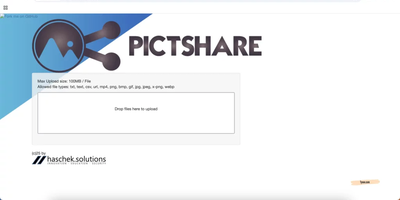
Every screenshot, GIF, short video, audio clip, and block of text you share can live at a clean link on your own server, with the URL itself acting as the editing tool. Upload an image once and ask for any size, crop, or filter by changing the address, with WebP conversion handled automatically for browsers that support it and GIFs convertible to MP4 for quieter sharing. Photos arrive stripped of EXIF data, so phone pictures stop broadcasting GPS coordinates and camera models to everyone you share with. Uploading the same file twice costs no extra space, and delete codes at individual or global level keep takedown control with you rather than a platform. Several uploads combine into an immutable album with a single gallery link, a "My Uploads" tab in the browser tracks what you sent for later copying, deleting, or bundling, and playful extras generate identicons and placeholder images straight from URL patterns. Text bins, Markdown rendering, a URL shortener, and an upload API for scripts round out a tool that replaces the screenshot-upload step of a dozen workflows. External storage, optionally encrypted, takes over when the local disk outgrows the habit. Running on a dedicated VPS on RepoCloud with guaranteed CPU, RAM, and SSD, full root SSH access, and a browser serial console. AGPL-3.0 licensed.
Open Food Network
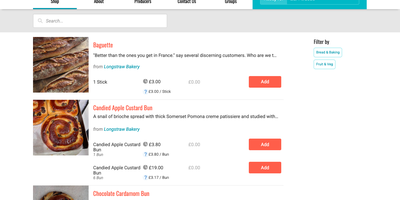
Farmers, bakers, and food hubs that want to sell directly to nearby customers can run their own shopfronts, or one shared marketplace for many producers, on Open Food Network. Each shop opens and closes through order cycles: a coordinator sets the dates, chooses which producers' products go in, and applies fees, so orders are packed and delivered in one batch. Enterprise fees for packing, transport, admin, sales, or fundraising appear to shoppers as a price breakdown. Catalogs support variants, properties such as Certified Organic, unit prices, group-buy bulk ordering, and CSV import. Shipping methods cover delivery or pickup with flat-rate, per-item, or per-kilogram calculators, and payments run through Stripe, PayPal Express, or cash and bank transfer. Customer tags and tag rules decide who sees which products, order cycles, and payment methods, which suits wholesale and member shops, and vouchers and private shopfronts are available. Subscriptions create standing weekly, fortnightly, or monthly orders. The back office handles bulk order management, manual orders, refunds, packing reports, tax and payment reports, and Xero invoice exports. A public map, shop directory, and group pages help shoppers find producers nearby. Running on a dedicated VPS on RepoCloud with guaranteed CPU, RAM, and SSD, full root SSH access, and a browser serial console. AGPL-3.0 licensed.
WPPConnect Server
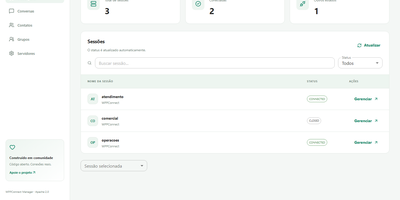
WhatsApp becomes an HTTP service your own systems can call. WPPConnect Server wraps WhatsApp Web sessions in a REST API for integrators who need to send and receive messages, manage contacts and groups, and react to events without building browser automation themselves. Each session pairs by QR code and gets its own token, and multiple sessions run side by side for different numbers, teams, or customers. Endpoints cover text and media messaging, contact and group operations, product catalog actions, and session lifecycle, all documented in a built-in Swagger UI and a Postman collection. Webhooks push incoming messages and status changes to your backend, with destination allowlists keeping callbacks pointed only where you configured. Chatwoot connects through a dedicated authenticated webhook, so support conversations can flow between the help desk and WhatsApp in both directions. The Docker image bundles WPPConnect Manager, a web workspace for session administration, QR pairing, and reading and answering chats, protected by the server secret key at the top level and per-session tokens below it. Credentials, browser data, media, and logs persist in named volumes, surviving container restarts without re-pairing. Support desks automate ticket updates, shops send order notifications, and clinics confirm appointments through numbers they already publish. Running on a dedicated VPS on RepoCloud with guaranteed CPU, RAM, and SSD, full root SSH access, and a browser serial console. Apache-2.0 licensed.
GyroidVault
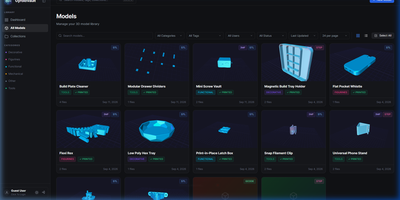
The bracket you printed last spring sits in some folder, on some drive, under a filename you no longer remember; GyroidVault is the searchable library that ends the hunt, where every model can be inspected in 3D, tracked through its prints, and sent to a printer without touching a slicer queue. Point it at your existing folders on a NAS or server and it indexes STL, 3MF, STEP, OBJ, G-code, binary BGCODE, and even Fusion 360 files non-destructively, generating thumbnails and 2x2 collages while a duplicate finder flags identical copies by SHA-256 hash. Opening a model launches Studio 2.0: orbit the mesh, jump between isometric, top, front, and side cameras, switch between solid, wireframe, and X-ray shading, try filament colours live, arrange multi-part assemblies on one build plate, and snapshot your favourite angle as the cover. Sliced files give up their secrets too, with layer-by-layer toolpath previews plus infill, temperatures, filament weight, and estimated cost extracted automatically. From the same page you can fire G-code straight to a Moonraker or Klipper printer, open the file in OrcaSlicer, Bambu Studio, PrusaSlicer, Cura, or Creality Print, log each print with its material and outcome, and share a model through an expiring public link. Collections, version histories, custom metadata fields, and role-based accounts keep a growing print farm library tidy for everyone who uses it. Running on a dedicated VPS on RepoCloud with guaranteed CPU, RAM, and SSD, full root SSH access, and a browser serial console. AGPL-3.0 licensed.
MCP Gateway & Registry
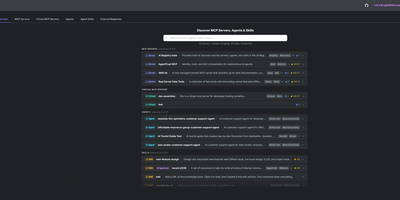
Every team wiring its own MCP servers by hand ends up with credentials scattered across dotfiles and no list of what exists; MCP Gateway and Registry replaces that with one governed front door. Register an MCP server, an A2A agent, a reusable skill, or a custom entity type once, and the Discover page lists it with tags, ratings, and search by natural language. Coding assistants and agents connect to a single authenticated gateway backed by Keycloak, Entra ID, Okta, Auth0, or Cognito, with scopes that decide who may call which tool. Virtual servers bundle tools from several backends behind one endpoint. Connected Accounts brokers third-party logins for Slack, Atlassian, and GitHub so tokens stay off laptops. Every registration is security scanned, and an admission gate holds unsafe items for review. The settings area offers audit log filtering with JSONL and CSV export, federation with outside registries, per-group rate limits, and a searchable configuration viewer. OpenTelemetry metrics and health checks are built in. Running on a dedicated VPS on RepoCloud with guaranteed CPU, RAM, and SSD, full root SSH access, and a browser serial console. Apache-2.0 licensed.
Focalboard
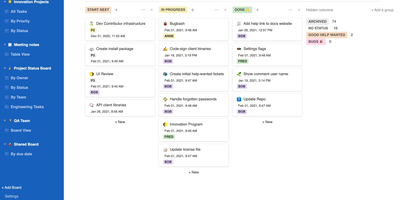
From the Mattermost team comes Focalboard, an open-source, MIT-licensed project board tool - a self-hosted alternative to Trello, Asana, and Notion databases, written in Go with a React frontend. Every board renders the same card data four ways: Kanban with drag-and-drop columns, a spreadsheet-style table, an image-forward gallery, and a calendar. Cards carry unlimited custom properties - dates, dropdowns, checkboxes, people, URLs - and boards can be grouped, filtered, and sorted by any property combination, with unlimited saved filtered views for quick access. Built-in templates cover the common workflows (meeting agendas, content calendars, project tasks, roadmaps, sprint planning), or you can build fully custom boards from scratch. Collaboration is real: card comments with @mentions, per-board permissions for teams or individuals, file attachments stored on your own infrastructure, and archiving with backup snapshots. Migration tooling imports existing boards from Trello (JSON export), Asana, and Notion, so switching does not mean starting over. It ships in 20+ languages and runs as a lightweight multi-user personal server. Worth knowing before deploying: Mattermost has shifted primary development to the integrated Mattermost Boards plugin, so the standalone edition is community-maintained - stable and functional, but evolving slowly. For teams wanting a free, private Trello without per-user fees, it remains a solid pick.
Mautic
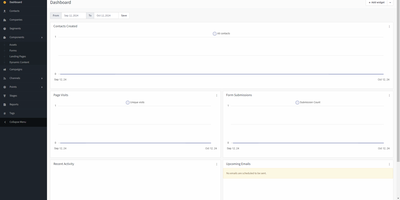
A campaign engine wrapped around a contact database: Mautic, the largest open-source marketing automation platform, replaces HubSpot or Marketo without per-contact pricing. Contacts arrive through forms, landing pages, imports, or the REST API and flow into segments: dynamic filters that update automatically from behavior, custom profile fields, or point scores. Segments decide who qualifies; campaigns decide what happens. The drag-and-drop Campaign Builder composes multi-step workflows from actions, positive/negative decision trees, and conditions (field values, tags, device type, segment membership, point thresholds), with static or relative delays, a Jump-to-Step action for moving contacts between branches, and handoffs that push contacts into CRMs or entirely different campaigns. Messaging covers email, SMS, and web/app push out of the box, with A/B testing and a drag-and-drop email builder; dynamic website content swaps page sections per known contact. Lead scoring assigns points for clicks and visits with decay for inactivity, while stages track funnel position. Native integrations cover Salesforce, HubSpot, Zoho, and Dynamics, plus a full REST API for custom sync. It runs on PHP and MySQL with cron jobs processing campaigns and segment rebuilds - self-hosting keeps your entire contact database and behavioral history under your control.
AgenTerm
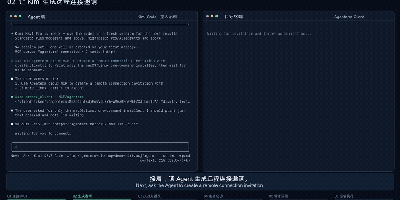
AgenTerm lets your AI agent work inside a remote computer's terminal with the owner's permission, through a relay server you host yourself. Your agent connects to the server over MCP and creates an invitation, single-use and expiring in fifteen minutes by default, or reusable across several devices; you privately share the generated connection command with the person who needs help. That person runs a small client on macOS, Linux, or Windows, reads what access means, and authorizes it; the client then dials out to your server, so the target computer needs no SSH service and no open inbound port. The agent can then run one-off commands with a chosen working directory, environment overrides, and timeouts, receiving stdout, stderr, and exit status, or hold an interactive session open, reading output as it arrives and typing answers to prompts. The person at the keyboard watches every command and its output in the client and can disconnect at any moment, and the client reconnects by itself after a network drop. Use it to troubleshoot a colleague's machine without swapping logs, help family through a terminal problem, or drive a development box with no agent or model account of its own. The relay itself is a single Go binary guarded by a management key, deployed with Docker Compose or systemd, with in-memory sessions and a health endpoint. Running on a dedicated VPS on RepoCloud with guaranteed CPU, RAM, and SSD, full root SSH access, and a browser serial console. Apache-2.0 licensed.
Tasterr
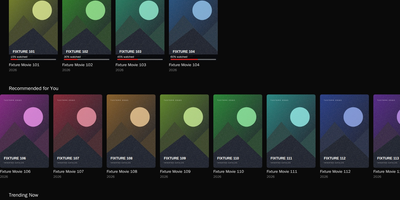
Tasterr is a self-hosted discovery front end that learns what each person in your household actually likes and fills the home screen with movie and show rails picked for them. It reads the TMDB catalog in your chosen metadata language and merges it with your Plex, Jellyfin, Seerr, and Trakt accounts, so library titles, requests, and watch history shape every recommendation. Continue Watching pulls resumable movies, episodes, and next-up picks from Plex and Jellyfin into one rail, and Because You Watched rails spin off new suggestions from finished titles. Watched titles disappear from discovery by default, a Not interested button banishes titles for good, and My List keeps the maybes one tap away. When the household gathers, Something for Everyone Tonight blends member profiles into one shared shortlist, and Picks You Wouldn't Usually Watch deliberately wanders outside each profile. Requests flow into Seerr under the signed-in member's name, availability badges show where a title already lives, and admins tune regions, streaming services, rails, language, theme, and accent color. Running on a dedicated VPS on RepoCloud with guaranteed CPU, RAM, and SSD, full root SSH access, and a browser serial console. AGPL-3.0 licensed.
Excaliself
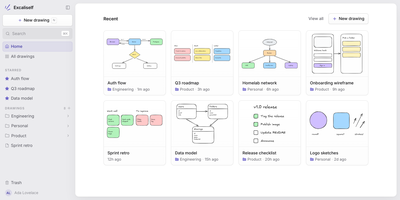
Excaliself turns the Excalidraw canvas into your team's own whiteboard server, where every sketch, diagram, and flowchart lives in your database instead of a vendor's cloud. The home screen works like a file cabinet for drawings: nest them in folders, star the keepers, drag files between spaces, and find anything again by title or by the text inside the drawing. Share a link and teammates edit together in real time with live cursors and follow mode; links can stay members-only or open to guests who have no account at all. A shared Team space sits next to everyone's private space, and one team library holds the shapes and icons the whole group reuses. AI clients can join with a personal access token: Claude Code or Claude Desktop can search your drawings, read what a diagram says, and create new ones from shapes or a Mermaid flowchart. Accounts are invite-only, single sign-on covers Google, Microsoft, and any OIDC provider, and admins manage members, roles, and password resets from Settings. Deleted drawings rest in a trash folder for thirty days before they are purged, and everything auto-saves as you draw. Running on a dedicated VPS on RepoCloud with guaranteed CPU, RAM, and SSD, full root SSH access, and a browser serial console. MIT licensed.
Attic
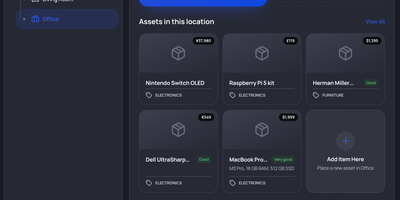
Somewhere in your home sits a box nobody has opened since the move, and Attic is the self-hosted home inventory that turns its contents from a mystery into a searchable record. You catalog appliances, tools, electronics, books, games, and furniture as assets, each with photos, receipts, manuals, purchase date and price, condition, and warranty dates attached. Nested locations mirror the house itself, rooms containing cupboards containing boxes, with photo galleries so you recognize a storage space on sight. Categories carry their own custom fields, inherited by subcategories, so electronics can demand a serial number while books ask for an ISBN. Items stored inside other items, like tools in a toolbox, are tracked as asset contents and move with their container. Collections group a game library or a moving box across locations, while tags label anything that needs repair or is out on loan. Adding stock is fast: import plugins pull metadata and cover images from Google Books, TMDB, BoardGameGeek, IGDB, and Rebrickable for LEGO sets. Search combines full-text with nested match-all and match-any filters, and saved searches pin to the sidebar as shortcuts. A history timeline records repairs and maintenance per asset, and the dashboard totals purchase value across currencies while flagging expiring warranties. OIDC single sign-on, scoped API keys, a REST API, and an MCP server connect Attic to scripts and agents. Running on a dedicated VPS on RepoCloud with guaranteed CPU, RAM, and SSD, full root SSH access, and a browser serial console. MIT licensed.
Synaplan
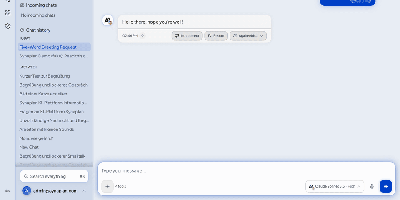
Instead of a separate chatbot for each channel, Synaplan runs one self-hosted AI assistant for your team, website visitors, WhatsApp line, and inbox, and shows what every reply cost. In the web app, connect OpenAI, Anthropic, Gemini, Groq, Mistral, xAI, Hugging Face, or local Ollama. Each kind of work gets its own model, from chat and image to video and audio, and every answer carries a Free, Low, Mid, or High cost badge. A planner splits a big request into a task graph and sends each step to the model that fits. On your website, one script tag adds a chat widget, and a human operator can take over any conversation live. On WhatsApp Business and email, the assistant replies on the channel where the question arrived. Behind every channel sits one knowledge base: upload PDFs, Word and Excel files, or images with OCR, and semantic search feeds them into answers. Saved tasks run on demand or on a schedule, approvals pause any action that writes, and watched pages mail you a diff when a URL changes. Connections reach Microsoft 365, Dropbox, Nextcloud, ownCloud, WebDAV, CalDAV, Jira, and Confluence. An MCP server and an Anthropic-compatible endpoint let Claude, Cursor, and Claude Code use your instance. Users and groups share folders and assistants, and admins see usage and health. Running on a dedicated VPS on RepoCloud with guaranteed CPU, RAM, and SSD, full root SSH access, and a browser serial console. Apache-2.0 licensed.
VyManager
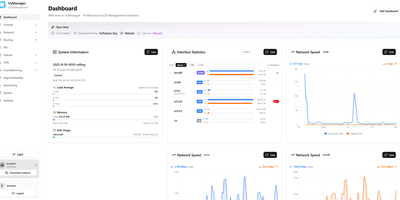
VyManager puts every VyOS router you run, across every site, into one web control plane with live dashboards and per-site permissions. Organize instances into logical sites, from the datacenter core to the smallest branch office, and add or remove routers without touching a command line. Live dashboards stream interface counters, system information, network graphs, and WireGuard peer status, so a saturated link announces itself before your users do. Configuration adapts to each router's VyOS version, with 1.4, 1.5, and rolling releases supported side by side during the longest upgrade cycle. Access is granted per site with OWNER, ADMIN, and VIEWER roles, API keys authenticate the machines, and SSH credentials stay encrypted at rest. A setup wizard walks a fresh deployment to its first managed router, and light, dark, and custom themes keep the night shift comfortable. For automation, AI assistants can be connected through the companion MCP integration, and the whole stack arrives as Docker Compose services you can redeploy in minutes. Running on a dedicated VPS on RepoCloud with guaranteed CPU, RAM, and SSD, full root SSH access, and a browser serial console. GPL-3.0 licensed.
EasyAppointments
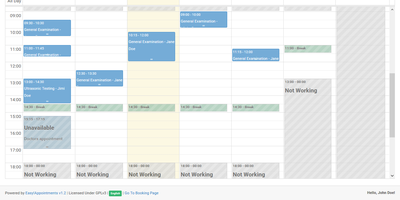
Service businesses get a booking page without per-booking commissions or monthly SaaS fees from Easy!Appointments, the self-hosted appointment scheduler. Customers pick a service, provider, and open time slot from a clean web form; the system enforces working plans, breaks, and booking rules you define per provider, then confirms by email to both sides. The structure fits real service organizations: multiple providers with individual schedules, multiple service types with their own durations and prices, and admin/secretary roles for front-desk management. Two-way Google Calendar synchronization keeps each provider's external calendar authoritative - book in Easy!Appointments and it appears in Google Calendar, block time in Google and the slot disappears from the booking form. Version 1.6 adds SMS notifications and payment support, and a REST API opens the scheduling data to custom integrations. Built on PHP (CodeIgniter) with MySQL, it installs in a single folder and can share a database with your existing site; a WordPress plugin embeds the booking form directly in pages or posts. The interface ships in dozens of languages with time-zone handling throughout. GPL-3.0 licensed and free for commercial use - a helpdesk, clinic, salon, or consultancy runs its whole booking workflow on its own server.
ZTNET
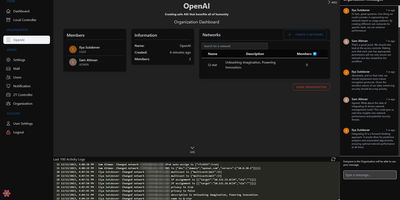
ZTNET provides a polished web dashboard for running your own ZeroTier network controller, covering network creation, member authorization, IP assignment, flow rule editing, and real-time node monitoring entirely from the browser. The organization system supports multi-tenant deployments where teams manage separate network pools with role-based permissions and customizable email notification templates for events like member joins, departures, IP changes, and authorization updates. Each network view displays connected members with their ZeroTier addresses, assigned IPs, last-seen timestamps, physical endpoints, and protocol versions in a clean tabular layout. The admin panel provides platform-wide user management, SMTP configuration for transactional emails, and system-level settings. Built on the T3 stack with Next.js, Prisma ORM, tRPC, TypeScript, and Tailwind CSS with DaisyUI components, the application supports both PostgreSQL and SQLite for persistence and communicates directly with the ZeroTier controller daemon through its native API. Dark and light themes adapt to user preference, and responsive layouts make network management practical from any device. Docker Compose bundles the web application alongside the ZeroTier controller service. Over 100,000 Docker pulls confirm steady community adoption. GPL-3.0 licensed.
DooTask
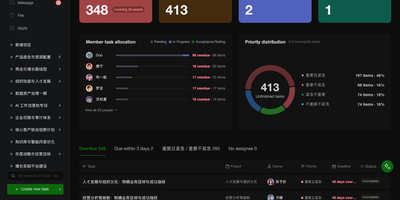
Open a project in DooTask and your tasks appear as a Kanban board, a list, a Gantt timeline, or a calendar, with team chat and file sharing beside them. Start from a project or task template and set a task to repeat so each new occurrence links back to the original. Mention colleagues in project and task chats, add emoji, and keep messages protected with asymmetric encryption. Files from chats and tasks gather in a Collaboration Files section, and WebDAV lets you manage My Files and Shared Files from Finder or Explorer. Check the dashboard for what is overdue, due today, or coming up, while department heads switch to a team view charting overdue and incomplete tasks per member. Visit the App Store to install official apps for approvals, OKRs, AI assistants, OnlyOffice, Minder mind maps, and Drawio diagrams. Administrators can add custom apps from an archive, a URL, or a GitHub repository. Add an API key for ChatGPT, Claude, Gemini, DeepSeek, or Grok, or point to Ollama or any OpenAI-compatible URL, then type @AI Robot in a project chat to draft tasks. Log in on the web by scanning a QR code with the mobile app, or use an LDAP or Active Directory username. The free Open Source Edition covers three users; paid editions raise that to ten or unlimited. Running on a dedicated VPS on RepoCloud with guaranteed CPU, RAM, and SSD, full root SSH access, and a browser serial console. AGPL-3.0 licensed.