Asterisk AI Voice Agent
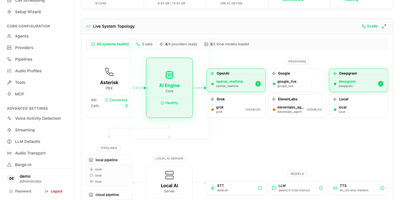
Asterisk AI Voice Agent answers calls on your existing Asterisk or FreePBX phone system with a configurable AI receptionist, and you manage every agent from a self-hosted web console. Choose a full realtime voice provider such as Deepgram, OpenAI Realtime, Google Live, ElevenLabs, or xAI Grok, or assemble a pipeline from separate speech-to-text, language-model, and text-to-speech services, including local models with optional GPU acceleration. Each agent bundles a prompt, greeting, voice, audio profile, and tool list, and one dialplan variable routes any extension to it, so a receptionist, sales line, and support desk can share an install. During a call the agent can transfer to extensions, check extension availability, take voicemail, email summaries, and book appointments through Google Calendar, Microsoft Calendar, or Calendly, while MCP servers and HTTP tools add custom actions. Callers can interrupt mid-sentence, and an inactivity watchdog politely ends silent calls. Call History keeps searchable transcripts with tool-call details, quality metrics, filters, and CSV or JSON export. A live topology dashboard shows ARI connection status, providers, pipelines, and containers, a setup wizard walks through the provider, API keys, and Asterisk connection, and a model catalog of about 250 entries downloads and switches local speech and language models. AudioSocket, ExternalMedia RTP, or WebSocket transports and tunable audio profiles match your carrier's codecs. Running on a dedicated VPS on RepoCloud with guaranteed CPU, RAM, and SSD, full root SSH access, and a browser serial console. MIT licensed.
Suparagent
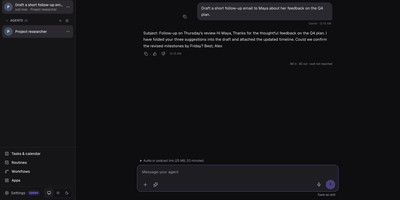
Suparagent turns a single server into a workspace of named AI coworkers that each have a job, a memory, and a folder of their own. Chat with an agent in the browser, pick an engine per conversation, and watch replies stream in as the sidebar keeps every thread searchable. Approval modes decide how much freedom an agent gets: ask first, accept edits, or plan only, so nothing touches a file or runs a command without your say. Routines send a prompt to an agent on chosen weekdays, through a webhook, or on demand, and every run lands in its own conversation. A kanban board with month, week, and upcoming views tracks tasks by owner and priority, and a canvas builds multi-step workflows from schedule triggers, model steps, agent steps, conditions, and approvals. Agents save notes you can edit, delegate to specialists in shared rooms, and reuse saved skills and templates. A usage panel totals turns and tokens by conversation, engine, and day, with a CSV export. Invite teammates with a one-time link, pair a phone, and keep agents working when your laptop is closed. Running on a dedicated VPS on RepoCloud with guaranteed CPU, RAM, and SSD, full root SSH access, and a browser serial console. Apache-2.0 licensed.

Pixtale
Scroll, do not file: Pixtale turns a folder of photos into a flowing masonry river you can browse for hours, pulling images from local disk, S3, and even Telegram into one gallery. Uploads get automatic thumbnails and high-resolution previews tuned for slow connections, so grandparents on hotel Wi-Fi see pictures fast instead of watching loading spinners. Every photo keeps its EXIF story, camera, lens, exposure, and capture time, and the timeline arranges the library chronologically without you renaming a single file. The Pixtale Sync companion ships photos from phones and PCs to the gallery automatically, ending the cable-and-import ritual after every trip. Favorites, albums, and a trash bin keep curation tidy, while multiple user accounts let each family member sign in to the same library with their own credentials. An admin overview watches photo counts, storage consumption, CPU, and memory, and storage settings let you add or repoint backends as the collection outgrows its first disk. Because the whole gallery runs from one Docker container with a small SQLite database, backups are a folder copy and the library stays portable between machines. Your photos live on your hardware, under your accounts, with no per-seat pricing as the archive grows. Running on a dedicated VPS on RepoCloud with guaranteed CPU, RAM, and SSD, full root SSH access, and a browser serial console. AGPL-3.0 licensed.
2FAuth
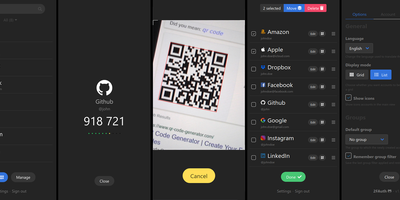
2FAuth generates TOTP, HOTP, and Steam Guard codes from any web browser, freeing your two-factor authentication from dependence on a single smartphone or app. Lose your phone, switch devices, or sit at a desktop computer, and your 2FA codes remain accessible through the web interface. The Laravel and Vue.js application stores account secrets in an encrypted SQLite database that backs up as a single file. Adding accounts works through camera-based QR scanning or manual secret key entry for services that only provide text codes. Group organization with drag-and-drop sorting keeps large collections navigable, categorized however you prefer. WebAuthn authentication with FIDO2 hardware keys protects vault access with phishing-resistant passwordless login, meaning the tool that secures your accounts is itself secured by the strongest available method. Automatic screen lock triggers after configurable idle time, and OTP obfuscation dots out generated codes until you tap to reveal them, preventing shoulder surfing in shared spaces. The REST API enables browser extensions and external applications to request codes programmatically. Import compatibility with Google Authenticator, Aegis, and 2FAS ensures painless migration without re-enrolling every account from scratch. PWA installation places 2FAuth on your device home screen for native-app-like instant access. Runs on a dedicated RepoCloud VPS with guaranteed resources and full root SSH access. AGPL-3.0 licensed.
Plainspace
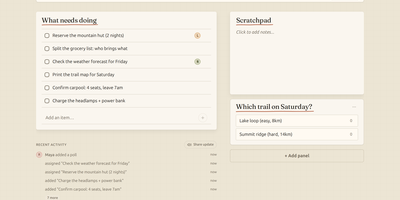
Planning a weekend trip, a household move or a club event in a group chat means the packing list is forty messages up, the poll about dates expired, and nobody remembers who volunteered to book the van. Plainspace gives that chaos one calm page: create a Space, share a single link, and everyone lands on the same shared board of tasks, notes, checklists, polls and availability, in any browser, with no app to install and no account to create. One person adds the campsite options as a poll, another claims the cooking tasks, a third drops the address and gate code into a note, and the whole group watches it come together with live updates as people type, vote and check things off. Optional push reminders nudge the person whose task is due before the plan quietly stalls. It is deliberately not a project management suite: no sprints, no story points, no permission matrices, just the handful of primitives real life actually coordinates with, presented touch-first so it works as well on a phone at the supermarket as on a laptop. Run it for your family, your team or your club on the hosted version, or self-host the same thing with Docker Compose next to the rest of your services. Running on a dedicated VPS on RepoCloud with guaranteed CPU, RAM, and SSD, full root SSH access, and a browser serial console. MIT licensed.
Filex
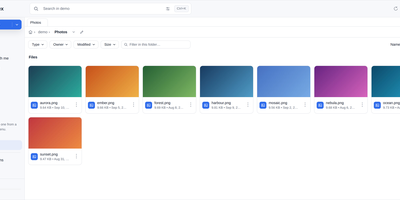
Your files already live in five places; filex puts them in one tree and serves that tree back out through almost any protocol. Mount local disks, S3 buckets, SFTP servers, WebDAV shares, FTP sites, and SMB network drives side by side, then copy in one storage and paste into another without thinking about where anything physically sits. The same tree is reachable as S3, SFTP, FTPS, NFS, and WebDAV, so rclone, restic, the AWS CLI, WinSCP, or FileZilla all work against it with the same per-user and per-folder permissions as the web interface. Sharing leaves the server under your control: public links carry a PIN, an expiry, and a download limit, and file-request links let people upload into a folder without seeing its contents. Anything deleted stays recoverable inside a retention window, overwritten files keep version snapshots, and encrypted folders are sealed in the browser so the server never receives a key. People sign in with OIDC single sign-on, LDAP or Active Directory, or the host machine's own accounts, with roles, groups, and tenants plus folder-level exceptions. A desktop app keeps chosen folders in sync within about a second, the file manager embeds into other products as a web component, and an MCP server plus REST API let agents work the same tree. It runs from one static binary or container on port 5212. Running on a dedicated VPS on RepoCloud with guaranteed CPU, RAM, and SSD, full root SSH access, and a browser serial console. MIT licensed.
Baikal
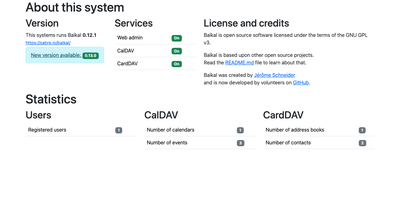
Your calendars and contacts do not need a cloud account, and Baikal is the small PHP server that keeps them on hardware you control while still syncing to every phone and laptop you own. The web admin panel is where you add users, create their calendars and address books, and reset passwords, no database editing or config files required. Each person signs in with their own username and password, so an iPhone, an Android phone running DAVx5, and a Thunderbird desktop can all stay in sync without sharing one master credential. Standard well-known redirects mean most clients configure themselves when you type the server address, and the combined dav.php endpoint serves calendars and contacts from a single URL. Events carry the full CalDAV feature set your clients expect (recurring appointments, reminders, attendees, and free-busy lookups), while CardDAV address books keep names, phone numbers, and photos in one place. Because storage is a plain database file or table set, backups are a copy you can make in seconds, and moving to a bigger host is a file transfer rather than a migration project. The same server happily runs for one person tracking a family calendar or for a small office sharing team schedules and a company address book. Running on a dedicated VPS on RepoCloud with guaranteed CPU, RAM, and SSD, full root SSH access, and a browser serial console. GPL-3.0 licensed.
Academic Commercialization Agent
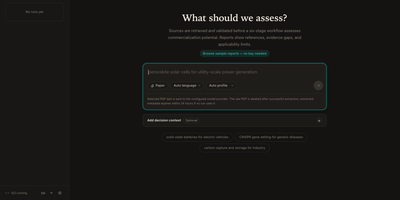
Got a research paper and no idea if anyone would pay for it? Academic Commercialization Agent answers with a cited triage report instead of a hunch. Type a topic or attach a paper PDF, pick a report language and scoring profile, and follow the run as it works through academic, patent, and market evidence. The result opens with a decision brief: an overall readiness score out of 100, the strongest evidence, the biggest risk, and a recommended first step. A scorecard breaks that number into technology readiness, manufacturing readiness, patent position, market accessibility, and evidence confidence, with a short reason behind each bar. The full report adds opportunities, risks, evidence limitations, reviewer notes, and a numbered reference list. Optional decision context captures who is deciding, what they own, and what choice is on the table, so the verdict reads as a license, invest, pilot, or spin-out call. Run history keeps every analysis searchable, interrupted runs resume from their last checkpoint, and two runs can be compared side by side. Reports export to Markdown or PDF and share by link, and a Sources search finds saved excerpts by ID or keyword. Six finished sample reports, one in Chinese, open without any key. A technology transfer office facing a pile of new disclosures can rank them in a first pass before spending expert time. Running on a dedicated VPS on RepoCloud with guaranteed CPU, RAM, and SSD, full root SSH access, and a browser serial console. MIT licensed.
Logseq
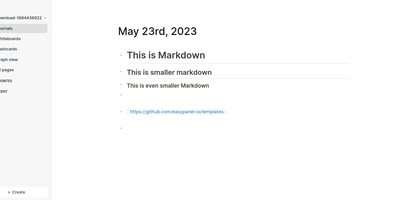
Every line an indentable bullet, every bullet a first-class block that can be referenced, embedded, and queried anywhere: Logseq is a privacy-first, local-first knowledge platform built around the block outliner. The daily journal is the system's beating heart - each day opens a fresh date-stamped page where tasks, meeting notes, and fleeting ideas land as blocks without filing decisions, then connect later through [[wikilinks]] with automatic bidirectional backlinks and ((block references)) that transclude any bullet into any page. Everything persists as plain Markdown or Org-mode files on disk - git-friendly, greppable, and owned forever, with sync via iCloud, Dropbox, Syncthing, Git, or an optional end-to-end encrypted service. Built-in tooling goes beyond notes: TODO/DOING task states with scheduling, native PDF annotation with area highlights, spaced-repetition flashcards, whiteboards for visual thinking, Zotero integration for researchers, and Datalog-powered queries that build dynamic views across the entire graph. A marketplace of hundreds of community plugins and themes adds AI chat, Ollama local-model integration, and custom workflows. Written in Clojure/ClojureScript, AGPL-3.0 licensed with 320+ contributors, and completely free - the local-first Roam for people who refuse subscriptions and lock-in.
All-In-One Free SEO Tool
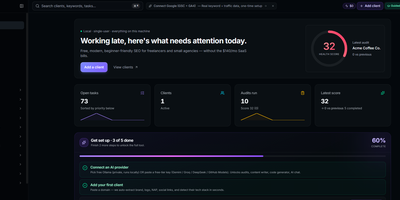
All-In-One Free SEO Tool packs site audits, rank tracking, keyword research, AI-search visibility checks, and client reporting into one self-hosted workspace that stands in for a stack of monthly SEO subscriptions. Every client opens on a ranked to-do list that separates work the agent can finish unattended from decisions that need a person, with time estimates attached. The crawler runs dozens of on-page checks, and over ninety single-purpose tools cover schema, Core Web Vitals, hreflang, robots.txt, redirects, and server logs. Rank tracking follows keywords by device and by city. The AI visibility tools record when ChatGPT, Perplexity, Gemini, or Google AI Overviews cite your domain. Agencies generate every client's white-label PDF in one run, review the drafts, and send only what they approve. An embeddable audit widget collects leads, and proposals are built from real findings. Four autonomy levels range from suggest-only to full autopilot, and every change the agent applies can be undone. Running on a dedicated VPS on RepoCloud with guaranteed CPU, RAM, and SSD, full root SSH access, and a browser serial console. MIT licensed.
ODS
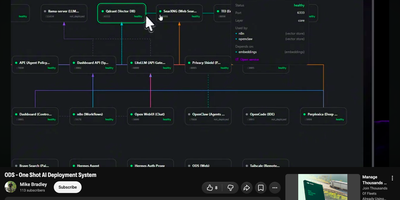
ODS turns a GPU machine or server you already own into a complete private AI stack with a single install command, replacing a shelf of separate tools with one system that serves models, chat, agents, automation, and search from your own hardware. The installer reads your GPU, VRAM, memory, and disk, then downloads a GGUF model matched to that hardware tier, and a compact bootstrap model starts answering within minutes while the full model finishes downloading. From the web dashboard you watch every service's health, ports, and resource use, restart what misbehaves, and check storage and updates without touching a terminal. You chat with local models in Open WebUI, hand background work to the Hermes and Portal agents, and build automations in n8n that connect the stack to more than 400 other apps. Documents you add become searchable knowledge through Qdrant vector storage, so answers cite your files instead of the model's memory. SearXNG and Perplexica answer web questions without trackers or accounts, Whisper transcribes speech, Kokoro reads text aloud, and ComfyUI generates images, all on the same box. Every bundled service is an extension you can enable, disable, or replace, and a Privacy Shield scrubs personal data before anything reaches an optional cloud model through the LiteLLM gateway. Running on a dedicated VPS on RepoCloud with guaranteed CPU, RAM, and SSD, full root SSH access, and a browser serial console. Apache-2.0 licensed.
ArchiveBox
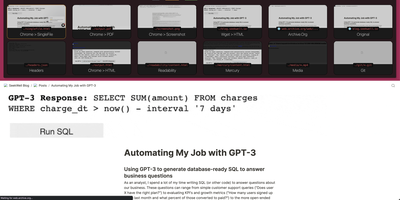
Backed by 27,700+ GitHub stars and actively developed with the v0.9.x architectural overhaul introducing an event-driven plugin ecosystem, ArchiveBox delivers the open-source self-hosted web archiving platform that preserves websites, bookmarks, social posts, media, source code, and research material in durable formats before link rot, platform shutdowns, and censorship erase them permanently. Feed it URLs one at a time or schedule automated imports from browser history, RSS feeds, Pocket, Pinboard, Instapaper, Wallabag, Shaarli, JSON, CSV, HTML bookmark exports, and browser extension captures. Each snapshot stores redundant copies as original HTML, rendered single-file HTML via SingleFile, full-page PDF, screenshot PNG, WARC archive, article text via Readability, favicons, HTTP headers, media files via yt-dlp, git repository clones, and structured metadata in SQLite. The Docker Compose deployment bundles Chrome, wget, curl, yt-dlp, SingleFile, and Readability parsers with automatic dependency management and isolation. Interact through the self-hosted web UI with search, tagging, and admin controls, the comprehensive CLI for batch operations, the REST API for programmatic access, or the Python API for custom integrations. The new abx-plugins system enables community extractors with per-plugin configuration, while the append-only-log architecture provides resumable crawls and audit trails. S3, B2, and Google Cloud storage backends sync archives to remote storage via rclone. Running on a dedicated VPS on RepoCloud with guaranteed CPU, RAM, and SSD, full root SSH access, and a browser serial console. MIT licensed.
Apostrophe
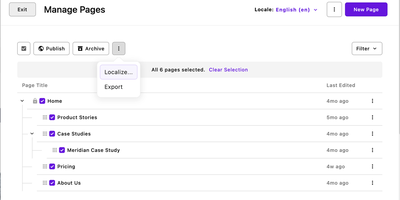
ApostropheCMS lets editors change text, images, and layouts directly on the finished web page, exactly as visitors will see them. Developers keep full control of the codebase underneath. Click a headline on the live page and type; drop content widgets into editable areas to build sections from rich text, images, galleries, and video; then flip between draft and published modes to preview changes before anyone else sees them. The admin menu handles the structured side of the site: pages in a tree, plus pieces for repeatable content like articles, events, and products, each defined by developers with a field schema API so editors only ever see the fields that belong there. Role-based permissions decide who can draft, who can publish, and which sections of the site each team can touch, and localization keeps language and regional variations of every page organized side by side. When a project outgrows server-rendered pages, the built-in REST APIs serve the same content to Astro, React, Vue, or any other frontend, so a visual-editing CMS quietly becomes the headless backend without a migration. Extensions from the module ecosystem bolt on forms, SEO tools, and integrations without forking the core. Running on a dedicated VPS on RepoCloud with guaranteed CPU, RAM, and SSD, full root SSH access, and a browser serial console. MIT licensed.
Butterbase
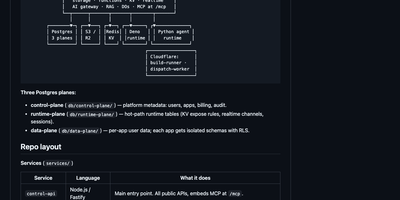
Butterbase gives AI applications a complete backend they can run themselves, from a dedicated PostgreSQL database for every app to an MCP server that lets agents operate that backend directly. Define schemas declaratively, apply migrations, protect rows with Row-Level Security policies, and call the generated REST endpoints without building a separate data API. Add email and OAuth sign-in with Google, GitHub, Apple, X, and other providers, then tune JWT behavior, post-login hooks, service keys, and API keys for each application. Store files in S3 or R2 compatible object storage with presigned URLs and access controls, and keep regional key-value data with TTLs and an audit trail. Run TypeScript functions on Deno, coordinate chat rooms or rate limiters as durable per-key objects, and stream table changes to live interfaces over WebSocket subscriptions. Route chat and embedding calls through one AI gateway, ingest documents into RAG collections, and build checkpointed agent workflows that can pause for human approval before continuing. Host static frontends and edge handlers, expose webhooks for application events, and manage schemas, storage, functions, realtime channels, and integrations through more than forty MCP tools. Running on a dedicated VPS on RepoCloud with guaranteed CPU, RAM, and SSD, full root SSH access, and a browser serial console. Apache-2.0 licensed.
Paperless-GPT
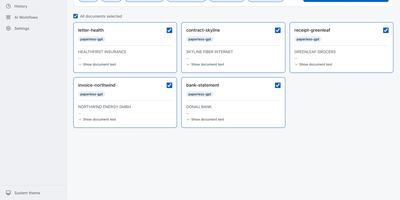
Paperless-GPT is an AI sidekick for paperless-ngx that names, tags, and files scanned documents for you. Picture a folder of scan_0042.pdf files: add a tag, and an LLM reads each one and proposes a title, tags, correspondent, document type, created date, and custom fields. Reviewers compare the current value with the suggestion field by field, edit what looks off, and apply a single document or the whole queue. A history list records every write and reverts any single field. In the OCR Playground, the scan sits next to freshly recognized text, so page limits, process modes, and prompts can be tuned before defaults are saved and documents are tagged for hands-off runs, with an activity log of what ran overnight. OCR options include LLM vision, Google Document AI, Azure Document Intelligence, and Docling, with searchable PDF export that carries a transparent text layer. Document Link fields tie a reminder to the invoice it cites and an amendment to its contract. Ad-hoc analysis summarizes a handful of documents with a custom prompt, and AI Workflows give invoices, contracts, and private mail separate prompts and steps. Local Ollama models keep paperwork on your own hardware. Running on a dedicated VPS on RepoCloud with guaranteed CPU, RAM, and SSD, full root SSH access, and a browser serial console. MIT licensed.
LocalAGI
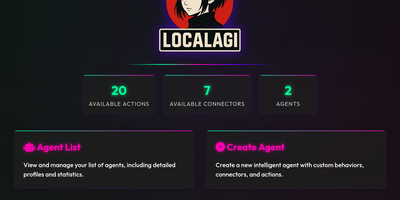
LocalAGI builds AI agents that never leave your hardware: a self-hosted platform for creating assistants, chat bots, and automations from a browser, with no cloud keys and no code required. Agents are configured in the Web UI with their own models, behaviors, and tools, and cooperative teams of agents can be generated from a single prompt. Each agent exposes a drop-in replacement for the OpenAI Responses API, and the platform also serves an MCP endpoint, connects to external MCP servers, and manages reusable Skills that can be created, imported, or synced from git. A built-in knowledge base gives agents short and long-term memory with file uploads and semantic search over collections. Planning, reasoning, and multimodal inputs let agents handle text, vision, and more, and custom actions can be scripted in Go without compiling. Connectors put agents on Discord, Slack, Telegram, GitHub Issues, and IRC, cron-style periodic tasks keep them working on schedule, and real-time observability shows what every agent is doing. It runs on consumer CPU or GPU hardware through Docker Compose, serving the interface on port 8080, pairing with LocalAI or your own models. Running on a dedicated VPS on RepoCloud with guaranteed CPU, RAM, and SSD, full root SSH access, and a browser serial console. MIT licensed.
Nautobot
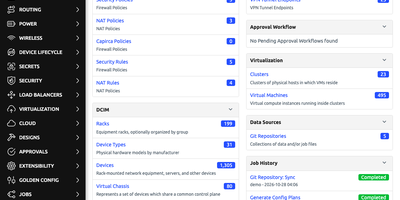
From the first rack to the last circuit, Nautobot is the open-source network source of truth that records what your network should look like and runs automation against it. Built-in models cover locations, racks, devices, interfaces, cables, VLANs, VRFs, IP prefixes, circuits, and contacts, so one searchable record replaces the spreadsheet and the wiki. Teams encode their own standards with custom fields, user-defined relationships, computed fields, and validation rules. Config contexts attach JSON or YAML data, such as syslog servers, to devices by location, role, platform, or tag. Jobs run your own automation code from the web UI, REST API, or command line, on a schedule, or through hooks when an object changes, with approvals and logs built in. Query the data over REST or GraphQL, and let the GraphiQL editor autocomplete a device and interface query you can save inside Nautobot. When an object is created, updated, or deleted, webhooks notify outside systems, with Jinja2-templated bodies and HMAC SHA-512 signatures. Git repositories can carry export templates, Jobs, and config contexts too, so YAML data and Jinja2 templates get pull request review before Nautobot syncs them. Open-source Apps add Golden Configuration for config backup, compliance, and remediation, Device Lifecycle for hardware tracking, SSoT for syncing other systems, and ChatOps. Object permissions and change logging keep a shared instance auditable. Running on a dedicated VPS on RepoCloud with guaranteed CPU, RAM, and SSD, full root SSH access, and a browser serial console. Apache-2.0 licensed.
Change Detection
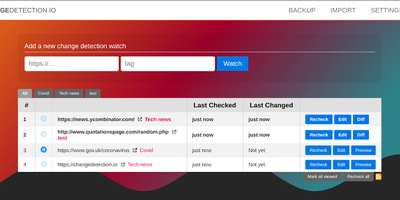
Price drops, restocks, job postings, government announcements, competitor edits - changedetection.io watches web pages and alerts you the moment anything changes, down to PDF text and checksums. Point it at a URL, set a check interval, and precise filters decide what counts as a change: a Visual Selector targets page elements by pointing and clicking, CSS selectors and XPath narrow scope, trigger-text and ignore-text rules (with regex support) cut noise, and JSONPath or jq handles API responses. A dedicated re-stock and price detection mode extracts product metadata and fires on thresholds - alert only when the price drops below your target or the percentage change exceeds a limit. JavaScript-heavy sites render through a real Chrome browser via Playwright, with the ability to execute JS steps first (log in, click, scroll) before extracting text. Notifications reach 85+ services through Apprise - Discord, Slack, Telegram, email, webhooks - optionally with a screenshot of the changed page, and AI-powered summaries (any OpenAI-compatible endpoint, including local Ollama) describe what changed. Per-watch proxies, custom headers, and POST/GET control cover hostile targets. Apache-2.0 licensed with local file-based storage: the URLs you monitor and why stay entirely your business.