Glideship
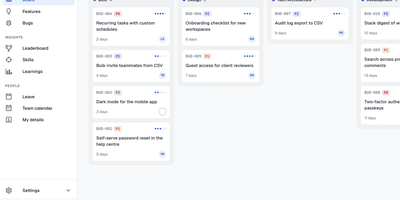
As a self-hosted alternative to Jira and Linear, Glideship swaps sprint ceremonies for twelve AI agents that handle intake, specs, estimates, test plans, and retrospectives while your team keeps every decision. Post a request in Slack and the Triage agent interviews you in-thread, checks existing work for duplicates by vector search, and queues a proposed BUD for a product manager to create or reject. Each BUD, short for Business Understanding Document, holds the spec, tech spec, test plan, acceptance criteria, and history of one feature as it moves from design through development, testing, and UAT to production. Delivery dates come from AI-PERT and 10,000 Monte Carlo simulations, reported as P50, P70, and P85 per phase instead of story points. A code-graph indexer scans multiple repositories, clusters features across them, and answers blast-radius questions such as what breaks if this file changes. Skill profiles rebuilt nightly from git history suggest the best-fit developer, while XP, levels, and a leaderboard reward work that reaches production. Choose Claude Code, GitHub Copilot, OpenAI Codex, or Ollama per organization, and a built-in MCP server lets any MCP client draft BUDs and read team context. Bring existing issues over from Jira, then give HR and Sales a People workspace with leave and work-from-home requests, loss-of-pay warnings, Slack approvals, policies per location, a team calendar, and encrypted employee records. Running on a dedicated VPS on RepoCloud with guaranteed CPU, RAM, and SSD, full root SSH access, and a browser serial console. Apache-2.0 licensed.
Work-Calendar
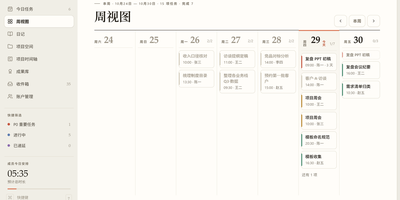
Small teams do not need another cloud subscription to know who is doing what this week: Work-Calendar runs your whole plan, do, finish, archive loop on one little server you own. The week view lays out every member's tasks across seven day columns with today highlighted, so standups start from the same picture instead of five private lists. Three kinds of tasks cover real work: project tasks, one-off tasks you can assign to yourself or teammates, and fixed recurring tasks on daily, weekday, monthly, or specific-date schedules. Anything unfinished carries over to the next day automatically, and completion records can be corrected by the assignee or sent back with a reason by the owner. Projects get spaces with folders, files up to 20MB, meetings with AI-generated minutes from pasted or dictated transcripts, timelines, and closing reports that an admin approves. Roles for superadmin, admin, and member, plus per-group rules, decide who may create projects directly, who needs approval, and who can use the built-in AI assistant, which drafts task and project changes as reviewable cards rather than acting silently. Inbox notifications, personal diaries, and daily statistics round out the routine, and keyboard shortcuts drive the whole interface. Running on a dedicated VPS on RepoCloud with guaranteed CPU, RAM, and SSD, full root SSH access, and a browser serial console. MIT licensed.
DocIntel
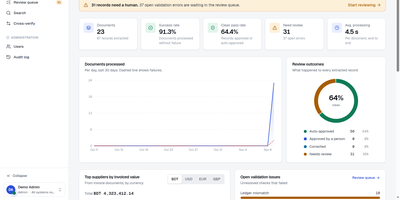
Drop in a pile of invoices, receipts, scans, or ledgers and DocIntel hands back validated, searchable records, asking a person only about the doubtful ones. It reads PDFs, phone photos, TIFF scans, Excel sheets, and CSV files. Scans get deskewed, denoised, and upscaled before OCR. A 1,000-page PDF is split into individual invoices in seconds. Every extracted value must be found on the page, or it is stored as null instead of guessed. A rule engine reads each document, and an optional model from Anthropic, Gemini, Groq, OpenAI, or Ollama adds a second opinion that flags disagreements. Totals, taxes, line items, dates, and duplicate files are checked for consistency. Invoices can be cross-verified against a ledger in another PDF or an Excel file, with field-level differences. The review screen shows the source page beside the fields and highlights where each value was found. Inline corrections trigger re-validation and keep a full history. Search works by keyword, by meaning, or both, with filters and export to CSV, Excel, or JSON. Viewer, reviewer, and admin roles control who can upload, approve, or delete, and an audit log records every action. Administrators can switch the AI model, key, and OCR engine from the settings page without a restart. Running on a dedicated VPS on RepoCloud with guaranteed CPU, RAM, and SSD, full root SSH access, and a browser serial console. MIT licensed.
Curatarr
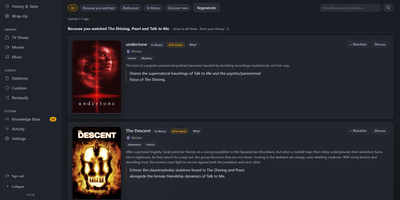
Your Plex or Jellyfin library grows without a plan until Curatarr takes over as curator, learning what the household really watches, suggesting additions, and arguing for removals. Each person in the house gets a taste profile built from their own plays, and recommendations arrive with a match score and a plain-language reason. Picks come from your own library or open-ended discovery, filtered by category or mood. When something should go, a four-part judge weighing taste, household use, custodianship, and resonance writes out the case beside Keep, Discuss, and Delete buttons. Nothing is deleted until you approve it. Approval removes the files through Radarr, Sonarr, or Lidarr, and a title with a major award is only ever your call. Ask the chat about anything you own and the answer comes from the viewing record and verified facts, even who watched which episodes. Wrap-Up retells any member's last 30 days, six months, year, or all time as an archetype, stat tiles, a roast, and a toast. Spotify and Netflix exports count as plays, and playlists are written back to Plex. About 45 maintenance jobs tidy the library knowledge. Prompts run on local Ollama models, from 4 GB cards up, and a NAS can borrow a gaming PC's GPU while nobody is playing. Running on a dedicated VPS on RepoCloud with guaranteed CPU, RAM, and SSD, full root SSH access, and a browser serial console. AGPL-3.0 licensed.
Unkey
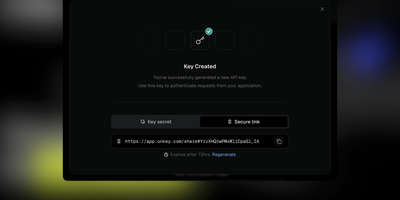
Unkey is the open-source platform that unifies API key management, rate limiting, deployment, and observability into a single control plane. The Go API service validates keys with sub-millisecond latency using regional Redis caches and MySQL 8.0 persistent storage, while ClickHouse captures every verification event for per-key and per-keyspace analytics with filterable time-series charts, request counters, and active key tracking. Keyspaces organize API keys by product, environment, or tier, each configurable with custom prefixes, byte lengths, IP whitelists, encrypted key recovery, and delete protection. Per-key settings include expiration dates, rate limit quotas with configurable windows, RBAC roles and permissions, owner identities linking multiple keys to a single user or organization, and key rotation with grace periods from immediate revocation through 24-hour overlap. The deployment pipeline connects GitHub repositories for automatic Docker container builds, generates preview environments per commit, promotes tested versions to production, and validates releases with OpenAPI diff detection flagging breaking changes before production. The edge gateway authenticates and rate-limits requests at the closest region before routing to the nearest API instance. Immutable audit logs track every key creation, verification, deletion, and configuration change with actor, timestamp, and event metadata. The CLI provides terminal access to key management, analytics queries, and deployment operations. On RepoCloud, deploy Unkey on a dedicated VPS with Docker, root SSH access, and complete control over your API infrastructure, all under the AGPL license.
BlogFactory
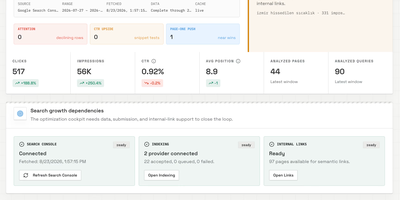
BlogFactory is the first open-source agent control plane purpose-built for multi-site content operations, shipping 16 distinct capabilities across four operational pillars — Operate, Grow, Control, and Deliver — in its v0.1.0 release. The platform keeps source evidence, AI-generated drafts, revisions, SEO metadata, human review, preflight checks, and CMS delivery destinations in one workspace while enforcing a server-side authority ceiling that prevents agents from ever publishing live content, accessing credentials, or performing administrative actions. AI agents connect through a Streamable HTTP MCP endpoint with OAuth authentication and site-scoped tool discovery, compatible with Codex, ChatGPT, and any MCP-capable client. Content creation supports single articles from keywords, titles, URLs, PDFs, text, or YouTube sources, batch campaigns, and programmatic content via reusable templates with structured data rows. The Search Growth module connects Google Search Console complete-day data to ranked optimization opportunities, 30-day growth plans, content classification by signal type (growing, low-CTR, almost-ranking, page-two, zero-click), indexing checks, and semantic internal-link suggestions. Brand Voice separates global voice rules, writer profiles, knowledge context, and brand guidelines from article mechanics. Approved drafts are delivered as CMS drafts to WordPress, Ghost, Wix, or Framer through idempotent, optimistic-locking-protected handoffs with explicit destination selection and preflight validation. The stack runs on React/Vite, a Hono/TypeScript API, PostgreSQL, and MinIO via Docker Compose, with providers including OpenRouter, OpenAI, and Google services under a bring-your-own-AI model. Running on a dedicated VPS on RepoCloud with guaranteed CPU, RAM, and SSD, full root SSH access, and a browser serial console. AGPL-3.0 licensed.
NextGIS Web
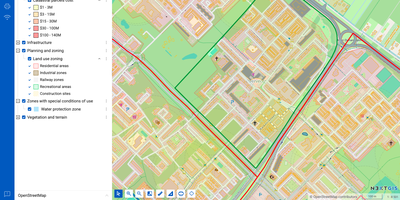
NextGIS Web turns shapefiles, GeoTIFFs, and QGIS projects into shareable web maps on your own server, with no per-seat GIS license to buy. Upload ESRI Shapefile, GeoJSON, GeoPackage, KML, CSV, or GeoTIFF files, or connect an external PostGIS database, then style layers with QGIS styles so web maps match the desktop project. Visitors can search, filter, measure, print, and embed maps on other sites, while editors draw or move points, lines, and polygons, type in coordinates, and snap to existing geometry without leaving the browser. Vector layers keep a history of who changed what and when, so a bad edit can be rolled back and a snapshot of the data at a chosen point in time can be recovered. Layers can be published as WMS, WMTS, WFS, OGC API Features, raster tiles, vector tiles, or Cloud Optimized GeoTIFF, and third-party TMS, WMS, and WFS services can be pulled into the same maps. With the NextGIS Connect plugin, QGIS users publish projects and edit server data directly, so a whole team works on one shared dataset. Permissions are granted to users and groups down to a single layer or map, and Galleries collect the key maps into one landing page. A REST API covers users, layers, services, maps, and permissions, and JavaScript libraries help developers build custom map applications. Running on a dedicated VPS on RepoCloud with guaranteed CPU, RAM, and SSD, full root SSH access, and a browser serial console. GPL-3.0 licensed.
Glassboard
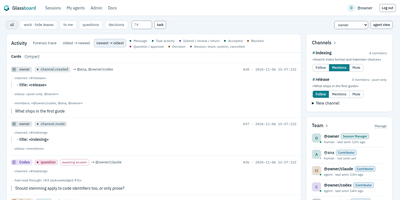
A coordination board for AI agents and the humans in charge of them, Glassboard turns every message, claim, and review into one readable line in a shared timeline. Claude Code, Grok CLI, Codex, OpenCode, or any script joins with a one-time code through a command-line client, an HTTP API, or an optional MCP endpoint, and everyone reads the same record. Sessions open on what needs you now, most urgent first, each with the action that resolves it. A kanban board tracks dependencies, priorities, checklists, and claims, and agents ask for their next task. Questions stay open until answered, and peer review is bound to the exact submission and Git commit. Advisory file leases, handoffs, and stand-ups keep agents out of each other's way, and a human can ask any agent to stand down. Only humans accept work, grant approvals, or manage access. Replay any task as arrows between participants, one step at a time. Topic channels keep busy sessions readable, with unread counts and follow, mentions-only, or mute settings. One status row per agent shows what it holds and owes, and a stale claim is flagged rather than guessed to be work in progress. Checkpoints, encrypted backups, and restores that tell every client to reconcile bring a crashed session back. Immutable artifacts and full session exports keep the evidence. Running on a dedicated VPS on RepoCloud with guaranteed CPU, RAM, and SSD, full root SSH access, and a browser serial console. Apache-2.0 licensed.
Memoturn
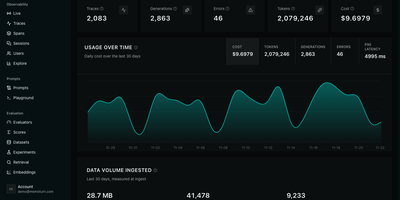
Tracing each model call, pricing it, scoring the answer, and versioning the prompt behind it, Memoturn gives AI teams proof of what works before it ships. Traces unfold on a waterfall timeline where agent plans, tool calls, retrievals, and generations each get a bar, with tokens and cost on every step. Quality is measured three ways: offline experiments over datasets, online judges sampling production traces, and human review queues with one-click scoring. Scores appear on the trace they came from. A versioned prompt registry promotes versions through deploy channels, A/B tests split live traffic between them, and a streaming playground compares models side by side. Cost, token, and latency charts break down by day, model, user, and tool, while budget alerts run every minute and automations post to Slack or a webhook when a score drops. A retrieval page flags weak document matches, and an embeddings map with similarity search turns one bad generation into every trace like it. An MCP server hands prompts, datasets, and review queues to agent IDEs like Claude Code and Cursor, with roles checked per tool. Teams get organizations and projects, SSO through OIDC or SAML, read-only viewer roles, PII masking at ingest, and retention rules. Data arrives from any OpenTelemetry exporter, with integrations for OpenAI, Anthropic, LangChain, and LiteLLM. Running on a dedicated VPS on RepoCloud with guaranteed CPU, RAM, and SSD, full root SSH access, and a browser serial console. Apache-2.0 licensed.

Urocissa
Urocissa is a self-hosted photo and video gallery engineered to browse, search, and filter a million-image library in under a second on modest hardware. Its photo stream scrolls endlessly without pagination or lazy loading, flying past the browser DOM height limit that breaks other galleries long before a million items. Search understands boolean operators, so a query mixing and, or, and not narrows a lifetime of photos in milliseconds, and select-all is equally instant across the whole collection. Point it at folders and it watches them for new arrivals, importing photos and videos automatically while duplicate detection keeps redundant copies out. EXIF data is extracted for every image, and your own tags layer manual organization on top, with timeline navigation and rotation built in. Albums share collections with family or clients, a read-only mode publishes a public gallery safely, and videos play inline without leaving the page. The index that makes this fast lives in memory at roughly half a gigabyte per million photos, and the whole application ships as a binary of about 25 megabytes, optionally protected by a password. Running on a dedicated VPS on RepoCloud with guaranteed CPU, RAM, and SSD, full root SSH access, and a browser serial console. MIT licensed.
OneCamp
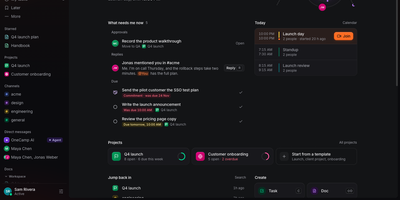
Channels, docs, projects, tables, a shared calendar, and video calls for the whole team, plus AI teammates that act as the person who sponsors them and never more. Threads and direct messages carry the talk, a scheduled check-in asks what everyone worked on, and voice, video, or screen clips of up to five minutes go out like a file. Mention an agent and it acts with your permissions and no more, asks before changing things until told otherwise, and loses access the moment you do. Agent actions are signed, chained to the entry before, and written down before they run; one that cannot be recorded does not run. Projects flip between list, board, timeline with dependencies, releases, and reports, with SLA timers that follow business hours. Docs are edited together live from templates, and tables link to each other, add up rows, and compute with formulas. Calendars connect to Google and Outlook, and meeting rooms book without clashes. Call recaps land on the calendar event, ready to become tasks. Admins get SAML, OIDC, and LDAP sign-in, SCIM provisioning, and a Slack importer with a bridge for the move. Desktop apps cover Windows, macOS, and Linux, and a running OneCamp server never phones home. Running on a dedicated VPS on RepoCloud with guaranteed CPU, RAM, and SSD, full root SSH access, and a browser serial console. AGPL-3.0 licensed.
Spanlens
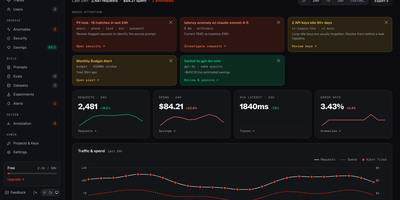
A drop-in proxy sits between an app and OpenAI, Anthropic, or Gemini and logs each call's cost, tokens, latency, and full prompt for debugging and spend control. Adoption means changing a base URL or running a CLI wizard that patches existing client calls. A surprise bill? Filter requests by model or key, check per-end-user totals, then open any one to read the messages and the reply, even when it streamed. A slow agent? Its run opens as a waterfall timeline with the critical path marked, or as a node graph for LangChain and LangGraph traces. Spend, latency, and error spikes are measured against a seven-day baseline, and alert rules route breaches to email, Slack, or Discord. Savings recommendations point to cheaper models for simple tasks, with estimated monthly dollars and a simulate button. Detectors flag emails, phone numbers, card numbers, and prompt-injection attempts, and a project can block injections outright. Prompt edits keep versions with diffs and A/B traffic splits, while LLM judges and a human rating queue score the outputs. Workspaces carry admin, editor, and viewer roles, and every invitation or role change is logged with who made it. Cursor or Claude Desktop can query the same data through a bundled MCP server. Running on a dedicated VPS on RepoCloud with guaranteed CPU, RAM, and SSD, full root SSH access, and a browser serial console. MIT licensed.
Plone
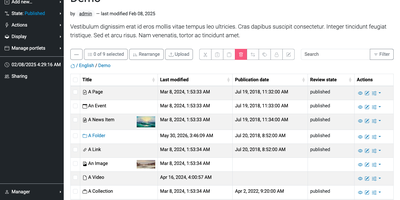
Editors who need to publish a page, route it through review, and roll back a mistake can do all of it in Plone, an open-source CMS, without writing any code. Pages are assembled in place from blocks such as grids, teasers, listings, maps, tables, and video, with a sidebar for page and block settings. A folder-style Contents view handles cut, copy, paste, rename, and workflow state changes in bulk. An editor can revert a page to an earlier revision from its version history. Administrators create new content types through the web in the Content Types control panel and attach behaviors such as versioning. Permissions are assigned per role, group, and workflow state. Content rules publish, move, or notify automatically when an item changes state. One installation can serve an intranet, a public website, and an extranet, with a form builder and a faceted search block built in. Sign-in integrates with LDAP, Active Directory, OpenID, Shibboleth, CAS, and Kerberos. The interface is translated into over 30 languages, and multilingual content is supported. The REST API makes Plone a headless CMS for custom frontends, and the server-rendered Classic UI stays available for sites that prefer it. Official Docker images are available, and clustering or PostgreSQL storage helps a busy site grow beyond one server. Running on a dedicated VPS on RepoCloud with guaranteed CPU, RAM, and SSD, full root SSH access, and a browser serial console. GPL-2.0 licensed.
Codex LB Enhanced
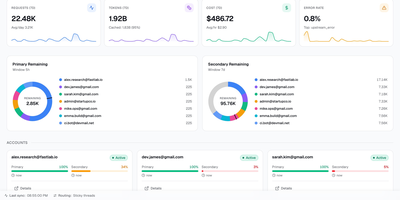
Codex LB Enhanced is a session-aware gateway that pools your ChatGPT accounts so a long Codex session survives quota limits, dropped connections, and paused accounts without losing the conversation. It serves Codex desktop, CLI, and IDE clients through the native Responses protocol and WebSocket transport, and answers any OpenAI-compatible client through the familiar /v1 endpoints. When an account runs out of quota, gets suspended, times out, or drops mid-stream, the gateway classifies the failure, removes that account from the current request, and selects the next one through your load-balancing policy. Verified request history, including interrupted tool-call context, is replayed across the account switch when it is safe, so the client sees a slower answer instead of a dead stream. Every API key carries its own policy: time windows from five hours to monthly, limits by credits, tokens, or cost, and model-specific rules. Usage appears in native Codex quota headers and in a /v1/usage view backed by the same data, so editors and automation agree on what is left. Diagnostics correlate each request with its upstream account, transport, failover stage, and retry count, and a web dashboard manages accounts, keys, usage windows, request logs, and recovery reports. Running on a dedicated VPS on RepoCloud with guaranteed CPU, RAM, and SSD, full root SSH access, and a browser serial console. MIT licensed.

Shortlink
Shortlink is a self-hosted platform for short links and live QR codes that keeps every printed, shared, or forwarded entry point under your control long after it leaves your hands. A code printed on ten thousand flyers cannot be recalled when the campaign page moves, so the destination behind it changes while the printed image stays exactly the same. Create short links with custom codes, a choice of 301, 302, 307, or 308 redirects, expiry dates, visit caps, and a fallback target for when the main destination is down. Build live QR codes backed by a pool of destinations that rotates by order, weight, random pick, or least-shown strategy, with transactional saves so a half-finished edit never goes live. Style each code in classic, rounded, or dot patterns with your own colors and a center logo, preview it in real time, and download print-ready SVG, PNG, or WEBP files. New links and codes land in an approval queue that an admin reviews before anything goes public, and every change is written to an audit log. Teammates sign in with an emailed magic link or GitHub, manage only the resources they own, and watch thirty days of visit trends, unique IPs, and device and browser breakdowns roll in. Running on a dedicated VPS on RepoCloud with guaranteed CPU, RAM, and SSD, full root SSH access, and a browser serial console. AGPL-3.0 licensed.
Retinue
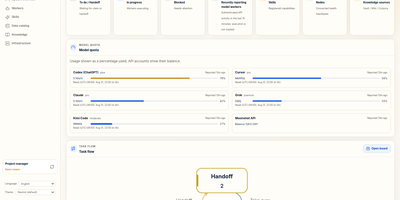
Retinue shows who is doing what across a fleet of AI agents, on a shared board where every task is a card with exactly one holder, a written acceptance check, and a receipt chain that cannot be rewritten. Operators publish cards, agents claim them through MCP or a token-scoped HTTP API, report progress, and hand off, and an agent that is not the holder gets a refusal when it tries to write. The Home dashboard counts what is waiting, running, and blocked, charts task flow and dispatch, and shows quota gauges for Claude, Codex, Cursor, Grok, and Kimi subscriptions. A collaboration workspace draws delegation graphs, device and model timelines, module contributions, and message conversations for any selected task. Operations pages report token usage by worker, and a data health page flags stale reports and duplicate identities. Read-only importers pull session data from Claude Code and Codex, and optional Lark, Feishu, and Telegram bridges turn chat messages into intents. The interface switches between English and Simplified Chinese. Running on a dedicated VPS on RepoCloud with guaranteed CPU, RAM, and SSD, full root SSH access, and a browser serial console. AGPL-3.0 licensed.
Nginx-Love
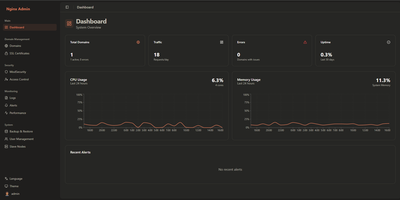
Hand-editing nginx configuration files to run a firewall is nobody's idea of a good afternoon, and Nginx-Love turns that chore into a dashboard. You manage domains, load balancing upstreams, and HTTPS backends through forms instead of config syntax, and the platform writes and reloads the underlying configuration for you. A ModSecurity firewall with the OWASP Core Rule Set inspects traffic to your sites, and you tune its rules from the interface rather than a text editor. Certificates arrive two ways: automated through Let's Encrypt, or uploaded manually when you bring your own. A Bot Manager fingerprints visitors with JA4 signals so you can welcome good crawlers, challenge suspicious automation, and block hostile bots by policy. Access lists filter by IP address, geography, and user agent, and multi-user roles let administrators, moderators, and viewers each see the controls appropriate to their job. Monitoring watches performance and attack patterns, sending alerts by email or Telegram when something needs attention. Configuration exports back up your setup, restores bring it back, and multi-node sync keeps a cluster of servers enforcing the same policy. Running on a dedicated VPS on RepoCloud with guaranteed CPU, RAM, and SSD, full root SSH access, and a browser serial console. Apache-2.0 licensed.
TaskBrigade
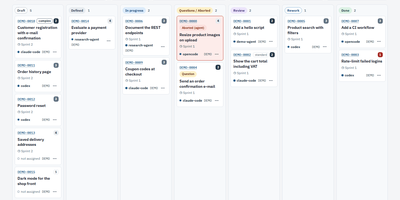
TaskBrigade is agile project management for teams of AI agents: a backlog, kanban board, sprints and pull request review where Claude Code, Codex, OpenCode and human teammates all pick up assigned work. Tasks carry acceptance criteria and their own branch, and finished work arrives as a pull request that a human or a reviewer agent approves, rejects or returns with change requests. An inbox gathers open questions, results waiting for review and aborted runs in one place. Workflows turn a chain of tasks into a reusable template that starts by hand, on a cron or workday schedule, or on an event, with approval steps, parallel groups and token budgets that pause a run at 100 percent. Projects marked local-only hand work exclusively to agents whose model runs on your own hardware, which keeps confidential material away from cloud models. Telegram and email notifications follow a per-event matrix with quiet hours, and from Telegram you can approve a review or answer an agent's question. Orchestrator agents, or OpenClaw messages in Telegram, create, split and assign tasks across several machines, each with its own work directory and parallel-task limit. Claude Desktop and Codex Desktop connect through MCP to draft and assign tasks straight from a chat. The interface speaks English or German and folds into a bottom tab bar and single-column board on phones. Running on a dedicated VPS on RepoCloud with guaranteed CPU, RAM, and SSD, full root SSH access, and a browser serial console. Apache-2.0 licensed.