MantisBT
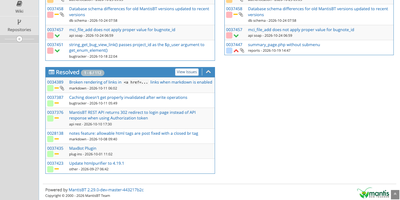
Every bug a team finds, from the first report to the day it is marked resolved, lives in one shared list in MantisBT, an open-source issue tracker. Reporters file issues with a summary, steps to reproduce, severity, and attachments, and email notifications reach the reporter, the handler, monitors, and note authors. Six access levels, from viewer to administrator, can be overridden project by project, and private projects stay hidden from users below the configured level. Administrators define their own status values, workflow transitions, and custom fields. Sub-projects inherit versions and categories from their parents, and issues link as related, parent and child, or duplicates. @mentions pull colleagues into a discussion, tags group related work, and a chronological history records who changed what. Triage works from stored and shared filters, the My View page, and summary charts, while a roadmap and changelog track what each version contains. Reporting comes through CSV and Excel export, optional time tracking with billing totals, and RSS feeds. Sign-in can use LDAP or Active Directory, scripts reach the tracker through REST and SOAP APIs, plugins extend the interface, and 50 languages are included. Running on a dedicated VPS on RepoCloud with guaranteed CPU, RAM, and SSD, full root SSH access, and a browser serial console. GPL-2.0-or-later licensed.

Castopod
Every podcast you publish through Castopod automatically becomes a Fediverse social account that Mastodon, Pleroma, and Pixelfed users can follow, boost, and comment on from their own timelines. This ActivityPub integration transforms podcast distribution from a one-way broadcast into a two-way conversation where listeners interact with episodes through the social platforms they already use. Beyond federation, the platform manages the complete lifecycle: upload an episode, and auto-generated RSS feeds distribute it to Apple Podcasts, Spotify, Deezer, Podcast Addict, and every compatible directory. IABv2-compliant analytics measure downloads, geographic distribution, and listening apps while maintaining GDPR, CCPA, and LGPD compliance through anonymized data collection. Podcasting 2.0 namespace support unlocks chapters with images, SRT/VTT transcripts, location tags, and person credits that modern podcast apps surface to listeners. Video episodes publish alongside audio, and auto-generated clips feed social media sharing workflows. Monetization tools span Value4Value micropayments, premium subscriptions, funding links, and cookieless advertising. Multi-user roles operate per-podcast: contributors, editors, and admins each work within defined permission boundaries. The PHP application runs behind nginx with MariaDB and Redis on a RepoCloud VPS with dedicated CPU, RAM, and SSD. AGPL-3.0 licensed.
Statainer
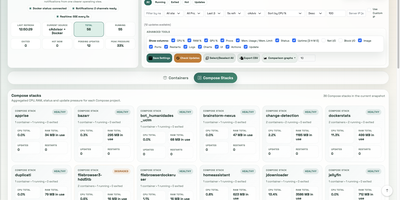
Monitoring and safeguarding Docker infrastructure without heavy enterprise software overhead is the primary mission of Statainer, an open-source management control center for container hosts. System operators inspect live CPU loads, memory consumption, network throughput, and disk I/O metrics across individual containers or comparative top-ranking charts. The interface groups containers by Compose projects, enabling administrators to start, stop, or restart entire application stacks and inspect real-time log streams without opening SSH sessions. The built-in Update Manager detects available image tags, executes single-click container updates, and maintains persistent deployment history with automated rollback capabilities for failed recreations. Custom alert configurations trigger instant notifications to Telegram, Discord, Slack, Pushover, or generic webhook endpoints whenever resource thresholds are breached or container health states change. Developers can provision scoped API keys with token authentication to automate container state transitions and export performance telemetry into custom monitoring workflows. Running on a dedicated VPS on RepoCloud with guaranteed CPU, RAM, and SSD, full root SSH access, and a browser serial console. MIT licensed.
Eclaire
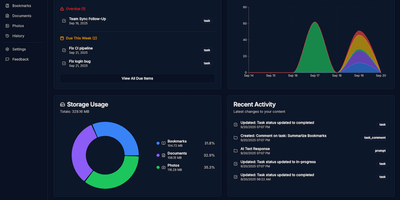
Built to consolidate fragmented digital life into a private personal cloud, Eclaire centralizes tasks, notes, documents, photos, and web bookmarks into a unified workspace powered by local artificial intelligence. Users can save web articles to generate clean Markdown copies and searchable PDF archives, automatically bypassing clutter and dead links. The integrated document ingestion engine extracts tabular data from spreadsheets, performs optical character recognition across uploaded receipts and handwritten images, and indexes multi-page PDF manuals for rapid full-text search. Conversational assistant panels allow operators to interrogate their accumulated library using natural language, asking for cross-document summaries, research timelines, or action items extracted from meeting transcripts. Background workers prioritize asynchronous indexing queues, categorizing image libraries with visual object tags and managing recurring task deadlines with automated Telegram alert notifications. External automation flows can interact directly with the unified storage layer via an OpenAI-compatible REST API, allowing mobile shortcuts and custom scripts to ingest bookmarks and dictate notes remotely. Running on a dedicated VPS on RepoCloud with guaranteed CPU, RAM, and SSD, full root SSH access, and a browser serial console. MIT licensed.
db-ui
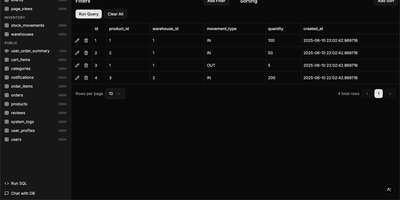
Traditional database management tools like pgAdmin and phpMyAdmin were built for DBAs, not for the rest of the team that just needs to look up a record or run a quick query. db-ui strips away the complexity and gives you a clean, modern interface that anyone can use. Browse tables in a paginated grid view with inline editing, filtering, and sorting built right into the column headers. The sidebar lists every table and view across all schemas with fuzzy search (Cmd+K to focus) that filters results as you type. Click any table to see its data, or switch to the schema introspection view to visualize columns, types, constraints, and relationships without writing a single query. The SQL editor provides syntax highlighting, result visualization in tabular format, and one-click CSV export for downstream analysis. For questions about your data model, the integrated AI chat assistant has full access to your database schema and can help you understand table relationships, write complex queries, suggest indexes, and provide optimization recommendations with streaming responses. Connect to PostgreSQL, MySQL, or Microsoft SQL Server through environment variables and deploy the whole application as a single Docker container. On RepoCloud, deploy db-ui on a dedicated VPS with root SSH access and direct connectivity to your database servers under the MIT license.
Composr
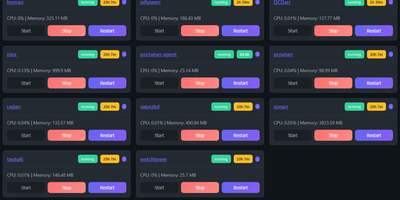
Managing multi-server container fleets often deteriorates into fragmented SSH sessions, mismatched compose files, and conflicting port allocations. Composr consolidates multiple Docker host daemons into a unified web dashboard that controls running containers, stack definitions, and system metrics from a single interface. Operators can connect remote Docker daemons through encrypted TCP sockets, inspect container health, and stream live execution logs with sub-second responsiveness. A built-in project creation wizard guides administrators through drafting new Compose topologies across local directories or remote server nodes. In-browser CodeMirror editors deliver live syntax highlighting for YAML files, configuration dotfiles, and reverse proxy definitions without detaching containers from disk. The platform tracks service properties directly, letting you toggle Compose profiles, relocate services between YAML manifests with pre-flight risk checks, and detect target port collisions before redeployment. Integrated backup managers bundle container metadata, compose files, and environment definitions into downloadable archive packages for automated disaster recovery. System operators can open interactive browser terminals into any active container, execute batch maintenance tasks, and configure scheduled image update checks. Running on a dedicated VPS on RepoCloud with guaranteed CPU, RAM, and SSD, full root SSH access, and a browser serial console. MIT licensed.
BlogFactory
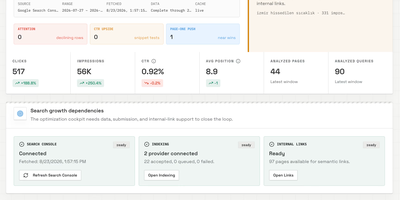
BlogFactory is the first open-source agent control plane purpose-built for multi-site content operations, shipping 16 distinct capabilities across four operational pillars — Operate, Grow, Control, and Deliver — in its v0.1.0 release. The platform keeps source evidence, AI-generated drafts, revisions, SEO metadata, human review, preflight checks, and CMS delivery destinations in one workspace while enforcing a server-side authority ceiling that prevents agents from ever publishing live content, accessing credentials, or performing administrative actions. AI agents connect through a Streamable HTTP MCP endpoint with OAuth authentication and site-scoped tool discovery, compatible with Codex, ChatGPT, and any MCP-capable client. Content creation supports single articles from keywords, titles, URLs, PDFs, text, or YouTube sources, batch campaigns, and programmatic content via reusable templates with structured data rows. The Search Growth module connects Google Search Console complete-day data to ranked optimization opportunities, 30-day growth plans, content classification by signal type (growing, low-CTR, almost-ranking, page-two, zero-click), indexing checks, and semantic internal-link suggestions. Brand Voice separates global voice rules, writer profiles, knowledge context, and brand guidelines from article mechanics. Approved drafts are delivered as CMS drafts to WordPress, Ghost, Wix, or Framer through idempotent, optimistic-locking-protected handoffs with explicit destination selection and preflight validation. The stack runs on React/Vite, a Hono/TypeScript API, PostgreSQL, and MinIO via Docker Compose, with providers including OpenRouter, OpenAI, and Google services under a bring-your-own-AI model. Running on a dedicated VPS on RepoCloud with guaranteed CPU, RAM, and SSD, full root SSH access, and a browser serial console. AGPL-3.0 licensed.
Forgejo
Governed by the non-profit Codeberg e.V. with over 150 contributors and quarterly major releases reaching v16.0 in July 2026, Forgejo delivers a complete code collaboration platform in a single Go binary that runs comfortably on 512 MB of RAM — providing full Git hosting with SSH and HTTPS, pull requests with inline code review, issue tracking with labels and milestones, kanban project boards, wikis, and an integrated package registry supporting Docker, npm, PyPI, Maven, NuGet, and Cargo. Forgejo Actions provides GitHub Actions-compatible CI/CD with reusable workflows, OpenID Connect for secure third-party access, ephemeral runners for autoscaling, and dynamic matrix support for complex build pipelines. The platform implements ActivityPub-based forge federation allowing issues, pull requests, and stars to work across independent instances — enabling a decentralized development ecosystem similar to how Mastodon federates social networks. Organizations and team permissions provide fine-grained access control, while LDAP, OAuth2, and OpenID authentication integrate with existing identity infrastructure. Code search indexes repositories for fast discovery, LFS handles large files efficiently, and mirror synchronization imports repositories from GitHub, GitLab, and other forges. Deploy via a single static binary, Docker container, or official Helm charts with SQLite for small instances or PostgreSQL and MySQL for production workloads. Running on a dedicated VPS on RepoCloud with guaranteed CPU, RAM, and SSD, full root SSH access, and a browser serial console. GPLv3+ licensed.