Antirion
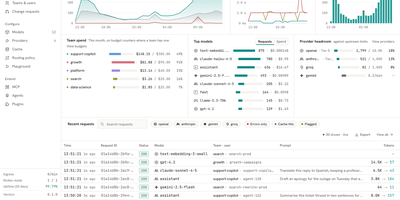
Your apps keep using the OpenAI SDK while Antirion, a self-hosted AI gateway, decides which provider answers, what each team may spend, and what gets logged. Clients speak the OpenAI, Anthropic, Gemini, or Bedrock APIs, and Antirion translates between them, so a Claude deployment can answer an OpenAI-style call, streams included. Add providers such as Amazon Bedrock, Vertex AI, Mistral, Groq, DeepSeek, or a vLLM server, then publish them as named Models. Routing rules send traffic by team or project with fallback chains, weighted splits, least-cost or least-latency targets, retries, hedging, and circuit breakers. Budgets and rate limits in dollars or tokens apply per organization, team, project, and key, with projections and alerts before money runs out. Guardrails check for personal data, secrets, keywords, and regex matches, then block, redact, flag, or divert. Exact and semantic caching answers repeated prompts without calling a provider. The request log records every attempt, route, token count, cost, and guardrail verdict, with Prometheus metrics and OTLP traces. An MCP gateway and A2A proxy put tools and agents behind the same keys. Sign in with OIDC, SAML, or GitHub, provision users with SCIM, and review every change in the audit log. Changes you choose can require a change request or a second person's approval, and the Playground sends requests from the console. Running on a dedicated VPS on RepoCloud with guaranteed CPU, RAM, and SSD, full root SSH access, and a browser serial console. Apache-2.0 licensed.
Kompl
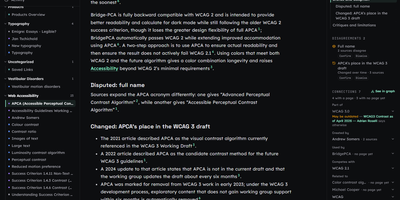
Save a link, a PDF, a YouTube video, or a bookmark export to Kompl and it reads the material on arrival, then writes it into cross-linked wiki pages instead of leaving it in a folder you never reopen. Save more on the same subject and the existing pages are rewritten, so source number fifty improves the pages it touches. Every claim carries a numbered citation back to the original text, and when two sources disagree the page records both sides with a confirm or dismiss button. A knowledge graph shows how topics connect, each link backed by the sentence that states it. An onboarding wizard stages pasted text, URLs, uploaded files, browser bookmarks, Twitter exports, Apple Notes, and Upnote exports for review before anything is compiled. Settings pick the compile model from DeepSeek or Gemini, cap daily spend, and show wiki health. Eight MCP tools let Claude Code, Cursor, Codex, and other agents search, read, and cite pages. Full backups export as one zip that restores without further model calls. Running on a dedicated VPS on RepoCloud with guaranteed CPU, RAM, and SSD, full root SSH access, and a browser serial console. Apache-2.0 licensed.
AxonHub
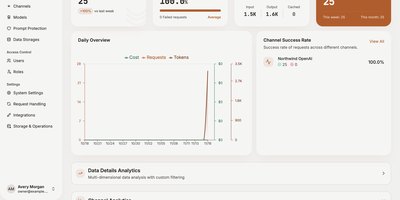
AxonHub is an open-source AI gateway that lets any OpenAI, Anthropic, or Gemini SDK reach more than 100 models through a single address. Point Claude Code, Codex, OpenCode, or your own scripts at one base URL, and the gateway translates each request for whichever provider sits behind the model name, so changing vendors means editing a string instead of rewriting code. Channels hold provider keys, model lists, weights, and health history, and load balancing with automatic failover sends traffic to the healthiest route. Chat, image generation, embeddings, and reranking all travel through the same endpoint. Every call lands in request logs with token counts, first-token latency, and cost, and traces group related calls into threads with a timeline of spans. A built-in playground tests one channel or the full gateway, prompt protection rules filter sensitive text before it leaves your network, and API keys can be limited by project, owner, or IP range. Roles and per-user usage tables keep teams apart. Running on a dedicated VPS on RepoCloud with guaranteed CPU, RAM, and SSD, full root SSH access, and a browser serial console. Apache-2.0 licensed.
Hezo
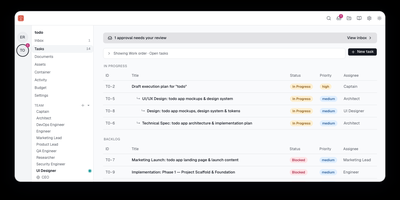
A whole company of AI agents, from a CEO to engineers, designers, and analysts, works inside Hezo under budgets, approvals, and sandboxes you control. Starting a project means picking a ready-made marketplace team (App Team, Social Media Marketing, or Investment Portfolio), using a template, or asking the CEO to assemble one, and the org chart can be reshaped while work continues. Agents pull tasks from a board with nested sub-tasks, wake on heartbeats, pause at approval gates, and push verified commits to your GitHub repositories. Each agent can run on its own model, whether Claude, GPT, Gemini, Grok, Kimi, DeepSeek, GLM, OpenRouter, Ollama, or LM Studio, using API keys or an Anthropic or OpenAI subscription signed in from the UI. Token budgets pause runs at their limits, cost per run stays visible, and a container-hours ledger enforces a monthly allowance. Every project works in its own container, and stored secrets reach agents only as placeholders that an egress proxy swaps for real values on hosts you allowed. A Coach agent turns lessons from finished tasks into durable rules, while documents, skills, and full-text search hold shared knowledge. Message the CEO from Telegram, Slack, or Discord, or drive Hezo from any MCP client through its built-in MCP server. The web app speaks 12 languages. Running on a dedicated VPS on RepoCloud with guaranteed CPU, RAM, and SSD, full root SSH access, and a browser serial console. GPL-3.0-or-later licensed.
Latitude
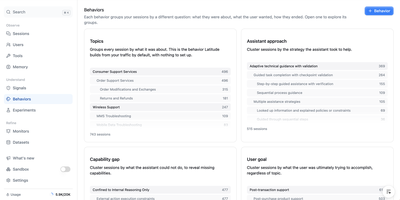
Production AI agents fail in quiet ways, and Latitude records every trace, session, and tool call so each failure can be found, grouped, and fixed. One line of telemetry from the TypeScript or Python SDK, or any OpenTelemetry exporter, sends traces from OpenAI, Anthropic, LangChain, LlamaIndex, CrewAI, and dozens of other providers and frameworks. Failing traces are clustered into signals with status, size, and trend, and flaggers and annotation queues let reviewers score outputs by hand. Evaluations are generated from those judgments and tracked with an alignment score. Semantic and exact-text search covers every trace, and saved searches, filters, and behavior groupings keep recurring questions one click away. Dashboards report cost per session, tool failure rates, and agent score across outcome, reliability, speed, and safety. Memory views show how an agent's stored memory changes over time, with diffs and the trace behind each edit. Monitors raise alerts, regression datasets replay fixes against the traces that failed, and Agent Dispatch hands the evidence to a coding agent. Running on a dedicated VPS on RepoCloud with guaranteed CPU, RAM, and SSD, full root SSH access, and a browser serial console. MIT licensed.
Open Canvas
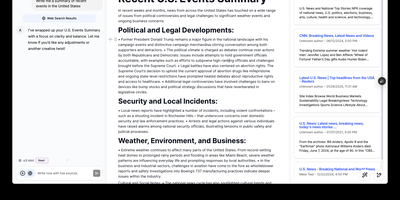
Open-source alternative to OpenAI's Canvas — a collaborative writing and coding environment where AI agents help you draft, edit, and refine documents through an agentic architecture built on LangGraph. The dual-mode editor combines a BlockNote rich text editor for live-rendered markdown with a CodeMirror-based code editor supporting syntax highlighting across multiple programming languages, letting you switch between prose and code artifacts within the same session. The built-in reflection agent automatically generates style rules and user insights from your chat history, storing them in a shared LangGraph memory store that persists across sessions for increasingly personalized assistance. Pre-built quick actions provide one-click access to common writing transformations including summarize, expand, simplify, and translate, while coding actions offer explain, refactor, add comments, and convert between languages. The monorepo architecture separates the Next.js 14 frontend from the LangGraph agent backend, connecting via HTTP and WebSocket protocols through the @langchain/langgraph-sdk client. Seven LLM providers are supported out of the box — OpenAI, Anthropic Claude, Google Gemini, Fireworks AI, Groq, Azure OpenAI, and local Ollama models — with Supabase handling authentication and data persistence. Deploy via Docker or build from source. Running on a dedicated VPS on RepoCloud with guaranteed CPU, RAM, and SSD, full root SSH access, and a browser serial console. MIT licensed.
Paddler
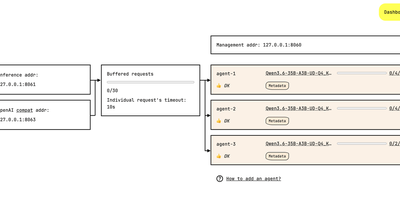
One binary. A fleet of machines. One calm endpoint for inference. Paddler balances large language model traffic across whatever hardware you already own, instead of renting tokens by the million. The balancer exposes an inference service, a management service, and a web admin panel from a single self-contained program. Agents on separate machines generate tokens and embeddings through slots, each carrying its own context and KV cache. Inference runs on the built-in llama.cpp engine, CPU or GPU. Need a different model? Swap it dynamically, no rebuild, no redeploy. Capacity follows demand: agents join the fleet when traffic grows and leave when it fades, and request buffering holds early work in a queue so scaling up from zero hosts drops nothing. Operators watch fleet health through observability metrics, configure models, chat templates, and inference parameters in the admin panel, and test prompts graphically before users ever see a change. A desktop edition drafts office workstations into service beside the rack servers. For medical, financial, or otherwise sensitive prompts, everything stays inside your own network, and predictable hardware replaces per-token pricing exposure. Running on a dedicated VPS on RepoCloud with guaranteed CPU, RAM, and SSD, full root SSH access, and a browser serial console. Apache License 2.0 licensed.
Agentic Security
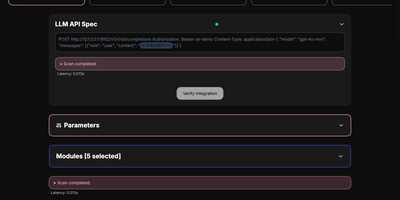
Find out how easily your chatbot can be talked into misbehaving before a stranger on the internet does. Agentic Security points a library of attack prompts at any LLM endpoint you can describe in a few lines of HTTP, then reports which attack families got through. Paste a request template with a marker where the attack goes, press Verify Integration to confirm the endpoint answers, and start the scan. Pick from jailbreak corpora on Hugging Face, obfuscation mutations like Base64, ROT13, mirrored words, and scrambled text, or drop your own CSV of prompts into a folder. Presets cover OpenAI, DeepSeek, Groq, Gemini, Claude, Azure, and custom APIs. Set a token budget, switch on concurrency, and watch a per-module table of failure rates and estimated cost fill in live. Download failed prompts as a CSV, export the full log, or generate a config and run the same scan as a CI gate with failure thresholds. Re-run the same scan after every model or system prompt change to spot regressions early. Running on a dedicated VPS on RepoCloud with guaranteed CPU, RAM, and SSD, full root SSH access, and a browser serial console. Apache-2.0 licensed.
Neo Chat
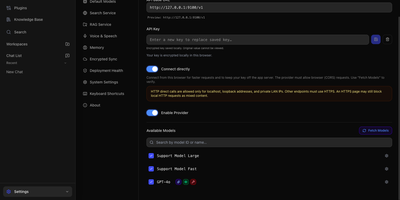
One chat window, every model you already pay for, and a history that stays in your own browser unless you decide otherwise. Neo Chat connects to Google, OpenAI, Anthropic, and any OpenAI-compatible gateway, so switching models mid-project takes one click. Agent mode runs multi-step tool workflows, and Deep Research drafts a plan for approval before producing a cited report that can be resumed if it stops. Attach files, build a knowledge base for retrieval, and let memory carry preferences between conversations. Browse a market of ready-made assistants and text skills, add OpenAPI plugins or remote MCP servers, and search the web through a configurable service. Answers render Markdown, math, diagrams, and charts, plus editable artifacts and interactive checklists, quizzes, flashcards, and calculators. Voice input and read-aloud sit beside the composer, and optional encrypted sync moves settings between devices. An access password can protect a shared deployment, and a health page checks that everything is configured. Switch models mid-conversation, keep one history, and stop juggling a tab for every provider. Running on a dedicated VPS on RepoCloud with guaranteed CPU, RAM, and SSD, full root SSH access, and a browser serial console. MIT licensed.
Proval
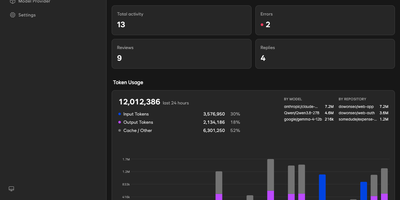
Proval is a self-hosted AI code review agent that reads every pull request on your GitLab, Forgejo, or GitHub server and posts a consolidated, severity-grouped review with inline comments, using a model you run yourself. When a pull request gets a meaningful push, a planning agent groups changed files into review units and dispatches specialist sub-agents in parallel, each exploring the codebase so cross-file issues surface. A writing agent merges their findings into one review, with comments on the affected lines, including multi-line ranges. Reply to any Proval comment and it reads the thread context and answers, and it works on issues too, greeting new ones and answering follow-ups on every message or only when mentioned. Choose per repository whether reviews run on first push only, every push, or not at all, skipping drafts until they are marked ready. Every review, reply, and issue comment is logged with its token usage, so each model's cost shows in the dashboard instead of hiding in an API bill. Your code is never stored; review context goes only to the LLM endpoint you configure, whether that is a cloud API or a local Ollama or llama.cpp server on your own network. Connect GitLab or Forgejo with an access token and webhooks, or GitHub through a GitHub App; Gitea and Codeberg use the same Forgejo-compatible path. Running on a dedicated VPS on RepoCloud with guaranteed CPU, RAM, and SSD, full root SSH access, and a browser serial console. AGPL-3.0 licensed.
Dialoqbase
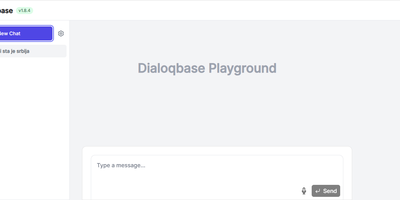
Retrieval-augmented chatbots on your own knowledge base - that is the whole mission of Dialoqbase, an open-source bot-building platform. Feed it content through a broad set of data loaders - web pages and full crawls, sitemaps, PDFs, DOCX, CSV, plain text, GitHub repositories, YouTube videos, and MP3/MP4 audio - and it handles the whole RAG pipeline in one self-contained app: chunking, embedding, vector storage, and LLM querying. The distinguishing architecture choice is PostgreSQL with pgvector for embedding storage and similarity search, which removes the separate vector-database dependency, and Redis-backed Bull queues for ingesting large documents without blocking the API. Model choice is wide open: OpenAI, Anthropic Claude, Google Gemini, Cohere, Fireworks, Hugging Face, local models via Ollama, and any OpenAI-compatible endpoint, with an equally broad list of embedding providers. Finished bots embed on any website with customizable styling or deploy to Telegram, Discord, and WhatsApp, and an API creates and manages bots programmatically. Multi-user support adds registration limits and per-user bot quotas. MIT-licensed and free for commercial use.
LocalGPT
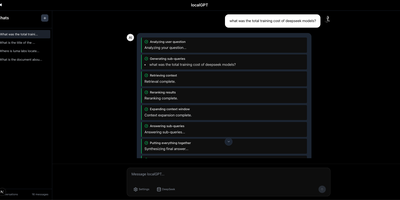
If a document is too sensitive for a hosted chatbot, LocalGPT lets you question it in plain English on your own server, with every answer citing the passages it used. Drop PDF, DOCX, HTML, Markdown, or plain-text files into a named index and scanned PDFs are read through OCR. Vector and full-text results are fused by rank, then a cross-encoder reranker keeps the best passages. A router decides per question between searching your documents and answering directly. Complex questions split into sub-questions that are searched separately, pooled, and answered in one pass. Progress cards stream the retrieval, reranking, and synthesis stages into the chat as they run. An optional verification pass appends a confidence percentage to the answer. A session-scoped semantic cache answers repeated questions faster. Per-chat settings toggle decomposition, pruning, verification, search type, model, and retrieval depth. Swap the answer model per session or per message, and choose the embedding model when you build an index. From a terminal, one command indexes a folder and another asks a question, and a REST API exposes every action the interface can take. A start script runs everything in Docker against Ollama on the host or in a container. Running on a dedicated VPS on RepoCloud with guaranteed CPU, RAM, and SSD, full root SSH access, and a browser serial console. MIT licensed.
RESTai
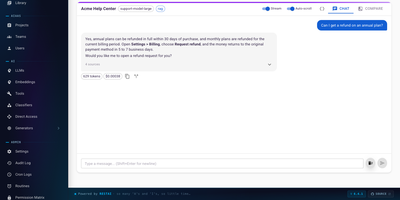
Every AI project you build in RESTai becomes an endpoint that any app can call over plain HTTP. RESTai gives you a browser dashboard where each project gets its own model, system prompt, tools, and chat playground. Build knowledge-base assistants over uploaded files and synced web pages, ReAct-style agents that call MCP servers, or drag-and-drop block projects that need no model at all. Connect Ollama, OpenAI, Anthropic, Gemini, vLLM, Azure, Bedrock, or any OpenAI-compatible endpoint, and let teams share the ones you approve. Daily charts follow tokens, cost, and latency per project, with rate limits, guardrails, prompt version history, and evaluation runs for quality tracking. Teams, roles, two-factor sign-in, white-label branding, and an audit trail cover administration. A one-line chat widget embeds a project on any website, and connectors reach Telegram, Slack, and WhatsApp. One install can serve several branded assistants and bill each team separately. Running on a dedicated VPS on RepoCloud with guaranteed CPU, RAM, and SSD, full root SSH access, and a browser serial console. Apache-2.0 licensed.
ChainForge
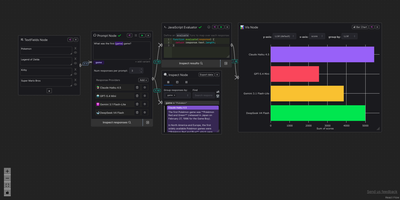
Comparing prompts and models by eye stops working fast, so ChainForge lays every experiment out on one visual canvas. Drop a table of inputs into a Prompt Node, add a handful of models, and the app sends every combination of template variable and model, then collects the answers in an Inspect Node that groups responses by any variable. Evaluator nodes score outputs with a few lines of code, and visualization nodes plot pass rates and numeric scores as histograms or box plots. Chat Turn nodes test follow-up questions, to see if a model caves when a user pushes back. Sparkle buttons draft synthetic table rows, test questions, and starter evaluator code with a model of your choice, and an LLM scorer can judge answers against a rubric you write. Example Flows open ready-made experiments, from a no-key starter with tiny in-browser models to prompt template comparisons, sycophancy checks, gender bias audits, red-teaming runs, and 188 flows converted from OpenAI Evals. Documents, Chunking, Retrieval, and Rerank nodes cover retrieval experiments. Finished flows export as cforge files, and results export to spreadsheets or JSON for the rest of the team. Running on a dedicated VPS on RepoCloud with guaranteed CPU, RAM, and SSD, full root SSH access, and a browser serial console. MIT licensed.
Argilla
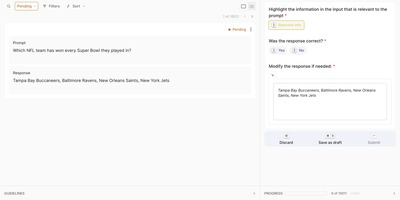
Before a language model learns from your data, someone has to label it well; Argilla gives AI engineers and domain experts a shared workspace to label, review, and refine the datasets that fine-tune language models and train NLP pipelines. You build each dataset from the Python SDK, mixing text, chat, and image fields with the exact questions your task needs: single-label classification for intent detection, span questions for named entities, ratings for response quality, rankings for preference tuning, or free text for corrections. Annotators then work through records in a focused labeling interface where model predictions already sit attached as suggestions, turning most reviews into a fast confirm-or-correct decision instead of a blank-page exercise. Full-text search, metadata filters, and status filters slice a hundred thousand records down to the ones needing attention, while vector-based semantic search finds lookalike examples, near-duplicates, and the disagreement hotspots where guidelines need sharpening. Dataset owners watch completion progress, manage who has responded to what, and split work across workspaces with owner, admin, and annotator roles for each team or client. Finished datasets export with responses, suggestions, and metadata intact, locally or straight to the Hugging Face Hub, ready for fine-tuning and evaluation runs. Running on a dedicated VPS on RepoCloud with guaranteed CPU, RAM, and SSD, full root SSH access, and a browser serial console. Apache-2.0 licensed.
Tracedown
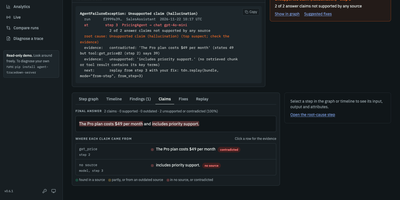
Tracedown finds the exact step that made your AI agent fail, shows the evidence, and replays the run with a fix to prove the problem is gone. Import failed runs from Langfuse, Arize Phoenix or any OpenTelemetry exporter with no code changes, or add one line to any of 13 agent frameworks, including LangGraph, CrewAI, and OpenAI Agents. A failed run turns into an AI stack trace you can paste into an issue, naming the root cause, the evidence, and whether the agent or the user was at fault. Replay re-runs the agent from the broken step with your change while earlier steps come from the recording, and the fix check repeats each suggestion three times without firing real tools. It also checks each claim against its sources, compares runs across prompt and model versions, groups failures into incidents with Slack, PagerDuty, or GitHub alerts, and reports cost per run, step, and model. Diagnosis is rules first, so it runs instantly and privately without an API key, with an optional LLM judge for sharper accuracy. Ask Claude Code or Cursor why a run failed through the built-in MCP server, and export spans over OTLP to any collector. Start as one container for a team, then scale out with Compose or a Helm chart; SSO, roles, and an audit log come included. Running on a dedicated VPS on RepoCloud with guaranteed CPU, RAM, and SSD, full root SSH access, and a browser serial console. Apache-2.0 licensed.
1FlowBase
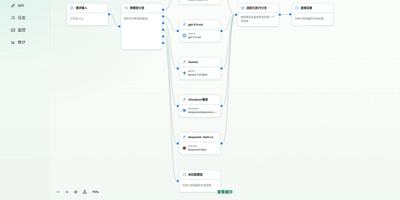
1FlowBase gives teams a single self-hosted foundation that connects model providers, retains every AI conversation, and turns that activity into working business applications. You connect OpenAI, Anthropic, Gemini, DeepSeek, Alibaba Cloud Bailian, or any OpenAI-compatible API through provider plugins and publish one stable endpoint for clients. Requests convert between Anthropic Messages, OpenAI Chat Completions, and OpenAI Responses, so applications keep working when a provider changes. You can route traffic by model name, fall back across branches when a provider fails, and combine planning, execution, and review models into a virtual model that callers use like any other model. Every gateway conversation is recorded with its model, reasoning effort, status, token totals, recorded cost, and latency, then broken down by model and by user in statistics views. You define data models and data sources, expose CRUD APIs, schedule workflows, and publish an OpenAPI 3.1 document for each application. Agents reach the same runtime through MCP with progressive list, get, and call tool discovery, and you manage MCP instances and third-party servers from the console. Pages come from native React blocks that you edit in place with a built-in AI assistant. Running on a dedicated VPS on RepoCloud with guaranteed CPU, RAM, and SSD, full root SSH access, and a browser serial console. Apache-2.0 licensed.
SandBase Harness
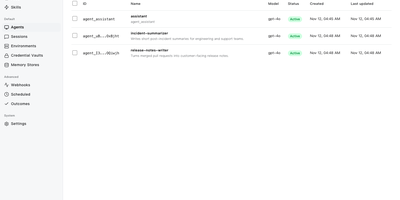
SandBase Harness gives your AI agents a proper home with sessions, tools, sandboxes, and an audit trail instead of a pile of scripts. The console lists agents with their model, status, and version, and an agent page shows its system prompt, attached tools, and skills. Every session keeps a resumable event log, and a transcript view opens any user or agent message as a rendered or raw event. Built-in tools run in a local process, per-session Docker containers, Kubernetes, or a self-hosted worker queue, and permission policies can always allow a tool or always ask a human first. MCP toolsets, credential vaults, and skill packages extend what an agent can reach, with Anthropic's xlsx, pptx, pdf, and docx skills listed next to your own. Memory stores, webhooks, scheduled deployments, and outcome definitions cover longer-running work. Settings include a model provider form, API keys for bearer authentication, and an interactive API reference for sessions, agents, environments, and vaults. A TypeScript SDK and a bundled MCP bridge connect other tools to the same runtime. Running on a dedicated VPS on RepoCloud with guaranteed CPU, RAM, and SSD, full root SSH access, and a browser serial console. Apache 2.0 licensed.