Stars
Forks
Watchers
Developer links
Open Canvas
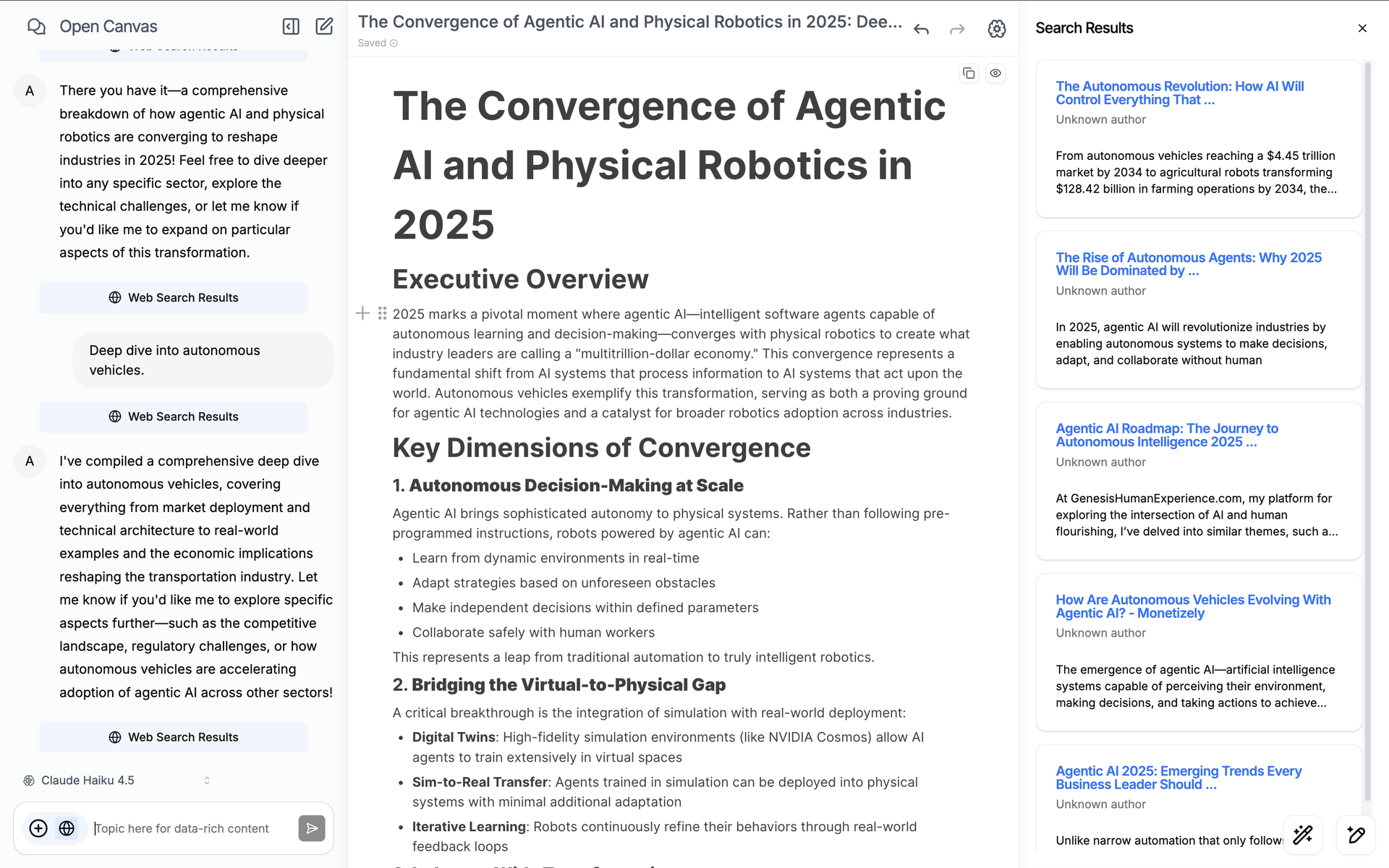
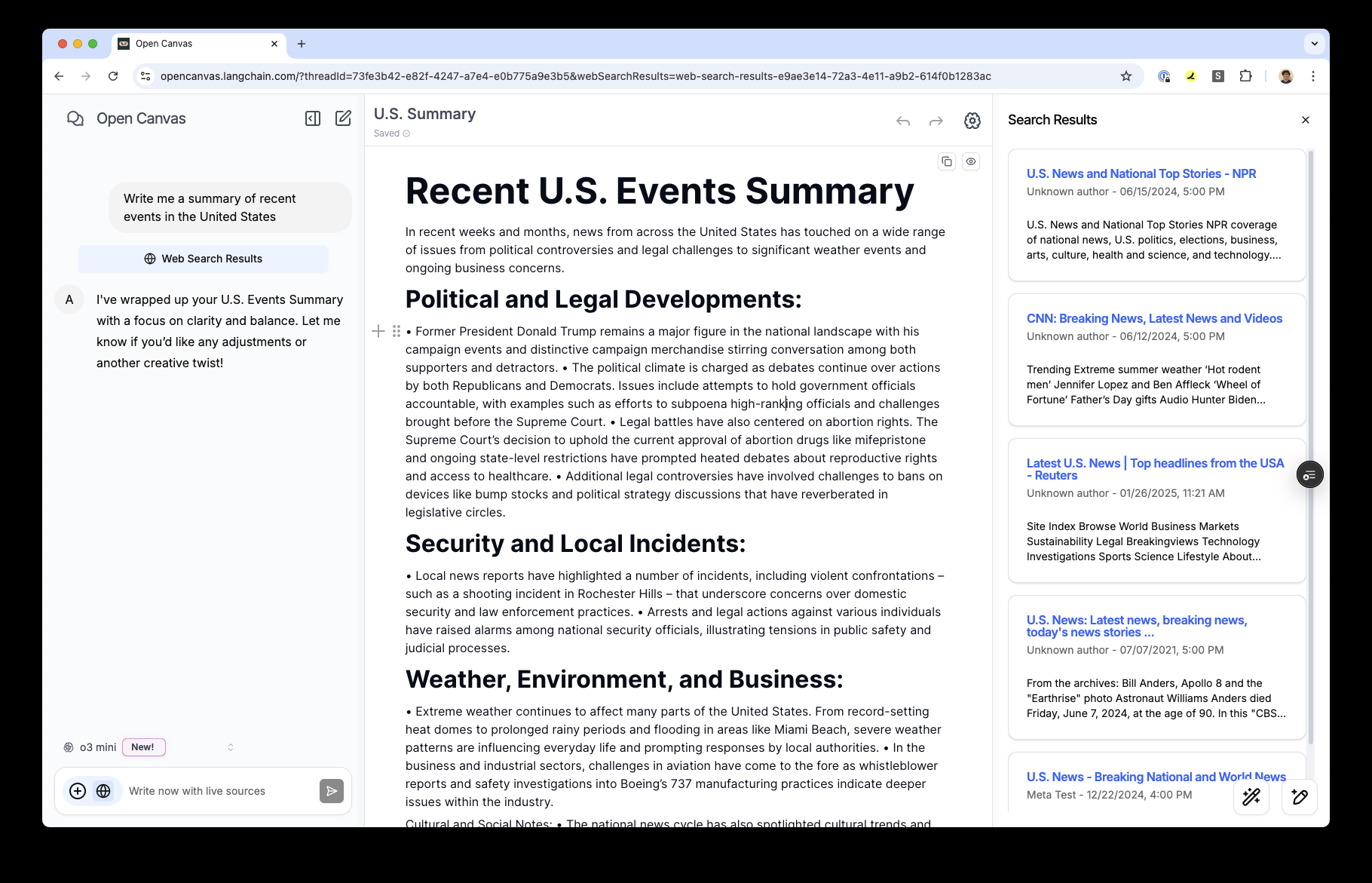
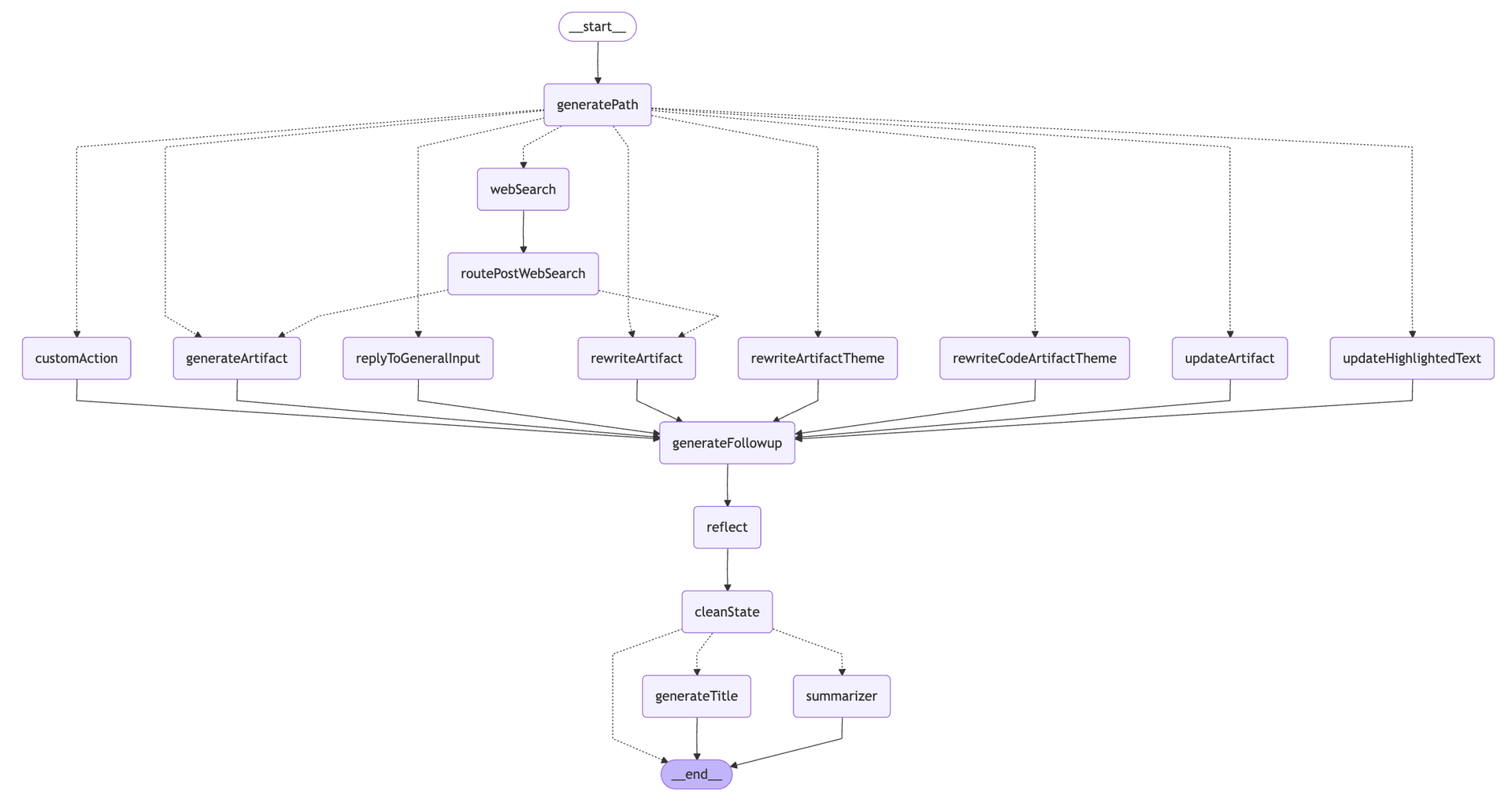
Open-source alternative to OpenAI's Canvas — a collaborative writing and coding environment where AI agents help you draft, edit, and refine documents through an agentic architecture built on LangGraph. The dual-mode editor combines a BlockNote rich text editor for live-rendered markdown with a CodeMirror-based code editor supporting syntax highlighting across multiple programming languages, letting you switch between prose and code artifacts within the same session. The built-in reflection agent automatically generates style rules and user insights from your chat history, storing them in a shared LangGraph memory store that persists across sessions for increasingly personalized assistance. Pre-built quick actions provide one-click access to common writing transformations including summarize, expand, simplify, and translate, while coding actions offer explain, refactor, add comments, and convert between languages. The monorepo architecture separates the Next.js 14 frontend from the LangGraph agent backend, connecting via HTTP and WebSocket protocols through the @langchain/langgraph-sdk client. Seven LLM providers are supported out of the box — OpenAI, Anthropic Claude, Google Gemini, Fireworks AI, Groq, Azure OpenAI, and local Ollama models — with Supabase handling authentication and data persistence. Deploy via Docker or build from source. Running on a dedicated VPS on RepoCloud with guaranteed CPU, RAM, and SSD, full root SSH access, and a browser serial console. MIT licensed.
Benefits
- Built-In Reflection Memory System
- A reflection agent automatically learns your writing style and preferences from conversations, storing rules in a shared memory store that personalizes all future editing sessions.
- Start From Existing Content
- Begin editing sessions with your existing documents, code, or markdown rather than forcing a chat-first interaction, enabling natural iteration on work already in progress.
- Seven LLM Provider Support
- Connects to OpenAI, Anthropic Claude, Google Gemini, Fireworks AI, Groq, Azure OpenAI, and local Ollama models with provider selection per session for maximum flexibility.
- Agentic Document Collaboration
- AI agents generate, rewrite, and incrementally update documents while maintaining full conversation context across sessions, enabling iterative refinement through natural language instructions and contextual suggestions.
Features
- Dual-Mode Editor
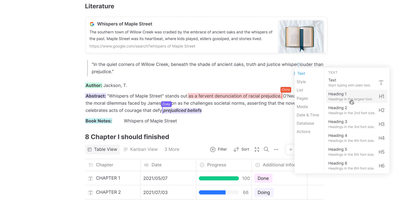
- BlockNote rich text editor for live-rendered markdown alongside CodeMirror for syntax-highlighted code with seamless switching between prose and code artifacts.
- Quick Action Toolbox
- Pre-built one-click transformations for writing (summarize, expand, simplify, translate) and coding (explain, refactor, add comments, convert language) tasks.
- LangGraph Agent Backend
- State machine orchestration via LangGraph handles content generation, reflection, and incremental updates with structured tool calls and streaming responses.
- Live Markdown Rendering
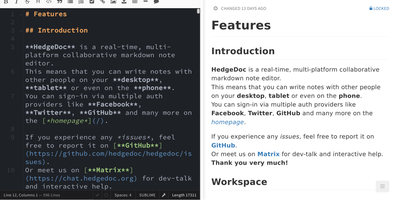
- View rendered markdown output while editing source text without toggling between modes, providing immediate visual feedback during document composition.
- Supabase Authentication
- Built-in user authentication and data persistence via Supabase with per-user memory stores, artifact history, and session management.