Kandev
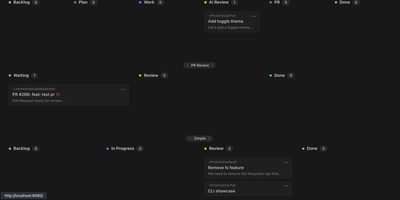
Kandev provides a command center for orchestrating AI coding agents across parallel workstreams. The Go backend paired with a Next.js frontend delivers kanban boards with drag-and-drop columns, pipeline workflow definitions with per-step agent handoffs, and an IDE-like review workspace combining file editor, file tree, terminal, browser preview, and unified git diffs. Multi-provider support connects Claude Code, GitHub Copilot, Codex, Qoder, Grok, and custom agents through configurable profiles with per-agent prompts, runtimes, and review gates. Tasks execute in isolated git worktrees with multi-repository support, letting agents work on separate branches simultaneously while changes surface in a consolidated review interface. Native integrations with GitHub, GitLab, Jira, Linear, Sentry, and Slack pull external issues into the kanban and link tasks to pull requests. Kandev exposes streamable HTTP and SSE MCP endpoints, enabling external clients — Cursor, Claude Desktop, Augment — to create tasks and read workspace context programmatically. Workflow definitions export as portable YAML for sharing across installations. Agentic workflows chain multi-step pipelines mixing different models per step — Opus for architecture, Sonnet for implementation, with human review gates between stages. Running on a dedicated VPS on RepoCloud with guaranteed CPU, RAM, and SSD, full root SSH access, and a browser serial console. AGPL-3.0 licensed.
Timon
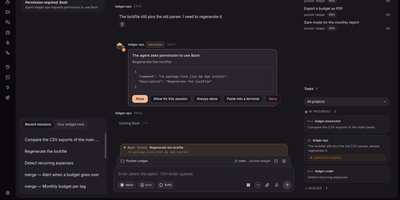
Describe a software job in plain words, and Timon's orchestrator splits it into tasks for a coder, a reviewer, and a merger working in parallel. Each coding task gets its own git worktree, a second model reviews the diff and sends it back when it falls short, and the merger runs the full test suite before landing the branch. A Kanban board tracks briefs, priorities, dependencies, and scheduled start times through pending, in progress, done, and blocked statuses. Agents ask before they push, publish, or delete anything, through clickable questions and permission cards, and secrets stay out of their sight. Work runs on the Claude Code, Codex, Copilot, Grok, opencode, Pi, and Hermes command line tools you already sign in to, and a mission moves to the next backend when one subscription runs dry. Memory carries a rule learned once into the next mission, and a crashed mission resumes from its recorded turns and tool calls. Routines, cron schedules, and webhook triggers run overnight series paced to your quotas. Each mission gets an isolated browser with annotations and recordings, voice dictation turns speech into requests, and the agents answer from a browser, a phone, Telegram, or the command line. Widgets, pages, themes, and layouts install as signed plugins without a restart, and agent roles are plain fields you can rename or extend. Running on a dedicated VPS on RepoCloud with guaranteed CPU, RAM, and SSD, full root SSH access, and a browser serial console. AGPL-3.0 licensed.
Tucano
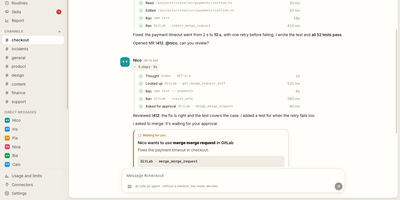
Tucano turns the coding agents you already use into a team that talks in channels, passes work between its members, and stops before anything real happens. Agents have names, roles, tools, and memory, and an @mention hands the turn to the next one, so one finds the bug, another fixes it, and a third reviews it. Connectors speak MCP for Jira, GitLab, GitHub, Slack, Datadog, or your own internal server, and each agent gets no access, read, or read and write per tool. Merges, purchases, posts, emails, and deletes arrive as approval cards showing the exact call, to approve once, always allow, or refuse with a reason, in the app or on Telegram. A Memory page lets you review, edit, and forget what agents learned, repeated paths become proposed skills, and skills from Claude Code and Codex import in one click. Routines run on a weekly calendar or when a connector reports a new issue, failing monitor, or email. Each agent picks its own harness and model and has a monthly token limit, while one Pause everything button halts the whole team. Agents can work in an isolated Linux computer or a live Chrome that you can take over. Server mode serves the same screens to a browser, listens on localhost by default, and pairs phones with one-time codes. Running on a dedicated VPS on RepoCloud with guaranteed CPU, RAM, and SSD, full root SSH access, and a browser serial console. Apache-2.0 licensed.
CUGA
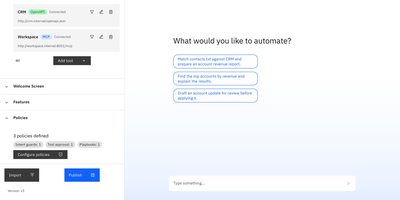
Turn a plain business request into a finished workflow, with a human sign-off on anything risky. CUGA is an agent harness you run on your own infrastructure, with a browser workspace where you build agents, test them beside a draft chat, and publish a versioned configuration when it behaves. Connect tools through MCP servers or OpenAPI specs, then write five kinds of policy: intent guards, playbooks, tool guides, tool approvals, and output formatters. A supervisor agent can route work to specialists that each carry their own tools and instructions. The chat workspace keeps conversation threads, uploaded files, and a knowledge panel for cited answers from company documents. Event Studio runs watchers on cron schedules, polling, or push triggers, with run history showing tools used and results. Memory records task guidance and user preferences, shows where each came from, and lets users switch it off or forget items, and administrators set retention rules. OIDC sign-in separates chat users from managers. Point it at any OpenAI-compatible endpoint, including a private inference server. Operations teams, internal tooling groups, and platform engineers can automate CRM reports, document review, and recurring briefs without sending data outside their boundary. Running on a dedicated VPS on RepoCloud with guaranteed CPU, RAM, and SSD, full root SSH access, and a browser serial console. Apache-2.0 licensed.
T3 Code
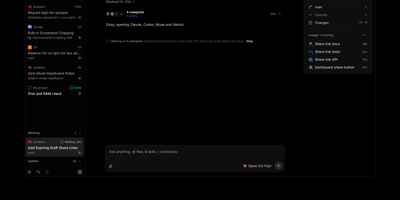
T3 Code puts every coding agent you already pay for behind one control surface, so Claude Code, Codex, Cursor, Grok Build, OpenCode, and Antigravity all run on your server while you direct them from your phone, browser, or desktop. Start a thread, choose the provider and model that fit the job, and watch the agent work in a shared conversation instead of a terminal you have to babysit. Permission modes decide when an agent must stop and ask, and its approvals, questions, and plan reviews arrive in the same thread wherever you happen to be connected from. When the work lands, review it file by file in the built-in diff view, then commit, push, and open pull requests through the Git and GitHub integrations without leaving the app. A real terminal sits beside the chat, and projects, settings, and scheduled tasks stay attached to the machine where the code actually runs. Install it as a background service and reach it from anywhere through T3 Connect, a Tailscale or LAN pairing, or the hosted web client, with a pairing code guarding local access. Outside agents can also drive threads over MCP, launching, messaging, and waiting on work across machines you have linked together. Running on a dedicated VPS on RepoCloud with guaranteed CPU, RAM, and SSD, full root SSH access, and a browser serial console. MIT licensed.
Happier
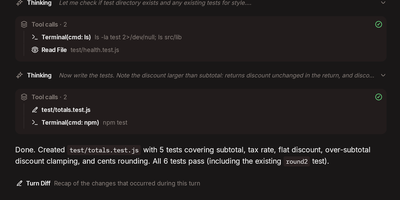
When a dozen coding agents are running at once, Happier puts every session in one list and lifts the ones waiting on you to the top. Sessions that need a decision gather under Needs attention and running ones sit under Working, so nothing stalls unseen. Start Claude Code, Codex, OpenCode, Pi, Cursor, Gemini, Copilot, Qwen, Kimi, Auggie, Kilo, Kiro, or Grok on any computer you have connected, or add a custom ACP backend for another agent CLI. Switch the agent mid-session, let Claude hand a review to Codex as a subagent, and move a live Claude Code or OpenCode session to another machine. Read the tool-call timeline, review the diff, mark exact lines, and send those notes back to the same session or a fresh one. Stage, commit, push, and open pull requests from the Git panel, or give each session its own worktree. Queue messages, steer a running turn, edit files, open a terminal, or dictate to the voice assistant. Pool several accounts so work continues when one hits a usage limit, and watch five-hour and weekly quotas reset. Share a session view-only, with edit rights, or as a public link. Content is end-to-end encrypted by default, and the relay serves the web app, so any browser can reach it. Running on a dedicated VPS on RepoCloud with guaranteed CPU, RAM, and SSD, full root SSH access, and a browser serial console. MIT licensed.
Agent Swarm
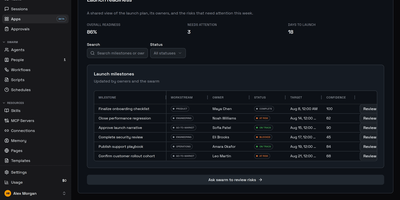
Agent Swarm gives a company one lead AI agent and a crew of coding workers that take requests from Slack, GitHub, Linear, or email and hand back pull requests while people only approve. The lead reads each request, plans it, and delegates to workers that run Claude Code, Codex, pi, opencode, Cursor, or Amp in isolated containers with a full development environment. Every agent keeps a persistent identity, and what one learns goes into shared memory with hybrid keyword and vector search, so the next task starts with context. Schedules run recurring jobs on cron or interval timers, and a DAG workflow engine adds triggers, conditions, per-step retries, and approval nodes that pause until someone answers in the dashboard or in Slack. The dashboard lists tasks, sessions, approvals, agents, people, workflows, scripts, skills, MCP servers, memory, and per-user usage costs. Its Apps feature builds versioned, role-restricted pages such as an incident board or a launch tracker, each with history and rollback. A configuration page tunes steering, memory, and integrations without editing environment files, and official templates supply ready-made agents for coding, review, research, QA, and content work. Workers can expose HTTP services, call approved third-party routes, and pay for x402 APIs in USDC. Running on a dedicated VPS on RepoCloud with guaranteed CPU, RAM, and SSD, full root SSH access, and a browser serial console. MIT licensed.
AgentField
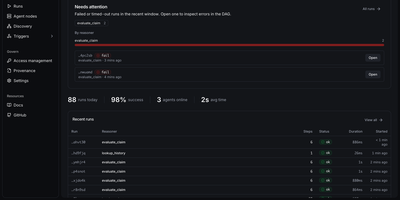
AgentField is the production backend that makes an AI agent as callable as any other microservice. A Python, Go, or TypeScript function decorated as a reasoner or skill registers with the control plane and instantly becomes a REST endpoint, and agents call each other through the same plane, so every hop is routed and traced. The dashboard summarizes runs, success rate, online agents, and a run timeline, and a Needs attention list surfaces failed runs with a one-click jump into the DAG. The Runs page filters and searches every execution, and a run opens into a step-by-step trace with timings, inputs, and outputs, or a graph of the call tree across agents. Agent Nodes lists each registered service with version, endpoints, and process logs. The Playground executes any reasoner from a form and shows the result and recent runs. Fan-outs run async with webhooks, server-sent events, bounded queues, and backpressure, and a single run may continue for hours. Human approval pauses, canary traffic weights, Prometheus metrics, access policies, and signed provenance records cover governance. Running on a dedicated VPS on RepoCloud with guaranteed CPU, RAM, and SSD, full root SSH access, and a browser serial console. Apache-2.0 licensed.
Jean
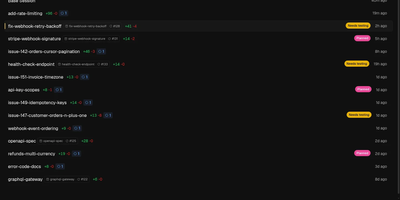
On your own server, Jean runs a team of AI coding agents, each in its own git worktree, and lets you steer them all from a browser tab. Every task starts from real context: a GitHub issue, pull request, workflow run, Dependabot alert, security advisory, Linear ticket, Sentry error, or a plain prompt. Jean creates an isolated worktree with its own chat sessions, terminal, and diff, so several agents can edit one repository without colliding. Choose the backend per task from Claude, Codex, Cursor, OpenCode, Pi, Command Code, Grok, and Kimi Code, using your own subscriptions and CLI logins. Plan, Build, and Yolo modes, plan approval, and session recaps keep long runs reviewable. Magic commands handle commits, pull request descriptions, AI code review with tracked findings, merge conflict resolution, and release notes, and every prompt is editable with its own model and reasoning effort. A split or stacked diff viewer covers uncommitted changes, branches, commits, and checkpoints, with line comments. Mr. Robot, a beta sweeper, polls open issues and drafts plans in fresh worktrees. Linked projects share context across repositories, and MCP servers can be switched on per project or per session. Token-protected web access works from a laptop or a phone, and the desktop app can attach to the same server. Running on a dedicated VPS on RepoCloud with guaranteed CPU, RAM, and SSD, full root SSH access, and a browser serial console. Apache-2.0 licensed.
Alook
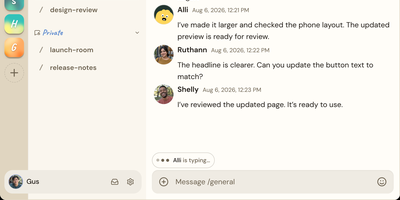
Alook gives the coding agent on your machine a seat in the team chat, with its own handle, inbox, and room memberships, so colleagues can ask it for work the same way they would message a person. You create servers, channels, and direct messages where people and agents are both first-class members, and an agent keeps one persistent identity across every room it joins. Claude Code, Codex, Cursor, OpenCode, Pi, Grok, and Antigravity connect through a small daemon, so the agent keeps running on your own hardware while the room stays reachable from anywhere. Because the agent holds memory across rooms, it can pick up a thread in one channel, report progress in another, and move tasks forward without you relaying messages by hand. Inviting a teammate takes a link; they join the room and talk with your agent directly instead of waiting for you to copy answers back and forth. The same room follows you from desktop to phone, so a question asked at your desk is still there, with the agent's reply, when you check it later. Self-hosting runs the web app, realtime WebSocket service, email worker, and wake-up queue on your own server with a local database, started with a single npx command. Running on a dedicated VPS on RepoCloud with guaranteed CPU, RAM, and SSD, full root SSH access, and a browser serial console. Apache 2.0 licensed.
Agent of Empires
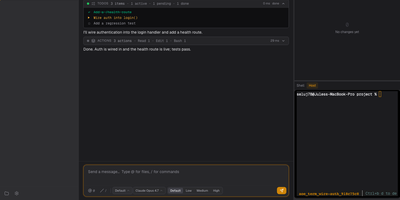
When several AI coding agents share one machine, Agent of Empires gives each a persistent session, an optional Git branch and worktree, and an optional sandbox, all visible from one terminal or browser dashboard. Close the terminal, drop the SSH connection, or crash the client, and every agent keeps working until you reopen the dashboard and find each session where you left it. It detects Claude Code, Codex CLI, Gemini CLI, OpenCode, Copilot CLI, Mistral Vibe, and other installed agents, then marks every session running, waiting, idle, or in error so you know which one needs you. Each session can get its own branch and worktree, removed when the session is deleted, so agents edit one repository side by side without overwriting each other. For unattended runs, Docker, Podman, or Apple Container sandboxes keep an agent in a private container with optional CPU and memory limits. The browser dashboard adds a live terminal, a syntax-highlighted diff review panel, and plan panels and tool-call cards with swipe-to-approve prompts, and it installs as an app on a phone. Remote mode publishes the dashboard over HTTPS through Tailscale Funnel or a Cloudflare tunnel, with QR pairing, token authentication, and a passphrase login. Running on a dedicated VPS on RepoCloud with guaranteed CPU, RAM, and SSD, full root SSH access, and a browser serial console. MIT licensed.
AgentRun
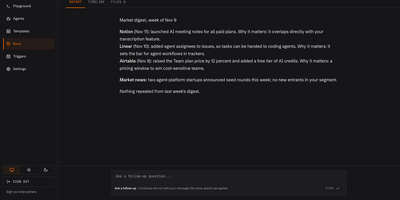
A control room for AI agents, where every run is recorded, capped, and ready to resume after a crash. Mission Control opens first with agent and run counts, tokens, success rate, and cost per day. A Templates page applies ready-made agents for code review, KYB due diligence, lead scoring, market monitoring, and release notes in a single screen. Every run gets a Report tab with the finished answer and a Timeline tab with each message, tool call, and charge. Tools are set to allow, ask, or deny. Spend caps pause a run instead of failing it. An agent can stop and ask a person a question. The Playground starts a run from a form and shows the same request as curl, so each agent doubles as an API. Triggers start capped runs on a schedule, from a signed webhook, or on a GitHub pull request. Learning mode keeps notes, skills, and workflows from each job so repeat work needs fewer tokens. Automated code review, customer research, and competitor digests are typical recurring jobs to hand it. Running on a dedicated VPS on RepoCloud with guaranteed CPU, RAM, and SSD, full root SSH access, and a browser serial console. Apache-2.0 licensed.
LoopTroop
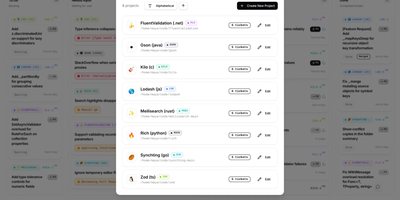
Big coding tickets fall apart inside one endless AI chat, so LoopTroop splits each into stages with fresh, minimal context and ends in a pull request. A council of two to ten models drafts, scores, and votes on each plan, beginning with interview questions that reach you in adaptive batches. The winner refines its draft into a PRD of epics and user stories. That PRD is cut into beads, small tasks with acceptance criteria, target files, and validation steps. Each bead runs in OpenCode inside an isolated Git worktree, so your checked-out branch stays clean. During a bead the agent sees only that task, its target file, and the test file. When a bead fails, the Ralph Loop keeps a compact error trace, resets the worktree, and retries in a fresh session, so tickets can run unattended overnight. You approve specs, blueprints, and the final changes at human gates. Optional Manual QA hands you a checklist for the running app and turns failures into fix beads. A dashboard shows council progress, generated artifacts, live logs, and bead changes. Free-tier models from OpenRouter, NVIDIA NIM, or OpenCode let you start without paid API keys. LoopTroop collects no telemetry, and the project recommends a disposable VM because the agent runs with your permissions. Running on a dedicated VPS on RepoCloud with guaranteed CPU, RAM, and SSD, full root SSH access, and a browser serial console. MIT licensed.
Heym
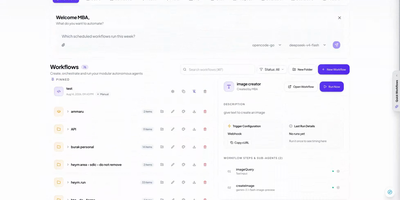
Heym lets you build AI agents and workflows on a visual canvas, run them from APIs, schedules, or chat, and watch every execution, token, and cost. Describe a system in text or voice and the AI Assistant draws the graph. Prefer hands-on? Compose it from LLM and Agent nodes, conditions, switches, loops, merges, and sub-workflows. An orchestrator calls named sub-agents in parallel. RAG runs on Qdrant or pgvector, and a knowledge graph keeps facts across runs. Triggers: cron, webhooks, messaging integrations, inbox events, WebSocket messages. Playwright nodes automate browsers, and Codex or OpenCode steps work on repositories. Checkpoints pause an agent so a person can accept, edit, or refuse before the run resumes. Every run lands in History. Traces list model requests, tool calls, tokens, latency, and USD cost, and alerts fire on errors, duration, spend, or run count. Evals compare prompts across models. OpenTelemetry exports reach Jaeger, Grafana Tempo, or Datadog. Publish workflows as REST or SSE endpoints, as MCP tools for Claude Desktop and Cursor, or as public Portal chat pages, then add dashboard widgets, Data Tables, a Kanban Board, and Drive file sharing. Running on a dedicated VPS on RepoCloud with guaranteed CPU, RAM, and SSD, full root SSH access, and a browser serial console. Source-available under the MIT License with the Commons Clause.

CrewAI Studio
Anyone who can fill in a form can run a crew of AI agents in CrewAI Studio, from defining roles to reading results, with no code to write. Each agent gets a role, backstory, goal, delegation switch, iteration limit, and temperature. Pick a provider and model per agent: OpenAI, Anthropic, Groq, xAI Grok, Ollama, or LM Studio. Tasks carry an expected output, can run asynchronously, and can take context from other tasks. Agents can search the web, scrape pages, run code, and query GitHub, YouTube, or Yahoo Finance news. Search tools also read your own PDF, CSV, DOCX, JSON, MDX, and text files. Custom tools call HTTP APIs and write files into a folder you choose. Knowledge sources accept text, PDF, CSV, Excel, JSON, or Docling files, with adjustable chunk size and overlap. Crews run tasks in sequence or under a hierarchical manager, with memory, cache, planning, and rate-limit options. Kickoff turns placeholders in agent and task text into input boxes and runs the crew in the background. A console panel shows the crew's output while it works, and a Stop button halts a run. Every run is saved, filterable by crew and date, and readable rendered, raw, or printable. Export one crew or everything as JSON, import it elsewhere, or generate a standalone single-page app. Running on a dedicated VPS on RepoCloud with guaranteed CPU, RAM, and SSD, full root SSH access, and a browser serial console. MIT licensed.
SoduWork
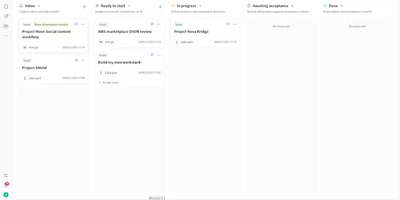
When an AI agent says the job is done, SoduWork makes a second agent check the work against your acceptance criteria and a person sign off before the request closes. You file a request, AI refines it and drafts the criteria, and you assign it to yourself, a colleague, or an agent. A failed review sends the work back with reasons. Seven harnesses are supported: Pi, OpenCode, Qwen Code, Kimi Code, DeepSeek Harness, Codex Harness, and Codex. Switch between them mid-conversation without losing history or the working folder, and any program that speaks the Agent Client Protocol joins through a catalog entry. Routine steps run on cheap or local models, hard ones on strong models, and long tasks move to a cloud runner on a server you provide. Save a chat that went well as a versioned plugin with inputs, workflow steps, and acceptance criteria, then submit it for review, grant it to chosen people, or revoke it. Plugin Developer drafts plugins from a description in chat, and the catalog already covers documents, slide decks, spreadsheets, deep research, PDF work, meeting minutes, and code repair. Admins get roles, usage and cost tracking, a model catalog, and an audit log, and connectors reach business systems through OAuth sign-in, OpenAPI documents, and MCP servers. Running on a dedicated VPS on RepoCloud with guaranteed CPU, RAM, and SSD, full root SSH access, and a browser serial console. MIT licensed.
Mikka
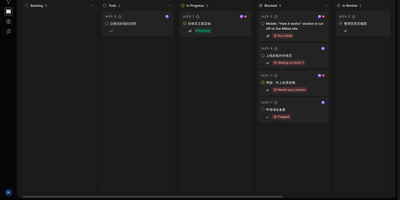
Instead of babysitting three coding agents in three terminal windows, you describe the work once and let Mikka run the team: its Coordinator bot plans the job, dispatches runs to Claude Code, Codex, or Cursor on your connected machines, and only interrupts you when a decision is actually yours. Every piece of work lives in a thread with its own conversation, so dispatched runs appear as cards that report progress, ask questions, and flag blocks while you watch, reply, or stop them from the web, desktop, or phone. Unclear requests come back as choice cards before anything runs, and finished work moves through review and verification runs, back to a fix run when a check fails, then to acceptance where the pull request merges as you. Runs use leases and checkpoints, so a machine that drops mid-task hands the work to another connected computer with the same repository. You can create your own bots beside the Coordinator, each with its own chat, memory, and threads, and answers can arrive as charts, tables, stat cards, and task chips with sources cited. Daemons connect over SSH or from the desktop app, other agents drive Mikka through MCP, and Telegram or Slack messages reach the Coordinator too. Running on a dedicated VPS on RepoCloud with guaranteed CPU, RAM, and SSD, full root SSH access, and a browser serial console. AGPL-3.0 licensed.
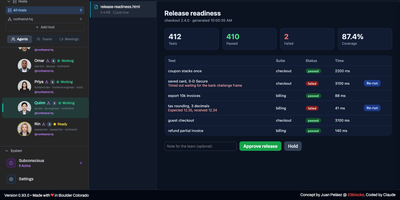
AI Maestro
One dashboard shows every AI agent you run, which machine it lives on, and whether it is working, waiting on you, or ready. Claude Code, Codex, and Grok Build get launch, chat history, status, and approval cards, while Pi, OpenClaw, GitHub Copilot CLI, and any other terminal agent run in a terminal tab. Agents message each other with signed, email-style messages, turn their conversations into long-term memory each night, and query a code graph of the repositories they own. Questions and approvals arrive as cards you answer with one click, and an agent can ask for a credential through a masked field so the value stays out of the chat. Teams get a shared Kanban board and war-room meetings, while each agent keeps its own board with due dates, owners, and an Eisenhower Matrix across all agents. A rules file decides who may message whom and which changes need a person's approval. Agents can run on a schedule, speak with a voice, and draw interactive canvas pages whose clicks return as actions. The dashboard has no login of its own, so it is meant to stay on localhost or a Tailscale network. Running on a dedicated VPS on RepoCloud with guaranteed CPU, RAM, and SSD, full root SSH access, and a browser serial console. MIT licensed.