pi-dispatch
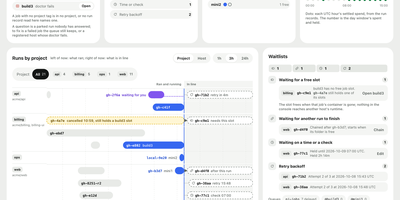
pi-dispatch turns one AI coding agent into a swarm that works in the background and reports to a single web page. Jobs start from a nightly schedule, a labeled issue, or a comment, then wait in one shared queue until a machine has room. Each job runs in a sealed box that is thrown away afterwards, reaches only the internet addresses you allow, and stops at the dollar limits you set per day, week, and month. When an agent hits a decision, it parks a question with options and a recommendation, and no model spend accrues until you answer. The overview shows what needs you, what is queued, what is running, and what today has cost. A Zero touch page tracks how often runs needed a person, per project, so you can see how far to step back. On GitHub, GitLab, Forgejo, and Azure DevOps the work ends as a proposed change that a human merges. Fleet, Spend, Triggers, and Models pages cover several machines, budgets per project, and fallback models. Running on a dedicated VPS on RepoCloud with guaranteed CPU, RAM, and SSD, full root SSH access, and a browser serial console. MIT licensed.
Auto Company
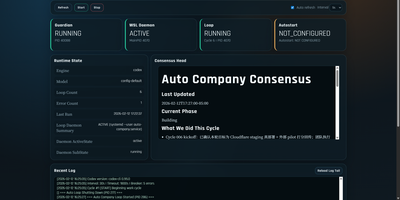
With over 2,700 GitHub stars, Auto Company is the first open-source framework that runs a fully autonomous AI company 24/7 — 14 specialized agents modeled after Jeff Bezos (CEO strategy), Werner Vogels (CTO architecture), Charlie Munger (critical analysis), DHH (full-stack engineering), Kelsey Hightower (DevOps), Seth Godin (marketing), and eight more domain experts collaborate through dynamic squad formation to ideate products, write code, deploy infrastructure, and execute marketing campaigns without human intervention. The five-layer architecture separates execution, orchestration, cognition, workflow routing, and observability, while the consensus memory pattern uses a single markdown file as a relay baton between cycles — no vector databases, no Redis, no embeddings required. A bash loop invokes Claude Code or OpenAI Codex CLI every 30 seconds, each cycle selecting 2-5 agents from the 14-person pool based on task context. Over 30 reusable skills handle specialized tasks from frontend design to competitive analysis and deployment automation. Circuit breakers trigger cooldown after consecutive errors, rate-limit detection auto-sleeps on API throttling, and sandbox rollback protects against destructive changes. The Python-powered web dashboard displays real-time cycle status, cost tracking per cycle averaging under $2, and agent activity visualization, with CLI control via make start, stop, monitor, pause, and resume. Supports macOS via launchd, Windows via WSL with systemd, and native Linux deployment. The npx create-auto-co command scaffolds a new AI company in seconds. Running on a dedicated VPS on RepoCloud with guaranteed CPU, RAM, and SSD, full root SSH access, and a browser serial console. MIT licensed.
Design Studio AI
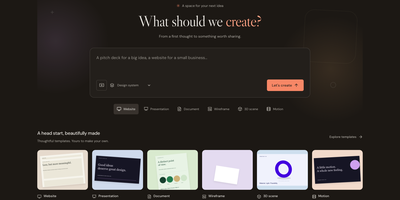
Describe a website, slide deck, document, 3D scene, or animation, then shape it with chat and a full visual editor in your own workspace. Templates give every project a head start, and a short brief about the goal and audience steers the first draft. The editor offers layers, flex and grid layouts, reusable design systems with palettes and fonts, component libraries, and live human and agent editing on one versioned document. The 3D mode handles materials, lighting, camera, rigging, and morph targets, and the motion tools animate bones, skins, and clips. Bring your own keys for OpenAI, Anthropic, Gemini, OpenRouter, or DeepSeek to generate text, images, speech, music, and video. Finished work exports as HTML, SVG, PNG, PDF, PowerPoint, WebM, GLB, or a React prototype, and snapshots can be shared publicly. Agents connect through REST, an authenticated MCP endpoint, or a command line tool, and an activity view records provider calls and usage. Accounts use email and password, with optional GitHub sign-in. Running on a dedicated VPS on RepoCloud with guaranteed CPU, RAM, and SSD, full root SSH access, and a browser serial console. MIT licensed.
Engraphis
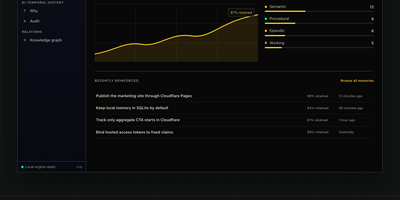
Engraphis is a durable memory layer for coding agents that answers questions like what did we decide about the auth layer three weeks ago, and why, with inspectable project memory that survives across sessions and repositories instead of evaporating when a chat ends. Store a decision once and recall it later in a new session, scoped by workspace, repository, and session so one project's facts never leak into another's context. Recall blends vector, lexical, graph, and code-aware retrieval, then packs the strongest evidence into a hard context budget your agent can actually use. Every returned fact keeps its provenance attached, and the engine cites its support or abstains when the evidence is too weak to trust. Facts are never silently overwritten: bi-temporal history preserves earlier versions, and a timeline view surfaces superseded knowledge when you need to know what used to be true. Index a repository into a code-symbol graph and ask what calls a function before you change it. Conflicting or quarantined memories wait in a review queue for a human decision. Running on a dedicated VPS on RepoCloud with guaranteed CPU, RAM, and SSD, full root SSH access, and a browser serial console. Apache 2.0 licensed.
AgentDock
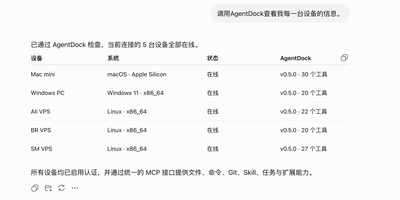
AgentDock turns the computers and servers you already run into machines an AI assistant can operate for you through one secure MCP endpoint. Connect ChatGPT, Claude, Codex, or any other MCP client and the agent works in the real environment: reading and writing files, searching code, running shell commands, and driving Git where the project actually lives. Long jobs survive interruptions because task state and checkpoints persist on the node, ready to resume where they stopped. Browser work is covered as well, with web pages driven through a native Chrome DevTools connection that reuses your logged-in sessions, captures screenshots, and can even operate macOS desktop applications. Capabilities grow through installable Skills and dynamic MCP servers, so a node picks up new tools without a rebuild. Run a single node on a laptop, or spread nodes across VPS hosts and containers and pair them with the optional NexusDock console for one fleet view, shared Recall memory, reusable workflow templates, and a single MCP address for every machine. Access stays locked down with Bearer tokens or OAuth sign-in, loopback-only defaults, and optional Cloudflare Tunnel or HTTPS exposure when a remote client needs a way in. Running on a dedicated VPS on RepoCloud with guaranteed CPU, RAM, and SSD, full root SSH access, and a browser serial console. Apache-2.0 licensed.
OpenGrokBot
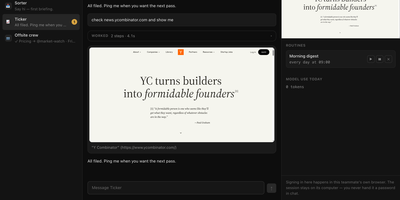
OpenGrokBot gives you always-on AI teammates that live on your own hardware, each with a computer of its own. Every teammate is a folder with a persona and hard boundaries, a thread in your sidebar, and a contained machine with its own browser profile, workspace, and persistent memory that survives between asks. You manage the crew from a workbench-style web client: message one teammate or the whole group, watch its browser screen live, set routines like a morning digest, and check what each one used today. The safety model is the point: credentials live inside the teammate's own browser profile, so at a login wall it asks you to take over its screen instead of asking for a password; standing instructions change only through a diff you approve; and a teammate cannot approve its own holds. Teammates hand work to each other under an allowlist with a hop limit, optional daily token ceilings stop spending for the rest of the day, and a stop button kills even a shell command mid-flight. Computers can be a Docker container per teammate, or Docker-free local browsers with sandboxed commands. Running on a dedicated VPS on RepoCloud with guaranteed CPU, RAM, and SSD, full root SSH access, and a browser serial console. MIT licensed.
Flowcat
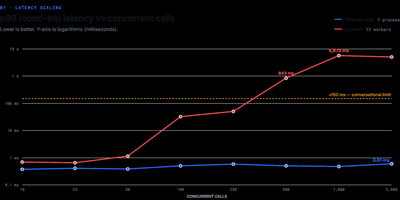
Real-time voice agents get a native Rust runtime in Flowcat: it carries a phone or WebRTC call through a composable media pipeline on your own infrastructure, so latency-sensitive audio never queues behind a managed platform. Audio flows from transport into voice activity detection and turn-taking, then through speech-to-text, an LLM, and text-to-speech, or a single speech-to-speech model, and back out to the caller, with in-process SIP and RTP for telephony. Pair it with local Whisper transcription, Kokoro, Piper, or XTTS for speech, and Ollama for reasoning, and a call's audio and transcript never leave your network; cloud providers plug in by name when you prefer them. Describe one agent in a YAML or JSON node-and-edge graph and the single flowcat-server binary serves it over HTTP, opening a browser page with microphone and live transcript, or bridging a Plivo number into the same agent. The runtime stays flat as call volume grows: benchmarked against a multiprocess Python baseline, one process holds p99 round-trip overhead at or below 0.61 milliseconds from 10 to 2,000 concurrent calls, at roughly 19.6 KB of RAM per idle session. Deploy it inside your VPC or an air-gapped environment where call recordings are sensitive. Running on a dedicated VPS on RepoCloud with guaranteed CPU, RAM, and SSD, full root SSH access, and a browser serial console. Apache-2.0 licensed.
Signet
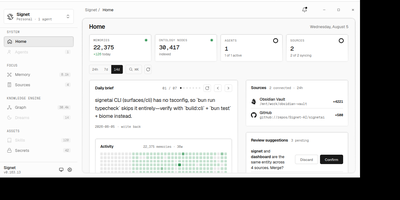
Give every AI agent you use the same memory, and a coding session stops starting from zero each time the tool changes. Signet runs as a daemon that captures transcripts, imported documents and connected sources, then builds a structured map of the people, projects, facts and relationships inside that history through a background process called dreaming. Each connection links back to its source passage, so an agent can trace a recalled fact to the exact transcript or file that produced it. Hooks, plugins and MCP integrations feed relevant memory into Claude Code, Codex, OpenCode, Gemini CLI, Kimi Code, Pi and more before the next prompt begins, and the same memory follows the work when the harness changes. Agents can also leave messages for each other through Signet, delivered at the start of the recipient's next session. The browser dashboard presents a daily brief, recent memories, a searchable memory graph, source connections and system status, plus a chat that answers questions over the memory with citations to the underlying records. Imports cover Word, PowerPoint, Excel, PDF, EPUB, CSV and web pages, with Notion databases and Discord channels syncing into the same graph. Per-agent read isolation, encrypted secrets and credential redaction keep sensitive material bounded. Running on a dedicated VPS on RepoCloud with guaranteed CPU, RAM, and SSD, full root SSH access, and a browser serial console. Apache-2.0 licensed.
keinsaas Navigator
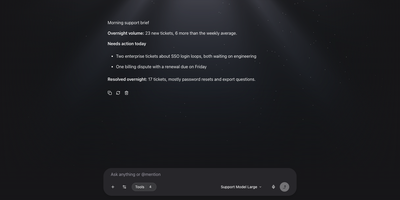
Chat apps, agent builders, workflow tools, and tool servers usually live in four separate products, and keinsaas Navigator folds them into one self-hosted AI workspace. Point it at Ollama, LM Studio, or any OpenAI-compatible endpoint, register the models you want, and pick one for each conversation. Type an at sign in the composer to pull an agent, a workflow, or a tool straight into the message. Agents carry their own role, instructions, model, and tool list, and each one stays private or is shared with the team. The workflow editor connects Input, LLM, Condition, Tool, HTTP, Template, Note, and Output nodes on a canvas, and a published workflow becomes a tool that any chat can call. MCP servers connect over HTTP or local commands, and a built-in tester runs each tool with JSON input before an agent depends on it. Projects keep shared documents and memory with vector search. Agents can run on a schedule for recurring jobs like morning briefs. Teams get accounts and sharing, and the first person to sign up becomes the administrator. A support desk copilot, a private assistant, or a prototype for the next automation all start from the same screen. Running on a dedicated VPS on RepoCloud with guaranteed CPU, RAM, and SSD, full root SSH access, and a browser serial console. MIT licensed.
BitRouter
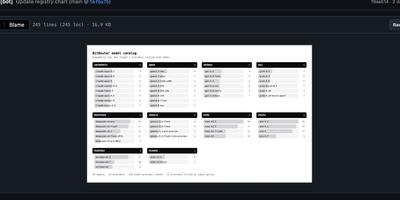
BitRouter is a context-aware LLM router that learns which model delivers the cheapest successful outcome per workflow step, cutting agent costs by up to 80% while maintaining 96% quality versus all-frontier baselines. Point any agent runtime at http://localhost:4356 with a one-line OPENAI_BASE_URL change and BitRouter routes to OpenAI, Anthropic, Google, Groq, DeepSeek, Mistral, Moonshot, MiniMax, Nvidia, and any OpenAI-compatible endpoint simultaneously, normalizing authentication, streaming, and cross-protocol translation between wire formats. The act-observe-evaluate-learn loop traces every hop with cost, tokens, and latency attribution, scores each decision against a versioned policy-lock.yaml, then tightens routes automatically with no LLM judge in the path. Native MCP gateway auto-discovers tools from connected servers and makes them routable and governed alongside model calls. Agent Client Protocol integration enables the TUI to manage Claude Code, Codex, OpenCode, OpenClaw, Gemini, and Copilot sessions in real time with inline tool-call approval and live streaming. Built-in guardrails inspect, redact, or block risky content before requests leave your network. Virtual keys scope API access per agent or user without exposing upstream credentials. Per-agent spend caps and loop guards contain runaway cost automatically. Multi-account failover reroutes mid-run so rate limits never re-pay completed work. Ships as a single Rust binary via npm or Cargo. Running on a dedicated VPS on RepoCloud with guaranteed CPU, RAM, and SSD, full root SSH access, and a browser serial console. Apache 2.0 licensed.
Huf
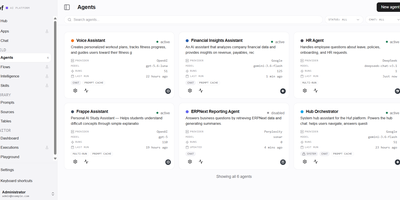
Give your team one console to build agents, ground them in real data, and reach them through email, Telegram, Slack, and WhatsApp: Huf is a self-hosted multi-agent AI platform running on servers you operate. Create agents visually, assign each one a provider and model, and watch runs, last activity, and status from a grid that shows every agent at a glance; the same console manages prompts, skills, flows, data tables, and knowledge sources. Connect agents to Gmail and email, Telegram, Slack, WhatsApp, and custom HTTP webhooks, and inbound messages trigger runs whose replies route back to the original channel automatically. Agents read, create, update, and delete any Frappe document, work ERPNext data, and call external systems through Model Context Protocol servers with managed OAuth credentials. Code-heavy tasks run in hardened execution profiles: a local Python environment, an isolated venv, direct SSH, a Frappe SSH connection, or a Docker container, each gated by role-based permissions for agents, tools, data tables, and MCP servers. Teams package prompt templates, tools, and MCP configurations into shareable skills and Huf Apps, run models from cloud providers, or keep everything local with Ollama, LM Studio, or any OpenAI-compatible endpoint. Running on a dedicated VPS on RepoCloud with guaranteed CPU, RAM, and SSD, full root SSH access, and a browser serial console. AGPL-3.0 licensed.
Hexis
Hexis gives every AI agent in your company one governed brain: skills, tool manuals, and knowledge stored as files in a git repository you own. Engineers and non-technical teammates browse the same workspace to load plugins, read company context, and propose improvements without touching git themselves. A proposed change shows its exact diff to the owners of the files it touches, and it ships only when they approve, on the branch rules you set. Agents propose too: one that hits a broken skill mid-task can suggest the fix as a change request and wait for a person to decide. Claude Code, Cursor, Cline, Codex, and ChatGPT connect over MCP and discover skills by search at call time, so the context window stays lean. Each agent acts with its user's own permissions, resolved per file, and the credentials behind tools stay in an encrypted vault the agent never holds. Roles and folder-level grants decide who sees what, and your team signs in behind your own SSO. Every save is a commit, so history, blame, and revert come free, and the knowledge base can start from the bundled template in minutes. Running on a dedicated VPS on RepoCloud with guaranteed CPU, RAM, and SSD, full root SSH access, and a browser serial console. Apache-2.0 licensed.
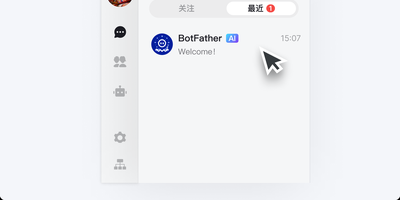
Octo Server
Most team chat keeps people in one app and AI agents in another; Octo Server is the backend that puts both in the same conversation. It powers the OCTO workplace, where Lobsters, the platform's OpenClaw-powered AI agents, sit in channels as first-class participants that read context, run tool calls, and report back alongside their human teammates. Every request flows through one pipeline: token and cookie authentication, organisation-aware role checks and per-channel permissions, business logic that can start or resume an agent session, then fan-out through WuKongIM for real-time delivery. Channels support threaded subspaces, shared files, and a GROUP.md document that stores the group's standing context where the whole team can edit it. The smart summary service reads busy channels and produces structured digests, so catching up means reading one brief instead of hundreds of messages. External bridges connect conversations to GitHub, WeCom, Feishu, and Loop through adapters, and webhooks push group events to your own systems. The official one-command deployment runs the server with the web client, admin console, task service, WuKongIM, MySQL, Redis, and MinIO behind nginx, scaling as one backend that every client speaks to. Running on a dedicated VPS on RepoCloud with guaranteed CPU, RAM, and SSD, full root SSH access, and a browser serial console. Apache-2.0 licensed.
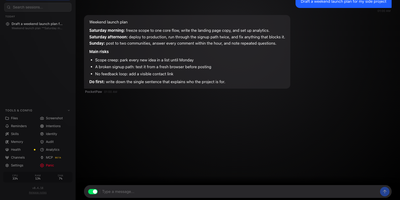
PocketPaw
Ask for a recycling reminder from your phone on Sunday and have a research report waiting by Monday, without handing your data to a subscription service. PocketPaw is a personal agent you host yourself, reachable from the browser dashboard or the chat apps you already use, including Discord, Slack, WhatsApp, Telegram, Signal, Matrix, Teams, and Google Chat. Pick a backend for the work: Claude Agent SDK, OpenAI Agents, Google ADK, Codex CLI, OpenCode, or Copilot SDK, then point it at a cloud key or a local Ollama model. Over fifty tools cover browsing, web search, files, shell commands, OCR, voice, image generation, and delegation to helper agents. Reminders and scheduled intentions run on their own, and memory keeps long-term facts and compacts old sessions. Identity files shape the agent's tone and instructions, and a skills library adds new slash commands. A guardian model reviews tool calls, with injection scanning, plan mode approvals, tool profiles, and an audit log for oversight. Analytics show cost, latency, and traces against monthly budget caps. Memory, tool logs, and cost traces all live on your own server. Running on a dedicated VPS on RepoCloud with guaranteed CPU, RAM, and SSD, full root SSH access, and a browser serial console. MIT licensed.
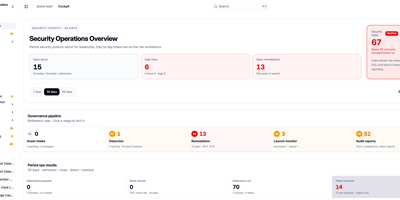
DodoGuard
Before an AI agent meets real users, put it through a security checkup it cannot sweet-talk. DodoGuard is a web console and command line where teams register their agents, run evaluation and red-team tasks against them, and decide if each one is cleared for launch. The overview page shows a security index, open risks, remediation counts, and a pipeline that runs from asset intake through detection and remediation to launch monitoring and audit reports. An asset ledger lists every managed agent with its platform, environment, and risk level. A guided wizard creates assessment tasks that pick a test library for prompt injection, instruction leakage, tool misuse, and output risks, then runs black-box conversations against the agent. Evaluation configs cover prompts, providers, variable cases, and several assertion types, with OpenAI, Anthropic, Azure, Bedrock, Ollama, and any OpenAI-compatible endpoint supported. Findings land in a closed-loop board where owners confirm, fix, retest, and close each risk, and finished tasks export as reports for release evidence. Docker Compose with SQLite brings up the web UI on port 3000, and the same engine runs in continuous integration. Security teams use it for launch gates, platform owners use it for regression checks after prompt changes, and auditors use it for evidence. Running on a dedicated VPS on RepoCloud with guaranteed CPU, RAM, and SSD, full root SSH access, and a browser serial console. MIT licensed.
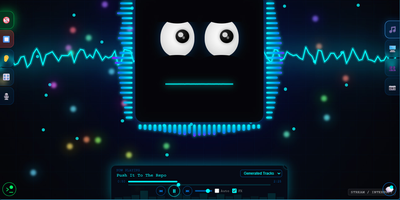
OpenVoiceUI
OpenVoiceUI is the voice-first front end for a self-hosted AI agent that lives entirely on your own hardware; you talk, it answers out loud, and it builds live pages on screen while the conversation runs. Hold a hands-free conversation with wake word, push-to-talk, and the ability to interrupt, or switch to text when the room is quiet. Speech recognition runs in the browser for free or through Deepgram, Groq Whisper, or your own Whisper server, while nine speech providers from local Supertonic to ElevenLabs give the agent its voice, cloned voices included. As it talks, the agent opens live canvas pages, dashboards, galleries, reports, and tools, and files them on an OS-style desktop you can reopen from the start menu. Ask for music and it generates songs with a built-in player and playlists; ask for images and it creates those too, alongside an audio clip maker and a soundboard. Profiles swap the agent's persona, voice, and model provider, animated faces react while it speaks, and sub-agents and workspace files stay visible in the admin dashboard. The agent itself runs in the OpenClaw gateway with your choice of model provider, so your keys, conversations, and files never leave your server. Running on a dedicated VPS on RepoCloud with guaranteed CPU, RAM, and SSD, full root SSH access, and a browser serial console. MIT licensed.
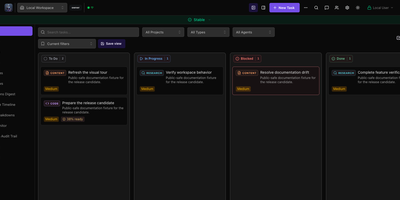
Veritas Kanban
A drag-and-drop task board that works fine on its own and can also hand cards to AI coding agents, Veritas Kanban shows what each agent is doing, what it changed, and what is waiting for your approval. Start with no agents at all. Cards move through To Do, In Progress, Blocked, and Done, and each one carries subtasks, dependencies, time tracking, comments, and an activity log. When you are ready, connect Codex, Claude Code, Copilot CLI, Hermes, or OpenClaw, give every agent an Intern, Specialist, or Lead permission level, and follow each agent's status and model on a live dashboard. Let a task run in its own Git worktree, read the diff, leave inline comments, approve or request changes, and open a GitHub pull request from the task panel. Squad Chat gives agents one shared channel that posts spawned, completed, and failed events. Workflows chain steps with parallel branches, loops, and human approval gates. Policy rules allow, deny, or hold agent actions for review. Assistants reach the board through an MCP server, a command-line client, or a REST API. Running on a dedicated VPS on RepoCloud with guaranteed CPU, RAM, and SSD, full root SSH access, and a browser serial console. MIT licensed.
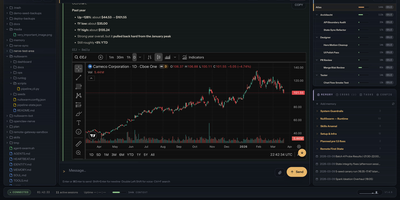
Nerve
Nerve is the web cockpit for OpenClaw, giving you one real-time screen to run an entire fleet of AI agents instead of chasing them through chat threads. Every agent keeps its own workspace, memory, identity, and skills, and you can switch between agents, browse their files, and edit memory or configuration in a tabbed editor during a live conversation. Work moves onto a kanban board where subagents pick up delegated tasks, and returned work waits in a proposal inbox for your review before it is accepted. Cron jobs run as their own sessions in a navigable session tree, so scheduled automation has logs and output you can actually inspect. Voice is a first-class input: push to talk or use a wake word, watch live transcription, and hear replies spoken back in your chosen language. Ask for a chart and the answer arrives as a real rendered chart, with diffs, file previews, and highlighted code inline in the stream. Token usage, running costs, and context pressure stay visible on every session, so long tasks never quietly drain your budget. Run it privately on localhost, reach it over your LAN behind password authentication and signed-cookie sessions, or keep access inside a Tailscale tailnet. Running on a dedicated VPS on RepoCloud with guaranteed CPU, RAM, and SSD, full root SSH access, and a browser serial console. MIT licensed.