codex-lb
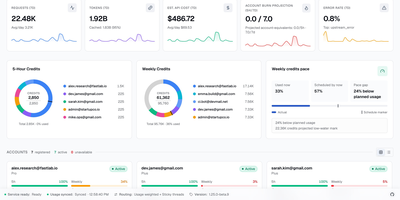
codex-lb turns a handful of ChatGPT accounts into one dependable endpoint for Codex CLI, OpenCode, OpenClaw, Hermes Agent, and any OpenAI-compatible client. Accounts join through an OAuth flow, and the dashboard shows each one's 5-hour and weekly quota as percent remaining, with reset times, plan, and a seven-day trend. Eight routing strategies, including capacity weighted, round robin, and sequential drain, pick an account per request, and sticky threads keep a session on the same account to preserve warm prompt caches. API keys carry expiry dates, model allowlists, reasoning-effort policies, per-account scoping, and token or cost limits per day, week, or month. Overview cards chart requests, tokens, cached share, estimated cost, error rate, and a weekly credit pace, and a searchable request log lists the model, transport, status, tokens, and cost of every call. A cost report breaks spend down by day, model, user agent, and account, with time to first token and tokens per second charts. Dashboard access is protected by a password with optional TOTP, a read-only guest mode, roles, and invites. Settings cover reset-credit handling, upstream proxy pools, model sources, a firewall, and a quota planner, and light and dark themes are built in. Running on a dedicated VPS on RepoCloud with guaranteed CPU, RAM, and SSD, full root SSH access, and a browser serial console. MIT licensed.
HolaOS
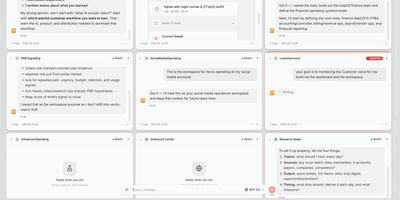
With over 6,500 GitHub stars, HolaOS bills itself as an "open agent computer" that reimagines the traditional operating system as a shared workspace where humans and AI agents collaborate across files, browsers, and 100+ integrated tools simultaneously. Unlike chat-only interfaces, HolaOS places live application UIs—Notion-style editors, browsers, custom workspace apps—side by side with the agent conversation, so operators always see what agents are doing and can intervene at any moment. The persistent memory system stores workspace knowledge locally as Markdown files and embedded vectors via SQLite vec, enabling RAG-powered recall that survives session boundaries without the typical context window bloat. Safe Session Compaction reserves roughly 70% of the model context window for fresh reasoning while folding older history into structured checkpoints that retain goals, constraints, progress, and decisions. Agents connect to Linear, GitHub, Slack, Jira, HubSpot, Gmail, and dozens more through one-click OAuth, automatically fetching relevant signals and converting scattered app data into working memory. BYOK support for Claude, GPT, and Gemini models lets operators use their own API keys at zero markup, while built-in Kimi K3 and GLM-5.2 models provide ready-to-use alternatives. Skills package reusable workflows that any agent can invoke on demand, and scheduled triggers enable autonomous digests, monitors, and reports. The runtime supports independent server deployment alongside the desktop client. Running on a dedicated VPS on RepoCloud with guaranteed CPU, RAM, and SSD, full root SSH access, and a browser serial console. Modified Apache 2.0 licensed.
GeoLook
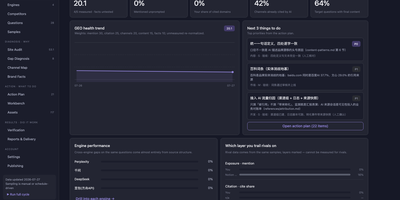
GeoLook shows you what AI search engines actually say about your brand, then turns that uncomfortable answer into a fix list you can work through and verify. You sample real answers across a wide matrix of AI engines and watch mention rate, ranking, and citation share appear per engine, with raw answer replay when a number looks suspicious. Competitor tables reveal which rival each engine prefers and which citation sources they rely on that you do not. A structured question bank sorts buyer, education, and probing questions, flagging the ones where you are absent, outranked, or described negatively. The site audit checks whether crawlers can reach, understand, and quote your pages, in the order those failures actually block visibility. Findings become tickets with an owner, effort estimate, risk grade, and acceptance check, and later sampling rounds confirm whether a fix worked or reopen the ticket when results slip. A content workbench ranks the topics most worth writing, checks drafts for citability, and prepares assets such as llms.txt and structured data snippets for publishing. Running on a dedicated VPS on RepoCloud with guaranteed CPU, RAM, and SSD, full root SSH access, and a browser serial console. MIT licensed.
CyberScraper 2077
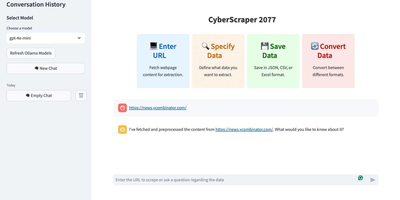
With 3,100+ GitHub stars, CyberScraper 2077 replaces brittle CSS selectors and XPath queries with natural language data extraction powered by Large Language Models. Users paste a URL, describe the data they want in plain English, and the AI extracts structured results from any website — no HTML parsing knowledge required. The tool supports three LLM backends: OpenAI GPT models for maximum accuracy, Google Gemini for cost-effective extraction, and local Ollama instances for fully private scraping where URLs and data never leave your server. Built on Python asyncio with Playwright browser automation, it handles concurrent page fetching with content-based and query-based LRU caching to minimize redundant API calls. The Streamlit web interface runs on port 8501 and provides one-click export to JSON, CSV, HTML, SQL, Excel, and direct Google Sheets upload. Tor network integration routes requests through onion routing for anonymous scraping of both clearnet and .onion hidden service sites with automatic circuit management and stream isolation. Stealth mode randomizes user agents, manages cookies, and controls JavaScript execution timing to bypass bot detection systems. Multi-page scraping navigates through paginated results with automatic URL pattern detection. Docker deployment packages all dependencies including Playwright browsers into a single container. Running on a dedicated VPS on RepoCloud with guaranteed CPU, RAM, and SSD, full root SSH access, and a browser serial console. MIT licensed.
LightRAG
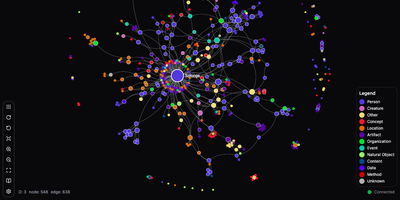
Plain chunk retrieval hands an LLM disconnected excerpts; LightRAG builds a knowledge graph from your documents so answers can join facts spread across many files. Ask about one named person, product, or clause and local mode pulls its details. Ask for themes across the whole library and global mode follows the links between entities. Hybrid blends the two, naive falls back to plain chunk search, and mix combines all three. Mix is the default. Upload text, Markdown, PDF, Word, PowerPoint, and Excel files; MinerU, Docling, or the native parser can extract images, tables, and formulas. The admin console manages documents, explores the graph visually, and debugs queries, while a query-only workspace page gives everyday colleagues a clean chat screen that works on phones. A REST API covers indexing and queries, and an Ollama-compatible endpoint lets chat front ends such as Open WebUI use the knowledge base as a model. New files merge into the existing graph without a full reindex, and deleting a document rebuilds only the entities and relationships it touched from cached results. Separate model roles let an inexpensive model extract entities while a stronger one writes answers. An API key or accounts protect the server, and named workspaces keep several knowledge bases apart. Pair it with local Ollama models and no document text leaves the server. Running on a dedicated VPS on RepoCloud with guaranteed CPU, RAM, and SSD, full root SSH access, and a browser serial console. MIT licensed.
Agent Gateway
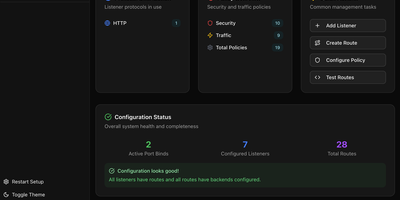
Backed by the Linux Foundation with contributions from AWS, Cisco, IBM, Microsoft, Red Hat, and Shell, Agentgateway is the first data plane built from the ground up for AI agent workloads — providing a unified Rust-based proxy that handles conventional HTTP and gRPC traffic alongside MCP tool servers, A2A agent communication, and LLM inference endpoints through a single deployment. The LLM gateway routes requests to OpenAI, Anthropic, Gemini, AWS Bedrock, and other providers through an OpenAI-compatible unified API with per-tenant budget controls, spend tracking, prompt enrichment, load balancing across multiple model endpoints, and automatic failover when providers experience outages. The MCP gateway federates multiple tool servers behind one endpoint, supporting stdio, HTTP/SSE, and Streamable HTTP transports with built-in OAuth authentication compliant with the MCP auth specification, integrating Auth0 and Keycloak out of the box. OpenAPI integration exposes existing REST APIs as MCP-native tools without code changes, enabling legacy services to participate in agent workflows. Policy-based RBAC controls which agents access which tools, while OpenTelemetry integration provides distributed tracing across agent communication chains. Deploy as a standalone binary with flat YAML configuration or on Kubernetes using the built-in controller with Gateway API support for declarative infrastructure-as-code management. Running on a dedicated VPS on RepoCloud with guaranteed CPU, RAM, and SSD, full root SSH access, and a browser serial console. Apache 2.0 licensed.
Infinite Canvas
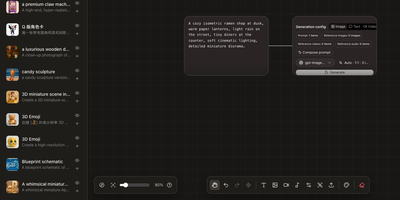
Instead of juggling a chat window, a folder of reference images, and a notebook of half-remembered prompts, Infinite Canvas puts the whole image-making process on one zoomable board. Drop in text, image, video, and generation-settings nodes, then wire them together so every result stays connected to the prompt and references behind it. Add one or several OpenAI-compatible endpoints, choose default text, image, and video models, and set image count, aspect ratio, quality, and transparent backgrounds per node. Batch results arrive as linked nodes that remember their prompt, model, and dimensions, so any of them can be retried later with the same settings. A prompt library searches seven built-in sources plus your own JSON sources and inserts the winner straight onto the board. An asset shelf keeps reusable images, clips, and audio within reach. Projects can be duplicated, exported, and synced between devices over WebDAV. Want a helper? A local Canvas Agent lets Codex read the active board and edit it through MCP, with approvals and permissions shown in a side panel. Plugins add node types, inspectors, and toolbar actions. Running on a dedicated VPS on RepoCloud with guaranteed CPU, RAM, and SSD, full root SSH access, and a browser serial console. MIT licensed.
Row-Bot
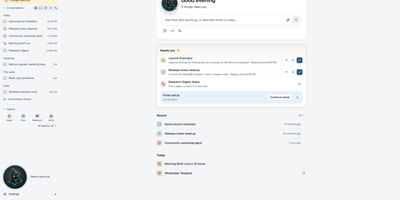
Conversations, goals, memory, and scheduled workflows live together in one private AI assistant that runs on your own server and opens in any browser, on a laptop or a phone. Chat with local models through Ollama, provider API keys, ChatGPT, Claude, or Grok subscriptions, or any OpenAI-compatible endpoint, and every tool call shows up in the transcript. Risky actions pause for Approve or Deny in the chat, on the Home screen, or on a connected channel. Memory grows into a personal knowledge graph with recall, review, and an Obsidian-compatible wiki vault. Ask for a deck, a mockup, or an app and a design or code panel opens beside the chat, with Present, export to PDF, HTML, PNG, or PPTX, a changes view, Git, pull requests, checks, and an interactive terminal. Goals keep going until done, delegated agents get their own conversations, and workflows run on a schedule, a webhook, or a chain, with run history and delivery to channels. Telegram, WhatsApp, Discord, Slack, and SMS channels, voice dictation, and an app catalog for GitHub, Notion, Linear, and Stripe extend it, and health checks propose one fix per problem. Pairing a phone takes a QR code and a one-time invitation, and the server serves a single owner across many devices. Running on a dedicated VPS on RepoCloud with guaranteed CPU, RAM, and SSD, full root SSH access, and a browser serial console. Apache-2.0 licensed.
Online Document Editor
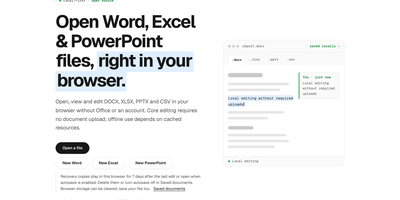
Open a browser tab and a full office suite appears, with no account to create and your files kept on your own device. Start a new Word document, spreadsheet, or presentation, or drop in a file, and edit with the familiar ribbon: styles and bullets in documents, formulas and charts in sheets, slides with layouts and notes. PDFs open for reading, commenting, highlighting, and filling, then save back out. Convert Word, Excel, and PowerPoint files to PDF, or move spreadsheets to CSV and back, without uploading a byte. An optional AI assistant, off by default, can rewrite, summarize, or translate a passage, fill spreadsheet cells, draft slides, or answer questions about a PDF page, using an on-device model or an AI service you connect. WebMCP tools let compatible browser agents open, convert, and export documents. Recovery copies stay in the browser for seven days, autosave can be switched off, and the site installs as a PWA for offline use. Host it as one static container or embed the editor in your own app through an iframe API. Running on a dedicated VPS on RepoCloud with guaranteed CPU, RAM, and SSD, full root SSH access, and a browser serial console. AGPL-3.0 licensed.
LLMIO
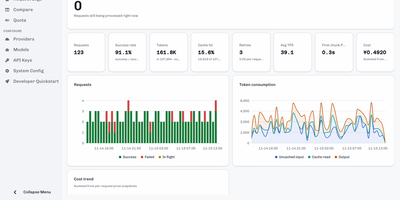
Every provider has its own API, quota, and price list, and LLMIO puts them all behind one door. Clients speak OpenAI Chat Completions, OpenAI Responses, Anthropic Messages, or Gemini, and a protocol bridge translates between OpenAI and Anthropic formats, including streaming events, when the upstream differs. Each model name maps to several providers with weights, a lottery or rotor load strategy, retry limits, and timeouts, and routing can follow tool calling, structured output, and image support. A per-model circuit breaker and rate-limit fallback keep one failing upstream from taking the rest down. The dashboard shows live requests, success rate, tokens, cache hits, retries, tokens per second, and cost, and analytics add trend, breakdown, latency, error, and model performance views with provider, key, and status filters. The request log records trace and session IDs with full request and response inspection, and a compare page lines up to six requests to show how a prompt cache builds. Access keys carry expiry dates, model allow-lists, and optional body logging. Quota sources, time-of-day pricing, and scheduled log cleanup round out the console. Running on a dedicated VPS on RepoCloud with guaranteed CPU, RAM, and SSD, full root SSH access, and a browser serial console. MIT licensed.
Typing Mind
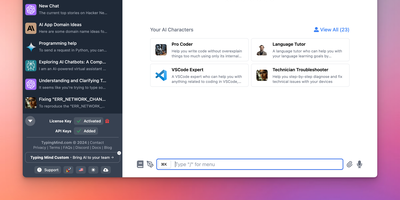
Bring your own API keys and work with OpenAI GPT models, Anthropic Claude, Google Gemini, Mistral, DeepSeek, Grok, Azure endpoints, and local models in one organized workspace: TypingMind is a unified chat frontend for large language models, replacing a browser tab per provider. Parallel chat sends the same prompt to multiple models and compares answers side by side, and models can be switched mid-conversation. A prompt library stores reusable, tagged prompts with variables, and the AI Agents system builds specialized assistants that bundle a base model, custom instructions, assigned plugins, and uploaded knowledge files for RAG. Plugins extend every connected model with web search, image generation (DALL-E, Stable Diffusion), Deep Research, URL reading via Firecrawl, and Zapier automation - plus MCP server integrations for Notion, Atlassian, and other external tools, and a JavaScript extension API for custom behavior. Chats store locally by default with optional sync. Self-hosting puts the interface on your own domain and, for teams, adds branding, member access limits, and shared prompt and agent libraries.
CCX
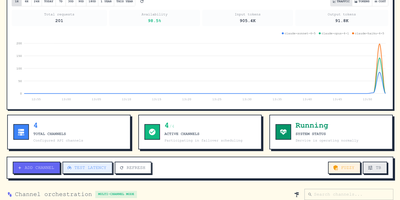
CCX gives every coding agent and chat client one stable address, and the real model providers can come and go behind it. Point Claude Code, Codex, or any SDK at the gateway and it forwards requests to the first healthy channel in a failover sequence, then moves down the list when an upstream returns errors. Each channel carries its own keys, model allowlist, proxy, and custom headers, and the Add Channel dialog detects a base URL and keys from pasted text. The admin console tracks requests, availability, tokens, and cost over ranges from one hour to a year, with a chart per model and a live success rate beside each channel. Drag a channel to change its priority, park it in the standby pool, or open its log to see the status, timing, and key of every call. Separate tabs cover Claude Messages, OpenAI Chat, Images, Vectors, Codex, and Gemini, and a dark theme and language switch are built in. Access is guarded by a proxy key and an optional admin key. Running on a dedicated VPS on RepoCloud with guaranteed CPU, RAM, and SSD, full root SSH access, and a browser serial console. MIT licensed.
Marimo
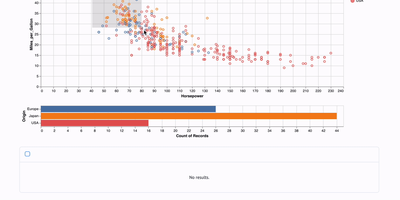
Marimo is a reactive Python notebook that treats cells like spreadsheet formulas: change one cell or interact with a UI widget and every dependent cell automatically re-executes, eliminating the hidden state bugs that make traditional notebooks unreliable. Backed by over 22,000 GitHub stars, notebooks are stored as pure Python files with PEP 723 inline metadata, making them Git-diffable, importable as modules, executable as CLI scripts with parameterized arguments, and testable with PyTest. Built-in SQL cells query Polars, Pandas, PyArrow, DuckDB, SQLite, PostgreSQL, and MySQL databases, with results automatically flowing into the reactive dependency graph. The AI-native editor provides GitHub Copilot autocomplete, context-aware assistants that access live runtime variables, inline code edits powered by configurable models from OpenAI, Anthropic, or local Ollama instances, and a pair mode that lets external AI agents connect over WebSocket. Notebooks become read-only interactive web applications with marimo run, collaborative authoring environments with marimo edit, or embedded flows inside existing FastAPI applications through ASGI middleware. Gallery mode serves multiple notebooks from a single instance with an auto-generated index page. The Docker image ships with SQL support, token-based authentication, health check endpoints at /health and /api/status, and configurable WebSocket or SSE kernel transport for proxy compatibility. Running on a dedicated VPS on RepoCloud with guaranteed CPU, RAM, and SSD, full root SSH access, and a browser serial console. Apache 2.0 licensed.
Bloomberg Terminal
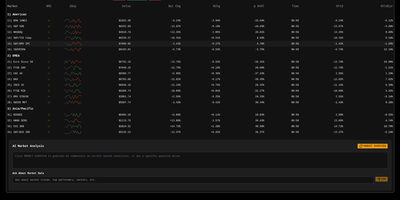
With 1,450+ GitHub stars and a live demo on Vercel, this Bloomberg Terminal clone delivers a professional-grade financial dashboard without the $24,000 annual seat license. The Next.js 15 App Router with React 19 and TypeScript serves a single-page terminal interface optimized for constantly mutating financial data, with partial pre-rendering enabling sub-500ms initial loads even on data-heavy views. Upstash Redis caches AlphaVantage market data to minimize API calls while maintaining sub-second update latency through React Query polling with configurable refresh rates. OpenAI integration provides AI-powered market insights, sentiment analysis, and trend interpretation directly within the terminal interface. Multiple specialized views cover market data tables with bid/ask spreads, financial news aggregation with category filtering, market movers highlighting top gainers and losers, and volatility analysis with historical comparison charts. Jotai atoms manage local state for watchlists, layout preferences, and terminal sessions while React Query handles server-state synchronization with aggressive stale-while-revalidate caching. The shadcn/ui component library with Tailwind CSS delivers accessible, keyboard-navigable interface elements styled after Bloomberg's iconic dark terminal aesthetic. Security features include origin restriction, rate limiting via Redis, and Zod-based input validation on all API routes. Motion (formerly Framer Motion) animates transitions between views and data updates without layout shift. Running on a dedicated VPS on RepoCloud with guaranteed CPU, RAM, and SSD, full root SSH access, and a browser serial console. MIT licensed.
Subtitle Translator
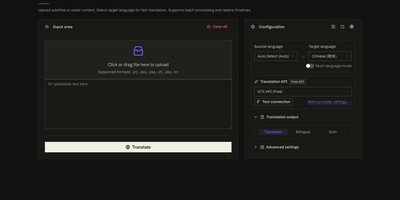
A whole season of subtitles can be translated in a single drop, with every timecode left exactly where it was. Subtitle Translator strips cue numbers and timing out of each file, sends only the dialogue to the translation engine, and puts everything back afterward, so a model never gets the chance to scramble a timeline. Pick any of 120+ target languages, or turn on multi-language mode to export several at once. Engines range from DeepL, Google, and Azure to dozens of LLM providers, gateways, and any OpenAI-compatible endpoint, including a local Ollama or LM Studio model. Context-aware mode feeds surrounding lines to the model for steadier dialogue and consistent character voices, and a glossary keeps names and product terms fixed across episodes. Bilingual output stacks original and translation in one file, either as plain SRT or as ASS with separate styles for each line. SRT, VTT, ASS, and LRC convert between each other during translation. Translated lines are cached, so a rate-limit pause or a closed tab only costs the missing lines. A text extractor strips timing for summaries and scripts. The interface itself is available in 18 languages, and companion tools handle Markdown, JSON locale files, and plain text. A back catalog of course videos or fan-subbed episodes becomes a weekend job instead of a month-long slog. Running on a dedicated VPS on RepoCloud with guaranteed CPU, RAM, and SSD, full root SSH access, and a browser serial console. MIT licensed.
pi-dispatch
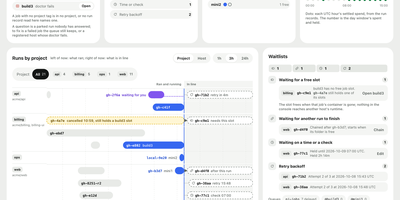
pi-dispatch turns one AI coding agent into a swarm that works in the background and reports to a single web page. Jobs start from a nightly schedule, a labeled issue, or a comment, then wait in one shared queue until a machine has room. Each job runs in a sealed box that is thrown away afterwards, reaches only the internet addresses you allow, and stops at the dollar limits you set per day, week, and month. When an agent hits a decision, it parks a question with options and a recommendation, and no model spend accrues until you answer. The overview shows what needs you, what is queued, what is running, and what today has cost. A Zero touch page tracks how often runs needed a person, per project, so you can see how far to step back. On GitHub, GitLab, Forgejo, and Azure DevOps the work ends as a proposed change that a human merges. Fleet, Spend, Triggers, and Models pages cover several machines, budgets per project, and fallback models. Running on a dedicated VPS on RepoCloud with guaranteed CPU, RAM, and SSD, full root SSH access, and a browser serial console. MIT licensed.
CPA Manager Plus
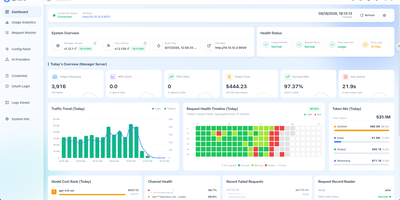
CPA Manager Plus is a self-hosted observability dashboard and management panel that tracks every AI request flowing through your CLI Proxy API gateway, breaking down failures, costs, and account health across providers like OpenAI, Anthropic, xAI, and Codex in one interface. When a request fails, drill into the persistent history to see status codes, affected models, latency, and redacted failure evidence without exposing raw response bodies. The cost analytics engine breaks down token consumption and estimated spend by model, provider, account, API key, project, channel, and time range while tracking input, output, reasoning, cache, and service-tier pricing semantics separately. Model prices sync automatically from models.dev with LiteLLM and OpenRouter fallbacks, and you can add local overrides for aliases or internal models. For teams running Codex or xAI accounts, the health inspector reads quota windows, reset evidence, credential state, and workspace status on a configurable schedule, routing credential failures into an action queue for review rather than letting them silently degrade throughput. Deploy the Lightweight Panel to replace your existing CPA management UI without adding another service, or run Full Mode as a single Docker container that adds the Manager Server with persistent SQLite storage for request history, historical analytics, and automated account inspections. Export or import request history as JSONL for external analysis, and back up the SQLite files alongside your encrypted management keys. Running on a dedicated VPS on RepoCloud with guaranteed CPU, RAM, and SSD, full root SSH access, and a browser serial console. MIT licensed.
AgentRQ
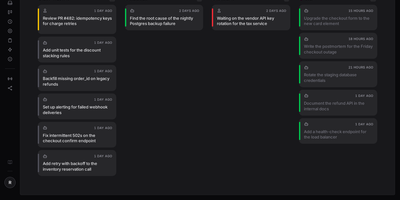
Where AI agents and people share one real-time workspace, an agent blocked on your decision never waits unnoticed until morning, and that workspace is AgentRQ, a human-in-the-loop task manager for agent fleets. In that workspace agents pull assigned tasks over MCP, report progress as they work, ask questions in the open, and pause visibly instead of going dark. Cards travel from Not Started to Ongoing to Blocked to Done on a list or Kanban board, and a Blocked card returns to work the second you answer from any device. Sensitive tool calls wait for an Allow click; flip YOLO on a task and they proceed automatically, still recorded call by call in a searchable trajectory. A timeline under every task totals how long the agent worked, waited, or stayed blocked. Scheduling spawns tasks on a cadence, completed tasks fire named events, and events hand new tasks to subscribed workspaces, chaining a release pipeline without glue code. Each project lives in an isolated workspace with its own agent, memory, skills, and Slack channel, and workspace memory carries yesterday's lessons into today's session. Voice-dictated tasks transcribe on device, 55 ACP-compatible agents connect through one gateway, and agents running on your own machines expose their terminals and resource use remotely. Running on a dedicated VPS on RepoCloud with guaranteed CPU, RAM, and SSD, full root SSH access, and a browser serial console. AGPL-3.0 licensed.