Open Source App Cloud Marketplace
Deploy, host, and scale with one click, at half the cost. Then customize with AI agents.
I Hate Money
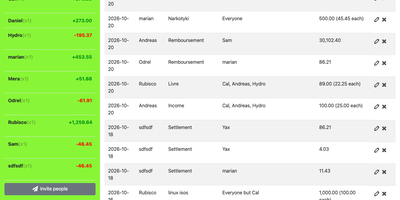
When vacations, shared apartments, and group events turn into a tangle of receipts and awkward IOUs, I Hate Money restores harmony with a dead-simple shared budget manager that requires zero user accounts for invited participants. Organizers create a project protected by a private code and share a single link with friends, roommates, or travel companions, allowing everyone to log expenses immediately from any desktop or mobile browser. Each bill entry records who paid, when the purchase happened, what it covered, and which members benefited, supporting both equal splits and custom weighted shares for participants who stayed longer or consumed more. Built-in multi-currency conversion lets international travelers record bills in foreign currencies and convert them automatically into the project default currency. Newly added expense filtering and direct reimbursement bill creation on the Settle screen calculate the minimum number of transfers required to square every balance, while Monthly spending statistics, JSON or CSV exports, and a REST API keep group finances transparent. Running on a dedicated VPS on RepoCloud with guaranteed CPU, RAM, and SSD, full root SSH access, and a browser serial console. BSD-3-Clause licensed.
Mere Medical
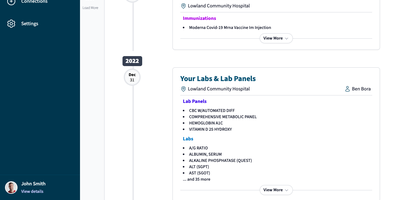
Mere Medical pulls the records from every hospital and clinic patient portal you use into one date-ordered timeline, so lab panels, immunizations, and procedures from different systems sit side by side. Each timeline card shows its facility and, when recorded, the provider, and expands with View More; a Jump To index leaps between years. The Summary tab condenses bookmarked labs, medications, conditions, immunizations, care plans, and allergies onto one dashboard whose cards can be dragged into any order or hidden. Lab results are graphed over time wherever the units line up, and a search bar finds specific entries by keyword. Connections sync from Epic MyChart, Oracle Health (Cerner), Veradigm, DrChrono, eClinicalWorks Healow, athenahealth, and NextGen, and several sources can feed one profile at once. Everything lives on your device, so records stay searchable offline and no account sign-in is needed; an optional password encrypts them at rest. Separate user profiles hold each person's records, and JSON export and import make backups simple. Experimental AI features add semantic search that links a phrase like high blood sugar to related labs, plus a Mere Assistant that answers plain-language questions about your records using local Ollama models or an OpenAI key. Install it on a phone or desktop home screen for quick access in the waiting room. Running on a dedicated VPS on RepoCloud with guaranteed CPU, RAM, and SSD, full root SSH access, and a browser serial console. MIT licensed.
Docspell
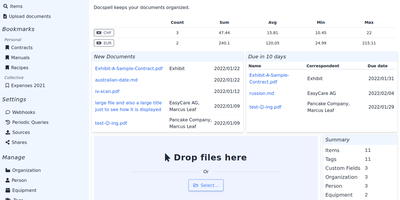
Convert paper archives, email attachments, and PDF records into an organized digital repository with Docspell, an open-source document management system that automates optical character recognition, metadata extraction, and full-text search. Users can ingest receipts and invoices through network scanners, monitored IMAP email mailboxes, mobile uploads, or drag-and-drop browser tools. The background processing pipeline executes optical character recognition via Tesseract, enhances image contrast with unpaper, and extracts text from Word documents and PDFs. Machine learning algorithms analyze document syntax to predict correspondents, suggest relevant organization tags, and identify due dates automatically. Team members can search their entire filing cabinet using complex Boolean queries and full-text indexing powered by Apache Solr or PostgreSQL. Administrators can configure multi-user collectives with isolated permissions, define custom metadata attributes, set up webhooks, and share time-limited document download links. Users can also merge multi-page scans, track processing job queues, and export curated document collections for tax filings or legal audits. Running on a dedicated VPS on RepoCloud with guaranteed CPU, RAM, and SSD, full root SSH access, and a browser serial console. GNU AGPL v3.0 licensed.
Sirius Scan
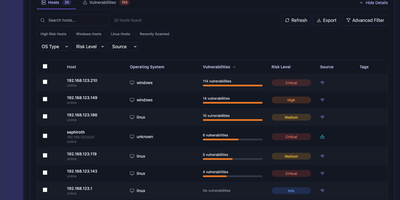
Point Sirius Scan at a network range and it finds live hosts, fingerprints their services, and lists every matching CVE with its CVSS score in a live web dashboard. The Vulnerability Navigator groups findings by severity, filters on CVSS, and exports results for remediation tracking. Scans run on Nmap with NSE scripts kept in sync with upstream, alongside Naabu port scanning. Lightweight remote agents connect back over gRPC from other networks, so segments the central scanner cannot reach still get assessed, and the same agents can run YAML detection templates locally in CLI mode with no server connection at all. An operator console runs PowerShell commands against connected agents and keeps command history beside the scan results. Real-time progress, severity trend charts, host detail pages, and an environment overview show what changed between scans. A REST API on port 9001 with API key authentication feeds results into existing security workflows, while service health monitoring and centralized logging confirm the platform itself is behaving. An installer generates fresh secrets and an initial admin password, and production overlays tighten the deployment further. Running on a dedicated VPS on RepoCloud with guaranteed CPU, RAM, and SSD, full root SSH access, and a browser serial console. MIT licensed.
ClassicPress
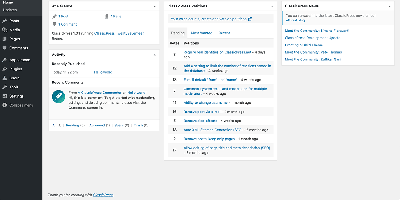
WordPress without Gutenberg: ClassicPress, the community-led fork, keeps the TinyMCE classic editor as the default and strips the block editor and Full Site Editing out of core entirely. The result is roughly half WordPress's size - obsolete libraries like jQueryUI, Thickbox, and Flash support are gone, replaced by native HTML5 elements and modern alternatives like SortableJS - which translates to a measurably faster admin and a leaner attack surface. Forked from WordPress 6.2, it remains compatible with the vast plugin and theme ecosystem targeting that lineage (anything not requiring blocks generally works, helped by a blocks-compatibility mode), and the PHP-first WordPress API developers have used for over a decade works unchanged - no React required to extend your CMS. The fork adds its own improvements: built-in media categories and tags with bulk editing, revision management that lets you prune database bloat, native HTML5 dialogs for accessible touch-friendly menus, and recent releases bring APCu object-cache support, vanilla-JS core widgets, and performant translations. Governance is democratic and community-driven rather than corporate. For content sites, business sites, and blogs where the classic editing workflow is the feature, ClassicPress is stability as a philosophy.
Animockup
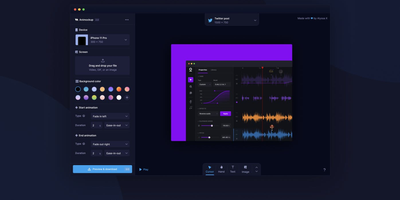
Product Hunt's Maker of the Year: Animockup delivers an alternative to expensive motion graphics tools for creating animated product teaser videos entirely in the browser. The FabricJS canvas engine provides a fully interactive editing surface where you import product videos or screenshots, place them inside device mockups ranging from iPhones and MacBooks to browser windows and smartwatches, and customize everything from background gradients to overlay text positioning. Anime.js powers the animation system with configurable start and end transitions, easing curves, and duration controls that produce smooth entrance and exit effects without timeline editors or keyframe knowledge. The built-in FFMPEG.wasm pipeline handles all video processing client-side — no server-side rendering required — exporting finished teasers to WebM, MP4, or GIF at custom framerates and resolutions up to 4K. The crop and reposition tool lets you precisely fit product footage into any device screen regardless of aspect ratio differences. Twenty-plus device frames cover phones, tablets, laptops, desktops, watches, and generic browser windows for maximum versatility. Firebase authentication handles user sessions while the optional Paddle integration manages subscriptions — or remove both for a fully free deployment. Self-hosting requires only a static web server with optional PHP for the payment webhook endpoint. Running on a dedicated VPS on RepoCloud with guaranteed CPU, RAM, and SSD, full root SSH access, and a browser serial console. MIT licensed.
Multiwoven
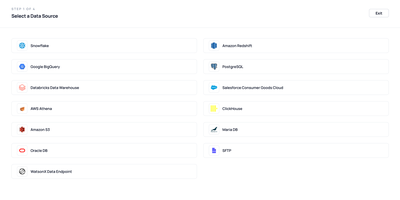
When warehouse data never reaches the CRM, ad platform, or help desk that needs it, Multiwoven is the open-source reverse ETL platform that syncs it there on a schedule. Sources include Snowflake, BigQuery, Redshift, Databricks, PostgreSQL, ClickHouse, MariaDB, Oracle, Amazon S3, and SFTP. Models define what to move: write SQL with a 100-row preview, pick tables in a visual selector, or reuse existing dbt models. Destinations span Salesforce, HubSpot, Klaviyo, Mailchimp, Zendesk, Slack, Airtable, Google Sheets, Stripe, Facebook Custom Audiences, HTTP endpoints, and vector stores such as Pinecone, Qdrant, and Weaviate. Each sync maps model columns onto destination objects like Salesforce Account, Contact, or Opportunity, then runs as a full refresh or as an incremental sync that moves only new or changed rows, optionally tracked by a cursor field. Schedules can be manual, an interval from minutes to weeks, or a cron expression. A dashboard reports sync activity, each run records its status with successful and failed row counts, and failed runs can trigger status emails. Workspaces keep sources, models, syncs, and destinations separate for each team, while Admin, Member, and Viewer roles and email invitations control access. A connector framework lets teams add sources or destinations that are not yet supported. Running on a dedicated VPS on RepoCloud with guaranteed CPU, RAM, and SSD, full root SSH access, and a browser serial console. AGPL-3.0 licensed.

ChatChat
One clean interface in front of Anthropic, OpenAI, Google Gemini, Cohere, and more: Chat Chat is a Next.js front door to the major AI providers, ending the juggling of separate subscriptions, tabs, and UIs per model. Bring your own API keys, pick a provider and model per conversation, and switch between them as the task demands: Claude for long-form reasoning, GPT for code, Gemini for multimodal work - the interface stays identical. Beyond configured presets, custom providers plug in with their own API endpoints and keys, which covers OpenAI-compatible gateways and local inference servers. The design splits into two dedicated modes: a chat interface for conversational work with customizable system prompts, and a search interface that pairs AI processing with query handling for research-style questions. The stack is modern and hackable - Next.js 14, Tailwind CSS, shadcn/ui on Radix primitives, Jotai for state - with full internationalization including English, Chinese, and Japanese. Self-hosting means your conversation history and API keys live on your instance rather than a third-party wrapper service, and pay-per-token API pricing typically beats stacking multiple monthly chat subscriptions. AGPL-licensed and deliberately simple to deploy: one container, environment variables for keys, done.
Otter Wiki
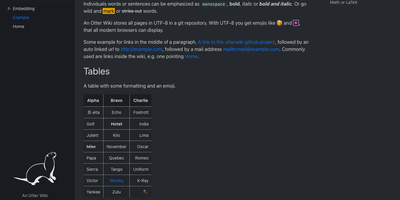
Every page in Otter Wiki is a plain Markdown file and every save is a git commit, so a small team gets a simple wiki whose history never goes missing. The editor highlights Markdown as you type, offers a toolbar for headings, lists, tables, code, alerts, and images, and can show a live preview beside the source. Paste or drop an image into the editor and it is stored as a page attachment. History, blame, and changelog views, with RSS and Atom feeds, show who changed what and when. Beyond standard Markdown you get footnotes, task lists, math formulas, Mermaid diagrams, alert boxes, and spoiler or folded blocks, plus experimental embeddings such as sortable data tables, info boxes, image frames, videos, and included pages. A customizable sidebar shows a menu, a page index, or both. Search offers case-sensitive and regular expression options. Dark mode is built in. Admins decide whether anonymous visitors, registered users, or approved users may read, write, or upload, grant rights per user, close registration, or require email confirmation. An optional, experimental git web server lets people clone, pull, and push the wiki, and changes can be pushed to or pulled from a remote repository over SSH. Running on a dedicated VPS on RepoCloud with guaranteed CPU, RAM, and SSD, full root SSH access, and a browser serial console. MIT licensed.
Friendica
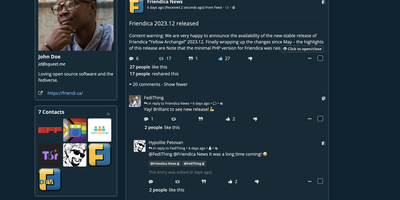
Friendica connects to more federation protocols than any other single platform: ActivityPub reaches Mastodon, Pleroma, Misskey, Lemmy, Pixelfed, and PeerTube; the Diaspora protocol bridges that network; and OStatus provides legacy compatibility. But protocol reach is just the foundation. Where most fediverse platforms stop at microblogging, Friendica offers long-form posts, photo albums, event calendars with RSVP, group discussions, and rich multimedia content. BlueSky and Tumblr connectors extend your reach into non-federated networks, while RSS import pulls content from any blog or news source into your timeline. Privacy controls let you scope each post to specific contacts, groups, or public visibility with per-post granularity rather than account-wide settings. Multiple themes customize the interface from Facebook-like layouts to minimal designs, and Fedilab provides native mobile access. Under the hood, the PHP application with MariaDB runs as either an Apache or FPM Docker image with Redis caching and background cron workers handling federation delivery, media processing, and notification dispatch. One of the oldest fediverse projects (1,650+ stars, 160+ contributors since 2010), Friendica has weathered every protocol evolution and platform migration the decentralized web has thrown at it, making it one of the most battle-tested social networking platforms available.
Upvote RSS
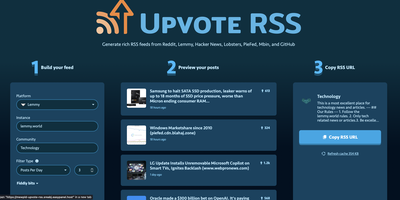
The antidote to doomscrolling: Upvote RSS turns Reddit, Hacker News, Lemmy, Lobsters, PieFed, Mbin, and trending GitHub repositories into calm, filtered RSS feeds. The MIT-licensed PHP app's killer feature is intelligent filtering: beyond simple score thresholds, the "posts per day" filter analyzes a community's recent history and computes the score cutoff that yields your target volume - say, exactly three r/technology posts daily - while a percentage-based threshold mode stays consistent as communities grow. Feeds are rich, not bare links: parsed full-article content via Readability (with optional Readability.js, Mercury, or Browserless for JavaScript-heavy pages), embedded videos and image galleries, top-voted comments with pinned-moderator filtering, scores, reading-time estimates, and optional AI summaries through Ollama, OpenAI, Gemini, Anthropic, Mistral, DeepSeek, or any OpenAI-compatible endpoint - with automatic provider fallback. A web UI builds the feed URL interactively with live preview; paste the result into any RSS reader. Reddit support includes custom domains like old.reddit.com plus NSFW filtering and blurring. Caching via filesystem, Redis, or APCu keeps repeated fetches cheap and avoids re-running paid summarizations.
Chatpad
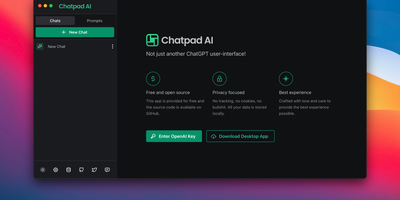
Why should your chat history live on someone else's servers? Chatpad AI - a React/TypeScript front end for the OpenAI API, built on the Mantine component library - is designed around that question. Enter your own OpenAI API key and start chatting with GPT models; every conversation, prompt, and setting is stored locally in your browser via DexieJS over IndexedDB, with no tracking, no cookies, and no backend database at all. That architecture is the point - the Docker image is just Nginx serving static files, making it one of the lightest AI deployments in the catalog, and pay-per-token API pricing typically undercuts a ChatGPT Plus subscription for moderate use. The interface earns its "premium quality" tagline with the details: a persona selector that switches communication styles per conversation, a saved-prompts library for messages you reuse constantly, organized chat history, and full data export/import so conversations move between browsers or into backups as files you control. A JSON config file customizes defaults - models, API endpoints, UI options - without rebuilding the image. AGPL-licensed, with desktop builds available upstream. For teams that want ChatGPT's utility with a self-hosted, zero-telemetry footprint, Chatpad is the minimal, sane answer.
JobSpy API
JobSpy API turns seven major job boards into a single REST endpoint, aggregating listings from LinkedIn, Indeed, Glassdoor, Google Jobs, ZipRecruiter, Bayt, and Naukri through one GET request. Built on FastAPI with the Python JobSpy scraping library, the API returns structured JSON or downloadable CSV containing job titles, companies, locations, salaries, descriptions, posting dates, and direct application URLs. Filters cover search terms, location, distance radius, job type (full-time, part-time, contract, internship), remote status, hours since posting, country, and salary range. Interactive Swagger UI and ReDoc interfaces provide try-it-now functionality for testing queries directly in the browser. Security includes x-api-key header authentication with configurable rotation, per-endpoint rate limiting with adjustable thresholds, and response caching with configurable TTL to reduce redundant scraping. Global proxy support routes outbound requests through HTTP/HTTPS proxies to avoid IP-based rate limiting from job boards. Environment variables control everything from default search parameters and logging levels to CORS origins and documentation paths. Health check and ping endpoints integrate with uptime monitoring services. Docker Compose exposes the API on a configurable port. MIT licensed.
Astuto
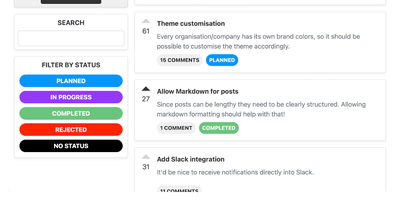
Feature requests, bug reports, upvotes, and a public roadmap: Astuto (Ruby on Rails backend, React frontend) gives users a Canny-style feedback portal so product decisions rest on visible demand rather than the loudest voice in the room. Feedback organizes into as many boards as you want (features, bugs, integrations), each post carrying a custom status you define - "planned," "in progress," "shipped," or whatever matches your process - and those statuses feed a public roadmap view showing users what is actually being worked on. Participation friction is adjustable at both ends: sign-in works with plain email or any OAuth2 provider, anonymous feedback can be enabled for unregistered users, and a moderation queue lets you approve posts before they appear when spam is a concern. Integration hooks are practical rather than sprawling - webhooks fire on events to connect Jira, Trello, or Slack, and a REST API manages the whole feedback space programmatically. Brand customization, an invitation system, private-site settings, and recap emails for administrators complete a deliberately minimal tool: it collects, organizes, and prioritizes feedback well, for free, forever.
TradingAgents GUI
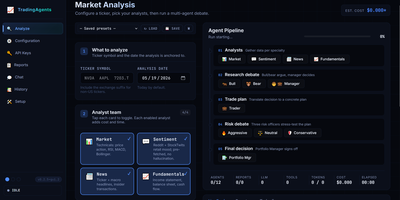
Built atop the TauricResearch TradingAgents framework with nearly 100,000 GitHub stars, TradingAgents GUI transforms a CLI-only multi-agent LLM stock analysis pipeline into a polished web application accessible at localhost:5000. The system deploys twelve specialized AI agents — fundamental analysts, sentiment experts, technical analysts, bull and bear researchers, a trader, risk management team, and portfolio manager — who collaboratively debate market conditions through structured LangGraph workflows before producing a final BUY, SELL, or HOLD recommendation. The interface supports ten LLM providers including OpenAI, Anthropic, Google, OpenRouter, DeepSeek, Ollama, xAI, Qwen, GLM, and MiniMax, with a first-run wizard that auto-detects configured API keys and tests connections. A live pipeline visualization shows each agent's status with real-time progress bars, while the tabbed output area separates Live Feed, Reports preview, and Tool calls into dedicated panes. The three-pane Reports tab provides searchable indexing, table-of-contents navigation, and export to Markdown, HTML, or PDF formats. Report length control across Concise, Standard, and Comprehensive modes saves up to 50% on token costs. Multi-session chat allows pinning past reports as grounding context with live token counting and context-window warnings. Three built-in themes — Terminal, Modern, and Bloomberg — persist per browser. Docker Compose deployment maps port 5000 with persistent report storage. Running on a dedicated VPS on RepoCloud with guaranteed CPU, RAM, and SSD, full root SSH access, and a browser serial console. Apache 2.0 licensed.
Dockerizalo
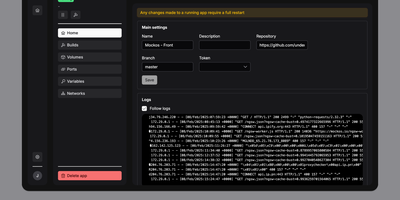
For self-hosters who want Git-driven container deployments without surrendering control of their existing reverse proxy or host networking, Dockerizalo provides a lightweight web platform that clones repositories, builds Docker images, and manages running services from a single dashboard. Point an application entry at any Git-compatible repository or public container registry image, configure custom build paths, and let the platform build and launch the container directly on your host Docker engine. A built-in template library accelerates database provisioning with pre-configured variables, networks, and persistent storage mounts. Through the web interface, operators manage environment secrets, bind-mounted volumes, custom Docker labels, and published TCP or UDP ports while coexisting peacefully alongside Caddy, Nginx, or Traefik setups. Per-application HTTP webhook triggers let teams automate continuous delivery from GitHub, GitLab, Gitea, or custom CI pipelines on every push event. Real-time paginated build and runtime container log streams prevent memory exhaustion on chatty APIs while keeping every deployment event visible. Configurable image retention policies automatically prune older tags and remove dangling images after each rollout so disk space stays clean. Multi-user account management allows homelab administrators to invite collaborators to the dashboard without sharing a single root credential. Running on a dedicated VPS on RepoCloud with guaranteed CPU, RAM, and SSD, full root SSH access, and a browser serial console. AGPL-3.0 licensed.

Peppermint
A deliberately simple ticketing system standing in for both Zendesk and Jira: Peppermint handles internal staff requests and external customer support alike. The stack is modern full-stack TypeScript: Next.js and React over Prisma and PostgreSQL, which makes it light to run and approachable for developers extending it. Ticket creation is straightforward - a markdown editor with file uploads, assignment, status tracking, and a logical workflow that new agents grasp without a manual. Mailbox integration converts email into tickets automatically: configure SMTP/IMAP per mailbox and incoming messages become trackable tickets. Each client accumulates an interaction history, giving agents context on every past request before replying. Two touches distinguish it from bare-bones ticketing: a built-in markdown notebook with todo lists for internal documentation and knowledge sharing, and OIDC authentication so agents sign in through your existing identity provider - Keycloak, Okta, Authentik, or Azure AD. Configurable webhooks and email notifications push ticket events to third-party services. The UI is responsive from mobile to 4K, and everything works fully offline in air-gapped environments. Docker-native and scalable via Kubernetes, with an active community of 3,000+ GitHub stargazers.
Siftly
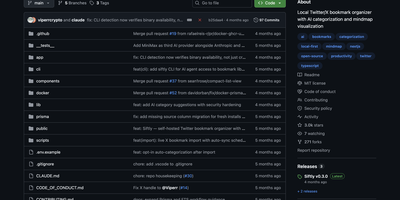
Siftly transforms your Twitter/X bookmarks from a chaotic pile of saved tweets into a searchable, AI-categorized knowledge base with an interactive visual mindmap. With over 2,700 GitHub stars since March 2026, the platform runs a four-stage enrichment pipeline on each bookmark: entity extraction mines hashtags, URLs, @mentions, and 100+ known tool domains without API calls; vision analysis generates 30-40 visual tags per image using the Anthropic SDK; semantic tagging produces 25-35 searchable descriptors; and categorization assigns one to three categories with confidence scores. Search combines SQLite FTS5 full-text indexing with Claude-based semantic reranking, narrowing candidates through keyword matching, category-intent detection, and deduplication before sending a bounded set for LLM relevance scoring, letting you find bookmarks by meaning rather than exact keywords. The interactive mindmap built on @xyflow/react renders your entire collection as a force-directed graph organized by category with expandable nodes, color-coded legends, and direct links to original tweets. Import bookmarks through a built-in bookmarklet or console script without browser extensions, then browse in grid or list view with filters for category, media type, and date range. Export as CSV, JSON, or category-grouped ZIP archives. Prisma 7 manages the local SQLite database with FTS5 built in, requiring zero external database setup. A bundled CLI provides JSON-output commands for stats, search, and category management. Running on a dedicated VPS on RepoCloud with guaranteed CPU, RAM, and SSD, full root SSH access, and a browser serial console. MIT licensed.