Inference Gateway
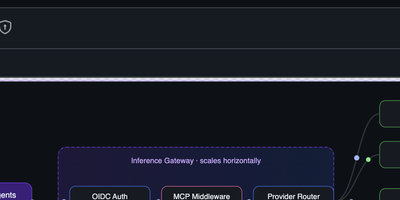
Inference Gateway puts a single OpenAI-compatible API endpoint in front of OpenAI, Anthropic, Groq, Cohere, Ollama, DeepSeek, Google, Mistral, MiniMax, Moonshot, Nvidia, and llama.cpp, so your application code never changes when you switch models or providers. The Go binary starts on port 8080 and normalizes authentication, streaming protocols, and response formats across all backends transparently. Native Model Context Protocol support auto-discovers tools from connected MCP servers and injects them into LLM requests without client-side management, enabling server-side tool execution across any provider that supports function calling. Agent-to-Agent protocol integration allows distributed agent communication through a declarative Agent Definition Language that generates production-ready Go or Rust servers from a single YAML manifest. The dedicated Kubernetes Operator manages Gateway, Agent, MCP, and Orchestrator custom resources with automatic HPA scaling, OIDC authentication, and service discovery that rebuilds MCP configurations when the discovered server set changes. Prometheus metrics and OpenTelemetry tracing provide full request-level observability across the entire inference pipeline. Middleware controls enable per-request provider selection, model routing, and fallback strategies. Official SDKs in Go, Python, TypeScript, and Rust provide typed client interfaces with streaming support. Docker Compose deployment requires only environment variables for API keys. A CNCF Sandbox applicant. Running on a dedicated VPS on RepoCloud with guaranteed CPU, RAM, and SSD, full root SSH access, and a browser serial console. Apache 2.0 licensed.
Checkmate
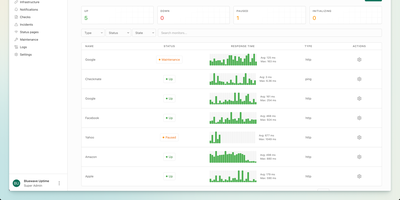
With 10,400 GitHub stars, 153 contributors, and no per-monitor pricing to worry about, Checkmate delivers comprehensive infrastructure monitoring from a single self-hosted dashboard — tracking uptime, page speed, server hardware, Docker containers, and even game servers without sending a byte of telemetry off your network. Ten monitor types cover HTTP, ping, TCP, gRPC, WebSocket, DNS, SSL certificate expiry, Docker container health, Lighthouse page speed with Core Web Vitals tracking, and game server status for over 100 server types including Minecraft and CS2. The Globalping integration enables geo-distributed monitoring from six continents, running ping and HTTP checks from Africa, Asia, Europe, North America, South America, and Oceania with results plotted on an interactive map. The optional Capture agent written in Go collects CPU, RAM, disk usage, temperature, and network metrics from any Linux, Windows, Mac, or Raspberry Pi host. Public status pages ship with four built-in themes and custom branding support, showing per-service uptime bars and incident history on a single shareable URL. Alert notifications reach teams through email, Discord, Slack, PagerDuty, Microsoft Teams, Telegram, Matrix, ntfy, Twilio SMS, and webhooks. Deploy via a single Docker Compose file requiring roughly 1 GB RAM — up and running in under five minutes on any Docker host. Running on a dedicated VPS on RepoCloud with guaranteed CPU, RAM, and SSD, full root SSH access, and a browser serial console. AGPLv3 licensed.
Maybe Finance
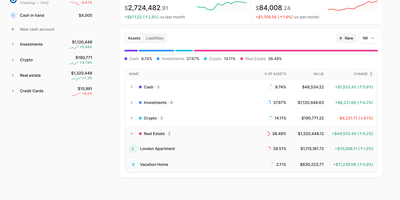
Roughly $1M of development work, open-sourced: Maybe Finance began as a $249/year commercial personal finance product before the company released it all. It aggregates bank accounts, credit cards, loans, investments, crypto, and real estate into a single net worth dashboard with historical trend charts - replacing the spreadsheet that usually glues a whole portfolio together. Transactions are categorized and tagged with rules, with merchant tracking and search across imported or synced activity; budgets track spending by category against plan; and the investment view follows holdings, cost basis, and returns across brokerage accounts. Multi-currency support converts accounts held in different currencies into a single reporting currency, bank synchronization works through Plaid where supported, and manual CSV import covers any institution. An optional AI assistant answers questions grounded in your own financial data. Because the app was built as a paid product with professional design before being open-sourced, its interface quality exceeds most community finance tools - and self-hosting means your balances and transactions are not monetized by a free app or gated behind an annual subscription. The stack is Ruby on Rails with Hotwire on PostgreSQL, licensed AGPL-3.0 and deployed via Docker. The original repository is archived; development continues in the community fork Sure, compatible with the same self-hosted setup.
Courselit
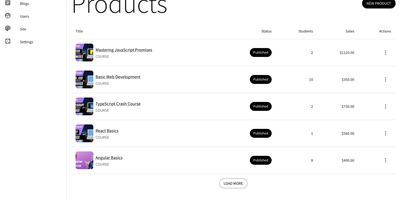
Course creators, educators, and training academies use CourseLit to launch branded digital schools, host interactive curricula, and monetize recurring memberships without paying platform revenue cuts. The visual course builder organizes multimedia lectures, downloadable workbooks, interactive quizzes, and gated content sections with customizable release schedules. Educators can package content into multi-tiered memberships, bundled digital downloads, or individual paywalled courses with direct Stripe billing and localized currency checkouts. Built-in email marketing automation allows creators to trigger welcome broadcasts, schedule lesson drip sequences, and re-engage inactive learners based on module completion milestones. An integrated site editor builds customizable sales pages, student dashboards, and community discussion boards to foster peer engagement and lesson feedback. Administrators can monitor enrollment analytics, review customer transaction logs, issue customized completion certificates, and manage learner permissions from a centralized control panel. Granular access controls let instructors grant free preview lessons to boost conversion rates while protecting premium educational materials behind secure authentication. Running on a dedicated VPS on RepoCloud with guaranteed CPU, RAM, and SSD, full root SSH access, and a browser serial console. AGPL-3.0 licensed.
Blinko
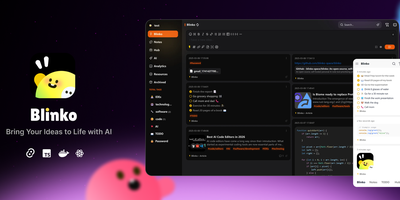
Capture fleeting thoughts as interactive flash cards and transform unorganized notes into an AI-searchable personal brain with Blinko. Users can jot down rapid notes, format rich markdown documents with code snippets and task lists, and attach multimedia files through a responsive web interface. An integrated retrieval-augmented generation engine indexes every note into vector embeddings, allowing users to query their entire personal archive using conversational natural language. You can connect local Ollama models or remote providers such as OpenAI, DeepSeek, Anthropic, and Grok to summarize lengthy entries and suggest hierarchical classification tags automatically. The interactive daily review interface presents random cards to help review, organize, or archive older insights before they are forgotten. Built-in tools include an integrated global music player for focused writing sessions, custom RSS feed ingestion, and password-protected note sharing with configurable expiration dates. Running on a dedicated VPS on RepoCloud with guaranteed CPU, RAM, and SSD, full root SSH access, and a browser serial console. GPL-3.0 licensed.
Roundcube
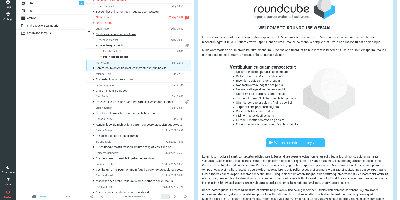
Two decades of continuous development made Roundcube the standard-bearer of open-source webmail - a PHP IMAP client that gives any mail server a polished, application-like interface in the browser. It connects to whatever IMAP/SMTP stack you run - Dovecot, Postfix, a hosted mailbox - and delivers the full desktop-client experience: drag-and-drop message management, threaded conversation views, full MIME and HTML mail handling, find-as-you-type address book with groups and LDAP connectors, multiple sender identities, full-text search, and spell checking in dozens of languages. The default Elastic skin is genuinely responsive, working as well on a phone as a desktop, and the entire UI is skinnable. The plugin API is where deployments get shaped: managesieve exposes server-side filter management in the UI, enigma brings PGP encryption and signing via GnuPG, markasjunk trains spam filters, zipdownload batches attachments, password lets users change credentials, and attachment_reminder catches the classic forgotten-attachment email - among hundreds of community plugins. Built-in caching keeps large mailboxes fast, IMAP ACLs and shared folders support team setups, and XSS protection is engineered into the rendering pipeline. It scales from a single personal mailbox to unlimited users, backed by MySQL, MariaDB, PostgreSQL, or SQLite. GPL-licensed with regular security releases.
GrowthBook
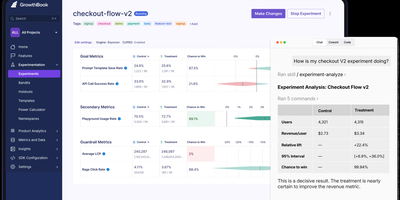
Used by over 3,000 organizations including Dropbox, Khan Academy, Sony, Pepsi, Wikipedia, and Mistral, GrowthBook is the open-source experimentation platform that handles over 100 billion feature flag evaluations daily across its cloud and self-hosted deployments. Feature flags support advanced targeting with user attributes, gradual percentage rollouts, prerequisite dependencies, and scheduled launches, with both client and server SDKs evaluating flags locally from a cached payload for sub-millisecond performance with zero network calls per check. The warehouse-native architecture queries experiment results directly from 11 data sources including BigQuery, Snowflake, Databricks, Redshift, ClickHouse, Mixpanel, and PostgreSQL, eliminating duplicate data pipelines. The statistics engine implements CUPED variance reduction, sequential testing, Bayesian analysis, post-stratification, multi-armed bandits, and sample ratio mismatch checks with fully open-source methodology. Product analytics provides dashboards with funnels, retention cohorts, and event-based tracking shareable across teams. Twenty-four SDKs cover React, Next.js, Node.js, Python, Go, Ruby, PHP, Java/Kotlin, Swift, C#/.NET, Rust, Elixir, Angular, and edge runtimes including Cloudflare Workers, Fastly Compute, and Lambda@Edge. The MCP server and REST API enable AI coding agents to create features, start experiments, and manage stale flags programmatically. Self-hosting deploys via Docker Compose with MongoDB, or via Helm charts on Kubernetes, with the same codebase powering both open-source and managed cloud offerings. Running on a dedicated VPS on RepoCloud with guaranteed CPU, RAM, and SSD, full root SSH access, and a browser serial console. MIT licensed.
Actual Budget
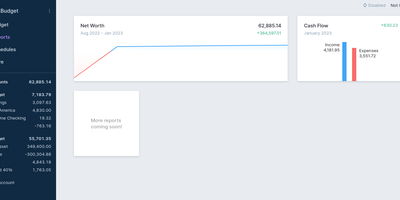
Every unit of income gets a job in Actual Budget - a local-first personal finance app built on envelope (zero-sum) budgeting, where you can only budget cash you actually have, which keeps the plan honest by construction. The data model is a SQLite file that lives on your device and works fully offline; the self-hosted Node.js sync server adds background multi-device synchronization using CRDT-based distributed-systems machinery, browser and mobile access as an installable web app, and automated backups. Optional end-to-end encryption makes the synced data unreadable even to the server hosting it. Transactions enter three ways: manual entry, file import (CSV, QIF, OFX, QFX, CAMT.053), or automatic bank syncing through GoCardless for EU/UK banks and SimpleFIN for US/Canada. Built-in YNAB4 and nYNAB importers migrate complete budget histories, and reports, schedules for recurring transactions, and rule-based transaction cleanup handle the day-to-day. A fully featured local API lets developers script custom importers and automation against their own data. 100% free, open source, and 26k stars strong.
Huginn
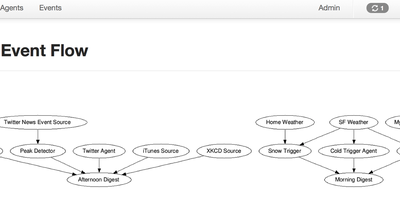
Huginn has established itself as the definitive open-source automation engine for developers who refuse to hand their workflow data to third-party cloud services. The platform lets you build agents that scrape websites, monitor RSS feeds, track weather via APIs, watch Twitter streams, aggregate news, detect price changes, and trigger notifications through email, SMS via Twilio, Slack webhooks, or social media posts to Twitter and Tumblr. Each agent creates and consumes JSON events, propagating them along a directed graph where complex multi-step workflows emerge from simple single-purpose components. The web interface provides visual agent management with drag-and-drop scenario building, real-time event logs, scheduling controls, and a built-in agent library covering dozens of use cases out of the box. Huginn supports Liquid templating for dynamic event transformation, regex-based content extraction, JavaScript-based data manipulation, and HumanTaskAgent for crowd-sourced workflow steps. Custom agents can be packaged as Ruby gems and loaded via the ADDITIONAL_GEMS environment variable without modifying core code. Deployment options include Docker with the official huginn/huginn all-in-one image or huginn/huginn-single-process for production multi-container setups with PostgreSQL or MySQL backends, plus native support for Heroku and OpenShift PaaS platforms. Running on a dedicated VPS on RepoCloud with guaranteed CPU, RAM, and SSD, full root SSH access, and a browser serial console. MIT licensed.
OpenFGA
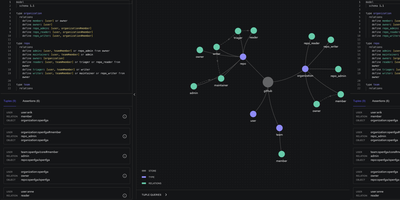
OpenFGA answers the question 'can this user perform this action on this resource?' in single-digit milliseconds, implementing Google's Zanzibar paper as a production-ready authorization engine adopted by Auth0, Grafana Labs, Canonical, Docker, Agicap, and Read.AI. The server exposes both gRPC and HTTP APIs for authorization queries including Check, ListObjects, ListUsers, Expand, and the high-throughput BatchCheck endpoint that deduplicates and processes multiple authorization decisions in a single request. Authorization models combine relationship-based access control with role-based and attribute-based patterns through a purpose-built DSL that supports contextual tuples, conditional relationship tuples with CEL expressions, and time-based filtering via the ReadChanges API. Storage backends include PostgreSQL 14+, MySQL 8, and SQLite in beta, with an in-memory adapter for development and testing. Official SDKs for Java, .NET, Node.js, Go, and Python provide type-safe client integration, while a Terraform provider enables infrastructure-as-code management of authorization stores and models. The built-in browser playground at port 3000 lets developers visually model authorization schemas, write relationship tuples, and test access control queries interactively before deployment. OpenTelemetry instrumentation integrates with existing monitoring infrastructure, and Helm charts simplify Kubernetes deployment. A VS Code extension provides syntax highlighting and validation for FGA model files, and GitHub Actions automate model testing in CI/CD pipelines. A CNCF incubating project with transparent governance. Running on a dedicated VPS on RepoCloud with guaranteed CPU, RAM, and SSD, full root SSH access, and a browser serial console. Apache 2.0 licensed.
Shiori
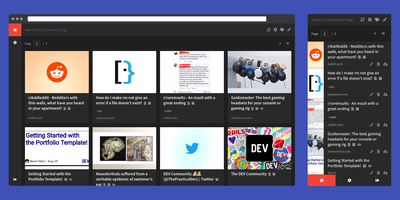
Most web links eventually break - the sobering statistic Shiori, a bookmark manager with archiving by default, is built on. Its answer is archiving by default - where possible, every bookmark you save gets a clean, readable offline copy parsed from the page, ads and navigation stripped, so the article survives even after the original URL dies. Conceived as a simple Pocket clone and written in Go, the entire server is a single binary using roughly 25-30 MB of RAM with SQLite out of the box (Postgres and MySQL supported) - genuinely the lightest archiving bookmark manager you can run. Saving is one click through the Firefox and Chrome extensions, and finding things again is where Shiori quietly outperforms its size: full-text search covers the archived page content, not just titles and tags, so you can find that article by a phrase you remember from paragraph six. Reader mode presents the cleaned text; archive mode shows the preserved page. It's dual-interface by design - a pretty web UI (installable as a PWA on mobile) and a complete CLI for terminal devotees - plus a REST API for scripting. Pocket imports work natively, and Netscape HTML handles browser imports and exports. Multi-user support included. MIT-licensed.
TaxHacker
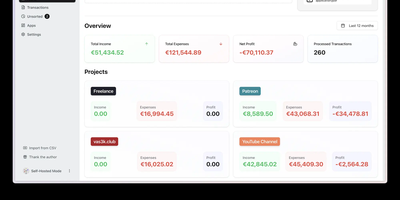
With 6,600+ GitHub stars and created by vas3k — one of the indie developer community's most recognized builders — TaxHacker is the self-hosted AI accounting application that turns receipt chaos into structured financial intelligence without surrendering a single document to third-party cloud services. Upload photos of receipts, invoices, or PDF bank statements, and the LLM pipeline automatically extracts dates, merchants, amounts, line items, tax breakdowns, and vendor information into an Excel-like structured database with custom fields you define through your own AI prompts. Currency handling covers 170+ fiat currencies and 14 cryptocurrencies (BTC, ETH, LTC, and more) with automatic conversion using historical exchange rates from the actual transaction date — critical for international freelancers filing in one reporting currency. The AI layer supports OpenAI (GPT-4o, GPT-4.1-mini), Google Gemini, Mistral, or fully local models via Ollama, LM Studio, vLLM, and LocalAI through OpenAI-compatible endpoints for complete air-gapped deployments. Features include multi-project workspace isolation, custom categories with AI-driven auto-classification, bulk document upload with batch processing, email server monitoring for automated attachment ingestion, flexible CSV export with attached documents, and comprehensive tax report generation. The tech stack runs Next.js 15+ for the frontend and tRPC API, Prisma ORM for database models and migrations, PostgreSQL 17+ for persistence, and Ghostscript plus GraphicsMagick for PDF rendering. Running on a dedicated VPS on RepoCloud with guaranteed CPU, RAM, and SSD, full root SSH access, and a browser serial console. MIT licensed.
Forem
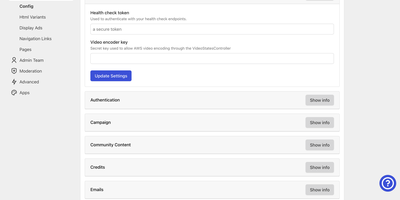
With 22,700 GitHub stars, 4,100+ forks, and proven scale powering dev.to — one of the largest developer communities serving millions of monthly users — Forem provides a complete community platform for building engaged audiences around shared interests, whether for developer documentation, customer communities, fan bases, or professional networks. The Rails backend with Preact frontend delivers article publishing with a rich Markdown editor, threaded discussions, user profiles with portfolio links, tag-based content organization, podcast hosting, classified listings for jobs and events, and social interactions including reactions, bookmarks, and following. AI-powered semantic search using PostgreSQL pgvector embeddings surfaces relevant content across articles and concepts, while scheduled automations enable community bots to create automated roundups, republish curated content, and trigger time-based moderation actions. Score-based content ranking replaces simple reaction counts with nuanced algorithms that resist gaming. The admin dashboard provides user management, content moderation, community settings, analytics, and organization controls. OAuth integration supports GitHub, Twitter, Apple, and configurable OIDC providers for frictionless sign-up. Dynamic open-graph image generation creates branded social cards automatically. Deploy with Kamal 2 to any cloud provider or bare metal server with PostgreSQL and Redis. Running on a dedicated VPS on RepoCloud with guaranteed CPU, RAM, and SSD, full root SSH access, and a browser serial console. AGPLv3 licensed.
OpenLLM
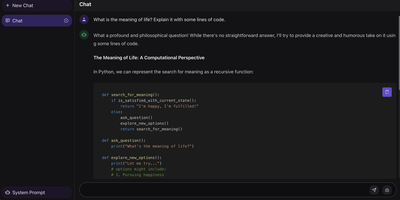
OpenLLM serves any large language model as an OpenAI-compatible API endpoint from a single CLI command, handling model download, backend selection, quantization, and port binding automatically. It supports the full spectrum of popular models including Llama 3.3, Qwen2.5, DeepSeek, Mistral, and Phi3, choosing between vLLM and PyTorch inference backends based on hardware capabilities. When vLLM is available, continuous batching with PagedAttention achieves up to 23x throughput improvement over naive serving, while GPTQ and bitsandbytes quantization reduces memory requirements for GPU-constrained deployments. The server exposes a RESTful API on port 3000 with full OpenAI client library compatibility, enabling drop-in replacement for commercial providers in any application using the standard chat completions format. A built-in web chat UI at the /chat endpoint provides immediate interactive testing without external clients. Custom model repositories allow teams to maintain private catalogs of fine-tuned models alongside the default repository that tracks the latest releases. Deployment workflows generate production-ready Docker images automatically, with Kubernetes manifest support for orchestrated scaling. Native integration with LangChain and LlamaIndex supports RAG pipelines, Transformers Agents enables tool-calling workflows, and HuggingFace Hub handles model discovery. Server-Sent Events enable real-time token streaming across all API endpoints. Backed by BentoML's production ML infrastructure. Running on a dedicated VPS on RepoCloud with guaranteed CPU, RAM, and SSD, full root SSH access, and a browser serial console. Apache 2.0 licensed.
Planka
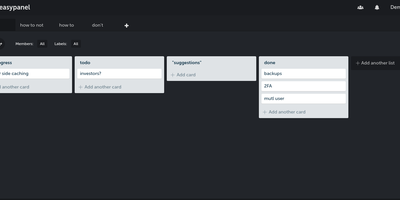
Trello's board model on your own server: Planka is an open-source Kanban project management tool. Boards organize into projects with lists, cards, labels, due dates, checklists, file attachments, and per-card stopwatch time tracking, all managed through drag-and-drop. Updates propagate over WebSockets, so a teammate moving a card or adding a comment appears instantly for everyone without a refresh - a genuine differentiator among self-hosted boards. Card descriptions use a full Markdown editor, custom fields adapt cards to your workflow, and views switch between Kanban, grid, and list layouts. Authentication supports OpenID Connect single sign-on with Google, Azure AD, Okta, or any OIDC provider - a feature Trello reserves for enterprise plans - and notifications reach 100+ channels including Slack, Discord, Telegram, and SMTP via Apprise. A REST API with 50+ webhook events supports custom integrations, and one-click board import eases migration. Built with React and Node.js on PostgreSQL, translated into 35+ languages, deployed via Docker.
KeeWeb
Your KeePass vaults, opened from any browser: KeeWeb reads, edits, and creates standard KDBX files, so it works with the same databases as KeePass and KeePassXC without conversion or lock-in. Self-hosting the web app gives you a password manager reachable from any modern browser, including mobile, with no client installation and no third-party cloud in the loop. All KDBX cryptography runs client-side; the server just serves the static app. Open multiple vault files simultaneously and search them all from one box, with advanced options covering specific fields, password history, and regular expressions. Vaults load from local files, your own server (WebDAV), or Dropbox, Google Drive, and OneDrive, with automatic sync - and files are cached for offline use, so a dropped connection never locks you out; changes resync once you're back online. Day-to-day niceties include a configurable password generator, protected fields that stay masked and are held in memory more defensively, entry history, tags with easy input, drag-and-drop attachments, and per-entry icons with favicon fetching. The optional KeeWeb Connect extension (Chrome, Firefox, Edge, Safari) autofills credentials using the keepassxc-protocol. MIT-licensed with matching desktop apps for macOS, Windows, and Linux.

Calibre-Web
With over 17,700 GitHub stars and continuous development since 2015, Calibre-Web has become the definitive self-hosted digital library solution for book enthusiasts who want beautiful web access to their Calibre collections. The responsive Bootstrap 3 interface delivers instant browsing, searching, and filtering across titles, authors, tags, series, book formats, and languages, with custom shelves for organizing personal reading collections. In-browser reading supports EPUB, PDF, TXT, CBR, CBT, CBZ, and DJVU formats with a configurable EPUB reader featuring multiple themes and page location tracking, while one-click email delivery sends books directly to Kindle, Kobo, and other E-Readers without leaving the interface. Native Kobo sync lets Kobo device owners synchronize their entire Calibre library wirelessly, maintaining reading progress and bookmarks across devices. Metadata management includes editing capabilities with automatic metadata downloading from Google Books, Amazon, and other configurable sources, plus eBook format conversion through Calibre binaries for on-the-fly EPUB, MOBI, AZW3, and PDF conversion. User management provides fine-grained per-user permissions controlling download access, upload rights, editing capabilities, and content visibility based on categories or Custom Column values. Authentication supports local accounts, LDAP directory integration, Google and GitHub OAuth, proxy authentication, and Magic Link login for easy E-Reader access. The OPDS catalog feed enables any compliant E-Reader app to browse and download from the library. Running on a dedicated VPS on RepoCloud with guaranteed CPU, RAM, and SSD, full root SSH access, and a browser serial console. GPL-3.0 licensed.

Karakeep
Previously known as Hoarder and now holding 28,000+ GitHub stars, Karakeep is the most popular open-source bookmark-everything application — combining AI-powered automatic tagging with full-text search, page archival, and cross-platform access for digital content hoarders who refuse to let valuable links disappear. The Next.js frontend with tRPC communication delivers a responsive interface for saving links, notes, images, and PDFs, while Puppeteer crawls bookmarked pages to fetch titles, descriptions, and images automatically. LLM-based auto-tagging supports OpenAI, Anthropic, or local models via Ollama for privacy-first deployments that never send data to external services. Meilisearch powers full-text and semantic search across all stored content including OCR-extracted text from images. A rule-based automation engine triggers custom actions based on bookmark properties — automatically sorting, tagging, or archiving content matching defined conditions. Full page archival via Monolith preserves complete page snapshots against link rot, while yt-dlp integration archives videos from YouTube and other platforms. RSS feed ingestion automatically captures new articles from subscribed sources. Collaborative lists enable teams to build shared bookmark collections, with per-list permissions and real-time sync. Native iOS and Android apps, Chrome and Firefox extensions, and browser bookmark sync via Floccus ensure capture from any device. Importers migrate data from Chrome, Pocket, Linkwarden, Omnivore, and Tab Session Manager. Running on a dedicated VPS on RepoCloud with guaranteed CPU, RAM, and SSD, full root SSH access, and a browser serial console. AGPL-3.0 licensed.