Alook
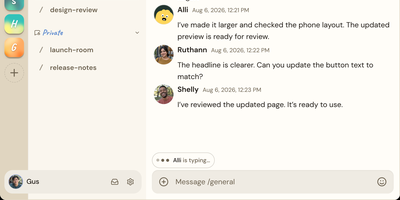
Alook gives the coding agent on your machine a seat in the team chat, with its own handle, inbox, and room memberships, so colleagues can ask it for work the same way they would message a person. You create servers, channels, and direct messages where people and agents are both first-class members, and an agent keeps one persistent identity across every room it joins. Claude Code, Codex, Cursor, OpenCode, Pi, Grok, and Antigravity connect through a small daemon, so the agent keeps running on your own hardware while the room stays reachable from anywhere. Because the agent holds memory across rooms, it can pick up a thread in one channel, report progress in another, and move tasks forward without you relaying messages by hand. Inviting a teammate takes a link; they join the room and talk with your agent directly instead of waiting for you to copy answers back and forth. The same room follows you from desktop to phone, so a question asked at your desk is still there, with the agent's reply, when you check it later. Self-hosting runs the web app, realtime WebSocket service, email worker, and wake-up queue on your own server with a local database, started with a single npx command. Running on a dedicated VPS on RepoCloud with guaranteed CPU, RAM, and SSD, full root SSH access, and a browser serial console. Apache 2.0 licensed.
Infinite OS
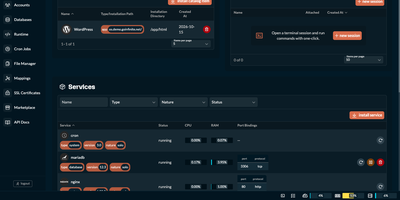
Infinite OS packs a complete hosting environment into a single Docker container, and you decide what it hosts after it starts. From the dashboard you add the runtimes, databases, domains, and applications that a normal image would have forced you to choose at build time. Open the Marketplace and WordPress, n8n, or dozens of other applications install in a few clicks, dependencies and services included, with a hostname and route created automatically. PHP, Node.js, Bun, Python, Ruby, and Java runtimes install on demand beside databases and workers, so one project runs its whole stack inside one environment. Public domains get free TLS certificates automatically, and changing the primary domain once updates the web server, PHP, and database records to match. The built-in web terminal needs no SSH setup, and a coding agent such as OpenCode can work there with the project files, runtimes, and databases within reach. A file manager, cron scheduler, PHP version switching, and per-route rate, bandwidth, and connection limits cover the daily work of running sites from the browser. Team accounts give each person their own login, and nearly every dashboard action has a matching CLI command and REST API call for scripting. Each project gets its own container with its own filesystem and services, so unrelated sites stay isolated while several lightweight environments share one machine. Running on a dedicated VPS on RepoCloud with guaranteed CPU, RAM, and SSD, full root SSH access, and a browser serial console. EPL 2.0 licensed.
CLIProxyAPI
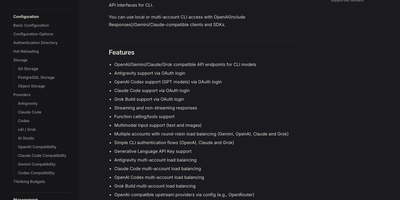
CLIProxyAPI turns AI coding subscriptions you already hold into one standard API endpoint that any OpenAI, Gemini, or Claude compatible client can call. Connect Codex, Claude Code, Grok Build, and Gemini accounts through simple OAuth sign in flows, then point your editor, agent, or script at a single base URL instead of juggling separate tools. Add several accounts per provider and the proxy spreads requests across them with round robin load balancing, so a busy team can pool capacity instead of pressing against one account's limits. Streaming, non streaming, and WebSocket responses are supported where the provider allows them, which keeps interactive coding sessions responsive. Function calling and tool use pass through, so agents can still run commands, edit files, and call external tools through the unified endpoint. Multimodal requests combine text and images, covering screenshot driven debugging and visual questions. Gemini API keys, AI Studio accounts, and hosted Gemini access sit alongside subscription accounts, and OpenAI compatible upstreams such as OpenRouter can be added in configuration. A management API exposes control endpoints for companion dashboards, while a reusable Go SDK lets developers embed the proxy inside their own services. Running on a dedicated VPS on RepoCloud with guaranteed CPU, RAM, and SSD, full root SSH access, and a browser serial console. MIT licensed.
Anubis
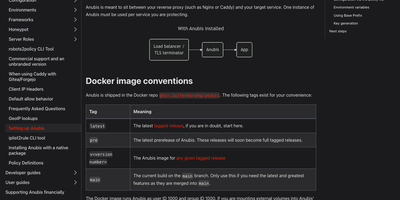
Anubis is a self-hosted web firewall that stands in front of your website and makes suspicious visitors complete a lightweight challenge before their requests are allowed through. Place it between your load balancer or TLS terminator and the application it protects, with one instance guarding each service. Requests that look like scraper bots are weighed and challenged, which raises the cost of mass crawling so automated harvesting stops being free. Requests that pass are forwarded straight to your target service over TCP or a Unix domain socket, so legitimate visitors reach the real site. You define the bot policy: allowlist known good bots and crawlers you want to keep, challenge the ones you are unsure about, and turn away the rest. Challenge difficulty and weight thresholds tune how hard visitors must work, letting you balance protection against friction for real readers. The server listens on port 8923 by default and exposes Prometheus metrics on port 9090, so request and challenge rates show up in your existing monitoring. Deployment is a single Docker image or native package with minimal resource needs, and configuration arrives through environment variables plus the policy file. Running on a dedicated VPS on RepoCloud with guaranteed CPU, RAM, and SSD, full root SSH access, and a browser serial console. MIT licensed.
Home Screens
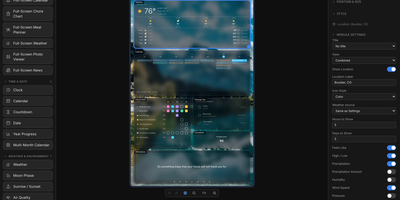
The family calendar is split across phones, the meal plan lives in someone's head, and the chore chart fell off the fridge: Home Screens turns a spare screen into a self-hosted family command center that puts calendars, weather, chores, meal plans, and photos on one shared display. You compose each screen in a drag and drop editor, placing any of 46 built in modules on a configurable canvas: clocks in 18 styles, weather in 14 views, calendars, to do lists, news, stock and crypto tickers, sports scores and standings for 15 leagues, traffic, air quality, and moon phases. Screens rotate through seven transitions, and a hub and spoke setup lets one server drive several physical displays, each with its own layout, dimensions, rotation, and scheduled profile. The phone remote wakes or sleeps displays, adjusts brightness, starts visual timers and morning routines, and runs the family organizer: chore charts with rewards, a meal planner with grocery list, shared to do lists, school timetables, and a notes board. Calendars arrive from Google, iCloud, or any iCal feed, weather from nine providers, and backgrounds from your uploads, Unsplash, NASA, Immich, Google Photos, iCloud, or OneDrive. Modules can appear or hide based on live conditions, plugins add new module types from a directory or a URL, and everything is stored locally with no cloud account. Running on a dedicated VPS on RepoCloud with guaranteed CPU, RAM, and SSD, full root SSH access, and a browser serial console. MIT licensed.
Supernote
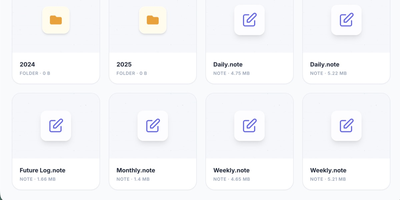
Your Supernote tablet fills with handwritten journals, meeting notes, and sketches, and this server gives that handwriting a private home: Supernote is a self-hosted sync cloud for Ratta Supernote tablets that stores notebooks on your own hardware and can transcribe, summarize, and search them with AI. Point the tablet at your server under its Private Cloud sync setting and notebooks upload automatically, ready to browse in the web interface alongside your task lists and AI insights. Turn on the intelligence layer and each synced page is transcribed by a vision model, either Google Gemini or a local model served by Ollama or another OpenAI-compatible endpoint, so notes never leave your network. Analyzers then read your journals to surface tasks, themes, and Daily, Weekly, and Monthly summaries. Every word is indexed for semantic search, which understands concepts: searching for budget also finds pages about expenses or money, even when that exact word never appears. Tasks discovered in your handwriting export as calendar feeds that drop into Home Assistant, Apple Calendar, Google Calendar, and Outlook. An MCP server lets assistants such as Claude, Gemini, and ChatGPT answer questions against your notebooks, and notebooks convert to PDF, PNG, SVG, or plain text for use anywhere else. The hub idles at about 160 MB of memory, or roughly 135 MB in bare sync mode. Running on a dedicated VPS on RepoCloud with guaranteed CPU, RAM, and SSD, full root SSH access, and a browser serial console. Apache 2.0 licensed.
CashPilot
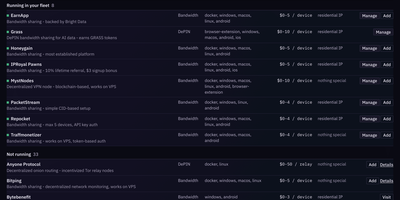
Idle bandwidth and spare hardware earn nothing sitting unused, so CashPilot deploys passive-income services across your servers and shows every balance in one web dashboard. From the catalog you start Docker earners such as Honeygain, Earn.fm, Traffmonetizer, PacketStream, ProxyRack, MystNodes, Storj, and Sia hostd with one click, no compose files to write, and you can add any service the catalog lacks by image name under the same container restrictions. Providers that run as browser extensions, desktop apps, or GPU nodes, 24 of them, are tracked alongside, while 15 built-in collectors read balances every hour into a single earnings history, so a service that runs without earning shows up as a flat line instead of a surprise. When a balance drops, CashPilot treats it as a probable payout and asks you to confirm rather than counting income by guesswork. One worker runs on each server under a single dashboard, with every figure broken down per server and per service. Extra copies of a service can earn through SOCKS5, HTTP CONNECT, or Tailscale exit-node proxies and stop dead if the proxy dies instead of leaking your real address. Earners are fenced off from your LAN, the host, your tailnet, and cloud metadata by default, and per-service guides flag restrictions such as providers that ban datacenter IPs. Running on a dedicated VPS on RepoCloud with guaranteed CPU, RAM, and SSD, full root SSH access, and a browser serial console. GPL-3.0 licensed.
LlamaForge
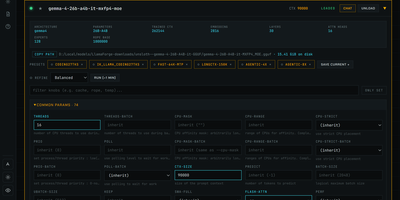
Running local models usually means choosing between a polished app that hides the engine and a terminal full of flags you half remember. LlamaForge refuses the trade: it installs and drives the official llama.cpp release itself, then puts a browser panel over all of it, every one of the 200-plus llama-server flags your build supports, grouped, searchable and editable per model. Before you load anything, each model is drawn into your GPUs at its real footprint, so the out-of-memory surprise happens on screen instead of in a crashed server; before you download anything, every quant on Hugging Face gets a fit rating for your VRAM, FITS, TIGHT or CPU OFFLOAD. Auto-Forge then measures placements, KV cache types and speculative drafters on your own hardware and keeps the fastest configuration, checking that a drafter still produces identical tokens before applying it with one click, and undoing it with one click. Keep several models loaded at once and a planner places each on the GPUs that fit it; when a game launches, Game Mode unloads your models and brings them back when you quit. Chat in llama.cpp's own interface, join from your phone by QR code, duel two models blind in the Arena under an Elo board, and let Embers, small local agents, keep a wiki and write scheduled briefs counting only facts they can quote verbatim. Running on a dedicated VPS on RepoCloud with guaranteed CPU, RAM, and SSD, full root SSH access, and a browser serial console. MIT licensed.
BarcodeBuddy
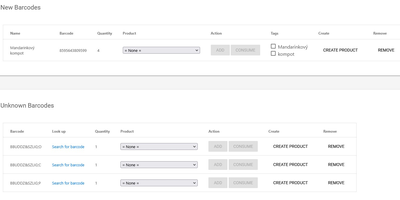
Barcode Buddy turns a cheap barcode scanner into a one-scan inventory clerk for Grocy: scan a product as you use it or unpack it, and your self-hosted grocery stock updates itself. Known barcodes are processed immediately according to the mode you are in, and printed mode barcodes switch that behavior on the fly: scan BBUDDY-P before unpacking groceries and everything adds to inventory, scan BBUDDY-C in the kitchen and scans consume stock, with variants for spoiled items, consuming everything, marking products opened, checking stock levels, and adding to the shopping list. A quantity barcode such as BBUDDY-Q-10 tells it that one carton scan means ten eggs, every time. Unknown barcodes are looked up on Open Food Facts to find the product name and category, then wait in the web UI where you pick the matching Grocy product once; saved tags preselect the right product whenever a looked-up name contains your keyword, so the second scan of anything is fully automatic. Products with tare weight enabled prompt for the weight before processing, chores can be marked done by barcode, and every processed scan lands in a history list. Scanners connect by grabbing USB input on the server, through the Android app with Bluetooth scanner support, or through a simple API that scripts and third-party apps can call. Running on a dedicated VPS on RepoCloud with guaranteed CPU, RAM, and SSD, full root SSH access, and a browser serial console. AGPL-3.0 licensed.
Joulenap
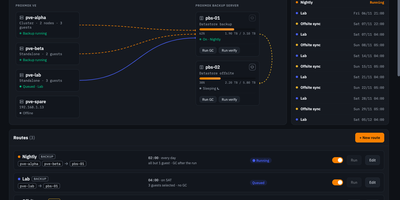
A dedicated backup server is the right way to keep copies on separate hardware, and a strangely expensive one to leave humming in the corner for a job that runs twenty minutes a night. Joulenap lets that machine sleep: at the scheduled hour it sends a Wake-on-LAN packet to your Proxmox Backup Server, waits until the API answers, runs the backup, applies retention, runs garbage collection and verification if you asked for them, then powers the box back down or suspends it for network cards that only wake from sleep. You describe your setup as routes: which hosts back up to which backup server, on what schedule, keeping how many copies, with guests as everything on a host or an explicit list. Fan several hosts into one server nightly, or copy one backup server to another across town for an off-site second copy with its own retention. A second route kind starts nothing at all: your Proxmox hosts keep their own schedules while Joulenap simply wakes the box, watches their tasks, and switches it off when they go quiet. Watch live task output, stop a run mid-flight if you must, and get results through Apprise, Telegram, ntfy, Discord or email per route. Status widgets feed Homepage, Homarr, Dashy and Glance, and a Prometheus endpoint lets Grafana alert you when a guest stops being backed up. Running on a dedicated VPS on RepoCloud with guaranteed CPU, RAM, and SSD, full root SSH access, and a browser serial console. AGPL-3.0 licensed.
Lotus
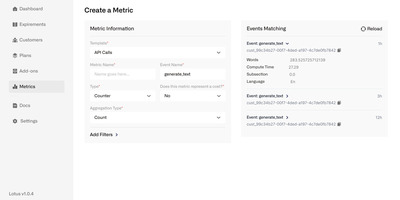
Lotus is an open-source pricing and billing engine that lets SaaS teams meter usage, design plans, and experiment with pricing without rebuilding their billing stack every time the model changes. You define how customers are charged: per seat, per API call, per gigabyte, in tiers, with prepaid credits, or as a bespoke enterprise arrangement negotiated over email. Plans are versioned and deployed like releases, so changing a price never means editing the plan that half your customers already signed. Usage events stream in from your product and are aggregated against each customer's plan, turning raw events into billable quantities your finance team can audit line by line. Before a new model goes live, you backtest it against historical usage to see exactly who would have paid what, and forecast the revenue before a single invoice changes. Experiments compare pricing variants on real customers, so the packaging debate ends with numbers instead of opinions. The control panel sits on top of your existing quote-to-cash stack, pulling from your payment, CRM, and data systems rather than demanding a rip-and-replace migration. Engineers integrate through the API: send events, read balances, and let Lotus handle the proration math when plans change mid-cycle. Running on a dedicated VPS on RepoCloud with guaranteed CPU, RAM, and SSD, full root SSH access, and a browser serial console. MIT licensed.
DiceFrame
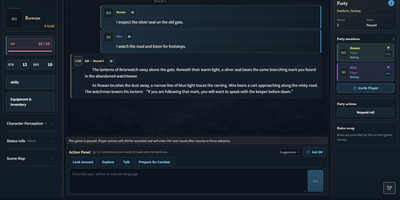
Game night keeps dying in the group chat because nobody can be in the same room, and the one willing game master is burned out by October. DiceFrame puts an AI game master on your own server instead: open the web UI, describe what your character does in plain language, and the engine adjudicates the action, rolls the dice check once, applies the result to your character sheet, and narrates what happens next. Run a solo campaign at midnight or invite friends through a link and play the same shared world from different cities, with waiting states, away players and live updates keeping the table in sync. Rules are layered rather than decorative; D&D 5e-inspired d20 play with advantage and disadvantage, CoC 7e-inspired d100 with bonus and penalty dice, custom d20 systems and freeform no-dice narrative all track hit points, gold, items, experience, death and revival properly. Build worlds, lorebooks and adventures in the content library, import scripts, PDFs and Foundry or Fantasy Grounds modules, or let AI assistance draft the world, rules and characters for you. Character cards are reusable across games, long campaigns are held together by session summaries and optional memory recall, and the story can be read aloud with text-to-speech through system voices or your own endpoints. Plugins and chat bots extend the table, all through your chosen OpenAI-compatible model endpoint. Running on a dedicated VPS on RepoCloud with guaranteed CPU, RAM, and SSD, full root SSH access, and a browser serial console. AGPL-3.0 licensed.

XianScan
Reading a new manhwa chapter on release day usually means waiting for a scanlation group, or pasting panels into three tools yourself. XianScan collapses that whole relay into one server: point its browser extension at a chapter on a reader site and it captures every page, or drop raw pages into the studio and let the pipeline run. Speech bubbles, captions and sound effects are detected automatically, the text inside them is read by OCR supporting ten languages in vertical and horizontal layouts, and tall webtoon strips are resliced along natural panel gutters so no bubble is ever cut in half. Translation keeps a sliding memory of previous pages so speakers, pronouns and story topics stay consistent, while terminology glossaries lock character names and cultivation terms across an entire series. The original lettering is then removed by neural inpainting that rebuilds the artwork underneath, and the translation is typeset back into the bubbles with computed font sizes, line breaks and per-script fonts, including right-to-left scripts and accent fonts for attack names. Inspect OCR boxes and confidence scores, fix text before saving, then read in the web studio or stream chapters to the Mihon app on your phone. Local models through Ollama or LM Studio keep everything offline, or plug in Gemini, OpenAI, Groq or OpenRouter keys when you prefer the cloud. Running on a dedicated VPS on RepoCloud with guaranteed CPU, RAM, and SSD, full root SSH access, and a browser serial console. MIT licensed.
Trading Journal AI
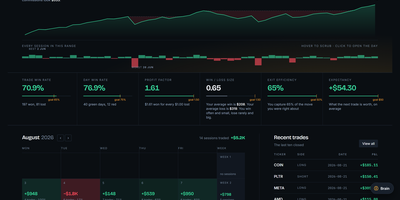
Most traders know their balance and almost nothing else, because the patterns that actually cost money hide across hundreds of individual fills. Trading Journal AI rebuilds your round-trip trades from a broker CSV, grouping partial fills, scale-ins and shorts automatically, then tracks win rate, profit factor, expectancy, drawdown, MFE, MAE and exit efficiency for every account. Thinkorswim and Interactive Brokers import directly, seven more brokers including Tradovate, NinjaTrader, Webull and tastytrade are in beta, and a generic template covers any other broker's export. The Leak Finder ranks groups of trades that share something you knew at entry, an entry window, a weekday, a size habit, an emotion from your diary, and shows which of them quietly drain the account, with confidence scored against the rest of your history. Exit Lab replays your completed stock trades on one-minute prices and compares your actual exits against 1R and 2R targets, breakeven rules, trailing stops and VWAP or EMA exits, in R and in dollars. If you add an Anthropic key, Claude reads your trading diary and grades each day on process rather than outcome; without one, every number still works, because the statistics are plain code and never AI. Four interface themes, one SQLite file, no account and no telemetry complete the picture. Running on a dedicated VPS on RepoCloud with guaranteed CPU, RAM, and SSD, full root SSH access, and a browser serial console. MIT licensed.
Torollo
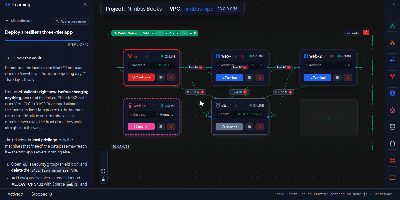
Torollo is a hands-on backend engineering lab where the architecture you draw becomes real infrastructure, so a load balancer on the canvas is an actual Nginx container and a firewall rule you sketch is enforced by iptables. Place Ubuntu servers, PostgreSQL, MongoDB, Redis, and RabbitMQ nodes, wire them into VPCs and subnets, then watch the traffic simulator send requests through the topology you built. Guided roadmaps walk you from a single web server to a resilient three-tier application, a cache-aside Redis design, and a worker queue, grading every step against the live system instead of your intentions. Validators probe container status, SQL schemas, Redis keys, network reachability, and HTTP responses, and a failed check explains exactly what was expected versus what your containers actually did. Built-in explorers let you run SQL against Postgres, query MongoDB collections, and issue Redis commands, while browser terminals give you a shell inside any node. Roadmaps are plain JSON files you can import or author yourself, progress is tracked per step with hints and solutions, and the whole catalogue is available in English and French. Running on a dedicated VPS on RepoCloud with guaranteed CPU, RAM, and SSD, full root SSH access, and a browser serial console. MIT licensed.
PaperPull
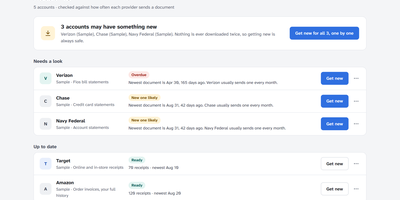
Years of bank statements, pay stubs and receipts sit scattered across dozens of websites, each demanding a login and offering one PDF at a time. PaperPull fetches that whole history for you: sign in yourself in a real browser window, answer the two-factor prompt, and it downloads statements, receipts, pay statements, W-2s and tax forms from 73 supported providers including Chase, Amex, ADP, Amazon, Walmart, Vanguard and Verizon. The tool only ever downloads; it never pays a bill, moves money or changes a setting, and that read-only promise is enforced by construction rather than by policy. Every archive is checked for freshness and for holes in the middle, so a series that looks current but quietly skipped three months is flagged by name, with per-account cadence learned from your own documents. Receipts become one long spreadsheet of every item you have ever bought across every store, with prices and dates, while transactions are read out of statement PDFs into workbook rows that are verified against each statement's printed beginning and ending balances. New documents can flow straight into a Paperless-ngx consume folder, everything runs under a password you choose on your own network, and no cloud account is involved anywhere. Running on a dedicated VPS on RepoCloud with guaranteed CPU, RAM, and SSD, full root SSH access, and a browser serial console. AGPL-3.0 licensed.
Vedetta
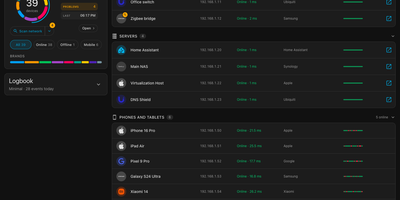
Your router calls it "Unknown device" at 192.168.1.23; Vedetta calls it the kitchen light and shows its work. Vedetta is a Home Assistant app that scans your local network, identifies what each device actually is, and explains every identification. One scan lists every device it can find with presence and latency history, in tile or list view, light or dark, on a computer or a phone. Behind each name sits the recognition engine: it weighs many weak clues together, counts a repeated fact once, groups devices by family, and shows certainty honestly, keeping anything doubtful in Other rather than inventing a label. Tap the info marker beside a name, brand, or type and a pop-up lists every clue, its weight, and the hypotheses that were rejected. Names or rooms you set by hand are never overwritten by later scans, and sleeping phones are remembered instead of flickering in and out. Choose from three search levels depending on how hard you want it to probe, let the nightly deep search refresh the picture, and use the network doctor to spot duplicate addresses, repeated restarts, devices that drop together, or a slowing gateway. It can also publish what you choose to Home Assistant and MQTT, display devices from other networks your Home Assistant already sees, and mask exports before they leave the machine. Running on a dedicated VPS on RepoCloud with guaranteed CPU, RAM, and SSD, full root SSH access, and a browser serial console. MIT licensed.
GlitchTip
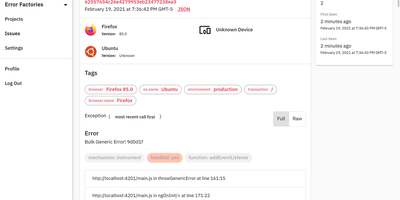
GlitchTip speaks Sentry's protocol without Sentry's operational weight - open-source error tracking that your existing SDKs already understand. The pitch is pragmatic: instrument your application with the official Sentry SDKs you already know - any language they cover - and point the DSN at your own GlitchTip instance instead. Errors, exceptions, log messages, and Content Security Policy violations flow into one place for triage, grouped into issues with stack traces, with alerts delivered by email or webhook the moment things break. Where self-hosted Sentry has ballooned into a docker-compose stack of twenty-plus containers, GlitchTip is a deliberately lean Django and PostgreSQL application a small team can actually run. Beyond errors, it bundles three more monitoring concerns: performance monitoring takes a works-out-of-the-box approach - no dashboard building, just your slowest web requests, database queries, and transactions surfaced automatically; uptime monitoring pings your sites and alerts on failures, or runs in reverse as a dead-man's-switch heartbeat for cron jobs that must check in on schedule; and log search puts application logs alongside errors for faster debugging. Unlimited projects and team members, MIT-licensed, built by Burke Software - your event volume is limited only by your own hardware.