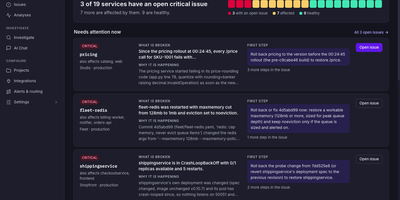
SerOps
Root cause first, dashboards second: SerOps reads the logs, metrics, traces, deploys, and commits you already produce and explains why an incident happened, even when no alert fired. It plugs into Elasticsearch, Loki, Splunk, Datadog, and the big three clouds for logs, plus Prometheus, VictoriaMetrics, Jaeger, and Tempo. GitHub, GitLab, Bitbucket, Azure DevOps, Jenkins, Argo CD, and Flux supply the other half of the story: which change shipped, and when. Analyses come back as a plain-language root cause, the reasoning behind it, and numbered next steps, with the suspect commit linked beside it. Evidence, not guesses. The Overview page opens on what is broken, why, and the first thing to try, so whoever is on call starts at the fix. Issues are deduplicated and land in a table you can filter by severity, status, project, environment, or service, then resolve, mute, or acknowledge. Need an answer now? Run an investigation over a window you pick, then keep asking in AI Chat, which sees the same evidence. Choose Claude, Gemini, OpenAI, DeepSeek, or local Ollama, cap monthly spend, and re-run any analysis on a second model to compare answers. Regex masking strips secrets and personal data from what goes to the model, and quiet windows skip the AI call. Alerts reach Slack, Teams, PagerDuty, OpsGenie, or email, with routing rules, quiet hours, and digests. Running on a dedicated VPS on RepoCloud with guaranteed CPU, RAM, and SSD, full root SSH access, and a browser serial console. AGPL-3.0 licensed.
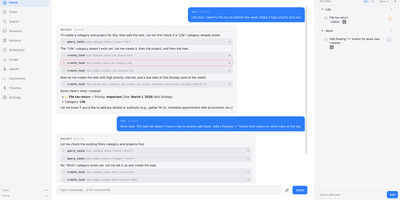
Open Walnut
Open Walnut replaces your scattered terminals and notes with one self-hosted command center where a CEO agent and a lead for each project run your Claude Code sessions like a small company. You talk to the CEO; each project lead plans the work, spawns worker sessions, checks their output, and only brings you the questions that actually need a person. Every session sits in its own column with live output, permission controls, terminals, and files, and sessions survive browser disconnects, dropped SSH connections, and server restarts. Codex, Gemini, OpenCode, and Goose sessions join the same columns, on your laptop or on remote dev boxes reached over SSH. Finished work comes back as a per-session diff: comment on individual lines and send the review straight back into the session that wrote it. Around the agents sit your tasks with subtasks, dependencies, and due dates, Markdown notes with wiki links and backlinks, a calendar, and long-term memory that a background job keeps consolidated. Search covers notes, tasks, sessions, and memory together, mixing keyword matching with local embeddings, so nothing you told it last month gets lost. Routines run one-time, interval, and cron jobs; plugins add whole apps, tools, and skills; and paired phones reach the same console through device tokens. Running on a dedicated VPS on RepoCloud with guaranteed CPU, RAM, and SSD, full root SSH access, and a browser serial console. MIT licensed.
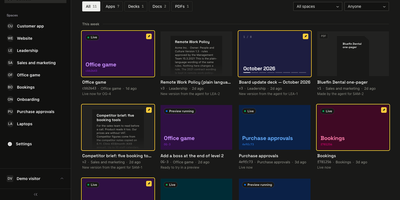
Viberglass
Describe the tool your team needs, and Viberglass has a coding agent build it, preview it, and run it, with nobody on the team touching code. Trackers, approval lists, checklists, and booking calendars replace spreadsheets, each app running on your own servers behind team sign-in, with backups and rollback. Changes run in a preview on a copy of the live data and go live only when the requester or a maintainer says so. The same tasks produce documents and presentations, kept as versioned artifacts that preview in the app, or open GitHub pull requests for engineering to review. For code, the agent writes a plan, asks the right person when something is unclear, takes line-by-line comments, then builds in parts, one pull request each. One task, one thread. Pick Claude Code, Codex, Antigravity, Qwen Code, Mistral Vibe, Kimi Code, OpenCode, or Pi, with provider keys, coding plans, or any OpenAI- or Anthropic-compatible endpoint. Run details show the agent's thinking, tool calls, prompt, worker log, and token usage. Tasks start in Slack, a browser extension, GitHub Issues, Jira, Shortcut, webhooks, schedules, or an MCP client. Roles for members, guests, and read-only viewers, open or private spaces, shared secrets, and an audit log cover a shared installation. Agent runs start in a throwaway container that is removed afterward, and stored credentials are encrypted. Running on a dedicated VPS on RepoCloud with guaranteed CPU, RAM, and SSD, full root SSH access, and a browser serial console. AGPL-3.0 licensed.
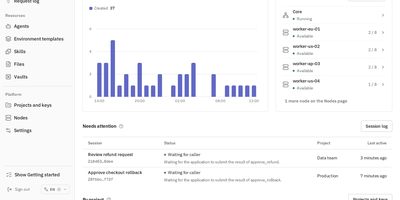
OpenAgentCore
OpenAgentCore puts Codex, Claude Code, and MiniMax Code behind one self-hosted Agents API, so your applications start agent sessions through the official OpenAI SDK while the work runs on machines you control. Set OPENAI_BASE_URL to your installation and issue a Project API key, and the same client code that talks to OpenAI now talks to your Core. Each session runs a native harness, exactly as it runs on a developer's machine, with the model provider, model ID, and protocol you configure per harness or per session. Choose where sessions execute: microsandbox nodes you operate, Docker, E2B, or a self-hosted workstation, VM, or container connected by the oac-daemon with a credential scoped to one environment. Idle microsandbox sessions release their compute and resume on a compatible node with workspace files intact, so long investigations do not rent a machine while they sleep. The Web console walks operators through setup, tracks sessions and turns, manages models and credentials, and issues keys, while the separate Core API serves operators and the Agents API serves applications. Durable execution state in PostgreSQL keeps events, results, and schedules recoverable across restarts. Sandbox providers, workspace filesystems, harnesses, and model providers all plug in through defined protocols, so every layer can be replaced on its own. Running on a dedicated VPS on RepoCloud with guaranteed CPU, RAM, and SSD, full root SSH access, and a browser serial console. MIT licensed.
mcpspan
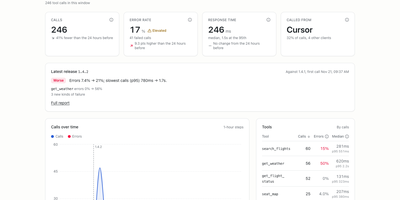
Every tool call, resource read, and prompt get an agent makes on your MCP server lands in mcpspan, with the client that asked, the response time, and the reason for any failure. One line added at startup sends them, with SDKs for eight languages or a proxy that wraps any server without touching its code. The overview charts calls, error rate, and median and 95th-percentile response time per tool, and failures are told apart as crashed handlers, reported errors, refused arguments, and tools an agent asked for that the server does not have. Sessions replay each connection step by step, mark repeated calls, and show what the agent did after every failure: retried, tried something else, or gave up. Release reports set each server version against the one before it, and client versions show whether a client's newest release gets its arguments refused more often. A tool-definition view shows what the tool list costs in tokens each session and which tools agents never call. Alerts go to Slack, Discord, or any webhook, and read tokens let an MCP client such as Claude Code answer questions about the numbers. Anything you can see exports as CSV or NDJSON, calls forward to OpenTelemetry, and README badges show usage. Running on a dedicated VPS on RepoCloud with guaranteed CPU, RAM, and SSD, full root SSH access, and a browser serial console. MIT licensed.
Design Studio AI
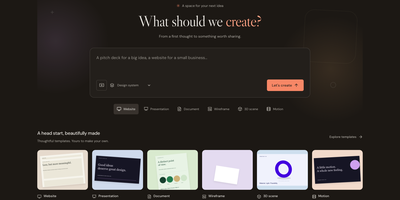
Describe a website, slide deck, document, 3D scene, or animation, then shape it with chat and a full visual editor in your own workspace. Templates give every project a head start, and a short brief about the goal and audience steers the first draft. The editor offers layers, flex and grid layouts, reusable design systems with palettes and fonts, component libraries, and live human and agent editing on one versioned document. The 3D mode handles materials, lighting, camera, rigging, and morph targets, and the motion tools animate bones, skins, and clips. Bring your own keys for OpenAI, Anthropic, Gemini, OpenRouter, or DeepSeek to generate text, images, speech, music, and video. Finished work exports as HTML, SVG, PNG, PDF, PowerPoint, WebM, GLB, or a React prototype, and snapshots can be shared publicly. Agents connect through REST, an authenticated MCP endpoint, or a command line tool, and an activity view records provider calls and usage. Accounts use email and password, with optional GitHub sign-in. Running on a dedicated VPS on RepoCloud with guaranteed CPU, RAM, and SSD, full root SSH access, and a browser serial console. MIT licensed.
Alma Relay
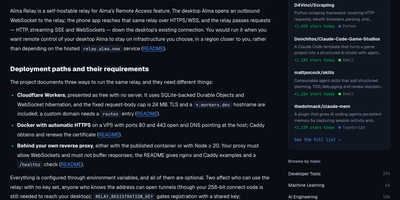
Alma Relay is the relay you run yourself so your phone can reach the Alma on your desktop from anywhere, without port forwarding, a VPN, or a third party sitting in between. Your desktop dials out to the relay and keeps that connection open, and when you open the app on your phone, its requests travel through the relay to the desktop and the answers stream back the same way. Pairing happens with a QR code that carries the relay address, so switching to your own relay takes one fresh scan instead of manual setup on every device. New pairings encrypt the session end to end, so the relay routes encrypted traffic it cannot read, and the routing values it handles are one-way hashes that are never written to disk or logs. When your phone is locked, the relay can pass along the "reply finished" and "Alma has a question" notifications through Apple's or Google's push services, so you hear about finished work without staring at the screen. A live view of the desktop's browser can ride along too, with short-lived credentials issued for the media connection. Sharing the relay with a team works through per-person tokens you can revoke individually, and regenerating your connect code cuts off every paired phone at once. Running on a dedicated VPS on RepoCloud with guaranteed CPU, RAM, and SSD, full root SSH access, and a browser serial console. MIT licensed.
OneCamp
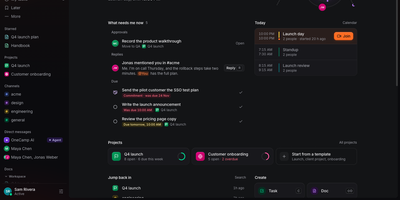
Channels, docs, projects, tables, a shared calendar, and video calls for the whole team, plus AI teammates that act as the person who sponsors them and never more. Threads and direct messages carry the talk, a scheduled check-in asks what everyone worked on, and voice, video, or screen clips of up to five minutes go out like a file. Mention an agent and it acts with your permissions and no more, asks before changing things until told otherwise, and loses access the moment you do. Agent actions are signed, chained to the entry before, and written down before they run; one that cannot be recorded does not run. Projects flip between list, board, timeline with dependencies, releases, and reports, with SLA timers that follow business hours. Docs are edited together live from templates, and tables link to each other, add up rows, and compute with formulas. Calendars connect to Google and Outlook, and meeting rooms book without clashes. Call recaps land on the calendar event, ready to become tasks. Admins get SAML, OIDC, and LDAP sign-in, SCIM provisioning, and a Slack importer with a bridge for the move. Desktop apps cover Windows, macOS, and Linux, and a running OneCamp server never phones home. Running on a dedicated VPS on RepoCloud with guaranteed CPU, RAM, and SSD, full root SSH access, and a browser serial console. AGPL-3.0 licensed.
Pitot
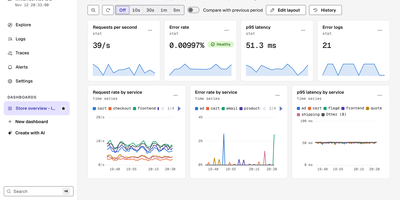
Point your OpenTelemetry exporters at one port and get traces, logs, metrics, dashboards, alerts, and an AI investigator, with no storage cluster to babysit. Pitot accepts OTLP over gRPC and HTTP, keeps everything in a single data directory as Parquet files you own, and lets you query with Explore and PitotQL even when no AI provider is configured. Ask the built-in agent which service is slowest right now and it runs typed queries across traces, logs, and metrics, then explains the evidence inline. Describe a dashboard in one sentence and it drafts, checks, and saves panels for request rate, error rate, p95 latency, service dependencies, slowest operations, and recent errors. Alerts watch service error rate, latency, throughput, and log volume. Prefer your own assistant? A remote MCP endpoint lets Claude Code or any MCP client search logs, inspect traces, query telemetry, and create dashboards after you approve its scopes through OAuth in the browser. Sign in with single-use login links or an OIDC provider, choose OpenAI or Anthropic for chat, and set how many days of telemetry to keep, 30 by default. Pitot runs as one node, which suits a single machine's worth of telemetry rather than fleet-scale clusters. Running on a dedicated VPS on RepoCloud with guaranteed CPU, RAM, and SSD, full root SSH access, and a browser serial console. Apache-2.0 licensed.
Agenvo
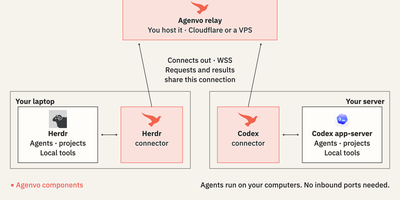
Your coding agents are scattered across a laptop, a server, and whatever machine you left running at home, and Agenvo is the self-hosted relay that lets one AI assistant reach all of them through a single MCP endpoint. Ask ChatGPT on your phone to check on Codex running on your server, or have an agent in Herdr on your laptop fix a failing test, from wherever you are. Connectors for Herdr, Codex app-server, Paseo, and Lody dial out to the relay over WSS, so the computers running agents need no inbound ports, no VPN, and no port forwarding. Your assistant sees the agents running in Herdr without restarting them, resumes Codex threads later, and starts new work where it fits: a Codex thread on the server, or Codex, Claude, or Devin in a Herdr pane. When an agent finishes a turn, waits for input, or exits, the relay pushes a change event back, so a watching assistant or ChatGPT dot reads the output and takes the next step. Closing the chat or losing the network does not stop the agents; connectors reconnect on their own, and your assistant picks up from each agent's current state. Deploy the relay on a single VPS with Docker or on Cloudflare, authorize MCP clients with OAuth over Streamable HTTP, and discover targets and method schemas with search before calling execute. Running on a dedicated VPS on RepoCloud with guaranteed CPU, RAM, and SSD, full root SSH access, and a browser serial console. Apache-2.0 licensed.
Ybkkasi
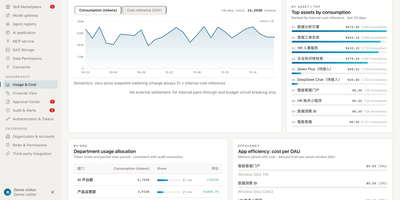
Enterprises keep buying AI tools and wondering why output does not compound, when the real gap is governance: nobody can say which agent owns what, what it may touch, or what it cost. Ybkkasi answers those three questions in one console for every MCP server, skill, agent, and AI application you run. Register each asset and move it through a lifecycle state machine from discovery to retirement, with 85 permission points deciding who can view, call, publish, or approve at every step. Work itself is organized as goals that break into projects and tasks, assigned to digital employees who each carry a home organization, a human supervisor, and a roster status. Approvals route through a dedicated center where lifecycle changes and sensitive actions wait for a human decision instead of happening silently. Every call is metered, so usage and cost reports attribute spend by department, by agent, and by skill, making showback a query rather than an argument. The audit log records who did what to which asset and when, giving compliance a trail they can actually read. Running on a dedicated VPS on RepoCloud with guaranteed CPU, RAM, and SSD, full root SSH access, and a browser serial console. MIT licensed.
Linux Update Dashboard
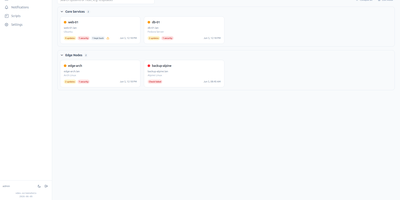
Linux Update Dashboard is a self-hosted web app that lets you check and apply package updates across a whole fleet of Linux servers from one browser dashboard, over SSH, with no agent installed on any managed machine. It discovers each server's package managers, operating system, installed packages, reboot state, and distribution lifecycle, then lets you refresh, upgrade selected packages, run full upgrades, autoremove leftovers, cancel running work, or reboot remotely while watching real-time command output stream into the page. Groups with health badges and explicit priorities organize fleets for clear overviews and ordered Upgrade All batches that run as waves across eligible systems. An encrypted SSH credential vault stores reusable passwords, private keys, and OpenSSH certificates with AES-256-GCM, and you can view or edit repository source files through sudoedit with diff review and activity history. Cron-based schedules automate refreshes, updates, autoremove, reboots, and notifications for chosen systems, while alerts go out by email, Gotify, MQTT, ntfy.sh, Telegram, or webhooks, with Home Assistant MQTT discovery entities for every server. Sign-in supports passwords with optional TOTP, passkeys and WebAuthn, OpenID Connect SSO, and API tokens, and the interface speaks ten languages with dark and light themes and custom branding. Because this tool can run commands on your servers, keep it on trusted networks behind TLS, a reverse proxy, or a VPN. Running on a dedicated VPS on RepoCloud with guaranteed CPU, RAM, and SSD, full root SSH access, and a browser serial console. AGPL-3.0 licensed.
Dialzen
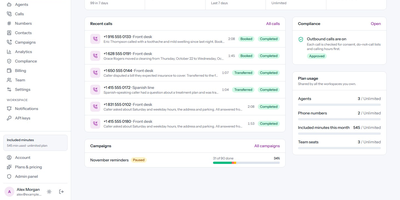
A missed call is a missed booking, and Dialzen picks up with an AI voice agent that answers support questions, schedules appointments, and follows up with people who agreed to be called. Build an agent from one of eight templates, add prompt variables, a knowledge base, voices, languages, and post-call analysis fields, then rehearse it with a browser test call. Agents book through Cal.com or Google Calendar, connect Google Sheets, send signed webhooks, and hand the call to a person when needed. Buy US and Canada numbers, import Twilio or SIP trunk numbers, route inbound calls, and set daily dial caps. No media server needed. Every call lands in a log with its recording, transcript, summary, sentiment, and extracted data, and analytics add a heatmap. An embeddable widget lets website visitors talk to an agent straight from the browser. Contacts carry consent records, CSV imports run as a dry run first, and opt-out phrases in English, Hindi, and Arabic are caught automatically. Campaigns check compliance at dial time, respect calling windows in each contact's time zone, and handle retries and pacing. A compliance center covers AI disclosure, recording notices, KYC approval for outbound access, kill switches, and an append-only audit log. Prepaid credit wallets, credit packs, and per-minute pricing turn it into a reseller business with workspaces, roles, and plans. Running on a dedicated VPS on RepoCloud with guaranteed CPU, RAM, and SSD, full root SSH access, and a browser serial console. MIT licensed.
Tiqora
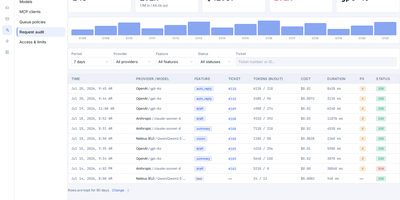
Swap the aging front end of an OTRS or Znuny helpdesk for a modern one that reads the same database and adds AI replies that show exactly which tools they called. Per-queue policies set how much freedom the assistant has, from drafts only to replying to customers without review, and a kill switch pauses all automatic replies at once. Draft replies, ticket summaries, queue triage, and a refine step with a word-level diff to review handle the daily agent workload. Personal data is masked before any model call, and an audit log records tokens, cost, and status per request against provider budgets. Any OpenAI-compatible endpoint works, and tasks like research, triage, summary, and vision route to their own model profiles with fallbacks. An MCP server and external MCP tool sources let agents search tickets, read the knowledge base, and look up customers under the same permissions as staff. A handoff to a human really stops the auto-reply. Mail, Telegram chat, phone calls with an incoming-call pop-up, and a web chat widget all become tickets. Incident, problem, change, and CMDB records, approvals by e-mail link, SLA escalation, and wallboards round out the service desk. PGP and S/MIME encryption, SAML and OIDC sign-in with SCIM provisioning, and GDPR anonymization jobs cover compliance. A customer portal with a knowledge base handles self-service. Running on a dedicated VPS on RepoCloud with guaranteed CPU, RAM, and SSD, full root SSH access, and a browser serial console. AGPL-3.0 licensed.
LearnBuddy
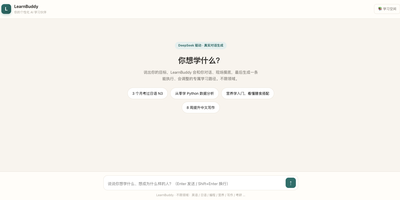
Tell LearnBuddy what you want to learn, in one conversation, and it works out where to start, what to do each day, and when yesterday's material needs another look. You describe the goal, whether that is a language, programming, nutrition, writing, or a career change, and three to five adaptive questions measure your actual baseline instead of making you pick a level from a dropdown. From there it builds a personalized path of four to twenty-four weeks and tells you daily what to study and what to review, so opening the app answers the question instead of raising it. Forgetting is treated as a scheduling problem: reviews resurface at spaced intervals, weekly self-checks test whether the plan still fits, and the roadmap replans dynamically when you race ahead or fall behind. Two editions run from the same codebase: try the hosted Cloud experience, or settle into Personal mode with your own model API key and your learning data stored on your own server. Optional OpenClaw and Feishu integration can bring the daily guidance into the chat tools you already live in. Running on a dedicated VPS on RepoCloud with guaranteed CPU, RAM, and SSD, full root SSH access, and a browser serial console. MIT licensed.
Hezo
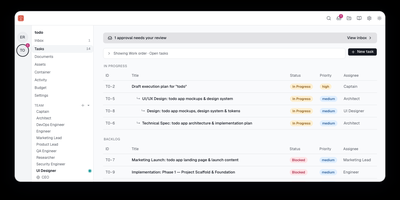
A whole company of AI agents, from a CEO to engineers, designers, and analysts, works inside Hezo under budgets, approvals, and sandboxes you control. Starting a project means picking a ready-made marketplace team (App Team, Social Media Marketing, or Investment Portfolio), using a template, or asking the CEO to assemble one, and the org chart can be reshaped while work continues. Agents pull tasks from a board with nested sub-tasks, wake on heartbeats, pause at approval gates, and push verified commits to your GitHub repositories. Each agent can run on its own model, whether Claude, GPT, Gemini, Grok, Kimi, DeepSeek, GLM, OpenRouter, Ollama, or LM Studio, using API keys or an Anthropic or OpenAI subscription signed in from the UI. Token budgets pause runs at their limits, cost per run stays visible, and a container-hours ledger enforces a monthly allowance. Every project works in its own container, and stored secrets reach agents only as placeholders that an egress proxy swaps for real values on hosts you allowed. A Coach agent turns lessons from finished tasks into durable rules, while documents, skills, and full-text search hold shared knowledge. Message the CEO from Telegram, Slack, or Discord, or drive Hezo from any MCP client through its built-in MCP server. The web app speaks 12 languages. Running on a dedicated VPS on RepoCloud with guaranteed CPU, RAM, and SSD, full root SSH access, and a browser serial console. GPL-3.0-or-later licensed.
Bemmoly
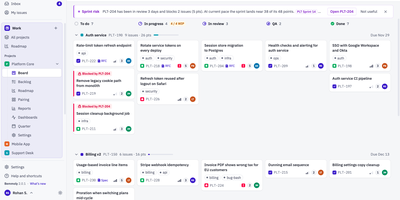
Planning a sprint, writing the spec behind it, and asking an AI what is slipping all happen in one sidebar. The board groups issues into status columns with work-in-progress limits and epic swimlanes, and a banner warns when a blocked issue threatens the sprint. Issues hold acceptance criteria, sub-issues, linked work, custom fields, and threaded comments. A backlog plans sprints against team capacity, while burndown, velocity, and cycle-time charts show how each one went. The roadmap lays epics along a timeline and forecasts which will finish late. Specs and RFCs live in Docs: several people edit a page together, comments stay attached to the words they discuss, and issue chips show current status. Bemmoly ships with AI disabled, and an admin decides if and when to enable it. After that, a morning brief names what needs attention, issue summaries cite the comments behind them, and plain-English questions return answers with numbered citations. Plans typed into the command palette change nothing until someone confirms them. Jira projects and Confluence spaces import with a preview before anything is written. Workflows are drawn in a visual editor, custom roles control who may change what, and sign-in covers OpenID Connect, SAML, and SCIM provisioning. Automation runs on events or schedules, signed webhooks announce them, and GitHub or GitLab pull requests link back to their issues. Running on a dedicated VPS on RepoCloud with guaranteed CPU, RAM, and SSD, full root SSH access, and a browser serial console. MIT licensed.
Moneat
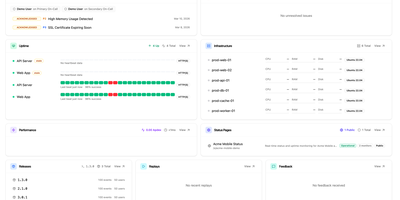
Moneat is the open-source observability platform that unifies error tracking, session replay, performance monitoring, logging, uptime checks, synthetics, product analytics, and AI observability into a single self-hosted application — replacing Sentry, Datadog, and Statuspage with one deployment. The Sentry SDK compatibility layer accepts data from @sentry/browser, @sentry/node, @sentry/react, @sentry/nextjs, sentry-sdk for Python, sentry-kotlin, sentry-java, sentry-android, sentry-cocoa, sentry-go, sentry-ruby, and Sentry.NET by updating one DSN endpoint. Datadog Agent compatibility redirects existing fleets by setting dd_url, and native OpenTelemetry OTLP ingestion accepts logs, traces, and metrics from any exporter or Collector. Error monitoring groups exceptions with smart deduplication, session replay records DOM-based user interactions linked to errors, distributed tracing visualizes transaction and span breakdowns with live service maps, and continuous profiling renders flamegraphs in pprof, JFR, and Sentry formats. Uptime monitoring runs HTTP, TCP, and ping checks with public status pages, while synthetics executes API tests, multi-step workflows, SSL checks, and DNS probes. Custom dashboards support drag-and-drop widgets with Grafana import, product analytics provides funnels and retention cohorts, release tracking surfaces crash-free rates with source map upload, and AI observability traces LLM calls end to end. Built on Kotlin and Java with ClickHouse for analytical storage, PostgreSQL for relational data, and Redis for caching, deployment uses Docker Compose with an interactive installer automating secrets and service orchestration. Running on a dedicated VPS on RepoCloud with guaranteed CPU, RAM, and SSD, full root SSH access, and a browser serial console. AGPL-3.0 licensed.