Headroom
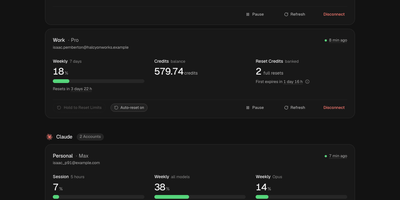
Headroom answers the question every multi-plan AI subscriber asks mid-task: which of my accounts still has room to work? It puts the live limits, reset times, credits, and spend of Claude, Codex, Cursor, Copilot, Grok, Antigravity, and Vercel AI Gateway accounts on one self-hosted dashboard instead of seven provider pages. Connect each account once, through its official CLI sign-in or a credential import, and a background scheduler refreshes every figure on schedule, renews tokens before they expire, and keeps 90 days of readings. Five-hour sessions, weekly pools, per-model limits, credit balances, banked resets, and on-demand spend sit side by side, and unreported figures show as unknown rather than a fake zero. Compare ranks same-provider accounts by the room they have left and names the one to use next, while Timeline lays every reset window on a two-week calendar. Analytics charts when you work, when you run dry, and whether each plan fits, and Wallet totals subscriptions, usage spend, and top-ups in one currency with renewals and budget alerts. In-app notices, Telegram messages, and signed webhooks warn about low limits, expiring resets, and broken sign-ins, and optional automations can spend a banked Codex reset or log a credit top-up the moment it lands. Personal, work, and side-project accounts stay separate under one owner login with passkeys and a Privacy Mode that blurs emails on screen. Running on a dedicated VPS on RepoCloud with guaranteed CPU, RAM, and SSD, full root SSH access, and a browser serial console. MIT licensed.
FoxProfile
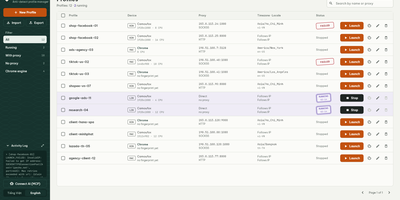
Every account you run deserves its own browser identity, and FoxProfile keeps those identities permanently separate instead of letting them bleed into one another. Create a profile once and it remembers its device: screen, GPU, CPU cores, fonts, and canvas noise are generated on first launch and reused on every later one, so the fingerprint a site saw yesterday is the fingerprint it sees tomorrow. Sessions stick too: history, cookies, and logins live in the profile directory, and the tabs you left open reopen where you left them. Each profile carries its own proxy (HTTP, HTTPS, SOCKS4, or SOCKS5, with a built-in checker) while timezone and locale follow the exit IP automatically or stay pinned to your choice, and the Check IP button compares the exit address across three services and flags mismatches or datacenter addresses. Cookies move in and out as standard editor JSON or Netscape files, whole profiles travel as ZIP archives, and bulk actions launch, stop, or delete fleets at once. On a server, the web panel runs profiles headlessly so you can manage them and view their screens from anywhere, the REST API scripts everything, and the MCP server lets AI agents drive the browsers directly. Running on a dedicated VPS on RepoCloud with guaranteed CPU, RAM, and SSD, full root SSH access, and a browser serial console. MIT licensed.
OpenNotebookLM
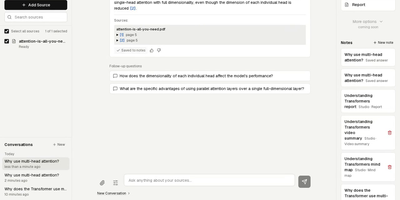
OpenNotebookLM is a self-hosted research workspace that reads your sources with you, answering questions only from the material you gave it and showing the passage behind every claim. Import papers, spreadsheets, recordings, web pages, PDF links, YouTube videos or playlists, Markdown folders, Obsidian vaults, and Git repositories, then select which sources the chat may use as evidence. Stream answers with follow-up questions, hover any numbered citation to inspect the supporting passage and page, and let the app flag citations that look unsupported before you trust them. The Studio turns the same sources into cited reports in briefing, study guide, FAQ, or timeline formats, expandable mind maps you can pan and question, two-host audio overviews in deep dive, brief, critique, or debate styles, narrated slides exportable to PowerPoint, and tables whose cells carry their own citations. Generate flashcards and timed quizzes from what you read, mark cards for review, and resume saved progress later. Save cited answers and Studio outputs as notes, convert notes back into searchable sources, and export almost anything: conversations, projects, mind maps as SVG, flashcards as Anki text, audio as MP3. Share projects with viewer or editor roles, keep conversations private per person, and bring Claude, OpenAI, any OpenAI-compatible provider, or a local Ollama model, with extraction, OCR, Whisper transcription, and Kokoro audio synthesis running on your own server. Running on a dedicated VPS on RepoCloud with guaranteed CPU, RAM, and SSD, full root SSH access, and a browser serial console. MIT licensed.
JellyGlance
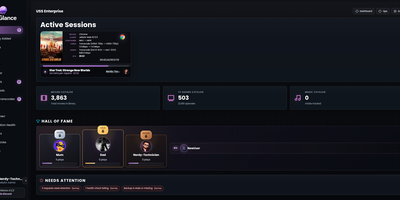
Running a Jellyfin or Emby server usually means a dozen open tabs; JellyGlance folds your whole media server into one screen you can leave open on a wall. Live sessions show who is watching what, from where, on which client, with direct play or transcode state, codec, bitrate, subtitles, and progress for every stream. Playback history accumulates in its own database, so statistics survive even when the media server forgets: top movies, series, libraries, clients, and users, watch-time trends, activity heatmaps, and weekly, monthly, and yearly recaps rendered as shareable cards. The home dashboard arranges by drag and drop, with presets, density controls, themes, kiosk mode for a wall display, and alert rules. Recently added shelves group by library, while library views surface totals and metadata gaps. Jellyseerr and Overseerr requests appear with poster cards, requester context, and admin actions, and the release calendar pulls upcoming titles from your *arr apps beside the queues of your torrent and Usenet clients, stalled items included. Wizarr invites, Tdarr transcodes, and Maintainerr cleanup connect from the same integrations area. Notifications travel by webhook, Discord, Gotify, and email newsletters, backups export to a plain folder, and sign-in spans local accounts, Jellyfin Quick Connect, and OIDC. Running on a dedicated VPS on RepoCloud with guaranteed CPU, RAM, and SSD, full root SSH access, and a browser serial console. MIT licensed.
AutonomousSDR
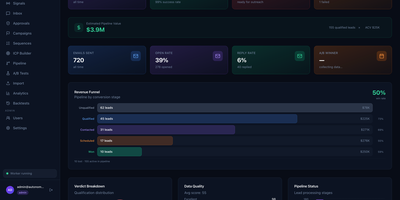
A lead fills in your form at midnight, and by morning AutonomousSDR has researched it, scored it, and queued a fact-checked email for you to approve. Leads come in from six channels, including web forms, ads, inbound email, LinkedIn signals, and a universal webhook for Zapier and Make. A research agent looks the company up online, then BANT scores, whose weights learn from won and lost deals, sort the lead as hot, warm, or cold. Hot leads receive a Cal.com booking link, warm ones enter an A/B-tested outreach sequence, and cold ones sync to HubSpot. Factual claims in a draft are matched to the research snippet behind them, and anything unsupported is flagged in the approval queue. An autonomy dial per organization switches between draft-only, approve-each-email, and full-auto modes. A campaign agent takes a quota, diagnoses why you are behind pace, and proposes strategy changes for your approval. Mailboxes rotate per rep with warm-up ramps and SPF, DKIM, and DMARC checks, sends honor recipient-local windows and daily caps, and any reply stops the cadence. Unsubscribe works in one click, and do-not-contact lists and GDPR erasure are included. Free Groq or local Ollama models work with no paid keys. Last quarter's won and lost deals can backtest the qualifier, and cost per meeting is compared with a human SDR. Running on a dedicated VPS on RepoCloud with guaranteed CPU, RAM, and SSD, full root SSH access, and a browser serial console. MIT licensed.
Lambda ERP
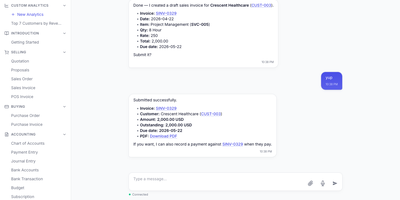
Lambda ERP gives a small business double-entry books, stock control, and full sales and purchase cycles, then lets people run all of it by chatting. A setup wizard asks your country and kind of business, proposes the chart of accounts and taxes for review, and books nothing until you approve. Quotations flow into orders, deliveries, invoices, and payments, purchasing mirrors them, and returns post credit notes with stock reversals. Tell it to bill a customer, change a price, or reorder stock, and it drafts the document, asks before submitting, and links the PDF. Attach a supplier PDF or photo and the assistant can turn it into an invoice or quotation. Trial balance, profit and loss, balance sheet, general ledger, aging, and stock reports come ready to use. Request a custom chart, such as top customers by revenue, and it is saved as a report you can rerun, edit, or share. Analytics queries use whitelisted datasets, never free-form SQL. Documents print as PDFs in layouts you edit by hand or by chat, and issued ones keep their original layout. An admin can enable role-scoped keys for a REST API, a chat API, and an MCP endpoint that Claude or Codex can drive. The assistant runs on your own OpenAI key. Admin, manager, and viewer roles and English, German, or French screens are included. Running on a dedicated VPS on RepoCloud with guaranteed CPU, RAM, and SSD, full root SSH access, and a browser serial console. Apache-2.0 licensed.
Duniya
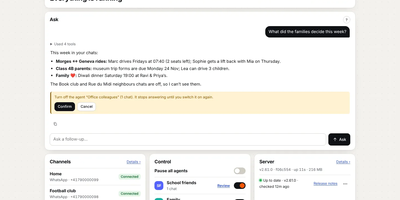
Duniya links to a spare WhatsApp number, plus a Telegram bot if you like, and runs AI helpers only in the family, school, and club chats you choose. Every other chat stays silent and is never stored. Start an agent from a template, such as car pooling, school friends, or neighbours, or describe it in a sentence and review every change as a visual diff. Corrections you make while reviewing answers become lessons the agent follows once you approve them. The owner gets an assistant too, with a morning brief, a catch-up on missed messages, and an Ask box that answers questions about people, events, and orders. A People page keeps families, kids, notes, and consent, Events track registrations, duties, and who has paid, and surveys follow up only with people who have not answered. Choose any model, from OpenRouter's free ones to a ChatGPT or Claude plan, OpenAI, Copilot, or Ollama, with a backup model and spending caps. It runs on a 1 GB server, installs with one command, and backs up encrypted to GitHub or S3. Updates arrive overnight by themselves, and a release that fails to start rolls itself back. The panel installs on a phone's home screen, in light or dark, with nothing from a store. Running on a dedicated VPS on RepoCloud with guaranteed CPU, RAM, and SSD, full root SSH access, and a browser serial console. MIT licensed.
Moneat
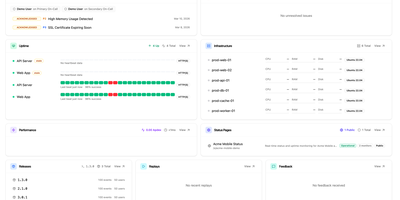
Moneat is the open-source observability platform that unifies error tracking, session replay, performance monitoring, logging, uptime checks, synthetics, product analytics, and AI observability into a single self-hosted application — replacing Sentry, Datadog, and Statuspage with one deployment. The Sentry SDK compatibility layer accepts data from @sentry/browser, @sentry/node, @sentry/react, @sentry/nextjs, sentry-sdk for Python, sentry-kotlin, sentry-java, sentry-android, sentry-cocoa, sentry-go, sentry-ruby, and Sentry.NET by updating one DSN endpoint. Datadog Agent compatibility redirects existing fleets by setting dd_url, and native OpenTelemetry OTLP ingestion accepts logs, traces, and metrics from any exporter or Collector. Error monitoring groups exceptions with smart deduplication, session replay records DOM-based user interactions linked to errors, distributed tracing visualizes transaction and span breakdowns with live service maps, and continuous profiling renders flamegraphs in pprof, JFR, and Sentry formats. Uptime monitoring runs HTTP, TCP, and ping checks with public status pages, while synthetics executes API tests, multi-step workflows, SSL checks, and DNS probes. Custom dashboards support drag-and-drop widgets with Grafana import, product analytics provides funnels and retention cohorts, release tracking surfaces crash-free rates with source map upload, and AI observability traces LLM calls end to end. Built on Kotlin and Java with ClickHouse for analytical storage, PostgreSQL for relational data, and Redis for caching, deployment uses Docker Compose with an interactive installer automating secrets and service orchestration. Running on a dedicated VPS on RepoCloud with guaranteed CPU, RAM, and SSD, full root SSH access, and a browser serial console. AGPL-3.0 licensed.
Eidoloom Studio
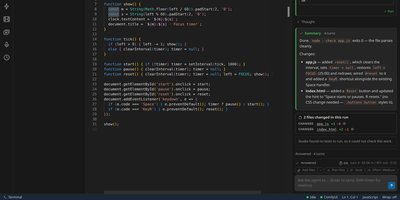
A model is only half an agent; Eidoloom Studio is the other half, with the planning loop, tools, approvals, undo, and checks, wrapped in a code editor that runs in your browser. The editor looks like VS Code, with a file tree, editor tabs, terminals, and the agent's chat beside it. Every edit arrives as a card with a diff to accept whole, in parts, or not at all. Commands wait behind Run and Skip. Trust it more and switch on auto-apply or auto-run; each edit stays an undo point. Plug in Ollama, llama.cpp, vLLM, LM Studio, or Strata, and nothing leaves your machine unless you add a cloud service. Switch on the sandbox and a folder's commands and terminals run in their own container, with the internet on, off, or only for installing packages. Admins invite people who each get a private sandboxed space, share folders with per-person rights, and wait their turn on one model. Plans become checklists, questions offer choices, goals keep it working, and a check after every edit confirms the file still parses. Optional tools add web search, a browser the agent drives, and Office documents, plus pictures, video, voices, and music on machines with a graphics card. The agent runs on the server, so closing the browser does not stop a run. Running on a dedicated VPS on RepoCloud with guaranteed CPU, RAM, and SSD, full root SSH access, and a browser serial console. AGPL-3.0 licensed.
Memoturn
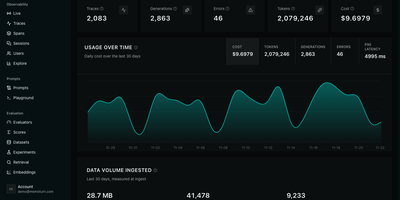
Tracing each model call, pricing it, scoring the answer, and versioning the prompt behind it, Memoturn gives AI teams proof of what works before it ships. Traces unfold on a waterfall timeline where agent plans, tool calls, retrievals, and generations each get a bar, with tokens and cost on every step. Quality is measured three ways: offline experiments over datasets, online judges sampling production traces, and human review queues with one-click scoring. Scores appear on the trace they came from. A versioned prompt registry promotes versions through deploy channels, A/B tests split live traffic between them, and a streaming playground compares models side by side. Cost, token, and latency charts break down by day, model, user, and tool, while budget alerts run every minute and automations post to Slack or a webhook when a score drops. A retrieval page flags weak document matches, and an embeddings map with similarity search turns one bad generation into every trace like it. An MCP server hands prompts, datasets, and review queues to agent IDEs like Claude Code and Cursor, with roles checked per tool. Teams get organizations and projects, SSO through OIDC or SAML, read-only viewer roles, PII masking at ingest, and retention rules. Data arrives from any OpenTelemetry exporter, with integrations for OpenAI, Anthropic, LangChain, and LiteLLM. Running on a dedicated VPS on RepoCloud with guaranteed CPU, RAM, and SSD, full root SSH access, and a browser serial console. Apache-2.0 licensed.
Geo-Monitor
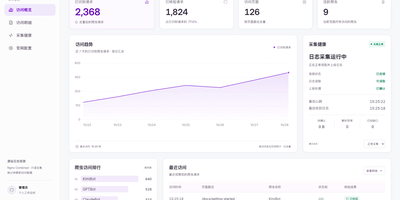
Search is being answered by AI crawlers first and humans second, yet most site owners cannot name a single bot that read their pages last week; Geo-Monitor answers that from the access logs you already have. A small collector sits beside Nginx or OpenResty, mounts the log read-only, and streams only new lines in batches, resuming after outages and surviving log rotation without ever touching your site's code. The console separates today, the last week, and the last month into identified requests, crawled pages, active crawlers, and trend lines, then drills into every visit with time, path, method, status code, claimed identity, and verification state. Identification and verification are deliberately different things here: a user agent only proves what a request claims to be, while a verified badge requires trusted log addresses and official IP evidence to agree. Twenty built-in identities cover OpenAI, Anthropic, Perplexity, Kimi, and Bytespider crawlers, and you can add, edit, or disable rules as new bots appear. Your sitemap syncs or imports as the content catalog, so coverage views show which pages crawlers actually reached, and collector health exposes heartbeat, backlog, and parsing problems. Running on a dedicated VPS on RepoCloud with guaranteed CPU, RAM, and SSD, full root SSH access, and a browser serial console. Apache-2.0 licensed.
Imbo
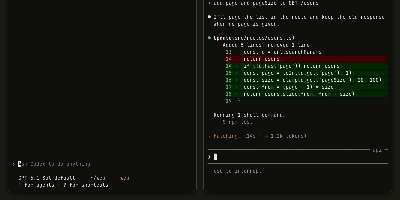
Your coding agents work in separate terminals and cannot ask each other anything; Imbo gives Claude Code, Codex, opencode, Cursor CLI, and six other agent tools one shared messaging network, so a session can send a question to another session and get an answer while both keep working. Messages land inside the receiving session mid-task, and a reply wakes an idle session so it can act on the answer. You add people by account ID, and their agents can message yours; group chats let several sessions from several people coordinate on one brief, with every reply reaching every member. Sessions can send files that land in the receiving machine's ~/.imbo/files folder, and an agent asks you first before sending your data out, deleting files, spending money, or touching production. From the web app or the iPhone app you can message your own sessions from anywhere, and a closed Claude Code session reopens in the background to pick the message up. The server is a single binary with a bundled PostgreSQL, HTTPS through Let's Encrypt, email code sign-in, and optional domain restrictions on who may register. Running on a dedicated VPS on RepoCloud with guaranteed CPU, RAM, and SSD, full root SSH access, and a browser serial console. Apache-2.0 licensed.
Thaliyola
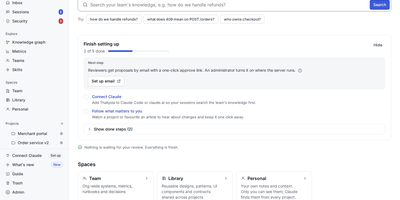
What one teammate's agent learns today, the rest of the team's agents can find tomorrow, because Thaliyola keeps it as knowledge a person has approved. Search matches by keyword and by meaning, and an as-of date shows what was true then, superseded entries included. Reviewers see each proposal as a line diff and can edit, approve, or reject it in the web app or by asking their own Claude. A changed API contract or shared design sends an impact notice to each consuming project. Engineers see what the team knows about the file open in VS Code, and pull requests get a comment listing the docs, contracts, known issues, and vulnerabilities their files touch. Incidents build their own timeline from notes, merged pull requests, session answers, and Sentry events, and resolving one drafts the root-cause write-up. Designers keep tokens in a design system that projects inherit from a shared library, with contrast checks, drift reports against the code, and exports to CSS variables. Claude skills are versioned, reviewed, assigned to people or teams, and synced into Claude Code. A security register matches lockfiles against OSV, ranks actively exploited CVEs first, and exports an SBOM. Agent sessions ask each other questions, claim files for 30 minutes, and hand unfinished work to a teammate. Running on a dedicated VPS on RepoCloud with guaranteed CPU, RAM, and SSD, full root SSH access, and a browser serial console. MIT licensed.

Nowen Reader
Nowen Reader turns a NAS folder of manga and novels into a private library you can browse, organize, and read from anywhere, without handing your collection to a cloud service. Drop comic archives and ebook files into watched folders and automatic scanning brings them into the library, detecting duplicates and cleaning up invalid entries along the way. Metadata arrives from AniList, Bangumi, MangaDex, MangaUpdates, and Kitsu, so covers, authors, and series information fill themselves in instead of being typed by hand. Read comics in single page, double page, or vertical webtoon modes with image filters and bookmarks, and pick up novels chapter by chapter where you left off. Reading status follows each user, with want to read, currently reading, and finished shelves plus personal ratings, favorites, and progress statistics. OPDS feeds stream pages directly to KOReader, Moon+ Reader, and other compatible apps, so your e-reader pulls from the same library. Optional AI assistance can suggest tags, summarize chapters, analyze covers, and translate pages. Libraries can be public, private, or shared with user groups, with per-library permissions for households. Running on a dedicated VPS on RepoCloud with guaranteed CPU, RAM, and SSD, full root SSH access, and a browser serial console. GPL-3.0 licensed.
Euron Open AI Chat
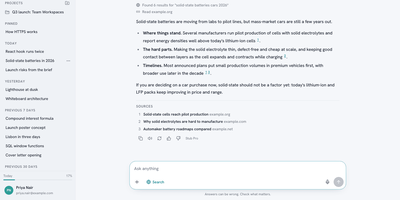
Your own ChatGPT-style assistant for a team or community runs on servers you control when Euron Open AI Chat answers from the models you enable. Admins add OpenAI, Anthropic, Gemini or any OpenAI-compatible endpoint, from OpenRouter and Groq to a local Ollama, and the picker lists only models whose provider has a key. Answers stream in and keep going when a tab closes or a phone drops its connection, and regenerated or edited messages stay as versions one click apart. Questions that need fresh facts trigger web search through SearXNG, Tavily, Exa or Brave, page reading, and answers with numbered citations. Attached images, PDFs, Word and Excel files, CSVs and code are read, and vision models describe photos. Image generation and editing work in the chat or in a studio with a gallery. Projects bundle shared instructions and knowledge files for a group of chats, and the assistant searches them and says where it looked. A memory page lists what the assistant remembers and who saved it, with a way to forget each fact. Voice means dictation and read-aloud. Shared conversations are frozen public links that an owner or admin can revoke. The /admin control plane manages users, roles, daily token and image allowances by tier, providers and models, sign-up rules, feature switches and an audit log, and never shows anyone's chats. Running on a dedicated VPS on RepoCloud with guaranteed CPU, RAM, and SSD, full root SSH access, and a browser serial console. MIT licensed.
GuardNous
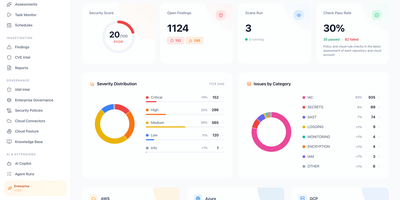
Point GuardNous at your repositories and AWS account, and your existing scanners feed one triaged list of findings that AI agents can fix only with a person's approval. Nine scanner adapters, from Semgrep and Trivy to Checkov and Gitleaks, share one format, and SARIF carries in results from any other tool. Triage, assignment, notes, and severity-based deadlines stay attached to findings across rescans. AWS connects through OIDC federation with no stored keys, and 44 rules check the account, show internet exposure, and offer five reversible fixes. Twenty agents with 72 tools answer questions from live data and run in the background within step and token budgets. A fix pull request, a cloud fix, or a Slack message runs only after a person approves the exact change. Bring your own model: OpenAI, Azure OpenAI, Anthropic, or a local Ollama. Six compliance frameworks, 21 built-in policies, SBOM export, and scheduled PDF reports cover governance. Tenants, seven roles, two-factor sign-in, and an audit trail keep teams separated and accountable. GitHub, GitLab, Bitbucket, and Azure DevOps connect to scan on push and open fix pull requests. Running on a dedicated VPS on RepoCloud with guaranteed CPU, RAM, and SSD, full root SSH access, and a browser serial console. Apache-2.0 licensed.
SEO OS
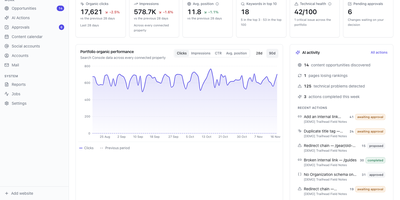
Instead of juggling a crawler, a rank tracker and a folder of spreadsheets, SEO OS audits your websites, proposes fixes, applies the ones you approve and measures whether they worked. Its crawler honors robots.txt, follows redirects and canonicals, avoids crawl traps and can render JavaScript. Sixty-one technical rules grade crawlability, indexability, metadata, content, links, structured data and security, each finding with evidence and a recommendation. Scores come with their factors, weights and a sentence explaining each one. Keyword reports flag striking-distance queries, CTR gaps, content decay and cannibalization, ranked by an explainable opportunity score. A content engine declines to create pages an existing one could cover, and a 14-stage pipeline takes approved ideas from research to publication. Internal-link suggestions come from PageRank over the site's link graph, with orphan detection and anchor-text auditing. GEO readiness scores pages across eleven machine-readability dimensions, while AI-visibility tracking checks whether assistants mention or cite the brand. Social listening watches Reddit, Hacker News and Bluesky for people describing the problem a site solves and drafts disclosed replies for approval. An approval queue groups changes by risk and shows each exact diff with the agent's reasoning, and adapters for WordPress, Git, Shopify, Webflow and webhooks apply only what you approve. Applied changes open experiments that report likely positive, inconclusive or likely negative, steering the next recommendations. Running on a dedicated VPS on RepoCloud with guaranteed CPU, RAM, and SSD, full root SSH access, and a browser serial console. MIT licensed.

LearnBuddy
Tell LearnBuddy what you want to learn, in one conversation, and it works out where to start, what to do each day, and when yesterday's material needs another look. You describe the goal, whether that is a language, programming, nutrition, writing, or a career change, and three to five adaptive questions measure your actual baseline instead of making you pick a level from a dropdown. From there it builds a personalized path of four to twenty-four weeks and tells you daily what to study and what to review, so opening the app answers the question instead of raising it. Forgetting is treated as a scheduling problem: reviews resurface at spaced intervals, weekly self-checks test whether the plan still fits, and the roadmap replans dynamically when you race ahead or fall behind. Two editions run from the same codebase: try the hosted Cloud experience, or settle into Personal mode with your own model API key and your learning data stored on your own server. Optional OpenClaw and Feishu integration can bring the daily guidance into the chat tools you already live in. Running on a dedicated VPS on RepoCloud with guaranteed CPU, RAM, and SSD, full root SSH access, and a browser serial console. MIT licensed.