Zoomies
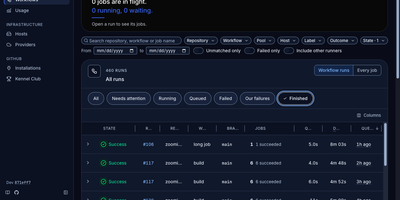
Zoomies converts servers you already own into an ephemeral GitHub Actions runner fleet, creating a clean runner for every queued job and destroying it the moment that job ends. Why rent CI minutes by the second while those machines sit idle? Point it at a GitHub organisation or a repository on a personal account and it watches for queued work through workflow_job webhooks, with polling as a fallback, then provisions capacity only on hosts matching the labels your workflow requested. One controller drives any number of agents across Ubuntu, Debian, Fedora, and Rocky Linux on amd64 and arm64, and agents connect outbound only, so a host behind NAT needs no inbound firewall rule. Registration needs no pasted tokens: Zoomies signs in as a GitHub App and mints single-use just-in-time runner registrations itself. Busy runners can borrow idle CPU and memory from quieter neighbours under rules you set. The live web UI shows pools, jobs, queue waits, and streaming logs in place, with a command palette for jumping anywhere and an audit row recorded for every change. Nightly backups seal themselves with your passphrase and ship to S3-compatible storage, restores are staged from the same tab, and you can ask the built-in assistant about your builds or connect your own tools through MCP. Running on a dedicated VPS on RepoCloud with guaranteed CPU, RAM, and SSD, full root SSH access, and a browser serial console. AGPL-3.0 licensed.
RAGOps Observatory
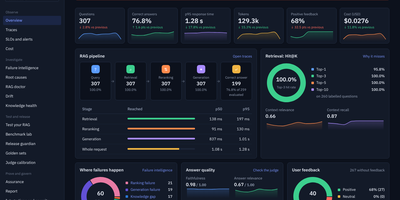
Between a RAG demo that looks fine and an assistant that fails quietly in production sits RAGOps Observatory, a platform that names the broken pipeline stage and blocks worse releases. Failed answers are assigned to one of seven stages, from knowledge gap and chunking to ranking and generation. An evidence graph links documents, retrieved passages, and answer claims, marking claims supported, contradicted, or sourceless. Failure intelligence groups recurring problems as new, growing, steady, or shrinking, so one fix can retire a whole pattern. The release guardian compares a candidate with the current version on the same questions and answers Pass, Review, or Block against your gates, logging every decision. A metric regression blocks only when statistically significant. The benchmark lab sets two to five runs side by side across models, retrievers, rerankers, or chunk sizes. The assurance report writes tests from your documents, including prompt-injection probes, then issues a sealed Ready or Not ready verdict with supporting evidence mapped to the EU AI Act. When answers go wrong, the RAG doctor re-runs your pipeline with candidate fixes and recommends only the one that verifiably helps. SLOs with error budgets, drift checks, cost tracking, and Slack, Teams, PagerDuty, or e-mail alerts cover monitoring. Use it to explain a quality drop, prove a new chunk size is safe, or give a reviewer evidence. Running on a dedicated VPS on RepoCloud with guaranteed CPU, RAM, and SSD, full root SSH access, and a browser serial console. MIT licensed.
Clavis
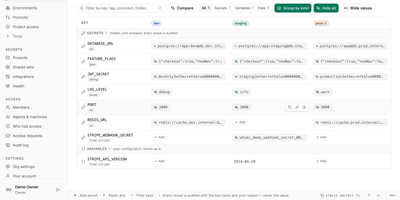
Every API key, database URL, and certificate your apps need lives in Clavis, which injects them at runtime and lets AI coding agents use them without reading a value. Development, staging, production, and branch environments sit side by side with inheritance, and every change is an immutable version that a rollback never rewrites. Promotion shows added, changed, and missing keys before anything is written and sends protected targets to an approver. A typed schema declares what each key must look like, generates matching config loaders for three languages, and lets CI fail on drift. Run any command with secrets injected and its output masked, or request a role that lasts one hour and expires on its own. Database and cloud credentials can be short-lived too, revoked the moment a command exits. Each agent gets its own identity, a deny-all allowlist of exact commands, and tools that list key names but never return values. The command text reaches the audit chain before anything is decrypted. Syncs push values to GitHub, Vercel, Fly.io, AWS, and Cloudflare, while importers pull from Infisical, Doppler, Vault, 1Password, and .env files. Single sign-on, SCIM, role-based access, encrypted share links, and secret scanning all ship free. Running on a dedicated VPS on RepoCloud with guaranteed CPU, RAM, and SSD, full root SSH access, and a browser serial console. Apache-2.0 licensed.
QMReader
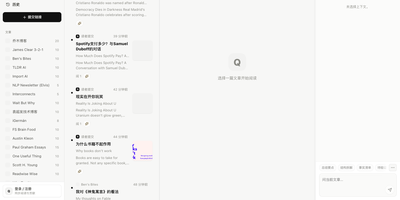
QMReader is a self-hosted reading workbench that treats RSS as raw material for knowledge you keep, not a pile of unread badges waiting to be cleared. Subscribe to RSSHub routes, direct feeds, sitemaps, Hacker News, Product Hunt, GitHub Trending, and Hugging Face Papers, and new items land in the article list immediately while translation and rewriting finish in the background. English headlines gain Chinese translations automatically, and full articles can be read as the original, a Chinese translation, or a plain-language rewrite, all kept side by side on the same page. Highlight passages, attach your own commentary, and open an AI conversation scoped to the article in front of you instead of starting from a blank chat box. Work you produce becomes a public reading asset with a stable link: translations, rewrites, comments, and dialogues collect on contributor pages and flow out through asset catalogs and RSS feeds for the next reader. Split background workers keep fast feed fetching separate from slower AI processing, and search, unread, popular, favorites, and history views keep a heavy reading habit navigable. Running on a dedicated VPS on RepoCloud with guaranteed CPU, RAM, and SSD, full root SSH access, and a browser serial console. MIT licensed.
uptimepage
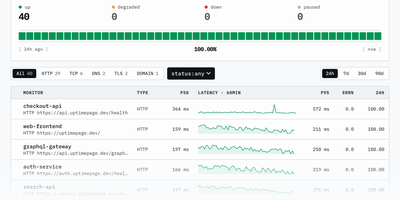
Uptime checks, a customer-facing status page, and on-call paging arrive in one self-hosted package, so a failing check can open an incident, page the right person, and update the public page without a second tool. Monitors cover HTTP, TCP, ICMP ping, DNS, TLS certificate expiry, domain expiry, cron heartbeats, and scripted browser login flows with per-step timings. Probe agents run in any region you choose, and the dashboard shows latency by region. Incidents open on failure and close on recovery, with acknowledgement to silence paging and reminders per monitor. Escalation policies page channels and schedules level by level, and layered on-call rotations support daily, weekly, or custom shifts, calendar overrides, and an iCalendar feed. Alerts reach Slack, Discord, Teams, Telegram, PagerDuty, SMS, WhatsApp, ntfy, Gotify, email, and webhooks. The public status page shows 90 days of uptime per component, maintenance windows, incident updates, and RSS, JSON, and email subscriptions. Everything can be driven by REST API, scoped tokens, a Terraform provider, or an MCP server for AI assistants. Self-hosted installs have no monitor limits and no plan to buy. Running on a dedicated VPS on RepoCloud with guaranteed CPU, RAM, and SSD, full root SSH access, and a browser serial console. AGPL-3.0 licensed.
Euron Open AgentDebugger
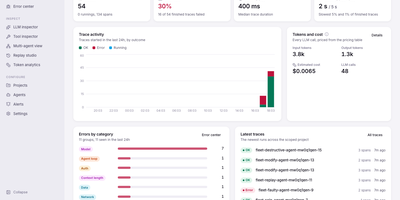
When an AI agent gives the wrong answer on step three, Euron Open AgentDebugger shows which prompt went out, which tool the model chose and where the run broke. Decorated Python or Node functions become traces of agent, LLM and tool spans, and any OpenTelemetry exporter can post to the OTLP/JSON endpoint with no SDK. A zoomable timeline and an execution graph with highlighted delegation edges show every span, filterable by agent, kind, model, tool and status. A supervisor calling a child agent over HTTP still produces one correctly parented trace, and the multi-agent view lists each agent's share of time and tokens. The LLM inspector shows provider, model, tokens, latency, finish reason and cost, and the tool inspector shows arguments, results, errors and retries. The error center sorts failures into ten categories and groups repeats by fingerprint, while a loop detector flags a stuck agent without stopping it. Replay studio reconstructs a past run with zero new calls, re-runs it with recorded tool results, or changes one input and runs live side by side, and side-effect steps are refused unless allowed. Prompt and response text stays off unless a project turns on content capture. Alerts on error rate, latency or cost reach signed webhooks, and token analytics break spend down by model and agent. Running on a dedicated VPS on RepoCloud with guaranteed CPU, RAM, and SSD, full root SSH access, and a browser serial console. MIT licensed.
Deskforce
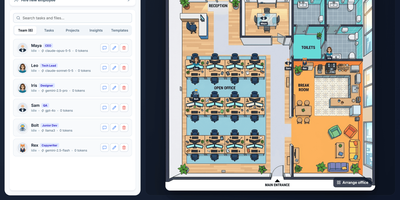
Staffing a virtual office with AI employees, Deskforce turns one goal into a plan you approve, delegated work, and a finished project. New hires pick a name, an avatar, a role, and their own model from OpenAI, Anthropic, Google Gemini, Grok, or a local Ollama server. On the floorplan, speech bubbles show what each model is writing as it writes it, and agents walk to the meeting room and coffee machine. Before anything is spent, the CEO proposes a plan with a cost estimate that you can approve, edit, or send back. Budgets cap each request, a monthly limit stops new work, and Insights charts spending per day, employee, and model. Model comparison runs one request on two or three models in separate projects and lines up result, time, and cost. Finished tasks land as git commits in the employee's name, ready to read or undo with one click. A file browser with history opens each project, and any project with an index.html gets a preview. When two agents need the same file, they hold a meeting first and agree who does what. Message the office from Slack and the senior employee answers, starts tasks, and flags plans waiting for approval. Templates rerun a saved task on a click, daily, or weekly. Close the browser tab and the work continues. Running on a dedicated VPS on RepoCloud with guaranteed CPU, RAM, and SSD, full root SSH access, and a browser serial console. MIT licensed.
Iso
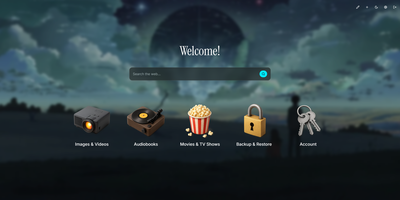
Drop a single container onto your host to launch Iso, a minimalist self-hosted startpage and service launcher that organizes every homelab web application behind a clean isometric icon grid and integrated search bar. No external database is required. Everything lives inside one human-readable JSON file or gets edited directly through the in-browser visual configuration modal. Add new service tiles in seconds, drag to reorder their display priority, and pick from a curated library of 3D isometric icons or upload custom graphics up to 25 megabytes. Switch instantly between built-in color palettes like Amethyst or upload a custom wallpaper with adjustable background blur and opacity sliders. A central search bar sits at the top of your startpage, routing queries directly to Google, DuckDuckGo, Startpage, Qwant, Searx, Bing, or any custom query URL template. Localize the interface into English, Spanish, French, or German with a single toggle. Custom greeting banners and optional page-load animations personalize the daily browsing experience for family members or lab users. Protect the dashboard and its visual editor behind shared password authentication configured via environment variables. Running on a dedicated VPS on RepoCloud with guaranteed CPU, RAM, and SSD, full root SSH access, and a browser serial console. MIT licensed.
Euron BrowserAgent
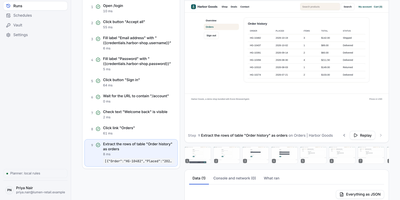
Turning a repeated browser chore into a reviewed list of steps lets Euron BrowserAgent run it the same way every time, on demand or on a schedule. Tasks are lists of steps (open, click, fill, choose, wait, extract text or a table, check, screenshot) and each target lists up to five selectors as ordered fallbacks. Describe a job in a sentence and the planner drafts steps from the real page, offline or through an OpenAI-compatible model or Ollama. Pick from page offers a page's fields, buttons, and tables as ready steps. A run opens a fresh headless Chromium context and keeps a screenshot of every step, the page's console and network errors, and extracted data as JSON or CSV. The replay steps through any run beside the page after each action, and a failed run names the step and the reason. Runs start by hand, from an API key, or on cron schedules in any time zone, with overlap rules and missed fires merged into one run. Logins are sealed in a vault, typed into pages by the worker, masked in screenshots, and scrubbed from records, with TOTP codes for two-factor sign-ins. An egress policy blocks cloud metadata and private networks unless a host is allowed. Workspaces add owner, editor, and viewer roles, an activity log, and run limits. Running on a dedicated VPS on RepoCloud with guaranteed CPU, RAM, and SSD, full root SSH access, and a browser serial console. MIT licensed.
OneCamp
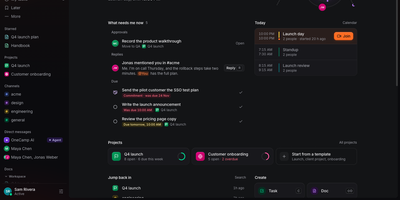
Channels, docs, projects, tables, a shared calendar, and video calls for the whole team, plus AI teammates that act as the person who sponsors them and never more. Threads and direct messages carry the talk, a scheduled check-in asks what everyone worked on, and voice, video, or screen clips of up to five minutes go out like a file. Mention an agent and it acts with your permissions and no more, asks before changing things until told otherwise, and loses access the moment you do. Agent actions are signed, chained to the entry before, and written down before they run; one that cannot be recorded does not run. Projects flip between list, board, timeline with dependencies, releases, and reports, with SLA timers that follow business hours. Docs are edited together live from templates, and tables link to each other, add up rows, and compute with formulas. Calendars connect to Google and Outlook, and meeting rooms book without clashes. Call recaps land on the calendar event, ready to become tasks. Admins get SAML, OIDC, and LDAP sign-in, SCIM provisioning, and a Slack importer with a bridge for the move. Desktop apps cover Windows, macOS, and Linux, and a running OneCamp server never phones home. Running on a dedicated VPS on RepoCloud with guaranteed CPU, RAM, and SSD, full root SSH access, and a browser serial console. AGPL-3.0 licensed.
Lampo
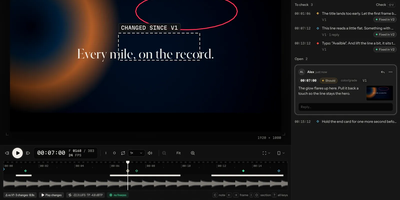
Feedback with a frame number attached: Lampo pins notes, drawings, and voice comments to exact video frames and hands AI agents the timecode and a marked screenshot of each. A producer marks up a cut, and the agent works through the notes, replying to each as fixed, won't fix, or a question pinned to that frame. The next render arrives as a new version with the unresolved notes carried over. Check mode lines up the old and new versions at the same frame, offering one key for looks right and another for still wrong. Hold T and talk while the video plays, and the note pins to where you started, transcribed and tagged by a speech engine on your own server. Auto-check reads burned-in text for typos and flags flash frames, freezes, clipping, silence gaps, and loudness that misses its target before anyone presses play. Clients draw on the frame, reply, and approve through a review link with no account, while you control downloads, expiry, and passwords. Sign-off stays with people. Claude Code, Codex, Cursor, and any MCP client connect through the CLI and MCP server, and an Agent view shows the plan, render progress, and a Stop button. Project Files hold footage, fonts, and logos with restorable versions, and playbooks carry the brief and house rules that agents read first. Running on a dedicated VPS on RepoCloud with guaranteed CPU, RAM, and SSD, full root SSH access, and a browser serial console. AGPL-3.0 licensed.
Llama RPC Farm
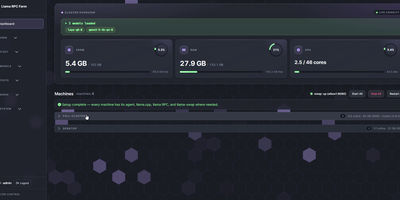
If your GPUs are scattered across a few machines, Llama RPC Farm pools them into one llama.cpp cluster behind a single OpenAI and Anthropic endpoint. A model editor lists every GPU and RAM chip, and ticking them lets one model span several machines with the device order in plain view. Models load on demand, and serve groups decide whether neighbors run together, stay always on, take turns, or clear the stage solo. A live dashboard tracks VRAM, memory, CPU load, temperature, and RPC state for each machine. The Flow Visualizer draws real per-tensor placement as a model runs, with pulsing GPUs wherever compute is in flight. Browse Hugging Face for GGUF files by quantization, task, company, or collection; sharded models download as one row. Weights can live on a shared network mount, or model sync can copy missing files to each machine. Access keys give each person or device a model allowlist and optional daily, weekly, or monthly request limits, with usage tracked per key. A Connect tab prints ready-to-paste client configs and tests the endpoint. A model that fits on one machine can run as a full replica on several, with requests balanced between them. Linux, Windows, macOS, and Raspberry Pi machines can share one cluster. A first-run walkthrough sets storage, installs the engines, and loads a tiny demo model. Running on a dedicated VPS on RepoCloud with guaranteed CPU, RAM, and SSD, full root SSH access, and a browser serial console. Apache-2.0 licensed.
Roamgate
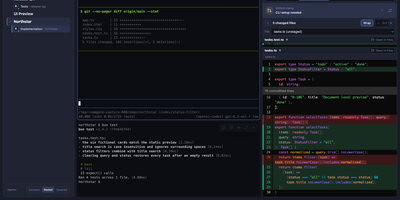
Close the laptop, keep the agents: Roamgate brings the Herdr workspace running on your server into any browser, so the terminal session you left mid-task is waiting on your phone exactly as you left it. Every workspace and recognized agent sits in one view: check what each agent is doing, read its conversation, and take over a real terminal with streaming output, split panes, scrollback, multiline paste, and clickable links. When the agent finishes, the review happens in the same place: inspect staged, unstaged, untracked, and branch changes, annotate exact diff lines, preview rendered Markdown, and send compiled feedback back into the agent pane without pre-filling a submission you did not approve. Files browse beside the terminals, and session history survives disconnects because Herdr owns the sessions, not your browser tab. Connections stay flexible: run the bridge beside Herdr on one machine, save SSH profiles to reach remote hosts, and install the whole thing as a PWA for an app window without tabs. Login is required even on loopback, push notifications flag agents waiting for input, and themes, accents, and terminal fonts make the cockpit yours. Running on a dedicated VPS on RepoCloud with guaranteed CPU, RAM, and SSD, full root SSH access, and a browser serial console. MIT licensed.
HostPog
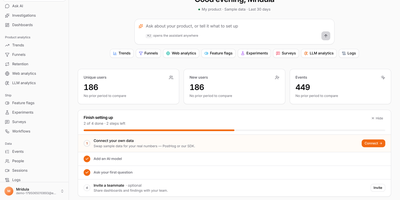
Product analytics that explains why a metric dropped instead of only charting the drop: HostPog pairs trends, funnels, retention, and web analytics with an AI analyst that runs the queries and shows the chart behind every answer. Funnels are built by naming the steps, then broken down by any property with drill-down to the people who dropped off. Web analytics tracks visitors, bounce rate, top pages, referrers, and UTM campaigns. The assistant keeps one conversation per user and can set up feature flags, experiments, surveys, and workflows, though anything it creates starts switched off until reviewed. Flags support percentage rollouts, person conditions, variants, and payloads, with bucketing that matches PostHog so users keep their variant. Experiments report a Bayesian chance to win, and surveys offer NPS, ratings, choices, and open text through the posthog-js widget you already ship. LLM analytics breaks down cost, tokens, latency, and errors by model and user, while logs arrive over OpenTelemetry or JSON and link each error to the person who hit it. Teams get workspaces, roles, invite links, and an audit log, and the assistant works with OpenAI, Anthropic, Gemini, OpenRouter, or a local Ollama model on your own key. Leaving PostHog takes five steps, starting with a read-only connection; nothing changes for your users until the last one, which can be undone. Running on a dedicated VPS on RepoCloud with guaranteed CPU, RAM, and SSD, full root SSH access, and a browser serial console. MIT licensed.
Tucano
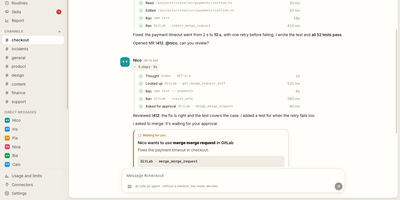
Tucano turns the coding agents you already use into a team that talks in channels, passes work between its members, and stops before anything real happens. Agents have names, roles, tools, and memory, and an @mention hands the turn to the next one, so one finds the bug, another fixes it, and a third reviews it. Connectors speak MCP for Jira, GitLab, GitHub, Slack, Datadog, or your own internal server, and each agent gets no access, read, or read and write per tool. Merges, purchases, posts, emails, and deletes arrive as approval cards showing the exact call, to approve once, always allow, or refuse with a reason, in the app or on Telegram. A Memory page lets you review, edit, and forget what agents learned, repeated paths become proposed skills, and skills from Claude Code and Codex import in one click. Routines run on a weekly calendar or when a connector reports a new issue, failing monitor, or email. Each agent picks its own harness and model and has a monthly token limit, while one Pause everything button halts the whole team. Agents can work in an isolated Linux computer or a live Chrome that you can take over. Server mode serves the same screens to a browser, listens on localhost by default, and pairs phones with one-time codes. Running on a dedicated VPS on RepoCloud with guaranteed CPU, RAM, and SSD, full root SSH access, and a browser serial console. Apache-2.0 licensed.

AI Inbox Agent
You open the inbox and AI Inbox Agent has already done the first pass: the mail sorted and summarized, and a draft in your voice waiting wherever an answer is needed. Unread Gmail lands in one of six categories, urgent through spam, with a priority, a confidence score, and a one-line reason, and phishing is flagged instead of answered. Summaries come with key points, action items with deadlines, and the sender's sentiment. Drafts come from your own history: the agent finds the closest past replies, borrows their tone, and lists the ones it used. Nothing leaves without your yes. Approve it, edit it, skip it, or type a plain-words note like "shorter, and confirm we'll cover the cost" for a rewrite. Approved replies join the examples, so drafts drift closer to how you write. Action items go to Google Tasks, Notion, or Todoist through n8n or any webhook, high-priority ones automatically and the rest in one click. High-priority threads return the next day and medium ones after a few days, with Done and Snooze. A morning digest lists what to act on first, and a stats page estimates the minutes saved. Rules decide which categories earn drafts and whether approval stays required. Bring a key for Anthropic, OpenAI, Gemini, or DeepSeek, or try the recorded demo mailbox first. Running on a dedicated VPS on RepoCloud with guaranteed CPU, RAM, and SSD, full root SSH access, and a browser serial console. MIT licensed.
Agentic Customer Service Platform
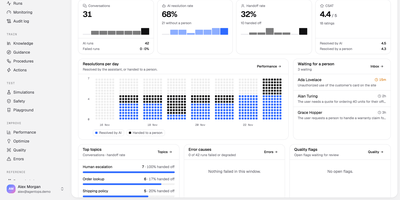
When a customer asks to cancel their latest order, this platform lets the AI propose the action while deterministic code checks the customer, applies policy, asks for confirmation and runs it exactly once. The assistant answers policy and FAQ questions from a knowledge base with hybrid dense and keyword retrieval, quotes its evidence and abstains when the evidence is thin. It looks up orders and tickets, handles refunds and cancellations, opens support tickets and escalates sensitive requests to a person with a priority, a reason and a first-reply deadline. Workflows pause at confirmation points and resume after a browser or backend restart, with duplicate effects prevented. AgentOps, the operator console, shows conversations, AI resolution rate, handoff rate and CSAT. A person can take over a live chat, reply, leave internal notes and hand back, and any run opens to show the model's proposal, the system's decision and what was allowed to execute. Teams edit knowledge articles, step-by-step procedures and plain-language guidance as versioned changes, and a knowledge-gaps list ranks the questions nobody could answer. Monitoring charts success rate, latency, token use and escalations per run, an audit log records every decision and takeover, and a safety page lists the release gates. Any OpenAI-compatible model works, including a local one. Running on a dedicated VPS on RepoCloud with guaranteed CPU, RAM, and SSD, full root SSH access, and a browser serial console. MIT licensed.
FraudGuard AI
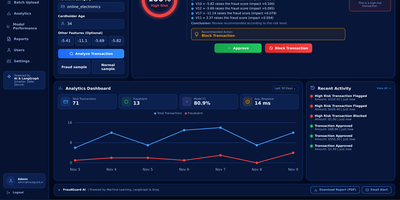
For every card transaction it scores, FraudGuard AI writes an investigation report that explains why the payment looks risky and sends the worst cases to a human analyst. Type an amount, time, merchant category, and cardholder age, or load a sample, and the model returns a fraud probability, a Low, Medium, or High risk level, and an action: approve, hold, or block. Tabs reveal the factors that pushed the score up or down, recommended steps, the agent's trace, and a chat box for asking why a case was flagged. High-risk cases wait for an analyst to approve or block them, and every note, decision, and alert is time-stamped and attributed to a user. A live-stream demo scores a generated transaction every second or so, a what-if simulator redraws the risk as you drag sliders, and batch upload scores up to 1,000 CSV rows. Analytics show daily transaction and fraud counts and a risk heatmap by hour and merchant category, while a model page lists precision, recall, a confusion matrix, and ROC and precision-recall curves. Every case exports as a PDF report, high-risk cases can trigger an email alert, and light or dark themes are remembered by the browser. Optional Firebase sign-in adds Admin and Analyst roles and a Users page where admins approve who may enter. Running on a dedicated VPS on RepoCloud with guaranteed CPU, RAM, and SSD, full root SSH access, and a browser serial console. MIT licensed.