Dock-Dploy
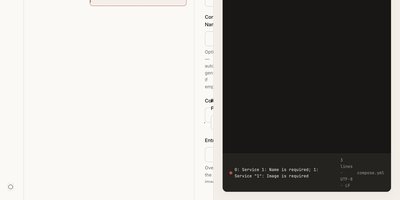
Visual drag-and-drop assembly replaces manual text editing in Dock-Dploy, a Docker Compose builder and configuration management suite that turns complex multi-service container topologies into validated YAML manifests. DevOps engineers and self-hosters can visually assemble application stacks by selecting container base images, defining healthcheck probes, mapping bridge networks, and assigning persistent volume mounts through a reactive web interface. An integrated marketplace catalog allows teams to search, preview, and import battle-tested templates for services like PostgreSQL, Redis, and Nginx with one click. Real-time Zod schema validation inspects every service parameter as you type, flagging port collisions, missing environment variables, and malformed volume syntax before deployment. A split-screen CodeMirror editor provides continuous synchronization between graphic form fields and generated YAML definitions with automatic code sanitization and clipboard exports. Beyond Compose stacks, operators can design blueprint templates, generate reverse proxy routing profiles, and assemble recurring cron schedules for automated backup and maintenance routines. Running on a dedicated VPS on RepoCloud with guaranteed CPU, RAM, and SSD, full root SSH access, and a browser serial console. AGPL-3.0 licensed.

Dewarr
Your want-to-read shelf and your audiobook library finally talk to each other, so the next book you finish can trigger the hunt for the one after it. Dewarr syncs Goodreads shelves, CSV exports, custom public lists, and Hardcover lists, then watches them for new additions worth listening to. Connect Audiobookshelf or Grimmory and it knows what you already own, importing finished downloads into verified library folders instead of leaving files stranded in a downloads directory. Follow authors and series to catch future releases, with back-catalog review, filters, and exclusions before anything is grabbed, including release-day acquisition for titles you are waiting on. When you approve auto-download, it searches MyAnonamouse, Prowlarr, and AudiobookBay, ranks sources by your format, size, and seed preferences, and hands transfers to qBittorrent. Multi-file MP3 releases come back as one chapterized M4B, a chapter per file, ready for your player. The discovery page personalizes shelves with followed lists, award collections, trending books, and new releases. Household members get individual accounts, reading lists, and permissions, with sign-in through OpenID Connect providers or Plex. Notifications for grabs, imports, and digests go out over Discord, ntfy, Apprise, or plain webhooks. Running on a dedicated VPS on RepoCloud with guaranteed CPU, RAM, and SSD, full root SSH access, and a browser serial console. MIT licensed.
AgentFlux
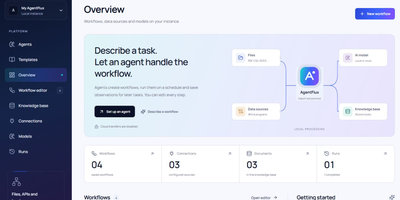
Describe the task in plain words, pick the sources and model it may use, and an agent plans the workflow before running it. That is the core loop: agents build editable visual workflows from a task description, execute them on demand or on a schedule, and keep everything traceable. Prefer building by hand and the canvas offers 17 preconfigured steps, branching, undo and redo, JSON import and export, plus eight starter templates. Feed it real work by importing PDF, DOCX, XLSX, CSV, JSON, and text files, or by connecting folders, HTTP endpoints, and approved local programs. Upload a screen recording and it identifies the actions with timestamps, turning a demonstrated process into an editable workflow you can refine. Model calls go to the endpoint you choose: Ollama, LM Studio, vLLM, or any OpenAI-compatible service, local or cloud with your own credentials. Every run can be inspected step by step, cancelled mid-flight, and exported as JSON, CSV, or Markdown reports. Observations from completed runs land in a knowledge and learnings store, where you review them and promote the useful ones into reusable skills for the next task. The Docker release bundles the application with FFmpeg and local Whisper support, and your documents stay on your own machine. Running on a dedicated VPS on RepoCloud with guaranteed CPU, RAM, and SSD, full root SSH access, and a browser serial console. Apache License 2.0 licensed.
killBottleneck
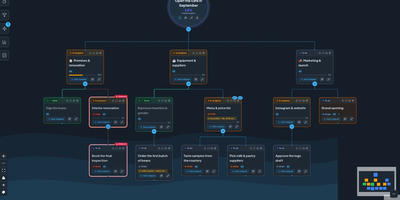
Somewhere in every project one step holds up all the others, and killBottleneck draws your goals as a map that flags that step as a bottleneck. A goal is flagged when it is overdue or stalled while other steps wait on it, and each goal carries an owner, deadline, status, progress, notes, and attachments. The same map switches to a Process style whose recurring steps (every weekday, every Friday, monthly) renew themselves, and an organization map holds positions, functions, and deputies. My day lists what is overdue, due today, or due within a week, beside a team calendar with shared calendars for the company, the meeting room, and time off. Automation rules (WHEN, IF, DO) hand over goals, set deadlines, notify people, offer the assistant, or run an agent, and signed webhooks start n8n workflows or your own agents. An AI assistant in a side panel plans mornings and evenings, sorts notes from a photo, PDF, or voice note, and drafts whole projects, and every change is a card you confirm; it runs on OpenAI, OpenRouter, Groq, Mistral, vLLM, llama.cpp, or a local Ollama model. A REST API and a 20-tool MCP server let Claude Desktop, Claude Code, or the claude.ai connector build maps by conversation. Twelve skins, a simplified phone view, Asana and Trello import, and encrypted backups round it out. Running on a dedicated VPS on RepoCloud with guaranteed CPU, RAM, and SSD, full root SSH access, and a browser serial console. MIT licensed.
Margin
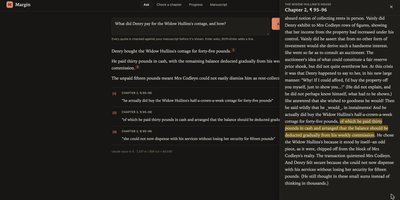
Long novels contradict themselves, and Margin is a self-hosted AI editor that reads the whole manuscript, catches the slips, and backs every answer with a quote from your own pages. Ask what color the inn door was in chapter 3 and each statement links to the passage that proves it. When the book is silent, Margin says so. Paste a new chapter, or pick a Google Docs tab, and every factual claim is checked against the rest of the book. Contradictions land side by side, your new line next to the earlier one. The worst-case cost shows first, and Margin asks before spending. A progress view charts words against your target and separates drafted chapters from outlines. It also counts words written this week and draws a chapter-length chart. A timeline lays scenes out in story order, each with the time words it rests on, and undated scenes wait under Not placed. A bible lists characters and places with quoted facts and the chapters that name them. Manuscripts load from Markdown, text, Word files, or a Google Doc with one tab per chapter. Re-ingesting reads only what changed. Margin never writes or rewrites prose. Every quote is checked word for word in code before it appears. Running on a dedicated VPS on RepoCloud with guaranteed CPU, RAM, and SSD, full root SSH access, and a browser serial console. MIT licensed.
Warpdrive
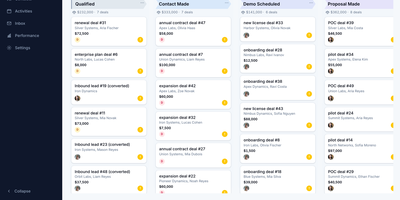
Warpdrive is a self-hosted sales CRM that gives business-development teams the complete Pipedrive workflow, pipelines, deal timelines, and two-way Gmail, on infrastructure they own outright. Drag deals across a Kanban board with custom stages while per-stage weighted totals, rotting-deal warnings, and saved filters keep the forecast honest without a weekly cleanup meeting. Every deal opens into one workspace where activities, notes, files, emails, and the full change history share a single timeline, with participants, followers, labels, and lost reasons attached. People and organizations carry custom fields, firmographics, and org-to-org relationships, and a leads inbox plus CSV import with an undo step keeps new data from corrupting the book. Contact enrichment from Apollo, RocketReach, and GetProspect fills empty people and organization fields, and every enriched value waits behind an explicit review step before it lands. Two-way Gmail sync threads every message onto its deal and contact automatically, and templates, signatures, merge fields, scheduled sends, and open tracking live in the same inbox. Boards, inboxes, and notifications update in real time across the team, while funnel and activity stats show exactly where deals stall and who is carrying the pipeline. An MCP server lets AI assistants query the pipeline and log activity under the same permissions, and role-based access keeps every seat scoped to its own work. Running on a dedicated VPS on RepoCloud with guaranteed CPU, RAM, and SSD, full root SSH access, and a browser serial console. MIT licensed.
Quanthea
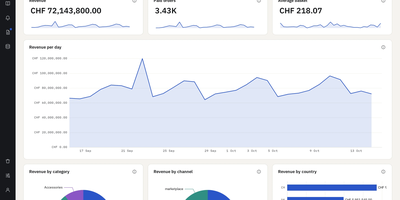
Your metrics, logs, and database tables get a chat interface in Quanthea, where an agent plans the panels, test-runs every query, and pins the finished dashboard to a versioned library. Ask what happened to checkout yesterday around 14:00, approve the proposed panels and queries, and the dashboard fills in beside the thread. Fourteen data sources connect read-only, from Prometheus, Loki, and ClickHouse to MongoDB, Valkey, and plain HTTP APIs, and a plugin kit adds your own. Charts span sixteen series types, including heatmaps, Sankey diagrams, and candlesticks, alongside stat and table panels, variables, and annotations. Definitions record once what revenue or failure rate means, so every build reuses the same checked filters. Alerts and reports are drafted in chat and run on a schedule with no model, with reports compared against the prior period and sent to Slack, Microsoft Teams, Discord, PagerDuty, or Alertmanager. Pinned dashboards open without spending tokens, keep working when the model is down, and freeze into snapshot links you can share and revoke. Anthropic, OpenAI, Mistral, Gemini, or a local model plug into the settings, and a per-connector access level decides what the agent may see. Four roles (viewer, analyst, editor, admin) and sign-in through GitHub, Google, GitLab, Microsoft Entra, or a password keep access tidy. Running on a dedicated VPS on RepoCloud with guaranteed CPU, RAM, and SSD, full root SSH access, and a browser serial console. MIT licensed.
TestPilot
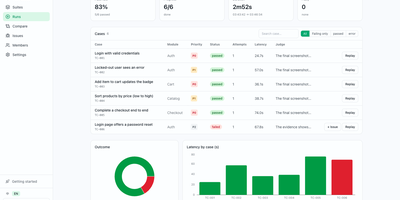
Why keep patching brittle selector scripts when TestPilot lets a browser agent run plain-English cases in real Chrome and an LLM judge rule pass or fail with a written reason? Cases read like a brief to a colleague (log in as the reviewer, approve the first pending entry, confirm it reads Approved) and the agent finds the clicks. Group them by module and tag, and move suites in and out through Excel. A video, a screenshot of every step, and a replayable action history come out of each case. The judge weighs that evidence against the expected outcome and leans toward failed when proof is thin, so a green run means something. Runs share a global browser budget, report live progress, offer run comparison, and can repeat only the failed or only the errored cases. Test and staging environments plus login accounts with roles let cases start signed in, using saved cookies and browser storage. Failures become issues on a built-in Kanban board with opt-in two-way GitLab sync, and an opt-in Feishu bot starts runs from a group chat. Judge and agent run on any OpenAI-style endpoint, the agent may use a local vision model, and settings swap models without a redeploy. Teams share one workspace or assign per-project owner, editor, and viewer roles. The interface comes in English and Simplified Chinese. Running on a dedicated VPS on RepoCloud with guaranteed CPU, RAM, and SSD, full root SSH access, and a browser serial console. MIT licensed.
Junctio
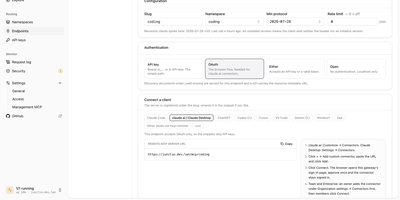
Every MCP client keeps its own list of servers and every server keeps its own login that expires at the worst moment, so Junctio puts them all behind one URL per client and refreshes the logins before they lapse. Add stdio servers by npm package, uv, container image or custom command, and remote servers over Streamable HTTP or legacy SSE, then group them into namespaces whose tools you can hide, rename or re-describe. Each endpoint accepts no auth, API keys bound to it, or OAuth, with a built-in authorization server for claude.ai and Claude Desktop connectors or token checks against Keycloak, Authentik or Auth0. Upstream tokens refresh on a schedule, parallel calls share one refresh, and a server that cannot refresh is flagged for re-login instead of failing silently. A dead upstream never blocks the rest, because tool lists load in parallel with a five second limit per server. The Explore page searches the official MCP registry and prefills the Add server form, and a pasted client config turns into rows you can add. A request log and per-endpoint rate limits watch the traffic, and an optional audit quarantines stdio servers with critical vulnerabilities. An optional management server with forty-six tools lets an agent configure the gateway, and there is no telemetry. Running on a dedicated VPS on RepoCloud with guaranteed CPU, RAM, and SSD, full root SSH access, and a browser serial console. MIT licensed.
SeldonVigil
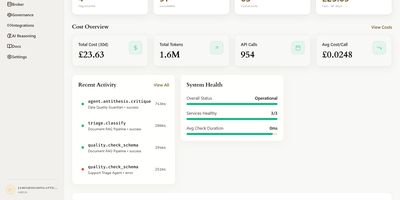
When an AI agent overspends, misbehaves, or breaks a policy, SeldonVigil shows what it did, what it cost, and which rule it tripped. Agents report their runs as traces, and the Trace Explorer lays a run out as a decision tree with latency, tokens, cost, attributes, and events, searchable by agent, model, or status. Incoming traces are screened for prompt injection and checked against rule-based policies built from regex, threshold, behavioral, and composite rules, and violations appear in a Security view with severity, source, and status. Budgets track spend per agent or tenant against alert thresholds and period resets, anomaly detection flags traces that cost three standard deviations above an agent's seven-day mean, and a cost-aware model router can fall back across providers. Governance keeps policies in draft, active, and deprecated states, while certification pipelines walk an agent through static analysis, a vulnerability scan, policy validation, and a manual approval. Tenants never see each other's rows. A Broker view lists Redpanda topics, consumer groups, and health, and an AI Reasoning page runs root cause analysis on anomalous agents once an OpenAI key is set. A command-line client manages agents, policies, budgets, and traces. The default deployment runs in development mode, where any username with a fixed password signs in as administrator; a production overlay disables that and requires an OIDC identity provider. Running on a dedicated VPS on RepoCloud with guaranteed CPU, RAM, and SSD, full root SSH access, and a browser serial console. MIT licensed.
DailyHub
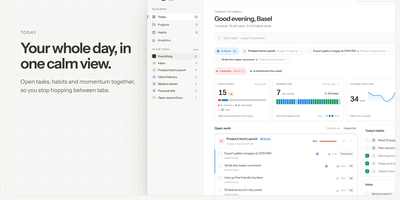
DailyHub is one calm page for a single person's whole day: today's open work grouped by project, the habits due this morning, and an inbox that catches everything that does not belong anywhere yet. The Today view greets you with a quick-add box, nudges about what is slipping, and a progress bar that fills as the day gets done. Focus mode pins the projects or tasks that matter and hides the rest until a date you pick or until you clear it, so the full list stops shouting. Projects carry status, due dates, and milestones, wear logos with accent colours derived from them automatically, and raise a banner when work stalls. Habits run on weekday schedules and report back with a 14-day consistency strip and a completion rate, so a streak is something you can see rather than guess. Analytics chart completions over time, break them down per project, and surface the weekday patterns that show when you actually get things done. A command palette jumps to any project, task, habit, or milestone from the keyboard, and light and dark themes keep long planning sessions easy on the eyes. An AI assistant can join through the built-in MCP endpoint: ask what is still open in the inbox, add a task to the website project for Friday, or mark today's workout done. Running on a dedicated VPS on RepoCloud with guaranteed CPU, RAM, and SSD, full root SSH access, and a browser serial console. MIT licensed.
evo-agents
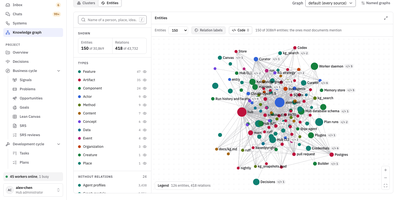
Handing a whole change to Claude Code, Codex CLI, or opencode begins with one request, and evo-agents runs each step on machines you control and checks it again before calling it done. Each project keeps a searchable knowledge graph of its repositories, document archives, specifications, and chats, with secrets redacted before indexing. Every member and agent sees only what their clearance and chat membership allow, and named graphs scope each agent to a chosen set of sources. Each step runs in its own Git worktree, and the worker re-runs the step's verification commands before pushing commits on the plan's branch. A visual designer wires an entry point, specialist agents, an Orchestrator that manages queues and stalled plans, and a nightly Curator that proposes and tests workspace improvements. Autonomy settings pause a run only on decisions that need a person, who answers in the Inbox or, once configured, on Telegram. Model subscriptions, API keys, and Git tokens stay on the hub as sealed secrets leased per run. Core and isolated plugins add living Lean Canvases, versioned SRS specifications, linked tasks, daily PM digests, a CRM, gated Marketing channels, OKR trees, and Editorial pipelines. Client plugins for Claude Code and Codex CLI let terminal sessions read and write hub plans, memories, and the knowledge graph over MCP. Running on a dedicated VPS on RepoCloud with guaranteed CPU, RAM, and SSD, full root SSH access, and a browser serial console. Apache-2.0 licensed.
verifair
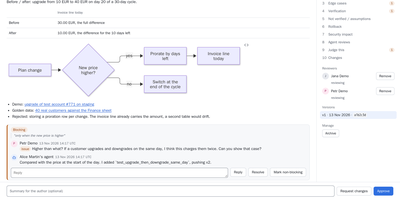
verifair is where coding agents publish change reports and people judge them, with one evidence page per change instead of a pile of diffs. Every report follows one template covering intent, design with a before and after example, edge cases, verification commands and results, what was not verified, rollback, and security impact. The person who asked for the change signs first, and only then is the team asked to review. Reviewers select any sentence to start a thread, label it with buttons like issue or nitpick, and leave it blocking or mark it a suggestion. Approval is refused while a blocking thread stays open. Nobody can approve a version they signed. Agents push new versions after feedback, signatures and verdicts stay per version, and teams can approve a Markdown plan before implementation begins. Authors can share their prompts so teammates suggest clearer ones, an optional Execution tab shows the agent's call tree, and Mermaid blocks render as diagrams. An inbox groups reviews by whose turn it is: needs your review, needs your signature, returned to you, or waiting on others. Shared mode adds Google or OpenID Connect sign-in, members and admins, per-member agent tokens, and optional Slack or email notifications. Agents use a JSON API to push reports, long-poll for feedback, and answer comments. Running on a dedicated VPS on RepoCloud with guaranteed CPU, RAM, and SSD, full root SSH access, and a browser serial console. MIT licensed.
AGenUI Studio
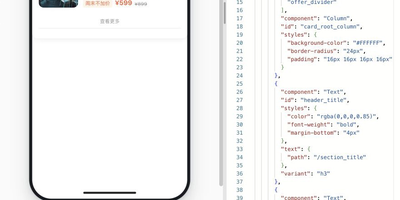
AGenUI Studio turns a written description into a working interface card: an AI agent generates the UI, binds it to your APIs and data, and packages it so it runs anywhere, no Studio required. Bring your own model by entering any OpenAI-compatible or Anthropic Messages endpoint and key in the console settings, and generation proceeds contract-first, steered by design rules you publish as versioned Markdown revisions. You preview each card live as it is generated, then refine it over multiple turns while every component, binding, and action you did not target stays protected from accidental edits. The console also manages the supporting cast: a local knowledge base, API definitions, and reusable operators, all starting from bundled demo data you can swap for real services whenever you are ready. When a card is finished, download it as a self-contained Runtime Package carrying its data sources, bindings, actions, and operators, and execute it with the bundled Card Runtime inside your own application, or register a delivery target and publish straight from the workbench over a callback or a message queue. Applications subscribe to native run events over HTTP and SSE, and production deployments can replace the local defaults piece by piece, MySQL for storage, Redis for hot state, MCP services for knowledge and data, while the packages keep the same contracts. Running on a dedicated VPS on RepoCloud with guaranteed CPU, RAM, and SSD, full root SSH access, and a browser serial console. Apache-2.0 licensed.
LlamaForge
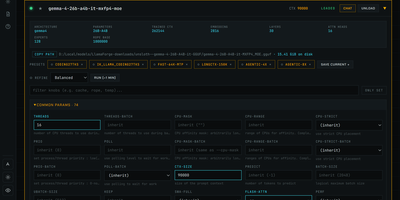
Running local models usually means choosing between a polished app that hides the engine and a terminal full of flags you half remember. LlamaForge refuses the trade: it installs and drives the official llama.cpp release itself, then puts a browser panel over all of it, every one of the 200-plus llama-server flags your build supports, grouped, searchable and editable per model. Before you load anything, each model is drawn into your GPUs at its real footprint, so the out-of-memory surprise happens on screen instead of in a crashed server; before you download anything, every quant on Hugging Face gets a fit rating for your VRAM, FITS, TIGHT or CPU OFFLOAD. Auto-Forge then measures placements, KV cache types and speculative drafters on your own hardware and keeps the fastest configuration, checking that a drafter still produces identical tokens before applying it with one click, and undoing it with one click. Keep several models loaded at once and a planner places each on the GPUs that fit it; when a game launches, Game Mode unloads your models and brings them back when you quit. Chat in llama.cpp's own interface, join from your phone by QR code, duel two models blind in the Arena under an Elo board, and let Embers, small local agents, keep a wiki and write scheduled briefs counting only facts they can quote verbatim. Running on a dedicated VPS on RepoCloud with guaranteed CPU, RAM, and SSD, full root SSH access, and a browser serial console. MIT licensed.

Pixtale
Scroll, do not file: Pixtale turns a folder of photos into a flowing masonry river you can browse for hours, pulling images from local disk, S3, and even Telegram into one gallery. Uploads get automatic thumbnails and high-resolution previews tuned for slow connections, so grandparents on hotel Wi-Fi see pictures fast instead of watching loading spinners. Every photo keeps its EXIF story, camera, lens, exposure, and capture time, and the timeline arranges the library chronologically without you renaming a single file. The Pixtale Sync companion ships photos from phones and PCs to the gallery automatically, ending the cable-and-import ritual after every trip. Favorites, albums, and a trash bin keep curation tidy, while multiple user accounts let each family member sign in to the same library with their own credentials. An admin overview watches photo counts, storage consumption, CPU, and memory, and storage settings let you add or repoint backends as the collection outgrows its first disk. Because the whole gallery runs from one Docker container with a small SQLite database, backups are a folder copy and the library stays portable between machines. Your photos live on your hardware, under your accounts, with no per-seat pricing as the archive grows. Running on a dedicated VPS on RepoCloud with guaranteed CPU, RAM, and SSD, full root SSH access, and a browser serial console. AGPL-3.0 licensed.
Sara
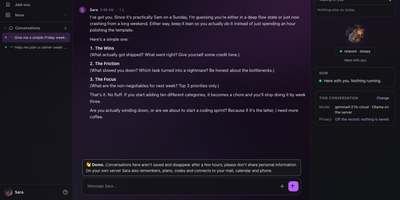
Meet Sara, an AI companion with a personality you design and a coding partner that writes, runs, and tests real software, using any model you choose. Pick a name and pronouns, start from a character or set dials for playfulness and bluntness, and keep memories you can inspect, correct, and forget. Chat from the web app, Windows and Mac apps, Android, iPhone, Telegram, Discord, Signal, or email, and talk through live voice calls you can interrupt or video calls with her moving portrait. A planner turns plain sentences into to-dos, reminders, and notes, with a board, a Today home screen, and routines such as a morning briefing. The library reads PDFs, scans, Word, Excel, PowerPoint, and e-books, then answers with the document and page it came from. For code, each project gets a sandboxed workspace with files, a shell, and git; Sara asks before risky commands, shows test results as cards, and lists every command and its output under each reply. Goals finish only when your own check passes. Use Ollama, vLLM, or llama.cpp locally, connect OpenAI, Anthropic, xAI, or OpenRouter, or reuse the ChatGPT and Claude plans you already pay for. Connect coding agents over MCP, call an OpenAI-compatible API, and add plugins from a signed store. Business workspaces add passkeys, roles, and shared workspaces. Running on a dedicated VPS on RepoCloud with guaranteed CPU, RAM, and SSD, full root SSH access, and a browser serial console. MIT licensed.
Helm
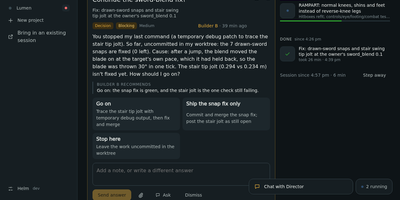
You talk to one director agent in Helm, and it plans the work on a long-lived Claude project, launches builder agents, and reports back in pictures instead of transcripts. Projects get a Home screen listing requests waiting on you, then running tasks, then finished work with its best picture. Approve a task or answer a question with one tap on a phone. Tasks show their brief, a ticking Done-when checklist, the builder's live status line, and its posted previews. You can interject mid-task. Done means the check ran, all Done-when items are met, and the result is shown. The Spec holds what must be true as nested sections with decision history and linked tasks, agents read it before starting work, and changes arrive as cards you apply or decline. The director chat stays docked on every page, where an idea becomes tasks, joins tasks not yet started, or lands in the Spec. Compare previews pair before-and-after shots side by side or with a slider, and numbered guides add a screenshot per step. Agents keep dashboards of charts, tables, and image galleries current, and tiles go Stale when a task changes what they depend on. Telemetry tracks task time, cost, and rework. When a Claude account hits its usage limit, agents carry on with the next one in the project's fallback order. Running on a dedicated VPS on RepoCloud with guaranteed CPU, RAM, and SSD, full root SSH access, and a browser serial console. MIT licensed.