ReadyLLM
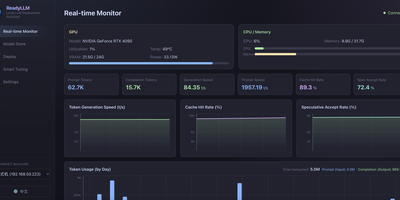
Your inference server should not sit mostly idle while a model crawls along at ten tokens per second, so ReadyLLM gives you a visual way to deploy, watch, and tune LLMs until the hardware is actually earning its keep. Add the machine under your desk or a remote box over SSH, let hardware detection read its GPU, VRAM, CPU, and memory, and get model recommendations that fit what you own instead of wishful downloads. A model store catalogs text, image, and video models with parameter counts, precision, resolutions, and real weight filenames, background downloads from multiple sources, and integrity checks when they land. One click starts or stops llama.cpp, vLLM, or SGLang services, installs a missing engine matched to your GPU backend, and leaves runtime parameters open for manual tweaks. Live curves track GPU utilization, memory, throughput, and latency as requests flow. When speed disappoints, two-phase auto tuning searches the knobs that matter, checks VRAM feasibility before it wastes your time, and benchmarks honestly against latency, throughput, or prefill goals; an AI tuning mode can reason through the same loop across several rounds. Beyond chat models, ComfyUI generation covers text-to-image and text-to-video, storyboards, shot-by-shot long video, and upscaling, with prompts optionally expanded first. Running on a dedicated VPS on RepoCloud with guaranteed CPU, RAM, and SSD, full root SSH access, and a browser serial console. MIT licensed.
Edi Life OS
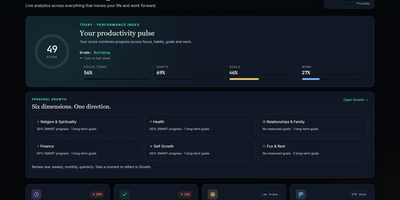
Edi Life OS puts the habits, goals, projects, money, focus sessions, and notes that usually live in five separate apps into one calm dashboard on your own server. Start the day from an Overview that rolls focus, habit trends, goals, finances, and the week ahead into one readable score. Connect long-term goals to six life areas, drive progress from a checklist, a measure, or a habit you actually keep, and use weekly, monthly, or quarterly reviews to choose the next honest step. Log daily habits with streaks and monthly progress, run timed focus sessions with short and long breaks, and keep a history of the deep work you finished. Track expenses, income, budgets, debts, and credits in your chosen currency, including recurring entries that land straight in the ledger. Plan projects on draggable Kanban boards with labels, priorities, due dates, checklists, comments, and attachments, then see card deadlines and money dues together in one calendar. Capture Markdown notes with preview and export, pin sticky notes with colors and connections, and give each account its own private workspace, theme, and currency. Ask an AI assistant through the optional MCP server to read your dashboard, create goals, log habits, or record expenses through a token-protected API that never touches the database directly. Running on a dedicated VPS on RepoCloud with guaranteed CPU, RAM, and SSD, full root SSH access, and a browser serial console. MIT licensed.
AgentSDR
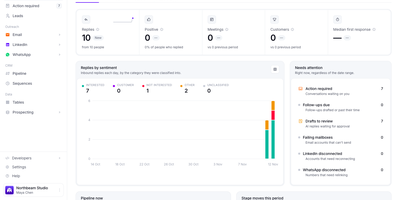
Outbound sales eats hours on list building, sequencing, and reply triage, and AgentSDR puts all three in one self-hosted workspace where AI drafts every reply for your approval. Leads holds every person and company as one record per contact, imported from CSV or Excel, so a reply on any channel lands in the same place. Tables enriches lists row by row with fifteen data providers, AI columns, and HTTP calls. Email sequences send from your own mailboxes with merge fields, sending windows, and daily limits. LinkedIn adds invitations with notes and follow-ups after acceptance, and WhatsApp covers chats and recorded calls. The Action required queue shows each reply with its AI classification, like Meeting Requested or Case Study, next to a drafted answer you edit and approve in one click. Nothing sends on its own. The Pipeline board groups open leads into needs action, waiting on them, and follow-ups exhausted, and Analytics charts replies, positive replies, meetings, and customers by channel. Do Not Contact rules, teams, and organization roles come built in. Founders, small sales teams, and agencies running outbound for clients get a lead-to-meeting engine. Running on a dedicated VPS on RepoCloud with guaranteed CPU, RAM, and SSD, full root SSH access, and a browser serial console. MIT licensed.
Guard Spec
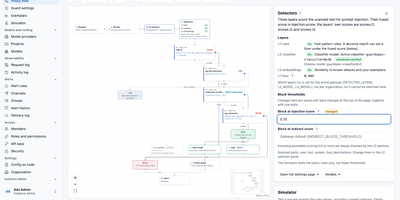
Any web page, document, or tool result your LLM reads can carry hidden orders, so Guard Spec sits between your app and the model and blocks prompt injection before it arrives. Change one base URL and the gateway accepts OpenAI-style chat completions, the Responses API, embeddings, and Anthropic's Messages API for Claude Code, then routes clean traffic to OpenAI, Azure OpenAI, Anthropic, Gemini, vLLM, or Ollama. Each request is sanitized, scored by pattern rules, an in-process classifier, and similarity to known attack examples, and judged against your policies; an injection gets an HTTP 400 and the model is never called. Tool results, retrieved documents, and MCP tool descriptions are scored one by one, so hidden instructions and poisoned tool definitions are caught. An output guard checks answers, including streamed ones, for exfiltration links, personal data, and a leaked canary. Policies per organization and project are written as text or in a visual editor, tested in a simulator, and edited as YAML with a diff. Rules see through Vietnamese diacritics, teencode, leetspeak, and homoglyphs, because detection was built for English and Vietnamese. Alerts reach Slack, Microsoft Teams, Telegram, email, PagerDuty, Opsgenie, or signed SIEM webhooks, and single sign-on works with OpenID Connect or SAML 2.0 plus SCIM provisioning and TOTP two-factor. Running on a dedicated VPS on RepoCloud with guaranteed CPU, RAM, and SSD, full root SSH access, and a browser serial console. Apache-2.0 licensed.
LMRing
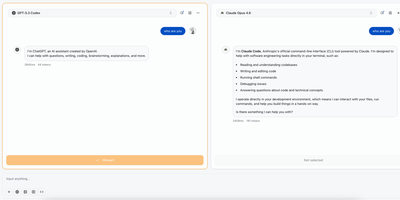
Stop guessing which model writes better and watch them compete on your own prompts: LMRing runs two to five language models side by side on the same input, streams every answer in real time, and lets you vote for the winner. Each comparison feeds a leaderboard you can read as a ranked table, a bar chart, or a scatter plot, so patterns in cost, speed, and quality stop hiding inside individual chats. The arena goes beyond text, with dedicated modes for comparing generated images, generated video across providers such as Sora and Veo, and live-rendered web development output where model code runs in front of you. More than fifty providers connect through their APIs, including OpenAI, Anthropic, Google, DeepSeek, Mistral, Groq, OpenRouter, and any OpenAI-compatible endpoint you point it at. Your comparison history is saved, shareable, and revisitable, which turns one-off impressions into an evaluation record your team can argue from. Sign-in flexes to your setup with GitHub, Google, or Linux.do OAuth, or email one-time codes, and the interface speaks English, French, and Chinese. Because the arena is yours, the prompts, votes, and provider keys stay on infrastructure you control instead of feeding someone else's public ranking. Running on a dedicated VPS on RepoCloud with guaranteed CPU, RAM, and SSD, full root SSH access, and a browser serial console. Apache-2.0 licensed.
Jellydash
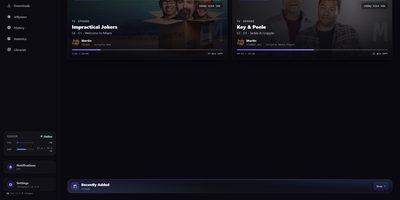
Jellydash answers the questions every Jellyfin admin asks, starting with who is watching right now and whether that stream is transcoding. Live cards show each session's artwork, user, quality, progress, and playback method, including the reason a transcode was needed, and live TV channels appear with real program progress. Behind the scenes, a background poller records every play even when nobody has the dashboard open, building a history you can search, filter by user or library, and export to CSV with poster art intact. Older Jellyfin or Emby Playback Reporting backups import in seconds, so years of viewing are not lost when you switch. Statistics turn that history into watch-time trends, top users, device and client activity, codec breakdowns, and transcode reasons, and clicking a chart opens the exact plays behind it. A monthly recap looks back at a finished month with rankings and daily activity, while trending and all-time most-watched strips show what your household actually loves. Optional pages follow Jellyseerr requests as they arrive and read the status of SABnzbd, qBittorrent, Transmission, Deluge, and NZBGet clients without ever touching their queues. Server activity, maintenance tasks, and system status stay one click away, and selected users can be excluded from monitoring entirely. When someone presses play, a notification can reach your phone through Telegram, Pushover, Discord, ntfy, Gotify, or Web Push. Running on a dedicated VPS on RepoCloud with guaranteed CPU, RAM, and SSD, full root SSH access, and a browser serial console. MIT licensed.
Promptly
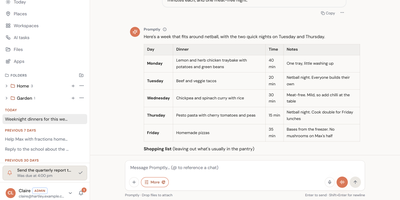
Promptly gives a family one login for an AI assistant, files, photos, mail, calendar, notes, passwords, group chat, and maps, all running on a computer they own. The assistant connects to Anthropic, OpenAI, Gemini, DeepSeek, OpenRouter, or local Ollama models, searches the web, runs several research agents at once for a cited report, and remembers what you tell it. Ask it to add a calendar event, find a beach photo, draft an email, or read a file, and it asks before it sends or acts. Talk mode holds a spoken conversation you can interrupt, while Study turns any topic into a course with short lessons and spaced reviews. The drive offers version history, link sharing, and WebDAV, with built-in editors for documents, spreadsheets, whiteboards, and presentations that several people can edit together. Photos get a timeline, albums, a map, duplicate clean-up, and search by what appears in the picture. Rooms gives the household Discord-style group chat, and Porch is an ad-free feed with no ranking. Passwords are end-to-end encrypted, with passkeys, shared vaults, and imports from Bitwarden, 1Password, and LastPass. Scheduled AI tasks with a visual flow editor automate chores, and a small-app store adds budgets, meal planners, and habit trackers. Invitations only, so nobody signs themselves up. Running on a dedicated VPS on RepoCloud with guaranteed CPU, RAM, and SSD, full root SSH access, and a browser serial console. MIT licensed.
Olano
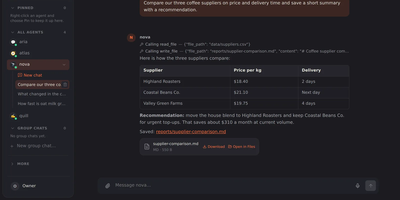
Olano turns one install into an office of AI agents, each with its own memory, workspace, tools and chat channels, all run from a web dashboard called Mission Control. Describe the agent you want to Agent Father in plain language, or edit a single config file, and it appears with its own schedule and permissions. Around 900 named tools across 88 toolkits cover Google Workspace, Microsoft 365, GitHub, Slack, Notion, Jira, Linear, HubSpot, Salesforce, Stripe and Shopify, alongside web search, a headless browser and SQL. People reach agents through 21 channels including Telegram, Discord, Slack, WhatsApp, Signal, Matrix, email and SMS, with approvals answered right in the chat. Each agent picks its own model from twenty providers, including Anthropic, OpenAI, Gemini, Bedrock and local Ollama. Memory persists in markdown files, a notes wiki with backlinks and searchable documents, while background workers write briefings and ideas into an approval queue. Cron schedules with time zones, a shared issue tracker, a calendar and an org chart keep work moving between humans and agents. Approval gates by tool category, PII and prompt-injection scanning, an encrypted vault and optional per-agent sandboxed shells behind an egress firewall keep each agent inside its lane. Agents speak MCP and A2A in both directions, and the dashboard installs as a phone app. Running on a dedicated VPS on RepoCloud with guaranteed CPU, RAM, and SSD, full root SSH access, and a browser serial console. MIT licensed.
Hivemill
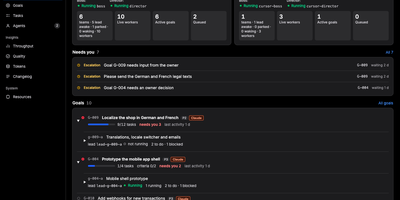
When you hand Hivemill a goal, AI coding agents build it, separate agents review and test it, and a judge decides the merge, all on a Linux server you control. You describe the outcome to a boss agent, a director staffs a lead, and the lead splits it into tasks, each with its own git worktree and branch. A coder opens a pull request and stops, because it cannot review, test, or merge its own work. The reviewer reads the diff, QA runs real tests against your acceptance criteria, and by default the judge merges only when both verdicts pass; anything else returns to the coder with findings. Pull requests, CI checks, and merges run through the GitHub CLI. Claude Code is the default runtime, a Cursor Agent org can run beside it, and hooks enforce each role's prompt and permissions. A spawn gate queues new agents until memory, load, and your Claude usage windows allow, so one modest machine stays responsive. Scheduled jobs mail the director recurring chores with a token cap per run, and a daily retro agent studies rejected work. Typical first jobs are bounded changes such as a filtered CSV export, a mobile navigation fix, or a duplicate-order check before import. A read-only web dashboard tracks goals, tasks, live agents, throughput, quality, and estimated cost per task. Running on a dedicated VPS on RepoCloud with guaranteed CPU, RAM, and SSD, full root SSH access, and a browser serial console. MIT licensed.
Lurker
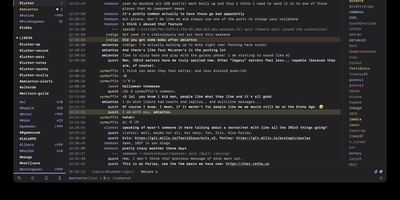
Lurker keeps you present in every IRC channel you care about, holding your connections open around the clock and recording everything said so a retro, searchable web client can hand it all back whenever you return. Invite your friends and each person gets their own set of networks under one roof, while admins decide which networks members may join and which channels newcomers are pointed at. Nothing said while you were away is lost: the full history is searchable by nick, channel or network, and clicking a result jumps straight to that moment, whether it happened an hour or a year ago. The everyday annoyances are handled too, with drafts that follow you between devices, a highlight and ignore system that cuts noise, bookmarks and private notes on users, reactions, replies, and image uploads that are optimized, stripped of metadata and stored on your own disk or S3. If you prefer your old client, the built-in bouncer speaks the soju and ZNC dialects with SASL, network discovery, on-demand scrollback and read markers that stay in sync everywhere, and DCC file transfers with an XDCC queue still work. Optional companion containers generate inline link previews in isolation and keep your IRC connections alive across restarts of the main service. Running on a dedicated VPS on RepoCloud with guaranteed CPU, RAM, and SSD, full root SSH access, and a browser serial console. MPL-2.0 licensed.

TG Vault
TG Vault turns Telegram into the front door of your private archive, pulling files out of channels and groups into storage you control and managing them from a proper web file manager. Batch-download channel and group media by date range or tag, subscribe to sources so new posts sync automatically, and upload, search, organize into folders, and preview media from the browser. Every transfer runs as a managed task with live progress, failure details, and pause, resume, and retry controls, whether it was started from the web console or the Telegram bot. Point the vault at local disk, OneDrive, Google Drive, Amazon S3, Aliyun OSS, WebDAV, or an OpenList instance, and let the optional qBittorrent extension forward finished downloads into the same storage, cleaning up sources or keeping them seeding. Access stays locked down with an administrator password, a bot user allowlist, and TOTP two-factor authentication, while one install script deploys and upgrades the whole Compose stack. Running on a dedicated VPS on RepoCloud with guaranteed CPU, RAM, and SSD, full root SSH access, and a browser serial console. MIT licensed.

Plain Week
Seven days and a Someday list fit on one screen in Plain Week, a minimal weekly planner and to-do list. Click an empty row, type, press Enter, and keep typing. Writing "17:30 Gym" sets the time for you. Each task opens into a dialog with eight colors, plain-text notes, and a checklist of subtasks. Repeats run every few days, weekly on chosen weekdays, or monthly on a set date, with optional end dates and edits for one occurrence or the whole series. Drag tasks between days, into Someday, or past the screen edge to another week, by mouse, touch, or keyboard. Right-click to color, duplicate, delete, or push a task to tomorrow or next week, with undo. Arrow keys change weeks and T returns to today. The planner works offline, installs as an app, and keeps data in the browser until you add an account to sync. Export every task to JSON, import it into another instance, and pick light or dark themes or right-to-left layouts. Running on a dedicated VPS on RepoCloud with guaranteed CPU, RAM, and SSD, full root SSH access, and a browser serial console. MIT licensed.

Kumiho
Drop a hard drive's worth of comics, e-books, and audiobooks into folders, point Kumiho at them, and the whole collection becomes a library you can browse and read from any browser. The scanner walks nested folders recursively and treats the folders that actually hold pages or files as series, so an existing collection works as it is, with no metadata matching ritual before the first read. Comics and manga open in a responsive viewer built for the format: page turning on a desktop, continuous webtoon scrolling on a phone or tablet. E-books in EPUB, PDF, and TXT open in the same library, while archives in ZIP and CBZ are read directly without unpacking. Audiobooks get a real player, with a chapter list, resume playback that remembers where you stopped, progress tracking, bookmarks, and a sleep timer for listening at night. A series folder can even carry its own soundtrack: an MP3 whose filename matches starts playing as background music while you read. Everything runs from one lightweight Go server in a single Docker container, storing its database and configuration in mounted volumes, so the library sits comfortably on a small VPS next to the files it serves. Running on a dedicated VPS on RepoCloud with guaranteed CPU, RAM, and SSD, full root SSH access, and a browser serial console. Apache 2.0 licensed.
Xianyu SaaS
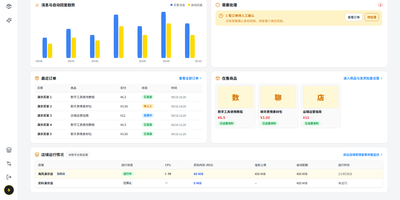
Xianyu SaaS runs all of your Xianyu (Goofish) shops from one self-hosted console, answering buyers with AI, delivering digital goods the moment orders verify, and keeping every store isolated in its own process. Add each shop by scanning a QR code in the Xianyu app, then switch between stores from one header while the overview tracks messages, replies, delivery results, orders, and pending tasks. The AI customer service center lets you pick a service persona, write shop-wide reply requirements in plain language, and maintain a separate knowledge entry for every product, covering audience, specifications, usage, delivery notes, and after-sales wording. Keyword rules answer the repetitive questions first, with product-specific rules outranking store-wide ones, and anything unmatched falls through to the AI with product knowledge and chat history in context. When a buyer pays, the system re-checks the platform order before delivering, drawing card keys one to fifty at a time from named pools, sending netdisk resources, or posting fixed text instructions, with a five-minute sweep catching orders missed while a shop was offline. A conversation workbench lets you search chats, take over from the AI with one click, send up to eight queued images, and jump from any order straight into the buyer's thread. A built-in operations agent manages a shop through chat, updating product knowledge, toggling reply rules, or binding delivery stock on request. Running on a dedicated VPS on RepoCloud with guaranteed CPU, RAM, and SSD, full root SSH access, and a browser serial console. GPL-3.0 licensed.
CLIProxyAPI Dashboard
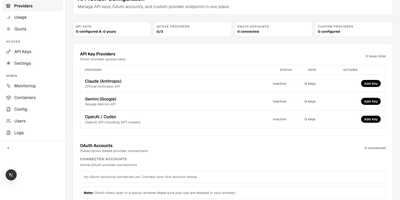
CLIProxyAPI Dashboard puts a web console in front of CLIProxyAPI so you manage AI providers, keys, quotas, and containers through forms instead of YAML files. Connect Claude Code, Codex, xAI, Antigravity, Kimi, and Devin accounts with OAuth, then add Gemini CLI, GitHub Copilot, Kiro, and Cursor through plugins you install and configure from the settings store. Any OpenAI-compatible endpoint can join as a custom provider with model mappings, and admins can mark a provider as shared so the whole team uses it. You create, revoke, and track API keys with per-user ownership, manage dashboard users and admin rights, and stream live logs beside container health. Quota views track rate limits per provider and per model, and Telegram alerts fire when remaining quota drops below your threshold. Usage analytics break down request counts, provider share, model statistics, error rates, and estimated cost. Configuration syncs to OpenCode automatically, model configurations travel as share codes, and backups can be created, scheduled, previewed, and restored from settings. One-click updates refresh the dashboard and proxy images, containers start and stop from the panel, and automatic TLS keeps the console reachable under your domain. Running on a dedicated VPS on RepoCloud with guaranteed CPU, RAM, and SSD, full root SSH access, and a browser serial console. MIT licensed.
Euron CodeAgent
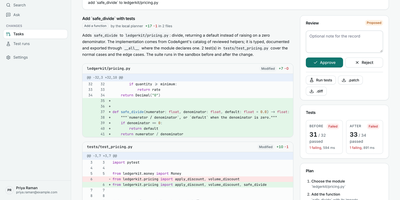
Euron CodeAgent answers questions about your repository with citations to exact lines, and its patches arrive with sandboxed test results for a person to approve. Upload a zip or tar.gz, or give an HTTPS git URL, and the code is indexed with a graph of calls, imports, and inheritance. Search matches symbols by exact name, prefix, or fuzzy spelling, text by literal or regular expression, and code by meaning. Each answer streams in with numbered chips that open the cited lines. When the code holds no answer, CodeAgent says so. Describe a change and the agent runs your tests, edits a scratch copy, reruns them, and files a patch with the diff, reasoning, and both results. Built-in offline skills rename a symbol across the codebase, add a tested helper, and repair a failing test with small verified changes. Reviewers comment on lines or the whole patch and approve or reject with a note, and a setting bars requesters from deciding their own tasks. Approved patches apply to a branch in CodeAgent's own copy and export as .diff or git am files, so nothing is pushed to your git host. Tests run in a throwaway container with no network and limits on CPU, memory, processes, and time. It runs offline with no key, and an OpenAI-compatible API or Ollama can be added for open-ended changes. Running on a dedicated VPS on RepoCloud with guaranteed CPU, RAM, and SSD, full root SSH access, and a browser serial console. MIT licensed.
Euron MCPHub
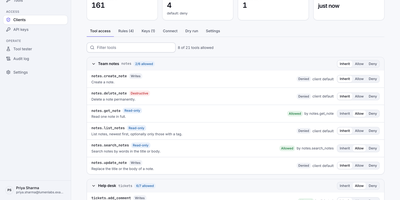
MCP servers multiply fast, and every agent ends up with its own URLs and copied tokens, so Euron MCPHub gives every client one endpoint and one key. Register a server by URL or launch command. Discovery lists its tools, resources, and prompts. The /mcp endpoint merges every server's tools as server.tool, or server__tool for APIs that reject dots. New clients start with no access. Rules allow tools by pattern, and the most specific rule wins. A denied tool never appears in the client's list. Rules can limit argument values and cap calls per minute. A dry run names the rule that would decide a call without making it. Upstream tokens are encrypted, write-only, and attached only when the gateway connects. Cloud metadata addresses are always refused, and private networks need an allow-list entry. Every call, allowed or refused, lands in a searchable call log with redacted arguments, CSV export, and usage charts. Tool definitions are fingerprinted, so a quietly rewritten description or schema gets a dated version with the diff. Scheduled health checks mark a server down after three failures and rediscover its tools on recovery. A tool tester calls any tool as one of your clients, and Connect tabs hold Cursor, curl, and MCP Inspector snippets. Admins, operators, and viewers get their own permissions, in a dashboard with light and dark themes. Running on a dedicated VPS on RepoCloud with guaranteed CPU, RAM, and SSD, full root SSH access, and a browser serial console. MIT licensed.
Hornhoof
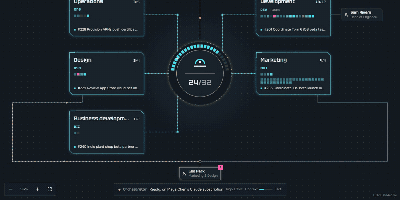
Hornhoof turns the AI plans you already pay for into a company of agents that splits goals across departments and has other makers' agents check the work, all on your own computers. Employees are real programs such as Claude Code, Codex, Kimi Code, and Antigravity, and one department can mix them freely. An orchestrator reads a goal in plain words, proposes departments, and hands each head a share of the work. One map shows who is working, who is waiting, and who stands idle. Open any agent and its real terminal appears in your browser. Each department keeps a task tracker with goals, owners, and dates, shown as a list, a board, or a graph. Every change is reviewed by an agent of another maker and tested before it joins the release. When one plan hits its limit, the task moves to the same role on another plan. Spare laptops and home servers take the full test runs, and a machine with a full copy takes over if the server stops. Only irreversible deletions wait for the CEO by default, and every question sits in one list you can answer by phone. Releases wait for your yes or ship themselves once every check is green. Templates cover marketing, sales, support, finance, and a household of devices and bills. Running on a dedicated VPS on RepoCloud with guaranteed CPU, RAM, and SSD, full root SSH access, and a browser serial console. MIT licensed.