Nemofy Agent
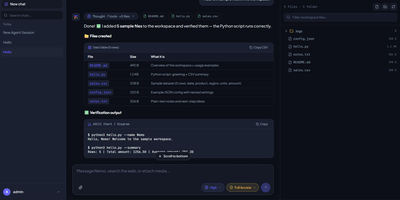
A private AI assistant with its own workspace: Nemofy Agent gives Nemo a file drawer, a code sandbox, and live web research, and by default pauses for your approval before anything sensitive runs. Ask Nemo to create files, crunch numbers, or test a script, and it builds them in a confined /workspace folder and runs verification commands. Files appear in a drawer beside the chat, where each opens to view, edit, save, or delete. For research, Nemo searches, fetches, and crawls the web through Firecrawl Local. PDF, Word, spreadsheet, and slide files are parsed natively. Pick a provider and model per conversation, from OpenRouter, River AI, OpenAI, Anthropic, Gemini, DeepSeek, Groq, NVIDIA, local Ollama, or a custom endpoint. A faster worker model takes parallel research and coding sub-tasks, with timeouts, retries, and a fallback model when a provider stalls. A context gauge shows what fills the window, and at 80% capacity older turns are summarized automatically. Reusable Markdown skills like code_and_data and deep_research load on demand, and external MCP tools connect from the same settings tab. In default mode, read-only actions run freely while sensitive ones pause to approve, edit, or reject, and paused runs resume after a restart. Access sits behind an admin login, and API keys are encrypted at rest per user profile with AES-256-GCM. Running on a dedicated VPS on RepoCloud with guaranteed CPU, RAM, and SSD, full root SSH access, and a browser serial console. Apache-2.0 licensed.
Model Hotel
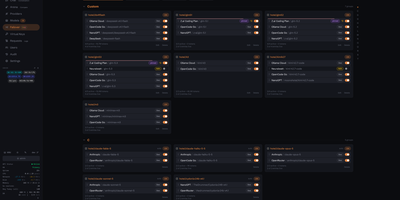
One OpenAI-compatible endpoint fronts every LLM provider you use, hosted or local, and fails over when a quota runs out or a provider goes down. Offer one model through two providers and a failover group forms by itself; the hotel/ prefix tries them all in your priority order. Anthropic, OpenAI, Google AI Studio, and OpenRouter sit beside Ollama, LM Studio, and TabbyAPI, plus any custom OpenAI-compatible API. Errors, timeouts, and rejected keys retry on the next provider, and a per-model circuit breaker benches repeat offenders. Models are discovered the moment a provider is added. Each client gets a virtual key with rate limits, a daily, weekly, or monthly dollar budget, and a list of allowed providers. Prompts and replies are never logged, and the request log records timing, tokens, cost, and gateway overhead for every call. A chat playground, a side-by-side compare grid, and blind bracket tournaments help you pick the best model. Claude Code, Codex CLI, and the OpenAI and Anthropic SDKs connect unchanged, alongside embeddings, rerank, image, and speech endpoints. Sign in with a passkey, an authenticator app, OpenID Connect, or GitHub, and give teammates named accounts with limited access. Prometheus metrics and Apprise alerts keep operators informed, and Traefik-balanced instances with an Android companion app cover high availability. Running on a dedicated VPS on RepoCloud with guaranteed CPU, RAM, and SSD, full root SSH access, and a browser serial console. MIT licensed.
AutoMorph
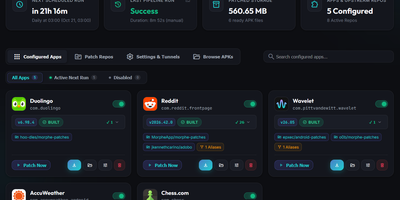
Patching the same Android apps by hand every time a patch repository updates is a chore with your name on it, and AutoMorph is the self-hosted patcher that takes the chore over and rebuilds your apps on schedule. It monitors patch repositories such as ReVanced, Morphe, and community repos for updates, downloads base APKs automatically with Google Play first and APKCombo, Uptodown, and APKPure as fallbacks, and applies your chosen patches without you touching a command line. The Add Package wizard walks you from a package name through suggested repositories, patch selection with per-patch options, and aliases that map same-role patches across repositories so two repos stop fighting over the same job. Builds run once a day at a time you choose, or start manually from the web portal while live build logs stream to your browser. The Patcher Control Center shows every tracked app's version, patch status, and download links, and email alerts carry direct download links whenever a patch succeeds. Distribution goes further: one-tap Obtainium import by QR code or deep link, plus an F-Droid compatible feed for Obtainium and Neo Store, deliver updates straight to your phone, and a custom keystore keeps them seamless. A low-spec mode trims heap and thread limits for small servers, retention settings clean up old builds, and Pangolin, Tailscale Funnel, or Cloudflare Tunnels expose the portal over HTTPS. Running on a dedicated VPS on RepoCloud with guaranteed CPU, RAM, and SSD, full root SSH access, and a browser serial console. MIT licensed.
Narralume
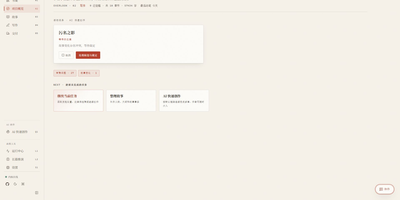
NarraLume is a writing studio for long novels where the AI proposes and you dispose, so a book stays yours across tens of thousands of words. Everything lives around the story bible: your stated intent, outline, entities, confirmed facts, relationships, chronology, and foreshadowing, kept as the single source of truth that planning, drafting, and review all read from. You can write chapters by hand in the studio, save versions and comments, ask for a selection edit, or delegate a chapter, a run of chapters, or a whole quick-creation plan to a model; whatever comes back arrives as a candidate with diffs, never as silent edits to your manuscript or canon. Review findings come with evidence you can accept, reject, or mark as false positives, and when generated prose collides with a locked fact the task stops and waits for your ruling instead of improvising around it. The run center keeps every AI job's steps, model calls, and checkpoints recoverable, the long-form lab searches story memory and previews plot impact without touching the book, and delivery ends with quality checks, exports, snapshots, and full-library backups. Running on a dedicated VPS on RepoCloud with guaranteed CPU, RAM, and SSD, full root SSH access, and a browser serial console. Apache-2.0 licensed.
Euron Open LogMind
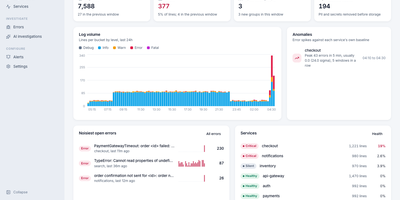
When production breaks, Euron Open LogMind searches and groups your logs, then returns a root cause where every claim cites a real stored log line you can open and re-check. Services send lines over HTTP, the Python or Node.js SDK, or any OpenTelemetry exporter. Credentials, emails, card numbers, and personal data are masked or hashed before storage, so secrets never reach a disk, a model, or a browser. The explorer filters by keyword, service, environment, level, trace, and request. It also draws a level histogram, shows the lines around any entry, and streams new lines live. Errors collapse by fingerprint: a timeout thrown 230 times for 230 different orders becomes one group. Service health, volume, and error rate come from the logs alone. An investigation collects the first failure, earlier warnings, other services' errors, deploys, and the failing request's trace. Statements that cite nothing real are removed and shown as removed. A single click re-reads every cited line from storage, and follow-up questions reuse the same evidence. Reports show their token cost, and OpenAI, Anthropic, Gemini, Ollama, or an OpenAI-compatible endpoint can write them. Search, grouping, live logs, and alerts work without any model, and threshold or anomaly rules notify by email, signed webhook, or Slack. Organizations, projects, and viewer, admin, and owner roles keep each team's data separate. Running on a dedicated VPS on RepoCloud with guaranteed CPU, RAM, and SSD, full root SSH access, and a browser serial console. MIT licensed.
tracesage
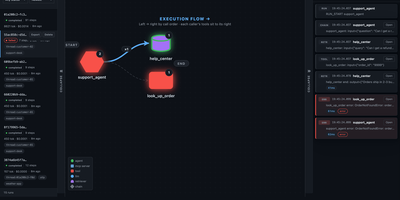
Every model call, tool call, and subagent behind an AI answer becomes a trace you can click through, replay, and search in the browser. LangChain and LangGraph runs are captured natively, Pydantic AI, OpenAI Agents SDK, CrewAI, and the OpenAI and Anthropic clients join with one line, and any OpenTelemetry exporter can post spans to the built-in collector. Run tracesage connect and Claude Desktop, Claude Code, Cursor, and Codex sessions appear as full traces, with every subagent nested under the call that spawned it. A failed tool call shows up as a red node on the exact step that broke, input and error included. A topology graph maps agents, tools, models, retrievers, and MCP servers, step-through replay walks a run at up to 5x, and a waterfall shows which step took the time and what it cost. Search covers prompts, replies, tool output, and errors across every assistant, and a Threads tab reads whole conversations as chat. Developers get terminal commands to show, watch, diff, and export runs, plus a pytest fixture that asserts which tools were called and how many tokens were used. Traces can flow out as OpenTelemetry spans to Tempo, Jaeger, Datadog, Honeycomb, or Phoenix. A bearer token protects a server exposed beyond localhost, and it refuses a public address without one. Running on a dedicated VPS on RepoCloud with guaranteed CPU, RAM, and SSD, full root SSH access, and a browser serial console. Apache-2.0 licensed.
Dispatch
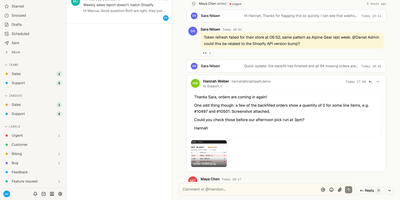
Dispatch turns the Gmail, Microsoft 365, and IMAP mailboxes your team already has into shared inboxes where every conversation gets an owner, a discussion thread, and a status. Teammates assign a conversation, leave internal comments with @mentions right next to the email, and watch presence and typing indicators so nobody answers the same customer twice. Labels, snooze, send later, undo send, signatures, and canned responses with variables keep daily triage quick, while full-text search digs up old threads. Rules label, assign, move, archive, notify, or call a webhook when conditions match, and the analytics view tracks volume, first-reply time, resolution time, and workload per teammate. An optional assistant summarizes long threads and drafts replies with your own Anthropic or OpenAI key. Group chats, direct messages, tasks linked to conversations, and contacts built from your mail sit beside the inbox. A REST API with workspace keys and signed webhooks connects it to the rest of your stack. One instance hosts many workspaces with custom roles, passwordless magic-link sign-in, and an audit log. Support desks, agencies, and small companies use it to replace per-seat tools such as Front, Missive, and Hiver. Running on a dedicated VPS on RepoCloud with guaranteed CPU, RAM, and SSD, full root SSH access, and a browser serial console. AGPL-3.0 licensed.
Pollen
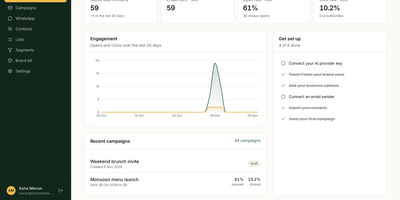
Sending regular email and WhatsApp campaigns without a copywriter starts with Pollen learning the business's voice from its website or writing samples, then drafting emails and replies in that tone. Compose takes a goal, a brief, a link, and a length, then returns three subject lines, preview text, and a body. A second model pass scores each draft, and a weak one is revised once. Rule checks catch spam phrases and a missing postal address. Contacts import from CSV. Segments come from rules over tags, source, email domain, and recent opens or clicks, or from a plain-English request the AI turns into rules. Emails carry signed tracking links and one-click unsubscribe. Campaign reports show delivered, opened, clicked, click-to-open, unsubscribed, and top links. A connected WhatsApp Business number adds a shared inbox that respects the 24-hour reply window, with AI-drafted replies, auto-replies, and template broadcasts to a list or segment. Many businesses can share one install, each in a workspace with its own team, keys, and data, plus a platform console for tenants and usage. Businesses bring their own OpenAI, Anthropic, or Gemini key and their own AWS SES or SMTP sender, and pay those providers directly. Seeding adds a demo café with 64 fictional contacts, a sent campaign, and three WhatsApp threads to browse before any key is added. Running on a dedicated VPS on RepoCloud with guaranteed CPU, RAM, and SSD, full root SSH access, and a browser serial console. MIT licensed.
Aperture Chat
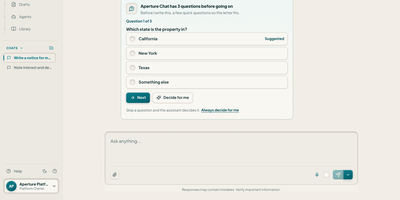
Aperture Chat is one governed workspace where chat, documents, slide decks, spreadsheets, agents, and automations draw on the same approved models, knowledge, and access rules. Choose any model or agent you are allowed to use and the answers arrive with citations from attachments, knowledge bases, and web search, plus a work trace of the research steps behind them. When a request is vague, the reply pauses to ask up to three multiple-choice questions. Replies keep running on the server after you close the tab, and if the chosen model fails, a similar one takes over and the trace names it. Drafts handles documents, slide decks, and spreadsheets with an assistant alongside, a Check panel that flags blanks and undefined terms, live co-editing, saved versions, and export to Word, PowerPoint, Excel, or PDF/A. New drafts start private. Agents bundle instructions, a model, knowledge, tools, and prompts, and automations run them on a cron schedule into a fresh chat or draft. Knowledge bases take uploads, web pages, synced folders, and cloud drives, and an ethical wall fences a file to one group. Administrators get single sign-on, SCIM, audit trails, retention rules, and a setting that keeps Social Security and card numbers away from the model. It suits legal and professional-services teams, and IT groups rolling out AI across an organization. Running on a dedicated VPS on RepoCloud with guaranteed CPU, RAM, and SSD, full root SSH access, and a browser serial console. MIT licensed.

Something
By the time you sit down each morning, your AI coworker can have read the inbox, checked the store for stuck orders, and drafted a plan for the day. You reach the same coworker in a web workspace, Chrome's side panel, Telegram, or Slack, and its memory follows you between them. A first-login interview learns what the company does, shows what it found online for you to fix, and proposes a starter plan of tools and routines. Memory keeps one fact per thing, tied to its source conversation; corrections add dated remarks, and outdated facts are struck through beside their replacements. Routines cover standing chores, from hourly inbox scans and stuck-order checks to weekly ad reviews and meeting prep, and a Marketplace tab suggests more for each connected tool. Tasks live on a list or board with owner, priority, and deadline. Skills are markdown playbooks you can edit in the browser. Dozens of services connect through a sign-in popup or a pasted key, among them Notion, Stripe, Linear, Shopify, and Google Workspace. It asks before anything goes out. In team mode, each person gets private files, memory, and routines, the board stays shared, and hand-offs reach teammates where they will see them. Claude Code or Codex can ask the coworker about the business and write back only after confirmation. Running on a dedicated VPS on RepoCloud with guaranteed CPU, RAM, and SSD, full root SSH access, and a browser serial console. AGPL-3.0 licensed.
LLMxRay
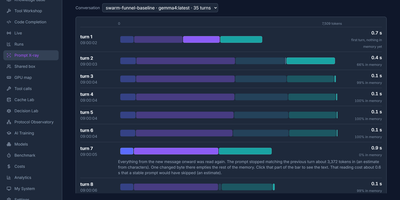
Point VS Code Copilot, Open WebUI, Continue, n8n or your own agent at LLMxRay instead of Ollama, and every turn shows what the cache kept, what was read again and what the daemon silently cut. Prompt X-ray draws each turn to scale, colored by part (system prompt, tool schemas, earlier turns) and dimmed where the model already remembered it. Runs lays one agent's calls out as a waterfall of waiting, loading, prompt reading and answering, with the tool time between them. Shared box names the tool that slowed the others and the setting to change. The GPU map shows what sits in video memory and which pulled models still fit. Tool calls scores a model on thirteen request shapes agents send, and Cache Lab finds the value that breaks the prompt cache and measures the fix. Chat colors each streaming token by the model's own probability, Compare streams up to four slots side by side, and Surgical Benchmark scores models on real token logprobs. A Knowledge Base searches PDF, DOCX, Markdown and CSV files, and Code Completion fills the gap between prefix and suffix. A read-only MCP server lets an agent diagnose its own calls. Turns can flow on to Jaeger, Phoenix, Langfuse or Grafana as OpenTelemetry spans, and nothing leaves the machine unless you send it. Running on a dedicated VPS on RepoCloud with guaranteed CPU, RAM, and SSD, full root SSH access, and a browser serial console. Apache-2.0 licensed.
Grafana Lookout
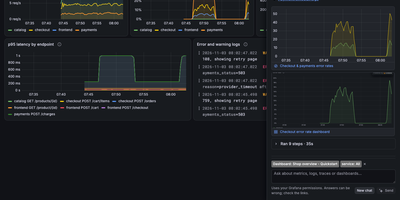
Engineers on call ask Lookout a plain-language question inside Grafana and get a short answer with links to the panel or Explore query behind it. Ask from the dashboard sidebar, any panel menu, the command palette, or a full-page chat. Explain with AI on any panel says what changed, and when. Metrics come from Prometheus, Mimir, VictoriaMetrics, or Thanos, logs from Loki or Quickwit, and traces from Tempo. Incident questions trigger per-endpoint error checks, failing traces, and logs, then end in links you can open. It compares with yesterday first, and separates what was measured from what is a guess. Ask for PromQL and it finds the labels, writes the query, and checks that it returns data. Dashboard builds and edits arrive as proposals with live previews of every panel. Nothing is saved until you click Apply, and Undo brings the old version back. Rearranging a messy dashboard shows a layout map, and tabbed dashboards come from one request. Every tool runs in the browser as the signed-in user, and tools only read. The setup page tests that the chosen model can call tools. Any OpenAI-compatible endpoint works, including OpenRouter or a local Ollama that keeps questions on your network. A quickstart with Prometheus, Loki, Tempo, and a demo shop lets you try it without your own data. Running on a dedicated VPS on RepoCloud with guaranteed CPU, RAM, and SSD, full root SSH access, and a browser serial console. Apache-2.0 licensed.
Mandate
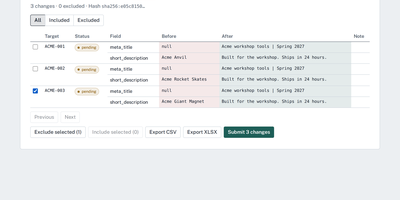
Let Claude or ChatGPT propose changes to your online shop, issue tracker, or internal APIs, and Mandate makes sure a person approves the exact before-and-after list before a single record is written. Requesters can exclude records or export the list as CSV or XLSX, while the approver's page is rendered by the server from stored data, never from text the model wrote. Approval rules depend on record count and role, chains can have several steps, and nobody approves their own request. Roles default to deny: an operation no role grants is never listed to the client, grants can pin an argument such as one brand, and fields like cost stay hidden. Approved changes are applied in batches by a durable workflow that survives restarts, and rollback restores the values recorded before the write. Any REST API with an OpenAPI document or any MCP server attaches without code, and presets for Magento 2 catalogs and Gitea issues ship ready to use. Typical uses include bulk shop edits, issue triage, read-only lookups for support staff with sensitive fields removed, and nightly automation that proposes while a person approves. One endpoint, one login, and one audit log with JSON Lines export serve every connected client, and credentials stay in an encrypted vault the model never sees. Running on a dedicated VPS on RepoCloud with guaranteed CPU, RAM, and SSD, full root SSH access, and a browser serial console. Apache-2.0 licensed.
Helpdock
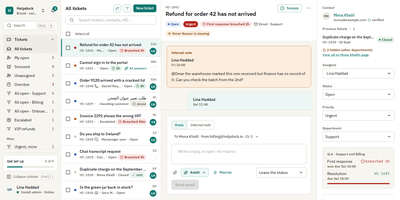
With Helpdock, every brand you run gets its own inboxes, help center and chat widget on one install, plus an AI assistant that answers only from that brand's own knowledge. Email over IMAP or webhook, Telegram, WhatsApp, Messenger, Instagram, a web form and the REST API all land in the same tickets, with shared statuses, assignment and rules. Agents work from saved views, internal notes, macros and a keyboard-first inbox, and a collision warning appears when two people open the same ticket. SLA clocks follow business hours, holidays and time zones, and pause in the statuses you pick. Workflow rules can be test-run before going live, and a CSAT survey goes out when a ticket closes. The help center publishes articles in English and Arabic on each brand's own domain, with right-to-left layouts and search in both languages. The assistant cites its sources, hands the chat to a person when the knowledge base has no answer, drafts articles from closed tickets and suggests replies to agents. Importers for Zendesk, Freshdesk and Zoho Desk bring history across without messaging a single customer. Staff sign in with passkeys, two-factor codes or SAML and OpenID Connect single sign-on. Running on a dedicated VPS on RepoCloud with guaranteed CPU, RAM, and SSD, full root SSH access, and a browser serial console. AGPL-3.0 licensed.
SocialCoach
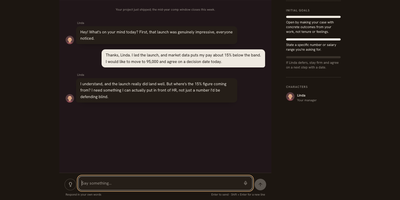
Asking for a raise, declining extra hours, or setting a boundary with a friend can all be rehearsed first in SocialCoach, an AI coach built for the conversations people dread. Pick one of 63 scenarios across seven areas of life, or describe your own situation, and talk to a character who has real goals, doubts, and limits, so politeness alone does not win the argument. A stance meter shows how firmly the other person holds their position as you speak, and optional timed replies add pressure for readiness practice. The debrief quotes what you actually said before judging it, separates communication quality from the outcome, and suggests one thing to change on the next attempt. A Today page recommends a daily scene from your goals, Growth tracks practice history against five competencies, and a Learn library offers short videos, theories, and cases with sources. Step into 3D dinners, elevator lobbies, and offices to answer by typing or speaking. Practice history stays in the browser and can be exported, with no sign-up needed, and the mobile-first layout installs as an app on a phone. Settings accept your own Anthropic or OpenAI-compatible model, or a server key, so a self-hosted copy runs on any gateway. English and Simplified Chinese are both built in. Rehearse a hard conversation three times here and the real one feels smaller. Running on a dedicated VPS on RepoCloud with guaranteed CPU, RAM, and SSD, full root SSH access, and a browser serial console. Apache-2.0 licensed.
Remyral
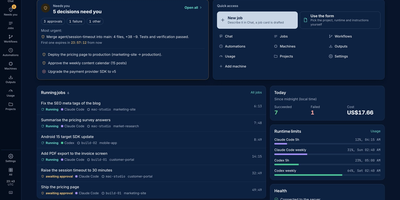
Remyral is a self-hosted control plane that runs Claude Code, Codex, Pi, and OpenCode across your own machines, with a shared queue, approvals, and an audit log. Requests start in chat, where the assistant drafts a job card that you approve, edit, or dismiss; plan mode writes phases and open decisions first and changes nothing until you approve the plan. The queue places each job on a Linux, macOS, Windows, or Docker worker by capacity, disk state, and required runtime, and the project's sandbox applies a network policy of off, allow-list, or web. Workflows mix agent steps with conditions, loops, HTTP calls, code, and approval nodes, started by a schedule, a signed webhook, or the API. A shared memory of rules, facts, decisions, and lessons reaches every runtime the same way, and lessons that agents propose wait for a person to accept them. Three security presets decide which actions need a person plus an authenticator code, and privileged actions land on a hash-chained audit log. Software jobs end as pull requests on GitHub, GitLab, or Bitbucket, with a merge decision and a deploy through Coolify or Cloudflare Pages, while usage and cost are tracked per runtime and account. Transient failures retry on another machine, and jobs that hit a usage limit wait for the window to reopen. Running on a dedicated VPS on RepoCloud with guaranteed CPU, RAM, and SSD, full root SSH access, and a browser serial console. Apache-2.0 licensed.
Agents Platform
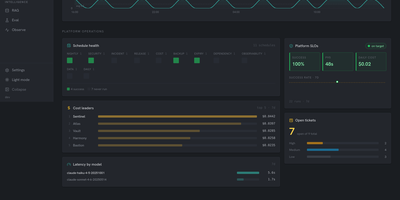
Twenty ready-made AI agent personas, a scheduler, a pipeline builder and a ticket board share one dashboard in Agents Platform, so recurring operations audits run, get summarized and turn into tracked work. Each agent carries a system prompt, skills in the SKILL.md format (adopted from the Anthropic skills catalog or imported by URL), MCP tool servers provisioned into SSH runs, and memories distilled from earlier results. Work runs in parallel, in sequence or as structured meetings, through conditional DAG pipelines or saved crews, on cron schedules or from inbound webhooks such as Prometheus alerts, git pushes and n8n flows. Execution happens over SSH on a host with Claude Code, through the Anthropic API, or against any OpenAI-compatible endpoint including local Ollama models. On SSH runs every tool call streams live into a step timeline, safety tiers stop read-only agents from writing files, supervised runs wait for approval, and scoped API keys guard the trigger endpoints. Recurring runs fuse into Combined Reports with a health score and metric trends, critical verdicts open tickets on a Kanban, Table or Gantt board, and Discord announces results. Cost, latency and SLO dashboards show per-agent spend, while eval suites with LLM-as-judge scoring and prompt A/B tests promote better prompts. A demo mode seeds weeks of sample history so everything can be explored without an API key. Running on a dedicated VPS on RepoCloud with guaranteed CPU, RAM, and SSD, full root SSH access, and a browser serial console. MIT licensed.
Mynah
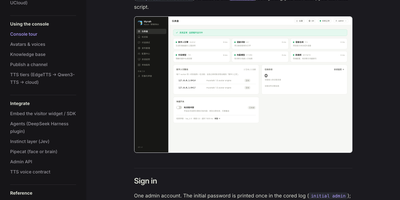
A visitor clicks your link and a face is already there, listening, answering within a fraction of a second, and stopping the moment they interrupt, because Mynah runs live digital humans in the browser instead of playing back rendered video. Underneath, cored takes WebRTC offers, runs the conversation through your chosen language model, speech recognition, and text to speech, and drives a lip synced avatar engine such as MuseTalk, FlashHead, or Wav2Lip, with a semantic end of turn model deciding when a person has finished speaking. The admin console is where you shape the experience: bake a new avatar from a talking video with explicit consent, clone or audition voices, swap avatars per channel without cold starts, and tune green screen keying and gestures live in the playground. Knowledge bases take your documents through ingestion and embedding so answers ground in your material, with retrieval tests before anything ships. Publishing freezes a model, voice, and knowledge snapshot into a channel: a shareable link with token, domain, or CIDR access control, its own branding, and a concurrency cap drawn from an engine pool that computes how many workers your VRAM can hold. Session monitoring shows who is connected and lets you kick a session, health checks watch every dependency, and light and dark themes with Chinese and English interfaces cover both console and visitor pages. Running on a dedicated VPS on RepoCloud with guaranteed CPU, RAM, and SSD, full root SSH access, and a browser serial console. Apache-2.0 licensed.