Statainer
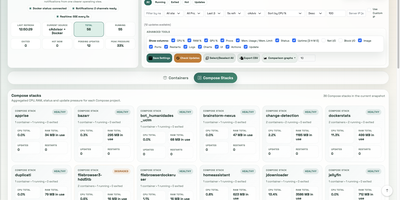
Monitoring and safeguarding Docker infrastructure without heavy enterprise software overhead is the primary mission of Statainer, an open-source management control center for container hosts. System operators inspect live CPU loads, memory consumption, network throughput, and disk I/O metrics across individual containers or comparative top-ranking charts. The interface groups containers by Compose projects, enabling administrators to start, stop, or restart entire application stacks and inspect real-time log streams without opening SSH sessions. The built-in Update Manager detects available image tags, executes single-click container updates, and maintains persistent deployment history with automated rollback capabilities for failed recreations. Custom alert configurations trigger instant notifications to Telegram, Discord, Slack, Pushover, or generic webhook endpoints whenever resource thresholds are breached or container health states change. Developers can provision scoped API keys with token authentication to automate container state transitions and export performance telemetry into custom monitoring workflows. Running on a dedicated VPS on RepoCloud with guaranteed CPU, RAM, and SSD, full root SSH access, and a browser serial console. MIT licensed.
GymCoach
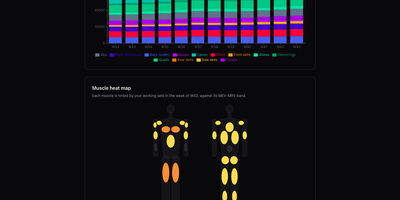
Strength training, cardio, and body metrics land in one workout log on your own server, backed by an optional AI coach that explains its advice from your real numbers. Quick entry such as 100x8@9 logs weight, reps, and effort in one line, with a rest timer, plate-loading calculator, and warm-up ramp beside the set table. A weight picker offers only loads your equipment can build, and a readiness check-in adjusts the suggested load and says why. Templates for 5/3/1 BBB, GZCLP, nSuns, PPL, and Upper/Lower run as written and edit like any custom program. Progress pages chart estimated 1RM, weekly volume per muscle group against MEV and MRV bands, a muscle heat map, bodyweight goals, and a training calendar. Garmin FIT, TCX, and GPX imports need no cloud account and add heart-rate charts and aerobic decoupling to each run or ride. The coach writes a weekly debrief, chats in a streaming conversation, and drafts a full program from a one-sentence goal, using your own Anthropic or OpenRouter key. History imports from Strong or Hevy CSV files with a dry-run preview and exports to CSV or TCX, and an MCP connector lets ChatGPT or other agents analyse it. The app installs as an offline-capable PWA, speaks English, French, Russian, and German, and keeps every user's data separate. Running on a dedicated VPS on RepoCloud with guaranteed CPU, RAM, and SSD, full root SSH access, and a browser serial console. MIT licensed.
SITREP
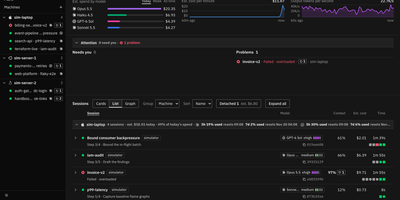
Watch every coding agent you run, on every machine, from one live browser dashboard. Sessions appear as cards, a sortable list, or a graph, grouped by machine or project, each showing its plan and current step, subagents, model and effort, context fill, git branch, and cost. Anything waiting on you, like a permission, a question, or a plan to approve, rises to a Needs you panel with the longest wait first, and you can answer it from the page or in the terminal. A Problems panel flags sessions that are stuck, failed, or colliding on the same file. The Plans board sorts every plan step into pending, in progress, review, blocked, and done. A session page adds a timeline of loops and subagents, changed files, and token and context charts. Spend is broken down by model and machine, and plan windows show how close each provider is to its limit. History keeps ended sessions by day, a wall view suits a spare screen, and browser alerts fire when a session needs you. Running on a dedicated VPS on RepoCloud with guaranteed CPU, RAM, and SSD, full root SSH access, and a browser serial console. MIT licensed.
Kandev
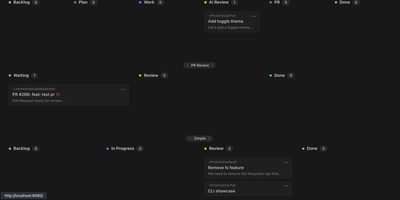
Kandev provides a command center for orchestrating AI coding agents across parallel workstreams. The Go backend paired with a Next.js frontend delivers kanban boards with drag-and-drop columns, pipeline workflow definitions with per-step agent handoffs, and an IDE-like review workspace combining file editor, file tree, terminal, browser preview, and unified git diffs. Multi-provider support connects Claude Code, GitHub Copilot, Codex, Qoder, Grok, and custom agents through configurable profiles with per-agent prompts, runtimes, and review gates. Tasks execute in isolated git worktrees with multi-repository support, letting agents work on separate branches simultaneously while changes surface in a consolidated review interface. Native integrations with GitHub, GitLab, Jira, Linear, Sentry, and Slack pull external issues into the kanban and link tasks to pull requests. Kandev exposes streamable HTTP and SSE MCP endpoints, enabling external clients — Cursor, Claude Desktop, Augment — to create tasks and read workspace context programmatically. Workflow definitions export as portable YAML for sharing across installations. Agentic workflows chain multi-step pipelines mixing different models per step — Opus for architecture, Sonnet for implementation, with human review gates between stages. Running on a dedicated VPS on RepoCloud with guaranteed CPU, RAM, and SSD, full root SSH access, and a browser serial console. AGPL-3.0 licensed.
HitKeep
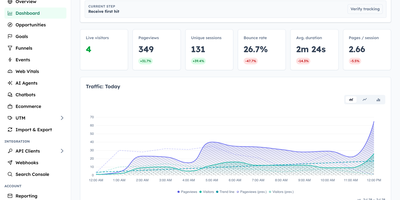
HitKeep is a sovereign web analytics platform that consolidates cookieless visitor telemetry, conversion funnels, e-commerce revenue reports, and AI engine visibility into a privacy-respecting dashboard that replaces Google Analytics and complex tracking clouds. Marketing teams can monitor inbound visitor journeys without installing intrusive consent banners or violating regional GDPR regulations. Custom conversion funnels and goal milestones track user registrations, checkout transactions, newsletter subscriptions, and software downloads with exact revenue attribution. Integrated Google Search Console synchronization brings organic search queries, keyword impression rankings, and click-through metrics directly alongside real-time pageview logs. A dedicated artificial intelligence visibility dashboard monitors crawling bots, retrieval citations, and direct referral visits originating from ChatGPT, Claude, Perplexity, and other generative search agents. Growth analysts can pose natural language questions to an embedded AI reporting assistant, generating instant cohort breakdowns and engagement trends without assembling complex manual filters. Site operators can configure custom tracking domains, whitelist reverse proxy networks, filter out referrer spam, and schedule automated database backups across persistent storage volumes. Complete data sovereignty controls allow teams to export raw event telemetry into open Parquet and CSV archives or stream metrics into external business intelligence warehouses via webhooks. Running on a dedicated VPS on RepoCloud with guaranteed CPU, RAM, and SSD, full root SSH access, and a browser serial console. MIT licensed.
MATE
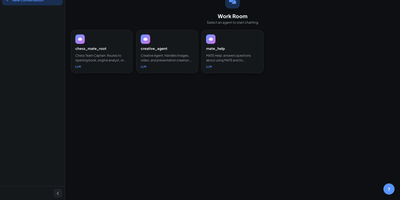
Change an agent's prompt, model, or audience from a dashboard and watch it go live without a single redeploy. MATE opens in a Work Room where any root agent can be picked from a card grid and chatted with directly. The Studio holds the builder: a drag-and-drop canvas draws parent and child agents, attaches tools and MCP servers, and keeps every configuration versioned with one-click rollback. Trace Replay plays a past conversation back across that canvas so each hand-off is visible. A template library imports ready-made agent teams, from research pipelines to support desks. The Control Room covers governance: role-based access per agent, dollar costs per agent and project, budgets that warn or block, guardrails for personal data and prompt injection, and alerts to Slack, Discord, email, or a webhook. Eval suites score replies by exact match, similarity, or an LLM judge, and a Playground compares models or prompts side by side on score, speed, and cost. Agents can be embedded as a chat widget, called through an OpenAI-compatible endpoint, or exposed over MCP and A2A. Agencies running client agents and platform teams juggling dozens of them can manage the lot from one dashboard. Running on a dedicated VPS on RepoCloud with guaranteed CPU, RAM, and SSD, full root SSH access, and a browser serial console. Apache-2.0 licensed.
OpenGTM
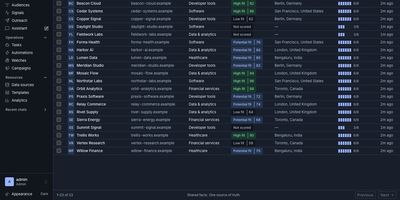
OpenGTM turns a market, a list, or a workbook into enriched, researched, ready-to-contact prospects on servers you control. Give it a market and it sources companies and people; hand it a CSV or a Clay table and it maps the columns into a shared record library. Enrichment columns run as waterfalls that try providers in cost order until a field is filled, and before anything spends a cent you see best and worst case estimates, with a workbook budget ceiling that halts paid calls on its own. Research columns send an agent to answer the hard question for each row, and the answer keeps citations to the pages it actually fetched, so a human can audit the claim before outreach. Live audiences segment your records and watch for hiring and buying signals, refreshing on schedules and firing automations when a prospect heats up. Finished rows flow out to HubSpot, Salesforce, Slack, Sheets, Airtable, Instantly, Smartlead, webhooks, or a warehouse, while every cell keeps a trace of provider attempts, latency, and cost. Your own agents get the same workspace through a REST API, webhooks, and an MCP server with scoped read and write tokens, and a seeded zero-key demo means the team can explore the whole loop before adding a single provider key under Settings. Running on a dedicated VPS on RepoCloud with guaranteed CPU, RAM, and SSD, full root SSH access, and a browser serial console. AGPL-3.0 licensed.
SyncWatch
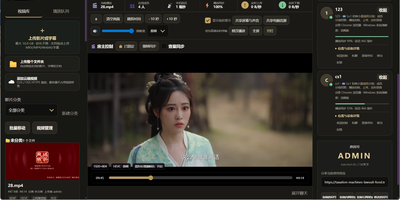
Movie night should not depend on everyone pressing play at the same second; SyncWatch runs your own watch-party server so friends in different places watch the same frame together. The host controls play, pause, seeking, and playback speed for the whole room, and late joiners or drifting clients are corrected back to the shared position automatically. You build the program from uploads or direct HTTPS media links, with subtitles, audio, images, and documents handled in the same library. Rooms can be permanent or temporary, protected by passwords and member limits, with host, admin, and permission-group control over who may operate playback. Between scenes, people talk through public and private chat, on-screen danmaku comments, emoji, voice messages, or full-room voice. Anyone can share a browser tab, window, desktop, or phone screen into the room, so a clip, a game, or a presentation becomes the shared screen. The server also keeps friends, notifications, online presence, bans, registration approvals, and an operations log, so a private community can run itself without a platform account. Uploaded media is analyzed and thumbnailed automatically, with browser-compatible versions generated for awkward formats. Backups, data export, a recycle bin, mail verification, and network diagnostics round out the admin side. Running on a dedicated VPS on RepoCloud with guaranteed CPU, RAM, and SSD, full root SSH access, and a browser serial console. Apache-2.0 licensed.
9Router Pro
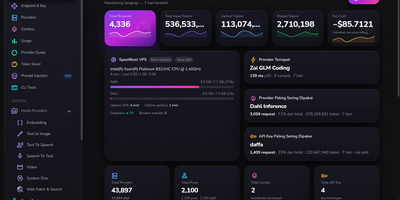
One endpoint for every model account you own: 9Router Pro sits between your applications and a fleet of LLM providers, decides which account answers each request, and keeps the whole operation visible on a live dashboard. Its signature trick is prompt injection scoped three ways, globally, per API key, or per model, delivered either as a system prompt or as a scripted chat history that primes the model far harder than instructions alone. Keys are products here: each carries a rolling token budget over 24 hours, 7 days, or 30 days plus rate limits per minute, hour, and day, so a resold plan enforces itself with polite 429 responses. Routing stays healthy on its own, with accounts tiered as clean, suspect, or cooldown, least-recently-used spreading across the fleet, flaky upstream responses retried against the next account, and proxy pools health-checked with one-click cleanup of the dead. The monitoring dashboard leads with VPS specs, fastest and most-used providers, top API key, and usage spectrum charts, while backup and restore cover providers, combos, keys, and settings section by section. Everything runs as a single application with one SQLite file and a dashboard localized into 34 languages. Running on a dedicated VPS on RepoCloud with guaranteed CPU, RAM, and SSD, full root SSH access, and a browser serial console. MIT licensed.
Cortex Hub
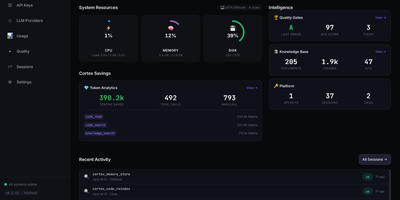
Cortex Hub gives every AI coding agent your team runs a shared brain, so what one agent learns in a repository is still there when the next agent, or the next person, opens it. Starting a session recalls the team knowledge and your own memory for that project, shows who else is editing, and picks up any task waiting for you. Agents search code by meaning and structure rather than text strings, tracing symbols, callers, and the blast radius of a change before touching it. Findings, file risks, and hard-won lessons are stored against the files they belong to, so they resurface exactly where they matter. Ending a session runs build, type, and lint checks, reports the result, and leaves a summary the next session starts from. A conductor can hand tasks to worker agents on other machines and track them centrally, while the dashboard shows sessions, keys, usage, and token savings across the team. Embeddings run locally by default, so your code memory never leaves the building just to be searchable. Running on a dedicated VPS on RepoCloud with guaranteed CPU, RAM, and SSD, full root SSH access, and a browser serial console. MIT licensed.
BlogFactory
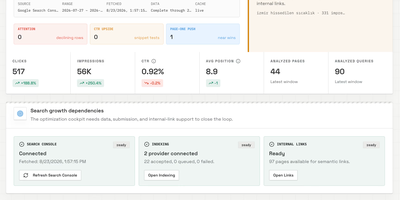
BlogFactory is the first open-source agent control plane purpose-built for multi-site content operations, shipping 16 distinct capabilities across four operational pillars — Operate, Grow, Control, and Deliver — in its v0.1.0 release. The platform keeps source evidence, AI-generated drafts, revisions, SEO metadata, human review, preflight checks, and CMS delivery destinations in one workspace while enforcing a server-side authority ceiling that prevents agents from ever publishing live content, accessing credentials, or performing administrative actions. AI agents connect through a Streamable HTTP MCP endpoint with OAuth authentication and site-scoped tool discovery, compatible with Codex, ChatGPT, and any MCP-capable client. Content creation supports single articles from keywords, titles, URLs, PDFs, text, or YouTube sources, batch campaigns, and programmatic content via reusable templates with structured data rows. The Search Growth module connects Google Search Console complete-day data to ranked optimization opportunities, 30-day growth plans, content classification by signal type (growing, low-CTR, almost-ranking, page-two, zero-click), indexing checks, and semantic internal-link suggestions. Brand Voice separates global voice rules, writer profiles, knowledge context, and brand guidelines from article mechanics. Approved drafts are delivered as CMS drafts to WordPress, Ghost, Wix, or Framer through idempotent, optimistic-locking-protected handoffs with explicit destination selection and preflight validation. The stack runs on React/Vite, a Hono/TypeScript API, PostgreSQL, and MinIO via Docker Compose, with providers including OpenRouter, OpenAI, and Google services under a bring-your-own-AI model. Running on a dedicated VPS on RepoCloud with guaranteed CPU, RAM, and SSD, full root SSH access, and a browser serial console. AGPL-3.0 licensed.
Coach Watts
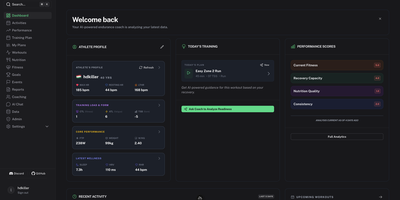
Coach Watts is a self-hosted AI endurance coach that reads your training, recovery, sleep, and nutrition data together and tells you, each day, whether to push or rest. Connect Intervals.icu, Strava, Whoop, Oura, Garmin, Withings, Wahoo, Polar, Fitbit, Hevy, Yazio, Rouvy, or Ultrahuman and every workout, HRV reading, sleep score, and meal lands in one athlete profile instead of fourteen separate apps. Each session gets a detailed breakdown with an execution score, and the performance view tracks Fitness, Fatigue, and Form alongside power curves so you can see a training block working, or quietly burying you. Daily recommendations weigh HRV and sleep before suggesting intensity, and the interactive chat answers questions against your own data when you want the reasoning behind a call. Adaptive plans generate around your schedule and goals, then adjust as life interferes. Nutrition tracking applies metabolic fueling logic that shifts between Eco, Steady, and Performance modes based on session intensity, so long rides get fed differently from recovery spins. Coaching alerts and system messages arrive in the dashboard, Telegram coaching is available for nudges on the move, and the whole platform speaks more than ten languages with timezone handling that follows traveling athletes. A Google account provides sign-in and the Gemini models behind the analysis, while your synced history stays in your own database. Running on a dedicated VPS on RepoCloud with guaranteed CPU, RAM, and SSD, full root SSH access, and a browser serial console. Apache-2.0 licensed.
FastLLM Proxy
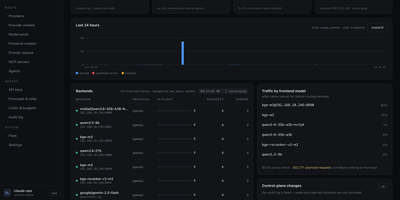
Local vLLM and llama.cpp boxes and hosted providers like OpenRouter, Anthropic, Bedrock, and Gemini all answer to one OpenAI-compatible address once FastLLM Proxy sits in front of them. Clients ask for a frontend model by name, and ordered rules pick the target by caller, prompt size, headers, budget spent, time of day, or how busy a backend is. Prompts that share a prefix return to the node holding their cache, and semantic routing sends coding questions one way and chat another using example prompts you write. API keys carry per-model grants, rate limits, and token or spend budgets, and the management console shows traffic, usage and spend, an append-only audit log, and a fleet topology. Failures fall through to the next target before a byte reaches the caller, and an admission gate turns a flooded engine into a bounded queue. An MCP gateway and an A2A agent endpoint put tool servers and agents behind the same address. Existing LiteLLM configs import unchanged. Running on a dedicated VPS on RepoCloud with guaranteed CPU, RAM, and SSD, full root SSH access, and a browser serial console. Apache-2.0 licensed.
Retinue
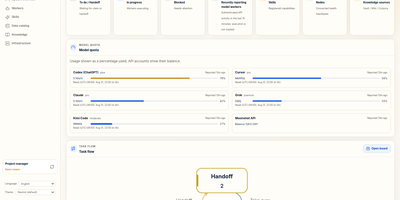
Retinue shows who is doing what across a fleet of AI agents, on a shared board where every task is a card with exactly one holder, a written acceptance check, and a receipt chain that cannot be rewritten. Operators publish cards, agents claim them through MCP or a token-scoped HTTP API, report progress, and hand off, and an agent that is not the holder gets a refusal when it tries to write. The Home dashboard counts what is waiting, running, and blocked, charts task flow and dispatch, and shows quota gauges for Claude, Codex, Cursor, Grok, and Kimi subscriptions. A collaboration workspace draws delegation graphs, device and model timelines, module contributions, and message conversations for any selected task. Operations pages report token usage by worker, and a data health page flags stale reports and duplicate identities. Read-only importers pull session data from Claude Code and Codex, and optional Lark, Feishu, and Telegram bridges turn chat messages into intents. The interface switches between English and Simplified Chinese. Running on a dedicated VPS on RepoCloud with guaranteed CPU, RAM, and SSD, full root SSH access, and a browser serial console. AGPL-3.0 licensed.
Snowshare
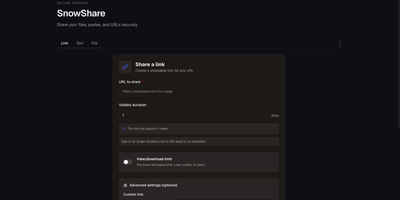
A dropped connection should not restart a 20 GB upload: SnowShare is a self-hosted app for sharing files, links, and pastes, with resumable transfers and an expiry date, a view limit, a password, and a QR code available on every share. Put several files into one share and let recipients preview common formats right in the browser, shorten a long address with an optional custom slug, or publish text and code with syntax highlighting. People you send a link to can open it with or without an account, depending on how you configure the instance. Give your users email and password accounts or OAuth sign-in, turn on email verification and CAPTCHA, and set separate storage quotas for anonymous visitors and registered users. Keep uploads on local disk or move them to S3-compatible storage, apply your own branding, and change quotas, sharing rules, SMTP, and storage from the admin panel without restarting. Automate sharing through the REST API with keys created from your profile, drop the generated ShareX uploader files into your capture tool, and receive signed webhook events when shares are created, opened, or deleted. Read the interface in English, French, Spanish, German, Dutch, or Polish, and let expired shares clean themselves up every hour. Running on a dedicated VPS on RepoCloud with guaranteed CPU, RAM, and SSD, full root SSH access, and a browser serial console. CC0 1.0 licensed.
loci
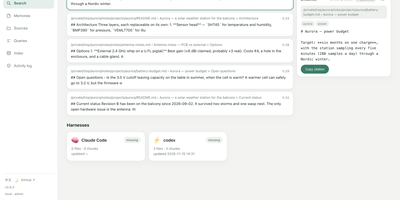
Point Claude Desktop, Cursor, Cline, or any other MCP host at one loci instance and every assistant searches the same notes, project docs, and saved memories. Hybrid retrieval fuses vector hits with BM25 using reciprocal rank fusion, so an exact identifier like user_id still surfaces, and every answer cites the file and section it came from, with optional claim-by-claim verification. Notes stay readable as Markdown, and the index updates incrementally from folders of text, HTML, org files, PDF, and Word documents or an Obsidian vault. Durable memories are saved with one command, structured task state is stored and fetched by exact key, and decision notes can declare what they supersede so a history command shows the chain and answers stop quoting retired policy. A memory health report shows which notes were cited, corrected, or never used. The web console has a dashboard, search with an evidence pane, memory editing, sources and file uploads, a query log, a note graph, and an activity log, in English or Chinese with light and dark themes. Role-based tokens separate viewers, editors, and admins. Embedding and chat calls go only to the providers you configure, and local endpoints like Ollama keep the whole workflow offline. Running on a dedicated VPS on RepoCloud with guaranteed CPU, RAM, and SSD, full root SSH access, and a browser serial console. MIT licensed.
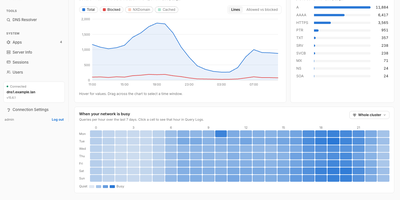
Resolvr DNS Dashboard
Resolvr gives your Technitium DNS server the clean, readable dashboard it deserves, turning raw query traffic into an overview you can understand at a glance. Four tabs divide the picture: Traffic charts queries over time with allowed and blocked stacked together and a seven-day heatmap of when your network is busy; Resolution shows where answers come from, cache, upstream, blocked, or authoritative, with response times and a flow diagram of each lookup; Top lists rank your chattiest clients and most-requested domains; and Infrastructure tracks DHCP scope usage, zones, and cache growth. Every chart is a doorway: click one and you land in Query Logs already filtered to what you clicked. Pick any device on the Clients page to see its queries, block rate, DHCP lease, and favourite domains. Query Logs themselves filter by client, name, protocol, response code, and time window, export to CSV, and can live-tail as new lookups arrive. Blocked Zones manages your feeds, your own blocked domains, and a checker that tells you whether a name is blocked and which feed caught it. Run a Technitium cluster and each panel gains a scope chip, comparing nodes side by side or merging their logs into one timeline. Running on a dedicated VPS on RepoCloud with guaranteed CPU, RAM, and SSD, full root SSH access, and a browser serial console. MIT licensed.

EuConform
Find out where your AI system stands under the EU AI Act with a short guided quiz, without sending a word to anyone's servers. EuConform walks you through its questions covering prohibited practices and the eight high-risk areas of Annex III, from biometrics and education to employment and justice, then returns a risk class with a score and a plain list of recommendations. A compliance gap analysis ranks missing obligations by severity and cites the matching article, from risk management to post-market monitoring. A deadline timeline shows which dates already apply to you. Providers of foundation models get their own track for the general-purpose obligations. Import the JSON artifacts written by the EuConform command line to review compliance signals, open questions, gaps, and an AI bill of materials in the browser, or load bias evidence to compare two model runs. Everything is processed locally, with no tracking and no cookies. The interface comes in English and German, with light and dark themes and keyboard navigation. Running on a dedicated VPS on RepoCloud with guaranteed CPU, RAM, and SSD, full root SSH access, and a browser serial console. MIT licensed.