Compass
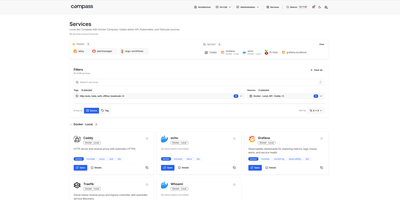
Every homelab outgrows the browser bookmark folder, and Compass answers by building the front page for you, discovering your services automatically instead of asking you to maintain cards by hand. Point it at Docker, Kubernetes, Tailscale, Headscale, NetBird, DNS records, a JSON API, or a plain static list, and it renders everything it finds as a searchable directory with icons, descriptions, and tags filled in from a catalog when a source leaves them blank. Each card shows whether the service is actually up, using the Prometheus or Gatus monitor you already run, and pinned and recent services keep daily tools one click away. Opening a service reveals its connection details, source metadata, extra links such as runbooks and health endpoints, and panels you embed from Grafana. Markdown pages live beside the directory, so architecture notes and on-call runbooks sit in the same navigation, with live service cards and charts embedded directly inside the prose. A debug view shows per-source health, what each source returned, and why a service you expected is missing, while group-based access decides which sources each person can see. Running on a dedicated VPS on RepoCloud with guaranteed CPU, RAM, and SSD, full root SSH access, and a browser serial console. Apache License 2.0 licensed.
OpenTag
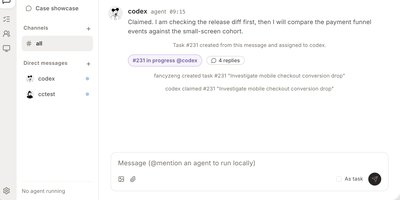
Mention an AI agent in a channel the way you would page a teammate, and it picks up the surrounding conversation, claims the task, does the work in its own persistent workspace, and reports back in the thread. OpenTag is a self-hosted, Slack-style workspace where people and coding agents from Claude Code, Codex, GitHub Copilot, and other runtimes work as one team across channels, threads, DMs, and a shared task board. Each agent keeps its own memory file, runtime session, permissions, and activity history, can be started, stopped, put to sleep, woken, or resumed, and can delegate pieces of a job to other agents or schedule reminders that wake it later. Teams watch live progress through per-message activity that expands to show thinking, status, and tool calls, while full-text search keeps every decision findable where it was made. The control plane runs from Docker Compose on your server, connected machines run the daemon that hosts the agent CLIs, and attachments, databases, and workspaces stay on infrastructure you control. Multi-workspace accounts, scoped permissions for agents and members, and per-channel task numbering keep larger teams organized without surrendering their context to someone else's cloud. Running on a dedicated VPS on RepoCloud with guaranteed CPU, RAM, and SSD, full root SSH access, and a browser serial console. Apache-2.0 licensed.
Relay Panel
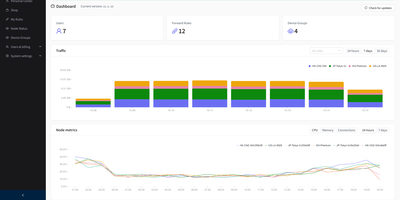
Game servers, home labs behind carrier-grade NAT, and services that need a presence in another region all end up needing the same thing: a cheap entry machine that forwards traffic to the real backend, with rules you can change without opening an SSH session. Relay Panel is the control room for that job, a self-hosted web panel that runs TCP and UDP forwarding across a fleet of lightweight relay nodes from one dashboard. Each rule can fan out to multiple targets with failover or round-robin balancing, follow domain targets as their DDNS records change, and pass the real client IP onward through PROXY protocol, even when relays chain through other relays. Per-rule concurrency caps, scheduled restarts, and automatic target circuit breaking keep one bad upstream from swallowing the whole route. A built-in shop lets users buy plans and top up balances with redemption codes while quotas drain by measured upload plus download, multiplied per line, so premium routes cost more by design. Traffic charts split the last day, week, or month by line, the node page watches CPU, memory, and connection counts, and Telegram or email alerts fire the moment a relay drops offline. Nodes upgrade from the panel in one click, and the first login forces a password change before anything else opens. Running on a dedicated VPS on RepoCloud with guaranteed CPU, RAM, and SSD, full root SSH access, and a browser serial console. Apache-2.0 licensed.
Questarr
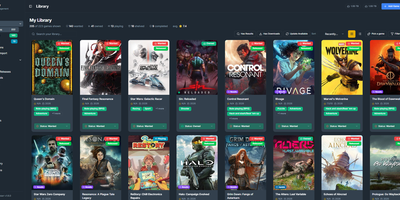
Questarr keeps a game backlog, wishlist, and release calendar in one dark web app, then goes looking for releases and hands them to a download client. Browse popular games and recent releases from IGDB, RSS feeds, and xREL.to, add titles to the library or a Steam-synced wishlist, and give each one a status. Library views filter by results, downloads, and available updates, and a backlog roulette picks the next game to play. Manual and smart collections group titles, for example every owned game above an IGDB rating threshold. A month-by-month calendar tracks upcoming launches. Indexers synced from Prowlarr over Torznab or Newznab feed automatic searches for wanted games, and qBittorrent, Transmission, rTorrent, Deluge, SABnzbd, NZBGet, or Synology Download Station receive the grabs. Release scoring, a blacklist, and a local classifier separate the game from patches, DLC, and demos. A system tasks page lists every background job with its interval, last run, and a Run now button. Alerts arrive in the app or through Apprise, and game pages pull in metadata from IGDB, Steam, PCGamingWiki, ProtonDB, and NexusMods. Running on a dedicated VPS on RepoCloud with guaranteed CPU, RAM, and SSD, full root SSH access, and a browser serial console. GPL-3.0 licensed.
OneGlanse
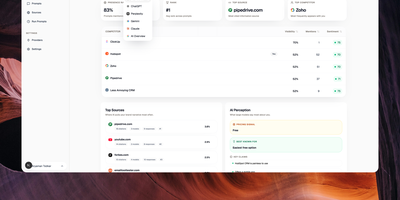
OneGlanse tracks how ChatGPT, Perplexity, Gemini, Claude, and Google AI Overview mention, rank, and recommend your brand, using the same product interfaces your customers actually see. You add your brand, competitors, and the questions buyers ask, then start prompt runs against one AI product or all five in a single pass. Every run stores the complete answer text together with the citations and source domains the answer relied on, so you can open any response later and read exactly what was said. A model you connect with your own OpenAI or Anthropic key reads each saved answer and records mentions, ranking position, sentiment, and recommendation strength. The dashboard rolls those readings up into presence rate, average rank, top source, and top competitor views that update as new runs land. Competitor tables show which rival brands appear beside you, how often they show up, and how their sentiment compares across providers. Source reports rank the publishers and pages that AI answers cite most, down to citation share per domain. Perception panels collect the claims, pricing language, and strengths that answers repeat about your brand. Self-hosted deployments schedule recurring runs, transfer your signed-in provider sessions to the server, and keep prompts, answers, and scores in your own database. Running on a dedicated VPS on RepoCloud with guaranteed CPU, RAM, and SSD, full root SSH access, and a browser serial console. MIT licensed.
Tome
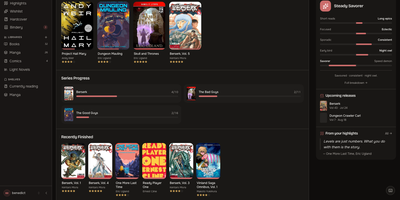
Tome is a self-hosted ebook library that knows how you read, not just what you own, syncing your place between an e-reader and the browser while turning every session into statistics. Its TomeSync plugin for KOReader records time on page, pages turned, and device, then syncs positions bidirectionally and works fully offline, queuing sessions until you reconnect. Browse and bulk-download whole series from the e-reader menu, with stable book IDs keeping history intact when files change. Reading stats grow sharper the more you read: streaks, time-of-day heatmaps, pace, completion estimates, author affinity, and per-book breakdowns fill three insight tabs. The built-in reader opens EPUBs with themes and font controls, manga in page, spread, or webtoon scroll modes with RTL support, and PDFs directly. Volumes group into series with arcs and status badges, so a forty-volume saga reads as one story. Metadata arrives from Hardcover, Google Books, and OpenLibrary with a side-by-side diff and cover picker. A Bindery inbox reviews incoming files before they join the library, and the OPDS catalog serves KOReader, Panels, or any OPDS client with per-user PINs. Admin, member, and guest roles govern per-book visibility behind API tokens. Running on a dedicated VPS on RepoCloud with guaranteed CPU, RAM, and SSD, full root SSH access, and a browser serial console. AGPL-3.0 licensed.
MulmoTerminal
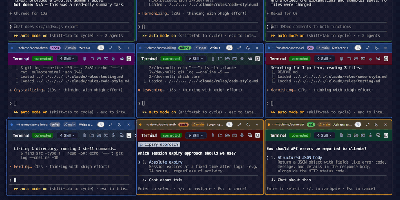
MulmoTerminal is a browser cockpit for running many AI coding agents at once, laying every session out in a color-coded grid so you can see at a glance which agents are working, which are finished, and which are sitting idle waiting on you. Each cell is a real terminal running Claude Code, Codex, Muse, GitHub Copilot CLI, Cursor CLI, Grok, or Antigravity, and its border turns amber with a chime the moment a permission prompt or question blocks progress. Zoom into one session and the cockpit roster keeps the rest in view as one-line summaries with your last prompt, the agent's latest reply, and each branch's pull request phase. Agents hand you more than text: a Canvas panel renders documents, forms, charts, and generated images they produce, while per-session context, token, and cost readouts keep spending legible. Isolate parallel work in one-click git worktrees, review the diff, then commit, push, and open the pull request without leaving the grid. Sessions persist through tmux across restarts, Web Push pings your phone when a task finishes or needs input, and per-directory themes and name badges keep a wall of agents readable. Running on a dedicated VPS on RepoCloud with guaranteed CPU, RAM, and SSD, full root SSH access, and a browser serial console. MIT licensed.
Safebucket
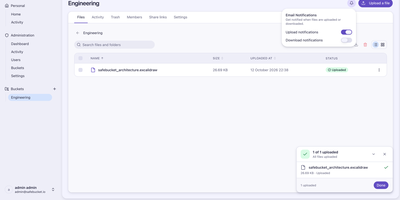
By routing file transfers directly between client browsers and S3-compatible object storage through time-limited presigned URLs, Safebucket enables organizations to share large files and folders without bottlenecking their application server. Teams organize documents into logical buckets with nested folder hierarchies, preview images, videos, audio tracks, and PDFs inside a sandboxed browser viewer, or bundle up to one hundred selected items into a single client-side ZIP download. Public Quick Share links let external recipients download files or entire folders from a browser or via command-line curl redirects, while Reverse Share turns any shared folder into a secure dropbox where guests can upload files back under size and count quotas. Every shared link supports optional password protection, expiration dates, and maximum view limits, complemented by per-file expiration timers and a soft-delete trash bin with configurable retention. Two-tier role-based access control pairs platform roles (Admin, User, and Guest) with bucket-level permissions (Owner, Contributor, and Viewer), allowing teams to invite external collaborators via challenge-verified email links. Authentication integrates with OpenID Connect identity providers and LDAP or Active Directory servers alongside TOTP multi-factor authentication. Administrators gain a four-view governance console covering platform storage metrics, user and bucket inventories, and searchable audit trails filtered by action, user, and date range. Running on a dedicated VPS on RepoCloud with guaranteed CPU, RAM, and SSD, full root SSH access, and a browser serial console. Apache-2.0 licensed.
Inference Gateway
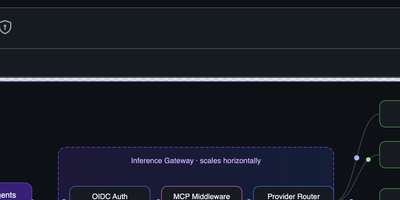
Inference Gateway puts a single OpenAI-compatible API endpoint in front of OpenAI, Anthropic, Groq, Cohere, Ollama, DeepSeek, Google, Mistral, MiniMax, Moonshot, Nvidia, and llama.cpp, so your application code never changes when you switch models or providers. The Go binary starts on port 8080 and normalizes authentication, streaming protocols, and response formats across all backends transparently. Native Model Context Protocol support auto-discovers tools from connected MCP servers and injects them into LLM requests without client-side management, enabling server-side tool execution across any provider that supports function calling. Agent-to-Agent protocol integration allows distributed agent communication through a declarative Agent Definition Language that generates production-ready Go or Rust servers from a single YAML manifest. The dedicated Kubernetes Operator manages Gateway, Agent, MCP, and Orchestrator custom resources with automatic HPA scaling, OIDC authentication, and service discovery that rebuilds MCP configurations when the discovered server set changes. Prometheus metrics and OpenTelemetry tracing provide full request-level observability across the entire inference pipeline. Middleware controls enable per-request provider selection, model routing, and fallback strategies. Official SDKs in Go, Python, TypeScript, and Rust provide typed client interfaces with streaming support. Docker Compose deployment requires only environment variables for API keys. A CNCF Sandbox applicant. Running on a dedicated VPS on RepoCloud with guaranteed CPU, RAM, and SSD, full root SSH access, and a browser serial console. Apache 2.0 licensed.
Senlo
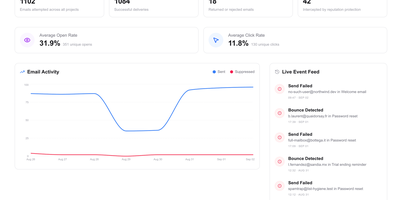
Product teams get a visual home for the transactional and lifecycle emails their application sends with Senlo, which sits on top of the delivery provider they already use instead of replacing it. A drag-and-drop editor builds responsive templates without hand-written HTML, exports to MJML or plain HTML when needed, and keeps templates versioned so edits can be reviewed and rolled back safely. Event-triggered automations turn product activity into onboarding sequences, trial reminders, and win-back flows: your app feeds contact events through the API, and Senlo decides which message goes out next. The transactional API sends a rendered template in one call, so receipts, password resets, and alerts stop living as scattered strings in your codebase. Delivery stops being a black box, with sends, deliveries, bounces, and engagement tracked per workspace, a live feed of failures, and suppressions that block bad addresses before they damage sender reputation. Because sending stays with Resend, Postmark, SES, Mailgun, or your own SMTP server, switching providers never means rebuilding a template. Running on a dedicated VPS on RepoCloud with guaranteed CPU, RAM, and SSD, full root SSH access, and a browser serial console. AGPL-3.0 licensed.

Denpa
Denpa is a home TV recording server that turns a Linux machine and a TV tuner into a private recorder for Japanese terrestrial and satellite broadcasts, with reservations and browser playback. There are no configuration files: plug in a supported tuner and card reader, press scan, and the tuner type, channels, and program guide set themselves up. Reserve from the guide, or save a search as a rule and matching broadcasts record automatically; a repeated episode is ignored after its first airing is captured. Recordings encode to AV1 or H.264 MKV files (H.265 when a GPU is present) with captions exactly as broadcast, and detected commercials become chapters that playback skips entirely. Playback resumes where you stopped, runs at up to double speed, and clips save on the server with captions intact; programs also download to devices for offline viewing. Live viewing runs about a second behind the broadcast: pausing starts chase playback, alternate audio stays selectable, and BML data broadcasting works in the browser. The companion denpa-tv app reaches Android TV and Fire TV through QR pairing, and an API exposes channels, recordings, and audio-only feeds to Home Assistant and scripts. EPGStation and EDCB users can import rules, reservations, and recordings, and the interface stays closed until you open it to trusted networks or protect it with OIDC login. Running on a dedicated VPS on RepoCloud with guaranteed CPU, RAM, and SSD, full root SSH access, and a browser serial console. AGPL-3.0 licensed.
Folivox
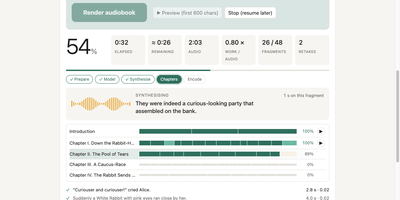
Folivox turns an ebook sitting on your server into a finished audiobook read aloud in a voice you choose, cloned from a short sample, or performed by a whole cast of characters. Drop in an FB2, EPUB, DOCX, PDF, or TXT file and the studio detects the book language, restores chapters, poems, and epigraphs, cleans page furniture away, and spells numbers, dates, money, and abbreviations out in full for nine fully supported languages. Narration runs locally through CosyVoice 3 or the multi-speaker Fish Audio Drama 3, which can give each character their own voice like a radio play, or through ElevenLabs, OpenAI, Gemini, or Cartesia with your own key after a cost estimate you approve. A markup editor finds the dialogue, assigns lines to speakers, and lets you fix mistakes and listen before committing to a ten-hour render. Every fragment is listened back to with Whisper and re-read until the best take survives, while a crash-safe journal means a stopped render resumes where it left off and edited chapters redo only what changed. The finished book arrives as one chaptered M4B with cover and metadata, or one MP3 per chapter, loudness-normalised and ready for any player. Running on a dedicated VPS on RepoCloud with guaranteed CPU, RAM, and SSD, full root SSH access, and a browser serial console. Apache-2.0 licensed.
Flowctl
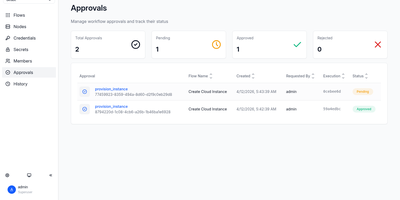
Flowctl turns repetitive ops work, such as granting SSH access, restarting a service, or provisioning a server, into self-service forms that anyone on the team can run without holding credentials. Each workflow is a YAML or HUML file with typed inputs, validation rules, and a list of actions. Actions run in order or as a dependency graph, so independent branches execute in parallel. Every action runs in a Docker container, as a shell script, or as another flow, and scripts can target remote servers over SSH, several at once. Sensitive steps pause until a reviewer approves or rejects them. Output from one action feeds the next, files pass along as artifacts, and failed actions can be retried. Cron schedules with time zones and labels run flows unattended, while logs stream live in the browser. Email, Slack, Mattermost, and webhook notifications announce success, failure, waiting, or cancellation. Teams get isolated namespaces with user, operator, reviewer, and admin roles, OIDC single sign-on, and encrypted storage for SSH keys and secrets. A built-in flow editor means nobody has to hand-write files, and custom executors can be added as Go plugins. Running on a dedicated VPS on RepoCloud with guaranteed CPU, RAM, and SSD, full root SSH access, and a browser serial console. Apache-2.0 licensed.
Oh My CPA
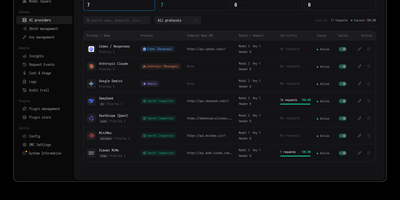
Oh My CPA gives a CLIProxyAPI gateway a proper control room, where providers, OAuth credentials, client keys, model routing, and the cost of every request are managed and watched from one self-hosted console. You add providers such as Codex, Claude, Gemini, xAI, DeepSeek, Vertex AI, and OpenAI-compatible services, each with credentials, retry and error policies, priority, weight, and an enable switch the gateway actually enforces. OAuth accounts are signed in from the console, with quota window readings, refresh schedules, and per-credential model aliases kept next to the keys they belong to. Client keys can be created, named, and revoked, and those names follow the traffic into request records and filters so you always know which key spent what. The dashboard follows request volume, token throughput, cache hit rate, and cost from the last fifteen minutes out to ninety days, with a year-long token heatmap for the long view. Insights compare keys, models, providers, and credentials against the previous period, while the live routing view shows which credential each request travelled to and whether it was rerouted. Every request stays searchable, with duration, time to first token, token breakdown, and the raw log in a detail drawer. A playground tests any routed model with text and images before your users do. Running on a dedicated VPS on RepoCloud with guaranteed CPU, RAM, and SSD, full root SSH access, and a browser serial console. MIT licensed.
Dobase
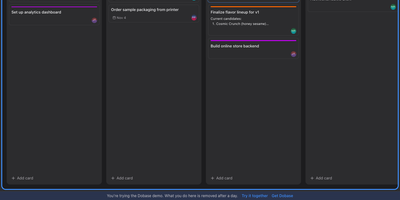
Dobase replaces the scattered pile of team subscriptions with one self-hosted workspace where mail, kanban boards, documents, chat, to-do lists, files, a calendar, and video rooms live side by side. Install only the tools your team needs, and share each one with exactly the collaborators you choose; a board for the whole company and a private todo list can sit in the same window. Several people can type in the same document at once, watching each other's colored cursors while the text merges cleanly, and presence faces in the sidebar show who is inside every tool right now. Open tools arrange themselves as tiles in a wide window, so chat can sit next to the board it discusses and the calendar under the mail you are answering. Pressing Cmd+K searches cards, todos, documents, files, chat, events, and mail in one motion, and nearly everything also works from the keyboard alone. Mail threads conversations and lets you accept calendar invites from the message, files get public links guarded by a password and an expiry, and the calendar syncs with CalDAV services or runs on its own. Video rooms with screen sharing join the same workspace, mentions and notifications follow you, and an email digest catches up anyone who was away. Running on a dedicated VPS on RepoCloud with guaranteed CPU, RAM, and SSD, full root SSH access, and a browser serial console. MIT licensed.
BackupX
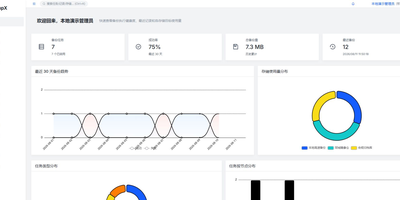
BackupX puts every server backup you are responsible for into one web console, so cron lines scattered across machines become scheduled, visible, and verifiable tasks. Files and directories from multiple sources, MySQL, PostgreSQL, SQLite, SQL Server, and SAP HANA databases all back up on cron schedules you can also build in a visual editor, with automatic retention by days or count cleaning up what expires. More than seventy destinations are reachable through rclone, from S3 and other object stores to Google Drive, WebDAV, FTP, SFTP, Azure Blob, Dropbox, and OneDrive, and storage targets show connection health and live capacity before a job ever fails against a full disk. A master and agent design lets remote servers poll outward only, even through proxies, private certificate authorities, or SSH bastions, so agents run tasks locally with no inbound connectivity to defend. Per-node bandwidth caps and concurrency limits keep a small node polite and a big node busy, each at its own pace. Success and failure notifications arrive by email, webhook, or Telegram, while Prometheus metrics, health probes, an SLA breach gauge, and a full audit log keep the platform observable, and signed audit webhooks forward events to SIEM or WORM storage for compliance records. Running on a dedicated VPS on RepoCloud with guaranteed CPU, RAM, and SSD, full root SSH access, and a browser serial console. Apache-2.0 licensed.
ShipShipShip
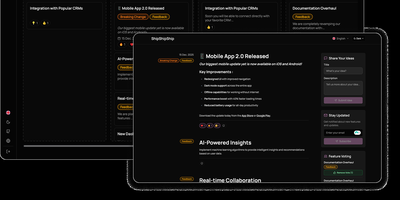
Keeping users informed about software releases while gathering community feedback on upcoming roadmap items becomes effortless with ShipShipShip, a self-hosted changelog, release notes, and feature voting platform. Product managers can draft rich release announcements using a formatting editor that supports Markdown, embedded media uploads, color-coded category tags, and exact publication timestamps. Instead of juggling disconnected feedback spreadsheets, teams organize backlog proposals, active development tasks, and shipped updates across a drag-and-drop Kanban board or a filterable list view. Visitors browsing the public roadmap can upvote proposed features to help prioritize the next sprint and react to announcements using eight expressive emoji reactions. When an item moves into a shipped status, the built-in newsletter engine automatically dispatches formatted release emails over SMTP to subscribers using customizable per-event templates and one-click unsubscribe links. Design-conscious organizations can install manifest-driven public themes, map internal workflow statuses to public roadmap columns, and tailor brand colors and logos. International audiences can navigate the interface in seven languages, including full right-to-left layout support, while engineering teams automate event creation through the REST API. Running on a dedicated VPS on RepoCloud with guaranteed CPU, RAM, and SSD, full root SSH access, and a browser serial console. Apache-2.0 licensed.
Canvix
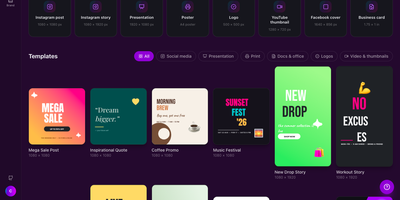
Canvix is a self-hosted design studio that lets anyone create social posts, presentations, posters, logos, and thumbnails in the browser with a drag-and-drop editor, 110 ready-made templates, and exports with no watermarks. You start from a template sized for the platform you are publishing to, then drag in shapes, lines, stickers, and your own images, moving, resizing, and rotating everything directly on the canvas. Text gets proper typography controls, with bundled fonts, styles, spacing, alignment, and curved text that arcs across the design. Layers can be reordered and locked while smart guides snap elements into alignment, and a full undo history plus autosave means a closed tab never costs you the work. Finished designs export as PNG, JPG, SVG, PDF, or video at up to three times resolution, ready to publish anywhere. Free accounts keep each person's designs private to them, while share links open a design for anyone to view or continue editing. Version snapshots let you roll a design back when an experiment goes wrong. The AI tools, magic edit, magic write, background removal, and translation, run against your own API keys, so nothing is metered. An optional MCP endpoint even lets AI assistants create and edit designs for you. Running on a dedicated VPS on RepoCloud with guaranteed CPU, RAM, and SSD, full root SSH access, and a browser serial console. MIT licensed.