Spillway
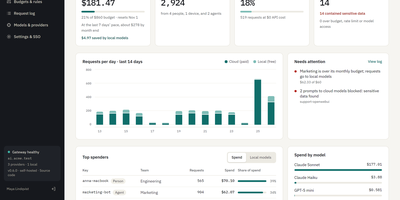
Every request to Claude, GPT, or a local model passes through Spillway, a gateway that gives each person, laptop, and agent its own key, caps what that key can spend, and sends over-budget traffic to a local model instead of an error. Limits are daily and monthly dollar amounts, with model allowlists per team. A contractor's key can expire on a set date, and a leaked one is replaced in a click without losing its history. Anyone who hits a limit sees where to ask for more, and an admin approves it with one click. Five routing rules cover the rest: local fallback at a share of a team's budget, personal data and API keys kept away from cloud models, agent rate limits, off-hours traffic kept local, and a brake on runaway keys. An agent looping overnight is stopped within the hour. If a provider fails, the local model answers instead. Every log entry explains its decision, with tokens, cost, and money saved, and prompts are stored with personal data masked. Clients speak OpenAI, Anthropic, or Ollama formats, so Claude Code, Codex, Open WebUI, and n8n connect with a base URL and a key. Alerts reach Slack, Microsoft Teams, or email. Sign-in through Google Workspace, Microsoft Entra ID, or OpenID Connect is free. Running on a dedicated VPS on RepoCloud with guaranteed CPU, RAM, and SSD, full root SSH access, and a browser serial console. AGPL-3.0 licensed.
Ferret
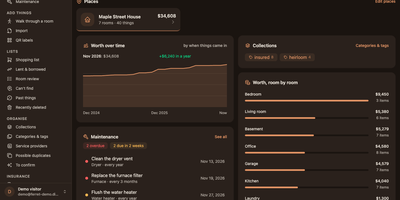
From the tent in the garage to the warranty on the fridge, Ferret keeps one searchable home inventory that your household runs on its own server. Properties, rooms, and boxes hold things with photos, receipts, manuals, serial numbers, and prices, and a quick add accepts a photo, a barcode scan, or a picture of a whole room to sort through. Printed QR labels on boxes and shelves open the list of what is inside. Warranties count down to the last day with a claim shortcut, return windows warn before they close, and maintenance repeats by date or by use, with reminders and how-to videos. Stock levels feed a shopping list, a lending log remembers who borrowed the saw, and a replacement forecast estimates what wears out and when. An insurance report totals value by room and category, exports PDF and spreadsheet files, and can be shared by link. Households have owners, admins, members, and read-only viewers, with invitations and single sign-on. Optional AI reads receipts, suggests details from photos, and answers questions in plain words, while a built-in MCP server lets Claude search, add, and update items with a key that can be read-only. Running on a dedicated VPS on RepoCloud with guaranteed CPU, RAM, and SSD, full root SSH access, and a browser serial console. MIT licensed.
Mastyf
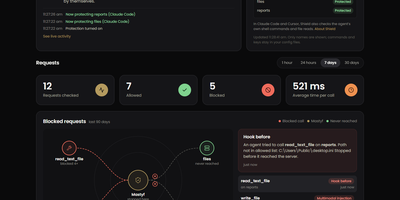
Between an AI agent and its tools sits Mastyf, a security gateway that checks every tool call against your rules before it runs. Home shows whether Protection is on; switching it on routes the MCP servers of Claude Code, Cursor, VS Code, Windsurf, Cline, and Claude Desktop through the proxy and catches servers added later within seconds. Blocked calls never reach the tool. Rules cover prompt injection, path traversal, secret leaks, shell injection, SSRF, encoding tricks, runaway token spending, and tool definitions that change mid-session. Policies are YAML you edit in the dashboard or any editor, with audit, warn, and block modes, hot reload, and a version history with diffs and one-click restore. Starter templates cover HIPAA, PCI-DSS, GxP, and data residency. The dashboard streams every decision into an Activity trail with a heatmap, tests sample calls against your rules, and tracks token spend per server against a monthly budget. Block alerts go to Slack, PagerDuty, or any webhook, and decisions can stream to Splunk, Elastic, OpenTelemetry, or syslog. Threat Lab uses a local Ollama model to invent attack tests and propose new rules, which apply only after you approve them. A client library with LangChain and OpenAI Agents adapters and an HTTP check service let custom agents ask before each tool runs. Running on a dedicated VPS on RepoCloud with guaranteed CPU, RAM, and SSD, full root SSH access, and a browser serial console. AGPL-3.0 licensed.
Connapse
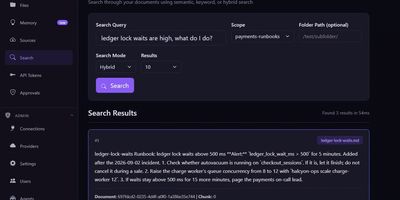
Give your AI agents a library to search and a memory that survives the session: Connapse serves both over MCP and a REST API. Upload files or whole folders, or index them where they live: SFTP servers (including folders on your own computer), Amazon S3, Azure Blob Storage, GitHub, Confluence, Jira, or a custom source server. Queries run vector and keyword search together and fuse the rankings, an optional cross-encoder reranker re-scores the top results, and each passage comes back labeled with its source file. Agents save dated facts with their sources into personal or team memory spaces, recall them later, correct them without losing history, and forget them on request, while a Memory page shows each space's timeline. Results from GitHub, Confluence, Jira and custom sources are checked against each reader's own access, and a passage is left out whenever that check cannot be made. Optional link search follows a GitHub issue to its closing pull request or a Jira issue to its epic, and code tools find definitions, callers, and what a change could affect. More than twenty named tools suit Claude Code, Cursor, and VS Code; each key gets only the tools its scopes allow, and deletes can wait for approval. Embeddings run locally by default, with OpenAI or Azure OpenAI one setting away. Running on a dedicated VPS on RepoCloud with guaranteed CPU, RAM, and SSD, full root SSH access, and a browser serial console. MIT licensed.
Afflatus
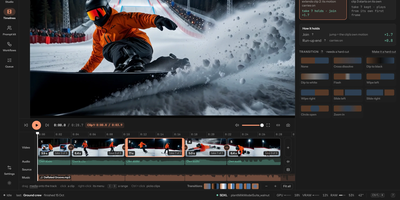
A studio with a library, a clean form for every model, and a timeline that makes real videos, Afflatus sits in front of your own ComfyUI so nobody wires a node graph. Forms cover SDXL, FLUX, Krea 2, Qwen Image, and Z-Image for pictures, plus MiniMax H3, LTX, and Wan 2.2 for video. A prompt designer writes in each model's own grammar through LM Studio, Ollama, or a hosted service. Renders land in a searchable library of projects and drafts that keeps seeds and settings, and one box finds anything by kind, model, LoRA, or words. Paint a mask and fix it, draw boxes for edits, or plot an X/Y/Z grid. The timeline chains any clip after any other and carries motion across the joins, with dissolves, wipes, and flashes where models change. Takes carry measured join scores with the smoothest marked, and exports are zips for DaVinci Resolve, Premiere Pro, or Kdenlive. One queue sends each job to whichever ComfyUI finishes first, a PC on your network or a RunPod pod rented with your key, ranking GPUs by cost per render and stopping idle ones. A Prompt kit keeps your cast, places, and styles consistent from render to render. Claude Code and other agents drive the studio over MCP with scoped tokens. Running on a dedicated VPS on RepoCloud with guaranteed CPU, RAM, and SSD, full root SSH access, and a browser serial console. AGPL-3.0 licensed.
Craftsail Growth
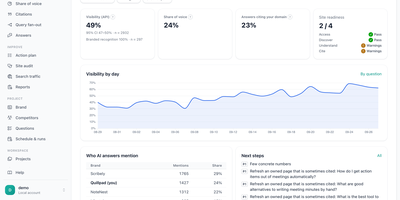
Buyers now ask an AI assistant for recommendations instead of typing a search, and Craftsail Growth shows whether those answers name your brand or a competitor. It puts your buyers' questions to ChatGPT, Claude, Gemini, Grok, Perplexity, DeepSeek, Kimi, Doubao, GLM, and MiniMax through their official APIs several times a day, so visibility per engine and per question carries confidence intervals instead of one vanity number. Share of voice ranks you against the competitors you track with a leaderboard and a trend line. Citation reports sort every cited URL into owned, competitor, review, social, and reference sources next to the web searches the engines actually ran. A site audit works through access, discovery, understanding, and citation in fix order, checking robots rules for AI crawlers, llms.txt, structured data, and answerable content. A ranked action plan blends citations, the audit, and Search Console data, and each accepted action carries an acceptance check that verifies itself on the next run. Creating a project from your website address crawls the site and drafts brand facts, competitors, and buyer prompts for you to review. Google Search Console and GA4 import, generated llms.txt, JSON-LD, and FAQ snippets, scheduled runs, reports, several projects and users, manual sampling sheets, and a dashboard in English, Chinese, and Portuguese round it out. Running on a dedicated VPS on RepoCloud with guaranteed CPU, RAM, and SSD, full root SSH access, and a browser serial console. AGPL-3.0 licensed.
OpenManga
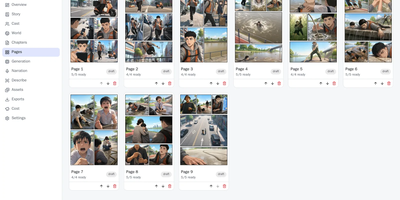
A written story becomes a manga chapter, manhwa episode, vertical webtoon, or narrated YouTube recap in OpenManga, with the same characters and places recognisable from the first panel to the last. It starts when AI splits a pasted story into cast, locations, chapters, scenes, and panel specs. You approve the reference portraits, turnarounds, outfits, and location sheets once, and every later panel is drawn against them. In the page editor you move panels, bubbles, captions, and sound effects, paint masks for targeted edits, compare art versions, and run a vision check on each panel. A production run prices the remaining work before it starts, respects a per-project budget cap, and can use half-price provider batches. The same run carries the project through artwork, narration, thumbnail, video, and YouTube text. Kokoro voices the narration locally, or you can cut it from your own recording. Exports cover print PDFs with KDP trim sizes, layered PSDs, CBZ, EPUB, webtoon strips, MP4, and Shorts. Supply your own keys for OpenAI, Gemini, Anthropic, DeepSeek, Meta Muse, OpenRouter, or ElevenLabs, or use paste mode with no key at all. Invite editors, comment on panels, share reader links, or let ChatGPT or Claude drive projects over MCP. Sign-up is closed until the admin opens it, and local narration wants about 8 GB of RAM. Running on a dedicated VPS on RepoCloud with guaranteed CPU, RAM, and SSD, full root SSH access, and a browser serial console. Apache-2.0 licensed.
Ianua
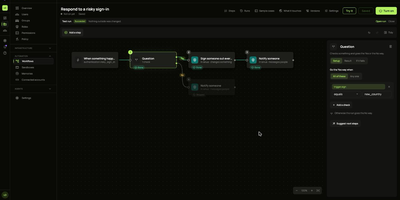
Giving every AI agent its own identity and only the access a person lends it, Ianua joins an identity provider, a zero-trust gateway, and visual workflows under one policy. Sign-in covers passwords, passkeys, authenticator apps, codes by mail or text, and magic links, with single sign-on over OIDC or SAML and OAuth 2, SCIM, and LDAP for your apps. The gateway fronts your apps, hands each a signed statement of who is calling, and refuses any request it cannot check. A missing answer counts as a no. Pipelines stack rate limits, a firewall that scores prompt injection, token budgets for model calls, and MCP tool allow lists. Agents hold their own key pairs and borrowed access that only narrows, and Test without sending previews whether a request would be allowed. They pursue goals on OpenAI, Anthropic, Ollama, or vLLM models under step limits and human approvals. Suspend pauses one agent, Stop all agents halts a tenant, and Contain is the kill switch for a compromised one. Workflows chain 27 services, including GitHub, Slack, and Jira, add sandboxed code steps, and rehearse drafts with Try it. A step that changes who can do what cannot go live without an approval right before it. A small connector dials out from private networks, and tenants keep separate roles, groups, and audit logs. Running on a dedicated VPS on RepoCloud with guaranteed CPU, RAM, and SSD, full root SSH access, and a browser serial console. AGPL-3.0 licensed.

Something
By the time you sit down each morning, your AI coworker can have read the inbox, checked the store for stuck orders, and drafted a plan for the day. You reach the same coworker in a web workspace, Chrome's side panel, Telegram, or Slack, and its memory follows you between them. A first-login interview learns what the company does, shows what it found online for you to fix, and proposes a starter plan of tools and routines. Memory keeps one fact per thing, tied to its source conversation; corrections add dated remarks, and outdated facts are struck through beside their replacements. Routines cover standing chores, from hourly inbox scans and stuck-order checks to weekly ad reviews and meeting prep, and a Marketplace tab suggests more for each connected tool. Tasks live on a list or board with owner, priority, and deadline. Skills are markdown playbooks you can edit in the browser. Dozens of services connect through a sign-in popup or a pasted key, among them Notion, Stripe, Linear, Shopify, and Google Workspace. It asks before anything goes out. In team mode, each person gets private files, memory, and routines, the board stays shared, and hand-offs reach teammates where they will see them. Claude Code or Codex can ask the coworker about the business and write back only after confirmation. Running on a dedicated VPS on RepoCloud with guaranteed CPU, RAM, and SSD, full root SSH access, and a browser serial console. AGPL-3.0 licensed.
Guard Spec
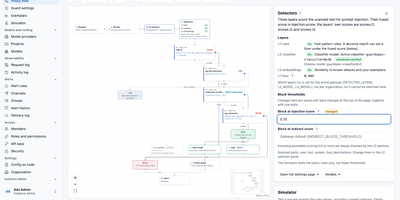
Any web page, document, or tool result your LLM reads can carry hidden orders, so Guard Spec sits between your app and the model and blocks prompt injection before it arrives. Change one base URL and the gateway accepts OpenAI-style chat completions, the Responses API, embeddings, and Anthropic's Messages API for Claude Code, then routes clean traffic to OpenAI, Azure OpenAI, Anthropic, Gemini, vLLM, or Ollama. Each request is sanitized, scored by pattern rules, an in-process classifier, and similarity to known attack examples, and judged against your policies; an injection gets an HTTP 400 and the model is never called. Tool results, retrieved documents, and MCP tool descriptions are scored one by one, so hidden instructions and poisoned tool definitions are caught. An output guard checks answers, including streamed ones, for exfiltration links, personal data, and a leaked canary. Policies per organization and project are written as text or in a visual editor, tested in a simulator, and edited as YAML with a diff. Rules see through Vietnamese diacritics, teencode, leetspeak, and homoglyphs, because detection was built for English and Vietnamese. Alerts reach Slack, Microsoft Teams, Telegram, email, PagerDuty, Opsgenie, or signed SIEM webhooks, and single sign-on works with OpenID Connect or SAML 2.0 plus SCIM provisioning and TOTP two-factor. Running on a dedicated VPS on RepoCloud with guaranteed CPU, RAM, and SSD, full root SSH access, and a browser serial console. Apache-2.0 licensed.
TestPilot
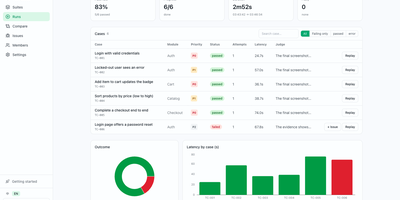
Why keep patching brittle selector scripts when TestPilot lets a browser agent run plain-English cases in real Chrome and an LLM judge rule pass or fail with a written reason? Cases read like a brief to a colleague (log in as the reviewer, approve the first pending entry, confirm it reads Approved) and the agent finds the clicks. Group them by module and tag, and move suites in and out through Excel. A video, a screenshot of every step, and a replayable action history come out of each case. The judge weighs that evidence against the expected outcome and leans toward failed when proof is thin, so a green run means something. Runs share a global browser budget, report live progress, offer run comparison, and can repeat only the failed or only the errored cases. Test and staging environments plus login accounts with roles let cases start signed in, using saved cookies and browser storage. Failures become issues on a built-in Kanban board with opt-in two-way GitLab sync, and an opt-in Feishu bot starts runs from a group chat. Judge and agent run on any OpenAI-style endpoint, the agent may use a local vision model, and settings swap models without a redeploy. Teams share one workspace or assign per-project owner, editor, and viewer roles. The interface comes in English and Simplified Chinese. Running on a dedicated VPS on RepoCloud with guaranteed CPU, RAM, and SSD, full root SSH access, and a browser serial console. MIT licensed.
Tracedown
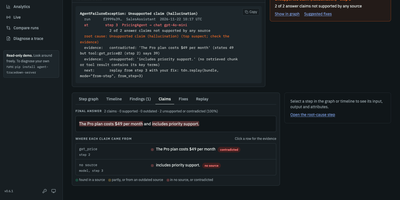
Tracedown finds the exact step that made your AI agent fail, shows the evidence, and replays the run with a fix to prove the problem is gone. Import failed runs from Langfuse, Arize Phoenix or any OpenTelemetry exporter with no code changes, or add one line to any of 13 agent frameworks, including LangGraph, CrewAI, and OpenAI Agents. A failed run turns into an AI stack trace you can paste into an issue, naming the root cause, the evidence, and whether the agent or the user was at fault. Replay re-runs the agent from the broken step with your change while earlier steps come from the recording, and the fix check repeats each suggestion three times without firing real tools. It also checks each claim against its sources, compares runs across prompt and model versions, groups failures into incidents with Slack, PagerDuty, or GitHub alerts, and reports cost per run, step, and model. Diagnosis is rules first, so it runs instantly and privately without an API key, with an optional LLM judge for sharper accuracy. Ask Claude Code or Cursor why a run failed through the built-in MCP server, and export spans over OTLP to any collector. Start as one container for a team, then scale out with Compose or a Helm chart; SSO, roles, and an audit log come included. Running on a dedicated VPS on RepoCloud with guaranteed CPU, RAM, and SSD, full root SSH access, and a browser serial console. Apache-2.0 licensed.
ibl.ai Ontology
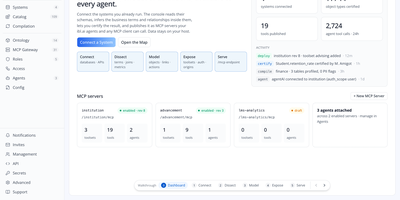
Turning a company's databases and web APIs into shared business terms, ibl.ai Ontology publishes certified tools that Claude, Codex, and other agents can call. Five pages carry the work: connect a SQL or API source, map tables under business terms, certify what the engine inferred, choose toolsets and origins, then deploy and watch calls arrive. SQL sources like MySQL, Snowflake, and ClickHouse are mapped and served as tools, while any system with an HTTP API joins through its OpenAPI document or hand-named endpoints. SQL logins are read-only, personal columns are tagged and masked before samples reach a model, and row limits come from toolset grants, fixed SQL, or sign-in claims. Callers sign in with ibl.ai credentials, Microsoft Entra ID, Google, or a custom OIDC issuer, API keys are limited to toolsets, and each caller gets 30 tool calls a minute. Each certified term becomes a tool with fixed SQL that an agent cannot widen, and the Playground runs any tool as you, showing what your grants return. Servers keep revisions with a Roll Back button, every tool call and refusal appears in an activity log, and a model key adds plain-language questions answered with the SQL that ran. Agents from ibl.ai attach in one dialog, while Claude Desktop, Codex, Cursor, Windsurf, and custom Model Context Protocol clients connect with a pasted snippet. Running on a dedicated VPS on RepoCloud with guaranteed CPU, RAM, and SSD, full root SSH access, and a browser serial console. MIT licensed.
Unit7
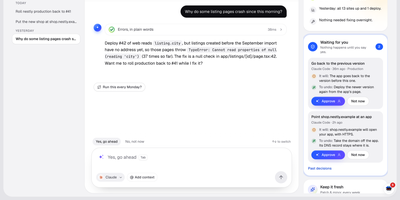
Unit7 manages the servers, Coolify apps, domains, databases, and backups behind software your AI wrote, taking its instructions in plain language. Ask it to deploy a repo, add a database, point a domain at production, or diagnose a slow site, and it does the work on your servers over SSH. Risky steps stop and ask first. The web app, CLI, and MCP server share one engine and one safety gate, and Claude Code, Cursor, Codex, Windsurf, and Antigravity all pass through it. Seven, the always-on agent, reviews the servers on a six-hour cycle and proposes from 24 named actions, never more than three per shift. Warden covers the routine without any AI, restarting crashed containers, rolling back bad deploys, blocking scanners, and running backups. The Map traces each domain to its app and database across Hostinger, Cloudflare, Vercel, and Supabase. It flags spoofable email, dangling DNS records, and records pointing elsewhere. Safety Net sends encrypted copies off the server, to your machine, a synced cloud folder, or S3, and schedules test restores to prove they work. Deploys detect the framework, switch traffic blue-green after a health check, and roll back instantly. Databases run as private containers, and their passwords go straight to an encrypted vault. An autonomy dial per environment runs from watch-only to full autopilot. One switch pauses everything. Running on a dedicated VPS on RepoCloud with guaranteed CPU, RAM, and SSD, full root SSH access, and a browser serial console. Apache-2.0 licensed.
Llama RPC Farm
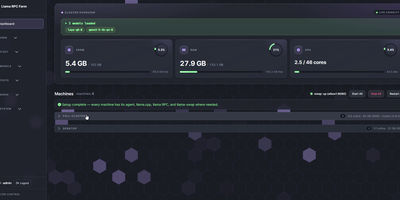
If your GPUs are scattered across a few machines, Llama RPC Farm pools them into one llama.cpp cluster behind a single OpenAI and Anthropic endpoint. A model editor lists every GPU and RAM chip, and ticking them lets one model span several machines with the device order in plain view. Models load on demand, and serve groups decide whether neighbors run together, stay always on, take turns, or clear the stage solo. A live dashboard tracks VRAM, memory, CPU load, temperature, and RPC state for each machine. The Flow Visualizer draws real per-tensor placement as a model runs, with pulsing GPUs wherever compute is in flight. Browse Hugging Face for GGUF files by quantization, task, company, or collection; sharded models download as one row. Weights can live on a shared network mount, or model sync can copy missing files to each machine. Access keys give each person or device a model allowlist and optional daily, weekly, or monthly request limits, with usage tracked per key. A Connect tab prints ready-to-paste client configs and tests the endpoint. A model that fits on one machine can run as a full replica on several, with requests balanced between them. Linux, Windows, macOS, and Raspberry Pi machines can share one cluster. A first-run walkthrough sets storage, installs the engines, and loads a tiny demo model. Running on a dedicated VPS on RepoCloud with guaranteed CPU, RAM, and SSD, full root SSH access, and a browser serial console. Apache-2.0 licensed.
killBottleneck
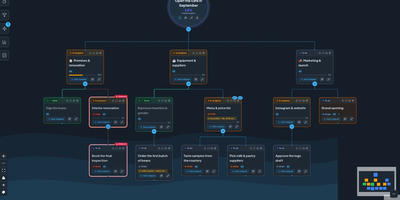
Somewhere in every project one step holds up all the others, and killBottleneck draws your goals as a map that flags that step as a bottleneck. A goal is flagged when it is overdue or stalled while other steps wait on it, and each goal carries an owner, deadline, status, progress, notes, and attachments. The same map switches to a Process style whose recurring steps (every weekday, every Friday, monthly) renew themselves, and an organization map holds positions, functions, and deputies. My day lists what is overdue, due today, or due within a week, beside a team calendar with shared calendars for the company, the meeting room, and time off. Automation rules (WHEN, IF, DO) hand over goals, set deadlines, notify people, offer the assistant, or run an agent, and signed webhooks start n8n workflows or your own agents. An AI assistant in a side panel plans mornings and evenings, sorts notes from a photo, PDF, or voice note, and drafts whole projects, and every change is a card you confirm; it runs on OpenAI, OpenRouter, Groq, Mistral, vLLM, llama.cpp, or a local Ollama model. A REST API and a 20-tool MCP server let Claude Desktop, Claude Code, or the claude.ai connector build maps by conversation. Twelve skins, a simplified phone view, Asana and Trello import, and encrypted backups round it out. Running on a dedicated VPS on RepoCloud with guaranteed CPU, RAM, and SSD, full root SSH access, and a browser serial console. MIT licensed.
AI API Cost Tracker
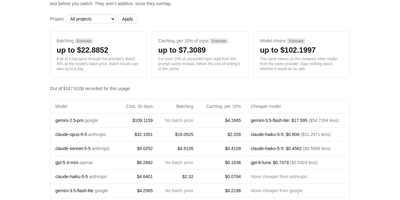
AI API Cost Tracker is an open-source ledger that prices every OpenAI, Anthropic and Gemini request and charges it to the customer, feature or agent run behind it. Apps report token counts through one HTTP endpoint, dependency-free client libraries or OpenTelemetry traces. Prompts and responses are never stored. Each request is costed at the price in force that day, so a rate change never rewrites history. Dashboards break spend down by project, provider, model, customer, feature and run, forecast month-end spend and flag spikes. Budgets, monthly or per run, alert at 80% and 100% by signed webhook, Slack or email. Agents can check a budget before they spend, or reserve it so concurrent steps cannot overspend. A "Why spend changed" page splits a rise into volume, model mix, tokens per request and price, and savings estimates size batching, caching and cheaper models. Outcomes turn spend into cost per resolved ticket. Reconciliation compares recorded costs with Anthropic's cost report, OpenAI's costs API and Google Cloud's billing export. An optional billing ledger sets each customer's revenue against their AI cost, drafts Stripe invoices and shares read-only portal links. Exports cover CSV, FinOps FOCUS and a reporting API. Roles, invitations and an audit log serve teams, with OpenID Connect sign-in for providers such as Okta or Keycloak. Running on a dedicated VPS on RepoCloud with guaranteed CPU, RAM, and SSD, full root SSH access, and a browser serial console. MIT licensed.
Memora
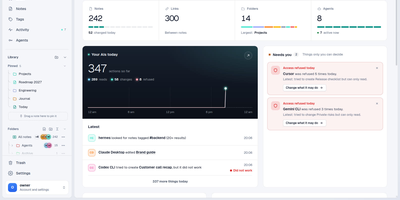
Memora is a self-hosted second brain where Claude Code, Cursor, ChatGPT, and your other AI agents share one memory made of plain Markdown notes that never leave your server. Agents read and write those notes through 77 tools on a Model Context Protocol endpoint, authenticating with a scoped API key per agent or with OAuth approved in the browser. Every change is committed to git, so any revision can be listed, diffed, and restored, and wikilinks and backlinks turn the vault into a navigable graph. The web UI shows a 3D brain with a region per folder, force, radial, and cluster graph layouts, and a canvas with a frame per folder, beside a reader and editor with reading settings. A live activity timeline records every read, write, search, and sign-in, with filters and JSON or CSV export. Mnemo, a built-in notes agent, finds, writes, tags, links, and tidies notes with your own OpenAI, Anthropic, or OpenAI-compatible key, shows every step, and hands tasks to sub-agents. Privacy rules hide folders from chosen agents, scopes and tool lists limit each key, and access rules allow or block by IP, CIDR, or domain. Images pasted into a note stay in its folder, and the interface installs as a PWA. Install with npm, Docker, or a systemd installer, then claim the instance with a one-time setup code. Running on a dedicated VPS on RepoCloud with guaranteed CPU, RAM, and SSD, full root SSH access, and a browser serial console. AGPL-3.0 licensed.