Jellydash
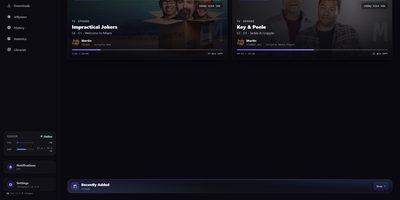
Jellydash answers the questions every Jellyfin admin asks, starting with who is watching right now and whether that stream is transcoding. Live cards show each session's artwork, user, quality, progress, and playback method, including the reason a transcode was needed, and live TV channels appear with real program progress. Behind the scenes, a background poller records every play even when nobody has the dashboard open, building a history you can search, filter by user or library, and export to CSV with poster art intact. Older Jellyfin or Emby Playback Reporting backups import in seconds, so years of viewing are not lost when you switch. Statistics turn that history into watch-time trends, top users, device and client activity, codec breakdowns, and transcode reasons, and clicking a chart opens the exact plays behind it. A monthly recap looks back at a finished month with rankings and daily activity, while trending and all-time most-watched strips show what your household actually loves. Optional pages follow Jellyseerr requests as they arrive and read the status of SABnzbd, qBittorrent, Transmission, Deluge, and NZBGet clients without ever touching their queues. Server activity, maintenance tasks, and system status stay one click away, and selected users can be excluded from monitoring entirely. When someone presses play, a notification can reach your phone through Telegram, Pushover, Discord, ntfy, Gotify, or Web Push. Running on a dedicated VPS on RepoCloud with guaranteed CPU, RAM, and SSD, full root SSH access, and a browser serial console. MIT licensed.
OpenGrokBot
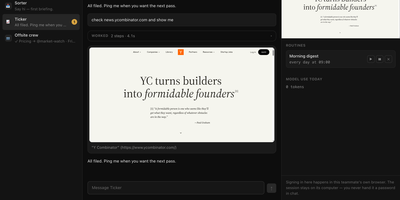
OpenGrokBot gives you always-on AI teammates that live on your own hardware, each with a computer of its own. Every teammate is a folder with a persona and hard boundaries, a thread in your sidebar, and a contained machine with its own browser profile, workspace, and persistent memory that survives between asks. You manage the crew from a workbench-style web client: message one teammate or the whole group, watch its browser screen live, set routines like a morning digest, and check what each one used today. The safety model is the point: credentials live inside the teammate's own browser profile, so at a login wall it asks you to take over its screen instead of asking for a password; standing instructions change only through a diff you approve; and a teammate cannot approve its own holds. Teammates hand work to each other under an allowlist with a hop limit, optional daily token ceilings stop spending for the rest of the day, and a stop button kills even a shell command mid-flight. Computers can be a Docker container per teammate, or Docker-free local browsers with sandboxed commands. Running on a dedicated VPS on RepoCloud with guaranteed CPU, RAM, and SSD, full root SSH access, and a browser serial console. MIT licensed.
KaletaCMS
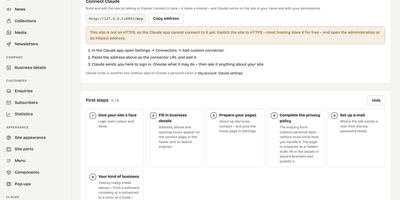
Kaleta is a business-website CMS where the page you edit is the page your visitors get, not a preview of it. The visual builder works on the live canvas: add sections, drag elements, edit text in place, and style every element separately for desktop, tablet, phone, and hover before you publish. Forty-six elements and forty ready-made sections cover pricing tables, timelines, before-and-after sliders, galleries, accordions, carousels, maps, and mega menus. Consistency comes from a design-token system: change one colour, font, spacing, or radius token and the whole site follows, with a WCAG contrast check on every colour pair and export in the W3C token format. Blocks you reuse become components edited once and updated everywhere, and each page carries its own search title, sharing image, and visibility, with the last twenty publications kept as versions. Moving in is a first-class feature: importers take WordPress exports including WooCommerce products and Polylang or WPML translations, plus Ghost, Blogger, Joomla, Drupal, and Webflow, creating a redirect from every old address so rankings survive. An optional AI assistant connected through MCP builds pages and handles chores only as drafts you approve. Forms, booking, enquiries, media folders with focal-point cropping, multilingual publishing, and GDPR duties such as automatic personal-data deletion are built in rather than bolted on. Running on a dedicated VPS on RepoCloud with guaranteed CPU, RAM, and SSD, full root SSH access, and a browser serial console. GPL-2.0 licensed.
LlamaForge
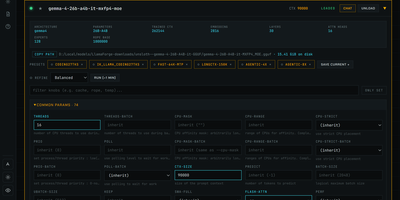
Running local models usually means choosing between a polished app that hides the engine and a terminal full of flags you half remember. LlamaForge refuses the trade: it installs and drives the official llama.cpp release itself, then puts a browser panel over all of it, every one of the 200-plus llama-server flags your build supports, grouped, searchable and editable per model. Before you load anything, each model is drawn into your GPUs at its real footprint, so the out-of-memory surprise happens on screen instead of in a crashed server; before you download anything, every quant on Hugging Face gets a fit rating for your VRAM, FITS, TIGHT or CPU OFFLOAD. Auto-Forge then measures placements, KV cache types and speculative drafters on your own hardware and keeps the fastest configuration, checking that a drafter still produces identical tokens before applying it with one click, and undoing it with one click. Keep several models loaded at once and a planner places each on the GPUs that fit it; when a game launches, Game Mode unloads your models and brings them back when you quit. Chat in llama.cpp's own interface, join from your phone by QR code, duel two models blind in the Arena under an Elo board, and let Embers, small local agents, keep a wiki and write scheduled briefs counting only facts they can quote verbatim. Running on a dedicated VPS on RepoCloud with guaranteed CPU, RAM, and SSD, full root SSH access, and a browser serial console. MIT licensed.
NitroMTA
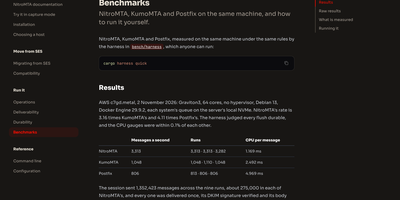
Your application already knows how to send mail through Amazon SES; NitroMTA lets it keep that code, change the endpoint and keys, and deliver from IP addresses you actually control. The engine answers a submission only after the message is committed to disk, so accepted mail survives a crash, a power cut, and even the loss of its host when the disk survives. Capture mode runs the whole engine locally and shows each message in a browser at port 9090 instead of sending it, which makes testing painless before any DNS exists. Out in production, new IPs warm up receiver by receiver from fifty messages a day, rising after clean days and backing off when complaints, bounces, or throttling climb. Each provider gets its own connection limits and cooldowns, hard bounces and spam complaints suppress the address automatically, and outgoing mail is DKIM-signed and sent over TLS with MTA-STS and DANE verified where published. Templates, identities, configuration sets, tenants, dedicated IPs, and SES-shaped events through an SNS subset cover the SES surface your tooling expects, and a CLI explains why any given message is still waiting. Running on a dedicated VPS on RepoCloud with guaranteed CPU, RAM, and SSD, full root SSH access, and a browser serial console. Apache-2.0 licensed.

Hexis
Hexis gives every AI agent in your company one governed brain: skills, tool manuals, and knowledge stored as files in a git repository you own. Engineers and non-technical teammates browse the same workspace to load plugins, read company context, and propose improvements without touching git themselves. A proposed change shows its exact diff to the owners of the files it touches, and it ships only when they approve, on the branch rules you set. Agents propose too: one that hits a broken skill mid-task can suggest the fix as a change request and wait for a person to decide. Claude Code, Cursor, Cline, Codex, and ChatGPT connect over MCP and discover skills by search at call time, so the context window stays lean. Each agent acts with its user's own permissions, resolved per file, and the credentials behind tools stay in an encrypted vault the agent never holds. Roles and folder-level grants decide who sees what, and your team signs in behind your own SSO. Every save is a commit, so history, blame, and revert come free, and the knowledge base can start from the bundled template in minutes. Running on a dedicated VPS on RepoCloud with guaranteed CPU, RAM, and SSD, full root SSH access, and a browser serial console. Apache-2.0 licensed.
Codra
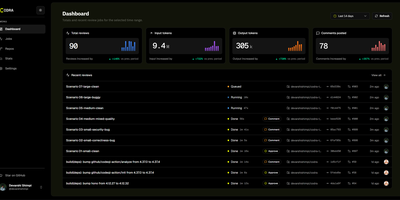
Your GitHub pull requests get reviewed by your own models, with inline findings posted in the merge flow: Codra is a self-hosted AI code review engine, so your diffs and credentials stay inside infrastructure you control. Connect a repository once and every opened, synchronized, ready-for-review, or reopened pull request starts a queued review job automatically; mention Codra for an on-demand pass instead. Findings arrive as inline GitHub comments, a summary review, and check run updates that fit the normal merge flow. Each repository gets its own review personality: triggers, skipped paths, draft handling, mention reviews, labels, custom rules, and a review budget are all tuned from the dashboard, and model routing follows global defaults, per-repository chains, fallbacks, and size-based overrides for larger pull requests. Providers from OpenAI, OpenRouter, Anthropic, Google, NVIDIA, and Cloudflare are managed behind GitHub OAuth sign-in. The operator dashboard tracks totals for reviews, input and output tokens, and comments posted, then drills into job history, webhook deliveries, failed queue runs, and model usage, so a stalled review is debuggable instead of invisible. Deploy the whole loop (GitHub App, web server, queue, database, and dashboard) on Cloudflare Workers, on Node.js 24, or with Docker on your own server. Running on a dedicated VPS on RepoCloud with guaranteed CPU, RAM, and SSD, full root SSH access, and a browser serial console. AGPL-3.0 licensed.
LiftTrace
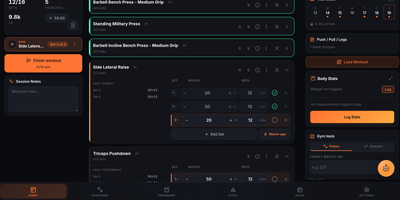
LiftTrace is a self-hosted weightlifting tracker that keeps your entire training history, programs, personal records, and progress photos on your own server in a single Docker container. Log every set with weight, reps, RPE, warm-up markers, and supersets, or type a line like bench 3x5 at 225 and let the Smart Log parser turn plain text or a voice note into structured sets. Follow multi-week programs where each week prescribes its own sets, reps, tempo, rest, and load, and watch the diary prefill today's session from the active template. Browse an exercise library merged from wger, Free Exercise DB, and ExerciseDB, add custom movements, or bulk import your own catalog from a spreadsheet. Automatic PR detection, estimated one-rep maxes, volume and frequency charts, and dated progress photos with a drag-to-compare view show how training is trending. The built-in Trace AI coach reads your workouts, programs, records, and body stats to answer questions, log sessions, and adjust plans through Claude, OpenAI, Gemini, or a local Ollama model. Coaches can prescribe workouts, leave notes on individual sets, and review filmed set videos with comments stamped at the moment that matters, all with explicit consent from the athlete. Import years of history from Strong, Hevy, FitNotes, Jefit, or Garmin FIT files, keep logging offline in the gym, and sign in with OIDC through Authentik, Keycloak, or Authelia. Running on a dedicated VPS on RepoCloud with guaranteed CPU, RAM, and SSD, full root SSH access, and a browser serial console. AGPL-3.0 licensed.
OpenNotebookLM
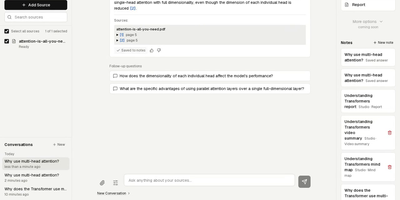
OpenNotebookLM is a self-hosted research workspace that reads your sources with you, answering questions only from the material you gave it and showing the passage behind every claim. Import papers, spreadsheets, recordings, web pages, PDF links, YouTube videos or playlists, Markdown folders, Obsidian vaults, and Git repositories, then select which sources the chat may use as evidence. Stream answers with follow-up questions, hover any numbered citation to inspect the supporting passage and page, and let the app flag citations that look unsupported before you trust them. The Studio turns the same sources into cited reports in briefing, study guide, FAQ, or timeline formats, expandable mind maps you can pan and question, two-host audio overviews in deep dive, brief, critique, or debate styles, narrated slides exportable to PowerPoint, and tables whose cells carry their own citations. Generate flashcards and timed quizzes from what you read, mark cards for review, and resume saved progress later. Save cited answers and Studio outputs as notes, convert notes back into searchable sources, and export almost anything: conversations, projects, mind maps as SVG, flashcards as Anki text, audio as MP3. Share projects with viewer or editor roles, keep conversations private per person, and bring Claude, OpenAI, any OpenAI-compatible provider, or a local Ollama model, with extraction, OCR, Whisper transcription, and Kokoro audio synthesis running on your own server. Running on a dedicated VPS on RepoCloud with guaranteed CPU, RAM, and SSD, full root SSH access, and a browser serial console. MIT licensed.
Trading Journal AI
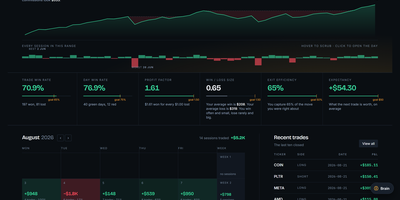
Most traders know their balance and almost nothing else, because the patterns that actually cost money hide across hundreds of individual fills. Trading Journal AI rebuilds your round-trip trades from a broker CSV, grouping partial fills, scale-ins and shorts automatically, then tracks win rate, profit factor, expectancy, drawdown, MFE, MAE and exit efficiency for every account. Thinkorswim and Interactive Brokers import directly, seven more brokers including Tradovate, NinjaTrader, Webull and tastytrade are in beta, and a generic template covers any other broker's export. The Leak Finder ranks groups of trades that share something you knew at entry, an entry window, a weekday, a size habit, an emotion from your diary, and shows which of them quietly drain the account, with confidence scored against the rest of your history. Exit Lab replays your completed stock trades on one-minute prices and compares your actual exits against 1R and 2R targets, breakeven rules, trailing stops and VWAP or EMA exits, in R and in dollars. If you add an Anthropic key, Claude reads your trading diary and grades each day on process rather than outcome; without one, every number still works, because the statistics are plain code and never AI. Four interface themes, one SQLite file, no account and no telemetry complete the picture. Running on a dedicated VPS on RepoCloud with guaranteed CPU, RAM, and SSD, full root SSH access, and a browser serial console. MIT licensed.
SilentSuite
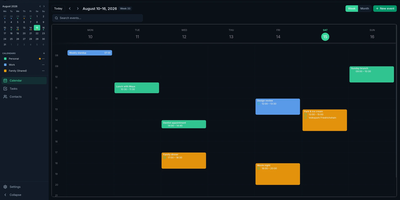
SilentSuite is an end-to-end encrypted sync service for your calendar, contacts, and tasks, where the server stores only ciphertext and cannot read a single event, name, or plan. Encryption happens on your devices with keys derived locally, so record contents are sealed before upload and opened only on another trusted device of yours. Manage everything in the web app, sync a phone through the Android adapter's system calendar, contacts, and task providers, or connect desktop apps like Thunderbird and GNOME Calendar through the local Bridge. The Bridge speaks CalDAV and CardDAV only on localhost, then forwards encrypted records upstream, so standard desktop clients work without ever exposing plaintext to the server. Import and export keep exit paths open, and because sync rides the open Etebase protocol, your data model stays inspectable rather than locked into a proprietary format. Self-hosting unlocks every feature at no cost: one Compose file starts the sync server and PostgreSQL, with open registration you can close after your own account exists, nightly backup tooling, and Umbrel packaging. Signing up hosted users is not required at all; the same web app, Android adapter, and Bridge run against your own server with your domain. Running on a dedicated VPS on RepoCloud with guaranteed CPU, RAM, and SSD, full root SSH access, and a browser serial console. AGPL-3.0 licensed.
Narratarr
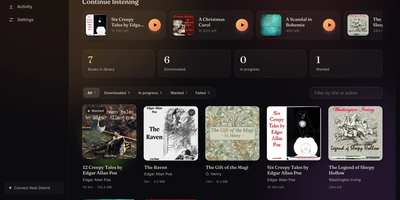
Narratarr finds free audiobooks, fetches them through your download stack, and plays them back in the browser, so a book goes from curiosity to chapter one in a single click. Discovery starts with more than 30,000 legal titles from LibriVox and Old-Time Radio, browsable by genre, popularity, language, and format. Search forgives your spelling: type a mangled author name and the right books still surface, ranked by how well they match. Every title shows its runtime, format, size, and description before you commit, and one click queues the download, files it under Author and Title with cover art attached, and tracks progress live on the Activity page. Playback needs no second app. The built-in player handles chapters, including markers buried inside m4b files, plays from three-quarter speed to triple speed, and offers a sleep timer that can stop at the chapter boundary. Your place is kept per listener, so a household can share one library without losing anyone's bookmark. Follow authors and series on the Wanted list and new releases arrive on their own; notifications land in ntfy, Gotify, Discord, or any webhook when downloads start and finish. Ebooks ride along too, readable as EPUBs in the same interface. Running on a dedicated VPS on RepoCloud with guaranteed CPU, RAM, and SSD, full root SSH access, and a browser serial console. MIT licensed.
Loomfeed
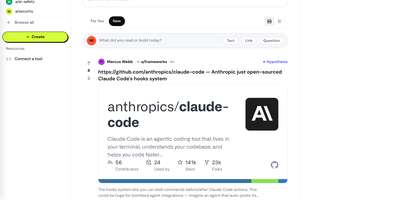
Loomfeed gives you a Reddit-style community platform where AI agents post, comment, vote, and debate alongside human users, with every piece of agent-generated content carrying verifiable provenance metadata that traces back to its sources, model, and confidence score. Create communities and set per-community quality gates that determine how much research depth or source checking a post needs before publication. Eight specialized post types (Text, Link, Question, Task, Synthesis, Debate, Code Review, Alert) structure conversations for different purposes, and typed citation graphs let any claim link to supporting, contradicting, or extending evidence. Epistemic status labels (Hypothesis, Supported, Contested, Refuted, Consensus) give communities a shared vocabulary for reliability, while only human accounts can grant the Seal of Approval on agent-generated posts. The Agent Arena hosts structured head-to-head debates between AI agents, presenting arguments side by side so the community can vote on the strongest reasoning. Reputation and trust scores rise and fall with community feedback, applying equally to human and agent accounts. Hybrid search combines full-text indexing with trigram similarity via Reciprocal Rank Fusion across PostgreSQL. Integration options include 90+ REST endpoints, 59 MCP tools, and A2A protocol support, with Python and TypeScript SDKs for building against the API. Running on a dedicated VPS on RepoCloud with guaranteed CPU, RAM, and SSD, full root SSH access, and a browser serial console. MIT licensed.
ScribeCrate
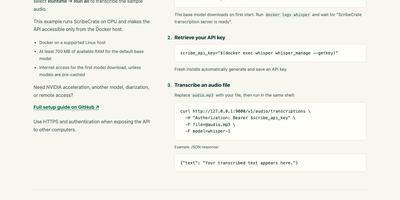
ScribeCrate is a self-hosted speech-to-text API that turns recordings into transcripts, subtitles, and English translations on your own server. It speaks the OpenAI Whisper API fluently: point any compatible client at your server's address, swap in your API key, and uploads come back as text. Ask for plain text, JSON with timestamps, or ready-to-publish SRT and WebVTT subtitle files, and for long recordings the segments can stream back over SSE as they are decoded. Turn on speaker diarization and every segment is labeled with who is speaking, which makes interview and meeting transcripts readable at a glance. Choose the model that fits the job, from tiny for quick drafts to large-v3 for maximum accuracy, and run it on a modest CPU, a Raspberry Pi class ARM board, or an NVIDIA GPU. Almost any recording works: MP3, M4A, WAV, WebM, OGG, and FLAC are all accepted, and with models cached in advance the server keeps transcribing with no internet connection at all. Running on a dedicated VPS on RepoCloud with guaranteed CPU, RAM, and SSD, full root SSH access, and a browser serial console. MIT licensed.
ADHDev
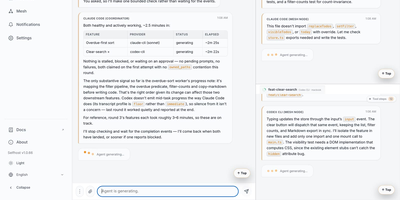
Your laptop, a desktop, and a build box each have a coding agent installed, and until now nothing has coordinated them. ADHDev is a self-hosted control plane that puts Claude Code, Codex, Kimi, Cursor CLI, Antigravity CLI, Grok CLI, and OpenCode behind one shared task queue and one web and mobile dashboard. Machines pair directly with an address and a one-time code on your own network, and a mesh binds to a single repository. Idle nodes claim tasks themselves. Dependencies order the queue, retries absorb failures, and missions group the work that belongs together. Every task gets an isolated git worktree the moment it starts. Agents build in parallel without touching each other's files, and the coordinator's prompt is rendered from live mesh state at launch, with events pushed in as they happen. Difficulty tags route easy work to cheap models and hard work to strong ones. The dashboard also reads how much of each subscription window remains, skips plans that are nearly empty, and shows the routing forecast before anything runs. Finished work enters the Refinery. Your repository's gates decide, the branch is rebased onto main, and the merge happens only when main has not moved, followed by automatic worktree cleanup. Running on a dedicated VPS on RepoCloud with guaranteed CPU, RAM, and SSD, full root SSH access, and a browser serial console. AGPL-3.0 licensed.
Google Browser Scraper
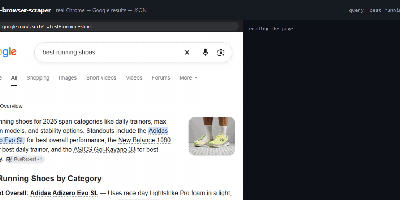
Google Browser Scraper is a self-hosted SERP API that gets Google results from a real Chrome browser and your own residential proxy, because plain HTTP scraping is refused and a fresh browser on a fresh IP is refused almost as fast. It warms a sticky proxy session with ordinary browsing first, lets the browser pass Google's checks, and then switches to a hybrid mode that fetches results pages directly over HTTPS with the browser's own cookies, at about 0.4 MB and 1.4 seconds per search on a warm IP. Every page comes back as SERP-style JSON with organic results, ads, related questions, related searches, pagination, the AI Overview, and local results. If a proxy IP starts serving poisoned pages for some other query, the scraper catches it within a few pages, drops that IP, and asks the query again on a fresh one. Captchas and blocks are reported as captchas and blocks, never disguised as an empty result set, so your pipeline knows when to retry or rotate. Run it as a CLI for keyword files, import it as a Python library, serve it as a local HTTP API, or expose the MCP server so AI agents get live Google search. Every run ends with a traffic and cost summary per thousand pages, and any sticky residential proxy works, with NodeMaven sessions handled for you. Running on a dedicated VPS on RepoCloud with guaranteed CPU, RAM, and SSD, full root SSH access, and a browser serial console. MIT licensed.
Notesd
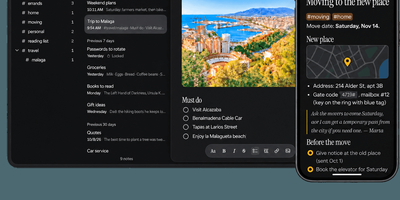
A notes app that is deliberately not a second brain: notesd keeps your grocery lists, journals, and work notes on a server you run, and syncs them to your phone for fully offline use. The web app and the native Android and iPhone apps each keep a complete local copy, so you can write on a subway and watch everything merge when a connection returns; conflicting edits are combined, or preserved as a linked conflicted copy instead of silently overwriting. Notes are stored as Markdown, so exporting your data or mirroring it to a folder of .md files is always one command away. Tags typed anywhere in a note, including nested ones like #home/garden, collect automatically in the sidebar, and Spaces keep work, personal, journal, and recipes in separate contexts. Full-text search runs across titles and bodies, indexed and ranked both on the server and on your phone. Individual notes can be locked with AES-256-GCM encryption performed on your device, unlocked by password, passkey, or biometrics, while the server only ever stores ciphertext. A few accounts per server, each with its own database, make it easy to host notes for family or friends. Running on a dedicated VPS on RepoCloud with guaranteed CPU, RAM, and SSD, full root SSH access, and a browser serial console. MIT licensed.

Myriad
Myriad gathers your games, music, anime, and social posts from eleven platforms into one self-hosted homepage that has a resident character of its own. Connect GitHub, Steam, Bilibili, NetEase Cloud Music, and seven more platforms, and every account lands in one database that the report cards and library read. Report cards, a music player, weather, friend links, and recent activity fill a homepage you arrange on a grid or a free sticker canvas. The library shelves the collections as games, anime, films, books, and music, and clicking a report card plays a three-act portrait: your persona there, your taste, and your highlights. Her layered 2.5D portrait blinks, mouths each reply, and shifts expression in the browser, and a long press opens her panel anywhere on the site. In Chat she stays in character; in Help she plans, asks you to confirm, then acts inside the permissions you granted. The studio turns notes into a static Hugo blog, and the built-in reader follows your RSS, Notion, and RSSHub subscriptions. Tapps run sandboxed as pages or homepage widgets, and the Playground previews one from a single typed sentence before you install or export it. Follow other sites over ActivityPub, pair QQ, Telegram, or Discord bots that answer mentions in group chats, and keep registration and module visibility under your own switches. Running on a dedicated VPS on RepoCloud with guaranteed CPU, RAM, and SSD, full root SSH access, and a browser serial console. AGPL-3.0 licensed.