Aural
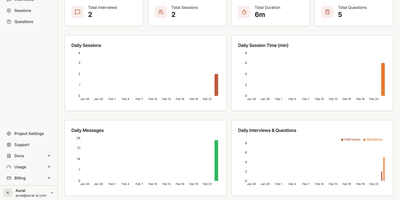
Aural runs the interview for you: describe the role in plain language, share one link, and its AI conducts the whole conversation with each candidate. The generator turns your brief into a complete interview with questions, assessment criteria, and recommended settings, or you build the flow yourself in the editor. Candidates join by chat, voice, or video, and the interviewer adapts in real time, adjusting follow-up depth, tone, and direction as answers develop. Technical rounds run inside the session with a full code editor for live programming questions and a whiteboard for sketching designs. Anti-cheating controls watch for tab switches, blocked external paste, and extra monitors, logging every event into a per-session integrity report. When the session ends, an AI report scores each question, pulls highlights, and names the areas to improve. Teams manage organizations, projects, and role-based access, invite candidates individually, in spreadsheet batches, or by parsing uploaded resumes, and rehearse with a practice mode that gives spoken feedback after every answer. Interviews speak English and Chinese, and the platform connects to the language model provider you already use. Running on a dedicated VPS on RepoCloud with guaranteed CPU, RAM, and SSD, full root SSH access, and a browser serial console. MIT licensed.
Jentic One
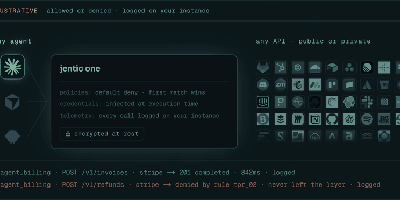
Jentic One is a self-hosted execution layer that lets AI agents call real APIs through a broker that checks permissions and injects stored credentials, so agents do useful work without ever holding your API keys. You register the APIs an agent may use, store each credential once on your own infrastructure, and approve which agents can connect. Every call the agent makes passes the permission check first, and denied requests stop at the broker with a 403 instead of reaching the outside service. Allowed calls go out with the credential attached, and each one lands in an execution record you can review later. Cutting off a single agent takes one change in the control plane, with no key rotation across your other tools. Agents connect through the jentic CLI, a generated skill, an MCP server, or plain HTTP, so coding assistants and in-house agents share the same gate. The stack runs as two units over one database: the control plane on port 8000 for administration, and the broker data plane that agents call. Quickstart runs on SQLite for trials, and production setups move to Postgres with pinned images and TLS. Running on a dedicated VPS on RepoCloud with guaranteed CPU, RAM, and SSD, full root SSH access, and a browser serial console. Apache-2.0 licensed.

Yarrtube
Follow the channels you actually chose, and let their newest uploads land on your own disk instead of in an algorithmic feed. Yarrtube tracks public YouTube playlists and whole channels, checks them on a schedule, and downloads fresh videos automatically the moment they appear. The built-in web player lets you watch the collected library from a desktop or a phone browser without ads interrupting. Downloads are organized into media-server friendly folders, so the same collection shows up inside Plex, Jellyfin, or Kodi next to your films and shows. For Plex homes, an optional scan trigger refreshes the library right after a download finishes, so new episodes surface without manual rescans. You control download quality per source and can cap how many videos each channel keeps, which protects limited disk space from runaway back catalogs. Grouping sources into categories and smart playlists keeps a growing archive browsable instead of turning into one long dump. Everything runs from one Docker container with two persistent mounts, one for its small database and one for the video files. A free YouTube Data API v3 key powers the new-upload checks, so setup takes minutes. Running on a dedicated VPS on RepoCloud with guaranteed CPU, RAM, and SSD, full root SSH access, and a browser serial console. MIT licensed.
Liwan
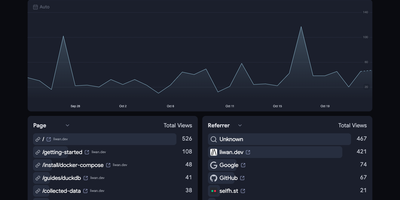
When you want honest traffic numbers without tracking cookies or stored IP addresses, Liwan puts a real-time analytics dashboard on your own server. The dashboard ranks pages, referrers, countries, browsers, platforms, and devices, charts visitors over time, and filters out bot traffic by default. Session metrics add bounce rate, average time on site, and entry and exit pages, while UTM fields attribute visits to campaigns. Collection is adjustable globally and per site: choose how visitors are grouped, whether to store country and city, country only, or no location, and how long events are kept. Drop rules discard internal, test, and local traffic before storage, and a pruning tool applies new settings to history after a dry-run preview. Tracking is one line of HTML, or your own server can send events with custom names and properties. Location can come from a MaxMind database or from Cloudflare, Vercel, and other proxy headers. One instance holds several projects and sites, with team accounts and single sign-on through Google Workspace, Microsoft Entra ID, or an OpenID Connect provider such as Keycloak or Dex. Running on a dedicated VPS on RepoCloud with guaranteed CPU, RAM, and SSD, full root SSH access, and a browser serial console. Apache-2.0 licensed.
Casnode
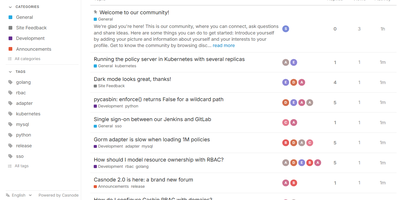
Casnode is a community forum that feels like Discourse from the first click, with topic lists, timelines, and a docked composer your members already know how to use. Readers browse Latest, New, Unread, Hot, and Top topics by category or tag, follow threads with a timeline scrubber and topic map, and jump back in exactly where they stopped reading. Writing feels familiar too: the composer offers Markdown with live preview, drag-and-drop image uploads, mentions, quoting, drafts, and emoji, so long technical answers are painless to produce. Every page is rendered on the server with canonical URLs, Open Graph data, sitemaps, and RSS feeds, which means search engines index your discussions properly instead of seeing an empty app shell. Accounts work out of the box with email and password, and administrators can add single sign-on through any OpenID Connect or OAuth provider, or connect Casdoor for SAML, LDAP, and a hundred more identity sources. Moderators get flags, a review queue, and controls to close, pin, archive, or recover topics, while the admin panel handles site settings, branding, users, categories, and posting limits. Personal messages, user profiles, notification levels from Watching to Muted, and light and dark themes round out daily life for the community. Running on a dedicated VPS on RepoCloud with guaranteed CPU, RAM, and SSD, full root SSH access, and a browser serial console. Apache-2.0 licensed.
Cliparr
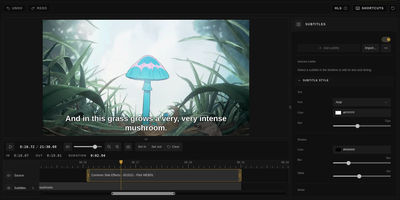
You are halfway through a film when a scene begs to be shared, and Cliparr is the self-hosted clip maker that turns moments from your Plex, Jellyfin, or local video library into shareable clips without opening a full video editor. Connect a media server and Cliparr follows live playback sessions automatically, so the scene you are watching is already loaded when you decide to keep it. Local video files open directly in the browser without being uploaded anywhere first. Mark the range, fine tune the start and end, then crop the frame freely or to a fixed aspect ratio with mouse or touch controls, which makes vertical clips for phones as easy as widescreen ones. Exports run entirely in your browser as video, audio only files, or GIFs, so the server never turns into a render box and the clip lands on the device you are using. Source details, artwork, and clip timing travel inside supported containers, keeping the exported file labelled with where it came from. Captions are a first class step: write your own subtitles, import an existing file, style the text, and burn it into the picture before export. Editor keyboard shortcuts, access control, and reverse proxy support round out a tool that fits into an existing media setup instead of replacing it. Running on a dedicated VPS on RepoCloud with guaranteed CPU, RAM, and SSD, full root SSH access, and a browser serial console. MIT licensed.
Print Farm Manager
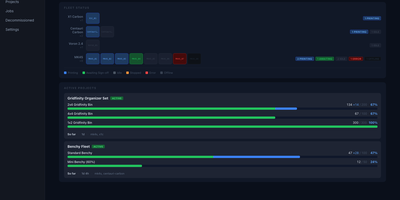
Print Farm Manager runs your whole 3D printer farm, whatever mix of brands it contains, from one self-hosted dashboard that watches every machine and feeds work to the idle ones. The live fleet view refreshes every 15 seconds with each printer's status, progress, and time remaining, so a walk past the screen replaces a walk past every machine. Define projects and parts, upload the G-code, and the scheduler assigns jobs to whichever suitable printer frees up next. When a print finishes, an operator confirms the result before the next job starts, which stops one failed bed from wasting a queue of filament overnight. Prusa machines connect over PrusaLink, Elegoo over SDCP or MQTT, Bambu over MQTT and FTPS with AMS slot selection, and Klipper and OctoPrint machines over their REST APIs, all in the same fleet. Onboarding a roomful of printers takes one CSV import instead of fifty afternoons of clicking, and the TV dashboard mode turns a spare monitor into a shop wall status board. The whole farm, configuration and job history included, exports to a single JSON file for backup or migration. It is built for a trusted local network, reached on port 3000 over the LAN or a VPN. Running on a dedicated VPS on RepoCloud with guaranteed CPU, RAM, and SSD, full root SSH access, and a browser serial console. MIT licensed.
Customermates
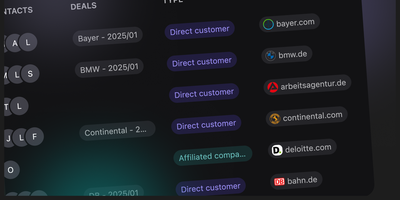
Customermates delivers a modern CRM purpose-built for teams who want practical customer management without enterprise-heavy complexity. The platform manages contacts, organizations, deals, services, and tasks through clean pipeline workflows while integrating AI agent capabilities, REST API access, webhook events, n8n automation connections, and Model Context Protocol tooling for AI-native operations. Team collaboration features include role-based permissions, comprehensive audit logging tracking every data change, and workspace organization for multi-team deployments. The deal pipeline provides customizable stages with drag-and-drop management, while task assignments and service tracking connect directly to contact and organization records for complete relationship context. API-first architecture exposes all CRM data through documented endpoints enabling custom integrations, reporting dashboards, and third-party tool connections. The n8n integration enables no-code workflow automation for lead routing, follow-up sequences, notification triggers, and cross-system data synchronization. Self-hosting requires only two files — a Docker Compose configuration and environment variables — with the published image at ghcr.io/customermates/customermates:latest running database migrations automatically on first boot. PostgreSQL provides the data layer with no additional infrastructure dependencies beyond a reverse proxy for TLS termination. The Community Edition includes unlimited users, unlimited records, full API access, n8n automation, and audit logging at zero cost. Running on a dedicated VPS on RepoCloud with guaranteed CPU, RAM, and SSD, full root SSH access, and a browser serial console. AGPL-3.0 licensed.
Relay Panel
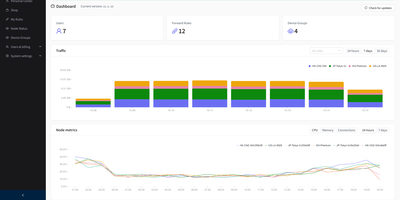
Game servers, home labs behind carrier-grade NAT, and services that need a presence in another region all end up needing the same thing: a cheap entry machine that forwards traffic to the real backend, with rules you can change without opening an SSH session. Relay Panel is the control room for that job, a self-hosted web panel that runs TCP and UDP forwarding across a fleet of lightweight relay nodes from one dashboard. Each rule can fan out to multiple targets with failover or round-robin balancing, follow domain targets as their DDNS records change, and pass the real client IP onward through PROXY protocol, even when relays chain through other relays. Per-rule concurrency caps, scheduled restarts, and automatic target circuit breaking keep one bad upstream from swallowing the whole route. A built-in shop lets users buy plans and top up balances with redemption codes while quotas drain by measured upload plus download, multiplied per line, so premium routes cost more by design. Traffic charts split the last day, week, or month by line, the node page watches CPU, memory, and connection counts, and Telegram or email alerts fire the moment a relay drops offline. Nodes upgrade from the panel in one click, and the first login forces a password change before anything else opens. Running on a dedicated VPS on RepoCloud with guaranteed CPU, RAM, and SSD, full root SSH access, and a browser serial console. Apache-2.0 licensed.
mkcertWeb
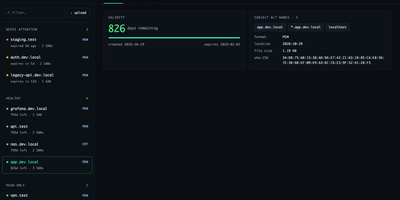
Your internal services deserve certificates your browsers actually trust, without a spreadsheet tracking when each one expires. mkcertWeb wraps the mkcert tool in a web interface where you generate certificates for any mix of hostnames, wildcards, and IP addresses, then download them as PEM, CRT, or PKCS#12 bundles for servers and client authentication. The certificate list groups everything by state, needs attention, healthy, read-only, or archived, showing days remaining, subject alternative names, and SHA-256 fingerprints at a glance. You can upload existing certificate and key files for viewing, attach a free-text note to each certificate, and archive or restore entries without ever overwriting a certificate of the same name. The root CA page offers downloads and install instructions for macOS, Linux, and Windows, and can generate a fresh CA for a new deployment. Devices enroll through the built-in SCEP server using one-time challenge passwords and templates, with an optional enterprise CA signing manual enrollments. A scheduled monitor checks expiry daily and sends alerts through SMTP email, ntfy, or an HTTP webhook, with test buttons for every channel. Settings save from the browser with secret masking, sign-in supports passwords or OpenID Connect single sign-on, and light and dark themes work down to phone width. Running on a dedicated VPS on RepoCloud with guaranteed CPU, RAM, and SSD, full root SSH access, and a browser serial console. GPL-3.0 licensed.
Airbroke
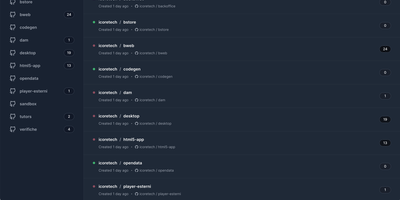
Engineering teams use Airbroke to catch application exceptions in one self-hosted error tracker where they can triage issues, replay failing requests, and debug without a per-event bill. Your existing Airbrake or Sentry clients point at its compatible HTTP collector endpoints, so instrumented applications keep reporting with no new SDK to adopt, and every occurrence lands in storage where the footprint stays small even under heavy ingestion. The web interface groups errors into issues you can triage, bookmark important occurrences for follow-up, and read occurrence charts that show whether a bug is a one-off or a slow-building wave. When an HTTP exception looks suspicious, you can replay the original request directly or copy a generated cURL command that reproduces it exactly, turning vague log complaints into debuggable cases. An AI assistant answers questions about issues in context, an MCP API lets LLM agents query your error data programmatically, and multiple OAuth providers secure sign-in for the team. It runs as a small service needing only a database, a single core, and a few hundred megabytes of memory. Running on a dedicated VPS on RepoCloud with guaranteed CPU, RAM, and SSD, full root SSH access, and a browser serial console. MIT licensed.
OpenGateLLM
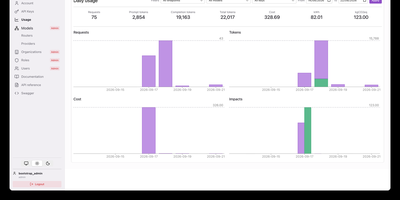
One endpoint, every model you run, and a government-grade paper trail for each request. OpenGateLLM sits in front of your AI infrastructure as the single door: applications call one OpenAI-compatible API, and the gateway decides which backend answers, a self-hosted vLLM cluster, an Ollama box in the corner, a Hugging Face TEI embeddings service, or a hosted provider when you allow one. You publish friendly model names as routers and attach real provider APIs behind them, then load-balance across those backends by shuffle or least-busy so a second GPU node starts earning its keep the moment you register it. Chat completions, embeddings, reranking, OCR, and audio transcription each get their standard endpoint, so existing OpenAI SDK code, LangChain, and LlamaIndex projects point at a new base URL and keep working. Governance is built in rather than bolted on: organizations, users, and roles control who may call which model, API keys authenticate every request, and rate limiting keeps one enthusiastic team from eating the whole cluster. Usage monitoring follows every inference, and carbon footprint estimates attach to models through their hosting zone and parameter counts. Retrieval-augmented generation against Elasticsearch or Qdrant plugs into the same surface. No chat history is stored, which is rather the point when the data is yours. Running on a dedicated VPS on RepoCloud with guaranteed CPU, RAM, and SSD, full root SSH access, and a browser serial console. MIT licensed.
Supercheck
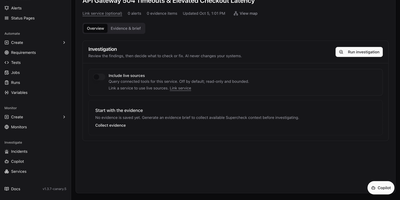
Browser tests, load tests, uptime checks, public status pages, and an AI incident investigator all live in one self-hosted dashboard called Supercheck. Write browser, API, database, custom, and k6 performance tests in a built-in code editor, or record a flow with the Chrome and Edge Recorder extension and save it as a Playwright script. Group tests into scheduled jobs, trigger them from CI with trigger keys, and review run logs, screenshots, traces, and reports. Five monitor types cover HTTP endpoints, website SSL expiry, ping, TCP and UDP ports, and scheduled synthetic browser journeys, with administrator-defined check locations and alerts to email, Slack, Discord, Telegram, Microsoft Teams, or webhooks. Status pages publish component health with 90-day uptime, incidents, scheduled maintenance, badges, and subscriber notifications under a subdomain or custom domain. When something breaks, the incident workspace collects evidence, drafts an evidence brief, and runs a read-only AI investigation across connectors such as GitHub, Prometheus, Grafana, and Kubernetes, while Copilot answers questions about that evidence. Requirements link expectations to tests and show coverage, and AI can extract them from a PRD. Organizations, projects, six roles, API keys, and audit trails keep teams in their lanes, and the CLI pulls, diffs, and deploys resources as code. Running on a dedicated VPS on RepoCloud with guaranteed CPU, RAM, and SSD, full root SSH access, and a browser serial console. AGPL-3.0 licensed.
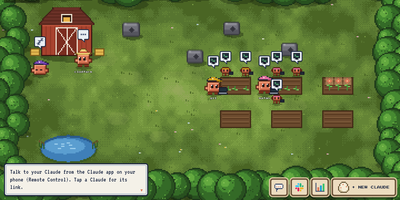
Clodfarm
While you sleep, a crew of Claude Code agents in a single Docker container keeps building: you plant a mission, the farm splits it into sub-agents on their own branches, and only work that passes your tests ever lands in the repo. Open the farm in your browser and every agent is a pixel Claude walking its plot, tending a task at a terminal or napping when the budget says stop, with the quest log, mission board, and a hatchery for new agents a click away. Each account is paced against its real five hour and weekly usage, measured live, always leaving you twenty percent and never paying overage, and teammates' agents message each other and hand jobs to whichever account still has room. Talk to any agent from the Claude app on your phone, post quests, set schedules like weekday issue triage at nine, and watch live dashboards the agents maintain themselves. Whiteboards let you sketch while an agent draws back full Mermaid architectures for the whole farm to see, the farm's logged-in browser does website work as you, and Slack mentions, Blender scenes, and other models from GPT to a local Ollama all plug into the same queue. Running on a dedicated VPS on RepoCloud with guaranteed CPU, RAM, and SSD, full root SSH access, and a browser serial console. MIT licensed.
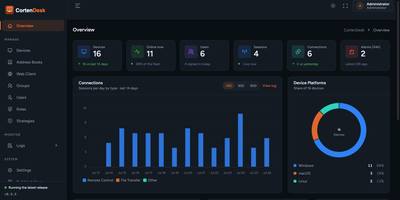
CortenDesk
Point your RustDesk clients at CortenDesk and the bare open-source server turns into a managed fleet console with a real address book, real access control, and a remote client that lives in the browser. One container runs the ID server, the relay, and the console together, and existing key pairs and device IDs move in unchanged, so migration is a hostname change rather than a rebuild. The fleet view shows live presence, platform, aliases, owners, and last-seen for every machine, organized into folders that double as the unit of access control. People see only their own devices plus the groups granted to them, and the same scoping is enforced in the RustDesk client API, not just the web pages. Policies push client settings over the heartbeat, covering permissions, password rules, and capture behavior, and enforced policies revert local changes automatically. Five audit logs record connections, file transfers, sign-ins, security alarms, and console actions, all filterable and exportable to CSV. When a browser is all you have, the built-in web client views and controls machines with file transfer, clipboard, audio, and multi-monitor switching, no installer required. Running on a dedicated VPS on RepoCloud with guaranteed CPU, RAM, and SSD, full root SSH access, and a browser serial console. AGPL-3.0 licensed.
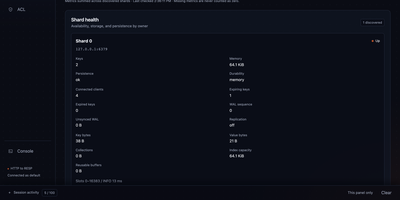
Ruvio
Ruvio is a Redis-compatible in-memory database that folds the cache, the lock service, the rate limiter, and the delay queue into one Rust process your existing clients already speak to. Connect with redis-cli or the first-party clients for Rust, .NET, Go, Java, Python, and Node.js, and the familiar strings, hashes, lists, sets, sorted sets, and streams are there, 287 commands in all. The difference shows in the primitives that usually need a second system: LEASE grants a fencing token for a key, SEMAPHORE caps concurrent holders with per-holder TTLs, INCRBY with MAX builds a counter that refuses to pass capacity, SETV writes only when your version is still current, CHANGES arms a feed of later writes on a shard, and XADD DELAY stores a stream entry now and reveals it to consumer groups when the delay passes. Each shard owns its keys outright, parsing, recording, and applying without a lock on the hot path, and features cost memory only on keys that use them. Durability is a startup choice you name, memory, snapshot, everysec, or always, written through a write-ahead log, and replicas copy shard by shard while optional coordinators agree through Raft to promote a replica when a primary stops answering. A browser operator UI shows data, command forms, Pub/Sub, and ACL users on the running server. Running on a dedicated VPS on RepoCloud with guaranteed CPU, RAM, and SSD, full root SSH access, and a browser serial console. AGPL-3.0 licensed.
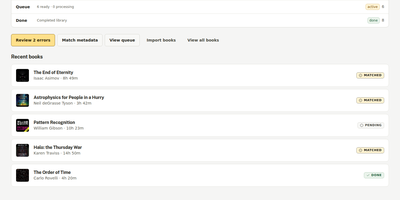
Bragibooks
A folder of loose audiobook chapters goes in; a single, perfectly tagged m4b library comes out. Bragibooks is the operations board for that transformation: you select a batch of audiobook folders from your server, and it searches AudiobookDB to match each one with the right title, author, narrator, and release, with a custom search on hand when the first match is wrong. Confirmed books enter a processing queue where m4b-merge merges split mp3, m4a, and m4b parts, converts formats, strips stale metadata, and writes clean, consistently tagged files while you watch the live job output in your browser. Saved output profiles let you route different batches to different directories or path formats, and the books library keeps every finished title with its metadata, files, and processing history a click away. The whole thing runs as one container with the interface built in, a SQLite database on a mounted config volume, and access restricted to your local network by default, with an optional API key for external tools. Audiobook collectors use it to tame download folders before importing into their player of choice, and hoarders of split-chapter rips finally get uniform Chapter 01 style files. Running on a dedicated VPS on RepoCloud with guaranteed CPU, RAM, and SSD, full root SSH access, and a browser serial console. GPL-3.0 licensed.
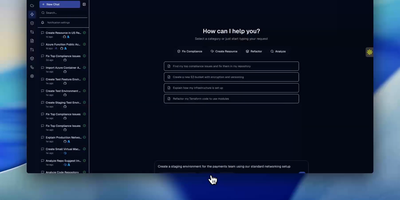
Opengeni
Enterprises requiring production-grade governance for long-running autonomous AI operations can rely on OpenGeni, a self-hosted orchestration platform with human-in-the-loop approvals, Connected Machine execution, and comprehensive audit replays. Operators can configure durable multi-turn workflows that execute continuously toward specified goals without premature termination, automatically pausing when human verification, structured multiple-choice decisions, or critical credential approvals are required. Teams can assign execution workloads across ephemeral cloud sandboxes or route them straight to enrolled Connected Machines to run commands directly against local code repositories without exposing inbound network ports. The integrated web console lets developers inspect live Server-Sent Event activity streams, replay complete turn histories from audit logs, inspect generated artifacts, and cancel or steer in-flight agent tasks on demand. Platform administrators can enforce fine-grained access policies through GitHub App repository bindings, broker temporary role-scoped secrets, and maintain a shared organizational knowledge base where agents propose findings for human review before vector indexing. Running on a dedicated VPS on RepoCloud with guaranteed CPU, RAM, and SSD, full root SSH access, and a browser serial console. Apache-2.0 licensed.