Input
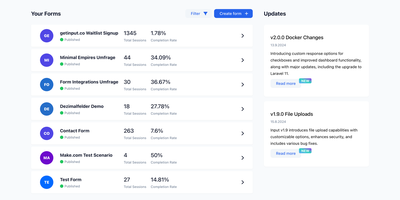
Input is a no-code form builder you host yourself, so the forms your customers answer and the data they submit stay on your infrastructure instead of a form vendor's cloud. Build in the drag-and-drop workbench by stacking blocks: short and long text, email, phone, number, date, checkboxes, multiple choice, rating, scale, file upload, link, secret, and consent fields, fifteen types in all. Conditional logic shows or hides blocks based on earlier answers, so a form can branch like a conversation instead of interrogating everyone with every question. Style the result in your brand colors and fonts until it looks like part of your site, then embed it on any page or share it directly. Respondents get a responsive form that adapts to desktop, tablet, and mobile, in multiple languages when your audience needs them. Submissions collect into a table view with one row per response and a summary view that charts choice distributions, common text answers, averages, and rating ranges, and everything exports to CSV for analysis elsewhere. Webhooks fire each submission as JSON to your other tools, with simplified setup for Make, and a custom completion page closes the loop with your message or a redirect. Consent fields and encrypted storage keep GDPR duties manageable, and unlimited forms and responses come standard because the server is yours. Running on a dedicated VPS on RepoCloud with guaranteed CPU, RAM, and SSD, full root SSH access, and a browser serial console. AGPL-3.0 licensed.
Meridian
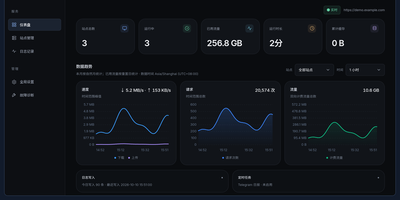
Meridian puts all of your Emby reverse proxy sites, playback routes, and day to day operations into one clean management panel instead of a pile of hand-written proxy configs. Each Emby site gets its own entry through a path, a dedicated port, or a subdomain, with primary and backup routes that switch automatically when one goes down. Three playback modes let video stream directly to clients while logins, posters, and API calls continue through the proxy, so bandwidth lands where it should. Accounts for each site are stored with passwords and expiry dates, renewal reminders arrive ahead of time, and account details can be imported or exported as JSON and CSV. Traffic trends, per-site quotas, rate limits, and static resource caching keep busy sites under control, while log filtering and connection diagnostics show exactly where a request went wrong. Certificates are handled through Cloudflare wildcard issuance and renewal, or by uploading your own, and encrypted backups protect the whole configuration. Routine administration can even happen from Telegram, checking daily reports, adding or pausing sites, and renewing accounts from chat. The whole panel runs as one small program with a built-in database and works comfortably from a phone. Running on a dedicated VPS on RepoCloud with guaranteed CPU, RAM, and SSD, full root SSH access, and a browser serial console. MIT licensed.
NetsGo
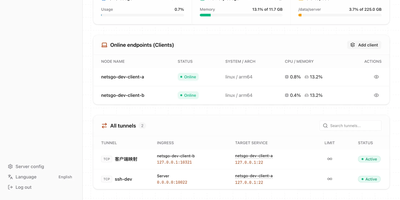
Created to eliminate the configuration fragmentation plaguing multi-device Homelab setups and small-team infrastructures, NetsGo merges what typically requires three separate tools — a tunnel daemon, a management panel, and a monitoring stack — into a single Go binary that starts with one command and listens on one port. The server exposes HTTP, TCP, and UDP tunnels, a built-in Web console for node management, a REST API for automation, and real-time traffic statistics with per-client bandwidth limiting, all sharing default port 9527 so firewalls and reverse proxies need only a single rule. Version 0.1.11 introduced Client-to-Client P2P tunnels via WebRTC DataChannel with three selectable transport strategies — Server relay, Prefer P2P with automatic fallback, and P2P only — reducing latency for direct connections while maintaining the centralized control plane. The management console displays every connected client's online status, authentication tokens, tunnel configuration, active transport mode, P2P candidate gathering progress, and cumulative byte-level traffic counters updated every second. Unlike frp or rathole which delegate management to external plugins or configuration files, NetsGo provides built-in client key generation, tunnel target migration between nodes, SOCKS5 proxying, IP-whitelist console access, and one-command server upgrades. Running on a dedicated VPS on RepoCloud with guaranteed CPU, RAM, and SSD, full root SSH access, and a browser serial console. Apache 2.0 licensed.

OpenCharts
OpenCharts puts a full trading terminal in your browser, with candlestick charts, drawing tools, indicators, and a paper-trading account funded with one hundred thousand dollars. You switch between eight timeframes from one minute to one week, overlay volume, bid and ask lines, and a bar countdown, then add SMA, EMA, RSI, MACD, Bollinger Bands, ATR, Stochastic, or VWAP studies from the toolbar. The drawing rail covers trend lines, rays, channels, Fibonacci retracement and extension, shapes, and text, with magnet snapping to price levels and an object tree that manages every annotation. Position tools calculate risk, reward-to-risk ratio, and position size against live account equity as you drag them across the chart. Market, limit, and stop orders rest in the book, trigger on price ticks, and honor take-profit and stop-loss levels you can drag directly on the chart. Positions mark to market on every tick, and the panels track equity, balance, used margin, and free margin in real time. Session replay rewinds one-minute history and plays it forward at up to ten times speed, so you can rehearse entries against past price action. A trade journal records notes, tags, emotions, and ratings per trade, filtered by symbol when you review the week. Running on a dedicated VPS on RepoCloud with guaranteed CPU, RAM, and SSD, full root SSH access, and a browser serial console. MIT licensed.
Meshlan
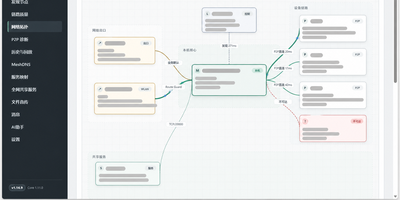
Meshlan turns your own Linux server into the control plane for a private virtual LAN that connects remote Windows devices as if they sat on the same router. Devices pair through your server, receive their certificates, and then talk directly to each other over encrypted tunnels whenever NAT allows, using dual-stack hole punching, UPnP, and STUN diagnostics to find a path. When a direct connection is impossible, traffic falls back to relays, and multiple relay nodes are chosen automatically by latency, jitter, packet loss, and health. You can publish a service that only listens on localhost, a local API, a web panel, a database, a game server, to the mesh on a custom port, with direct access or manual approval by its creator. Names stay stable while addresses change: devices answer to names like alice.mesh and services to api.alice.mesh, and an HTTPS gateway serves mesh websites without port numbers. Files move directly between devices over the encrypted link while the server only distributes metadata. The console shows the live topology with P2P and relay paths, latency, and service health, and local history keeps traffic and events for replay with a time slider. Optional AI automation keeps model keys on the server, encrypts context end to end, and asks for your confirmation before changing anything. Signed updates verify and roll back automatically when a health check fails. Running on a dedicated VPS on RepoCloud with guaranteed CPU, RAM, and SSD, full root SSH access, and a browser serial console. MIT licensed.
Agenticos
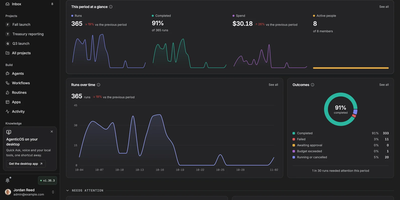
Give each team an AI teammate that works where the team already works: AgenticOS lets colleagues and agents share one live chat and the same project files, so an agent can answer in the thread, apply a correction from a reply, and show its work as it writes. You build an agent in the browser by writing its instructions, picking a model, and switching on tools, then publish it to web chat, Slack, Teams, Discord, Mattermost, Telegram, a website widget, or an API. Agents analyze spreadsheets, run code in a sandbox, browse the web in a browser you can watch and take over, and hand programming work to Claude Code or Codex. Company knowledge comes from uploaded documents and synced drives, searched with cited answers, while reusable skills teach agents how your team writes reports, reviews code, or researches a market. Agents can draw charts and diagrams in chat and publish dashboards as apps with stable links your team opens anywhere. Administrators set roles and department groups, cap each agent's monthly budget, require approval for sensitive tools, and read a recorded run history with costs. Running on a dedicated VPS on RepoCloud with guaranteed CPU, RAM, and SSD, full root SSH access, and a browser serial console. Apache-2.0 licensed.

Telegram Archive
Telegram Desktop's export is a file you make once by hand; Telegram Archive is a self-hosted backup that keeps saving your chats on a schedule and in real time, then lets you read them in a viewer that looks like Telegram. After one login with the code Telegram sends you, it stores messages, photos, videos, voice notes, stickers, documents, and link previews, saving each file once even when several chats share it. A live listener captures new messages, edits, and reactions as they happen, and a daily full pass fills any gaps. Every edit keeps its earlier text as a version, and with deletion tracking switched on, deleted messages stay in the archive marked as deleted. The viewer offers folders, forum topics, archived chats, pinned messages, polls, shared media, and search across every chat, plus a What changed feed of deletions, edits, and transcripts. Voice notes can be transcribed into searchable text by a server you run or rent. Family or colleagues get logins limited to chosen chats, or a share link that opens a single chat. One archive holds several accounts, a Telegram Desktop export can be imported for older history, and twelve themes suit phones and desktops. Running on a dedicated VPS on RepoCloud with guaranteed CPU, RAM, and SSD, full root SSH access, and a browser serial console. GPL-3.0-or-later licensed.
Doorman
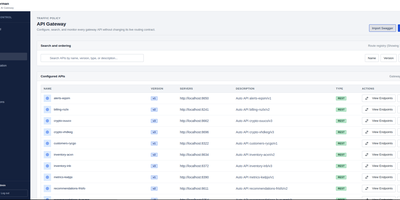
Doorman puts one controlled front door in front of every API you run, instead of teaching each service to reinvent keys, quotas, and abuse protection. It routes REST, SOAP, GraphQL, gRPC, gRPC-Web, and AI traffic through a single gateway while its control plane handles the surrounding work. Catalog APIs in a visual builder, configure protocols and endpoints, validate schemas, and manage semantic versions with deprecation and sunset dates as interfaces evolve. Control who may call what through users, roles, groups, and subscriptions, then attach credit tiers and quotas so heavy consumers stay inside the plan you sold them. Slow abusive clients with rate limits, throttling, and bandwidth caps, and keep flaky upstreams from cascading through retries and circuit breaking. Follow every request in searchable logs, review security controls and audit activity, and move configuration between environments with import and export. Start in a self-contained in-memory mode for a small deployment, then switch to shared MongoDB and Redis when several gateway instances need the same counters, revocations, and routing state. Running on a dedicated VPS on RepoCloud with guaranteed CPU, RAM, and SSD, full root SSH access, and a browser serial console. Apache 2.0 licensed.
PrintStash
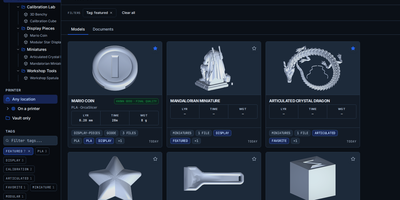
Every printing household eventually drowns in files named final_v3_REAL.gcode, and PrintStash is the library that brings order to your models, G-code, and print history. Upload STL, 3MF, OBJ, STEP, and other formats directly, or point it at a folder or NAS share and let it index everything in place without overwriting originals. Each model page pairs a 3D preview with its recommended G-code, the slicer settings behind it, and one-click actions to open files in your slicer. Revisions carry needs-test and known-good labels, so the version that printed beautifully is never confused with the experiment that delaminated. Connected printers report live temperatures and progress, accept sent G-code, and take queued copies across printer groups, with material or nozzle mismatches blocking automatic routing before they waste filament. Print outcomes feed time and cost tracking per model, and an optional Spoolman integration keeps filament inventory honest. Collections, tags, filters, favorites, and saved views keep a growing vault browsable, and optional AI search with local models finds models by description. Verified backups, file audits, trash recovery, user permissions, API keys, and OIDC single sign-on round out the administration side. Running on a dedicated VPS on RepoCloud with guaranteed CPU, RAM, and SSD, full root SSH access, and a browser serial console. AGPL-3.0 licensed.
PRISM
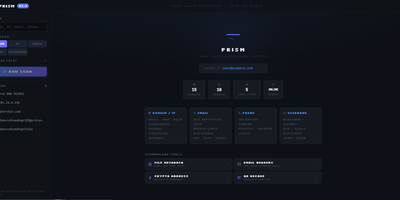
PRISM consolidates passive reconnaissance, credential leak detection, and network asset mapping into a unified operational dashboard to replace fragmented command-line security tools. Analysts can launch simultaneous multi-source investigations against domains, internet protocol addresses, email mailboxes, phone numbers, and online handles to uncover domain registrations, open network ports, cryptographic certificates, and historical web archives. The platform interrogates threat feeds and leak repositories to expose credential leaks, dark web mirrors, and email routing anomalies with automated SMTP mailbox verification. Cross-platform identity engines crawl thousands of social networks and public registries to correlate aliases, discover leaked commit identities, and trace digital footprints across the web. Discovered assets render into interactive entity relationship graphs alongside geographic internet protocol maps to help investigators visualize infrastructure clusters and ownership links. An automated operational security calculator evaluates exposure vulnerabilities across identity, web, and infrastructure vectors, producing an aggregated risk score with granular hardening recommendations. Scheduled watchlists continually monitor target infrastructure, dispatching webhook notifications to chat channels whenever new subdomains, ports, or credential leaks appear. Investigators can export comprehensive audit dossiers as self-contained HTML files, styled PDF documents, or structured spreadsheets. Running on a dedicated VPS on RepoCloud with guaranteed CPU, RAM, and SSD, full root SSH access, and a browser serial console. MIT licensed.
Topolograph
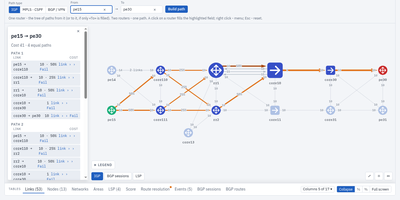
Before the maintenance window, know exactly where the traffic will go: Topolograph rebuilds your network the way its routing protocols see it and lets you break it safely on screen. Upload one router's LSDB output, from Cisco, Juniper, Arista, FRRouting, MikroTik, and a dozen other vendors, and the whole area's topology appears as an interactive graph, because the protocol already flooded it everywhere. Compute the shortest path between any two routers and see every equal-cost alternative with per-link loads, then fail a link or a node and watch SPF recalculate: which pairs moved to backup, which are left with none, and how the load shifted on every surviving link. Search the graph for prefixes, MAC addresses, or any network element, plan an MPLS TE path against real bandwidth attributes, and compare snapshots from different moments to answer what changed before the incident. Collectors can stream live OSPF, IS-IS, and BGP events over GRE, BGP-LS, or BMP so the timeline replays the network at the moment things broke, and a REST API, Python SDK, and MCP server let your own tooling and AI agents ask the same questions. Running on a dedicated VPS on RepoCloud with guaranteed CPU, RAM, and SSD, full root SSH access, and a browser serial console. MIT licensed.
FeatherPanel
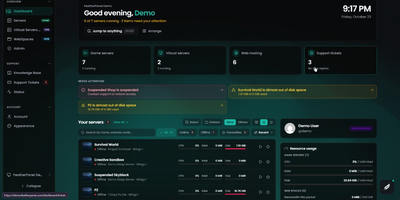
FeatherPanel is one control panel for game servers, Proxmox virtual machines, and web hosting, so a small host stops juggling three different admin tools to run its infrastructure. Game servers deploy from spells (the egg system Pterodactyl users will recognize, with egg imports supported) and open into a live websocket console with power actions, install logs, and CPU, memory, and disk graphs. The built-in file manager browses, edits, uploads, archives, and shares server files, while per-server databases, scheduled backups with retention limits, cron-style schedules, and lifecycle hooks automate the routine work around each server. Virtual machines and containers come from Proxmox nodes with browser VNC consoles, snapshots, ISO mounting, and reinstalls, and web hosting accounts get domains, SSL, databases, mailboxes, one-click WordPress and other apps, and Git deployment in the same UI. Customers help themselves through support tickets, a knowledgebase, and a public status page, while subusers receive fine-grained permissions instead of shared passwords. Plugins and themes from the marketplace extend the panel, a REST API and MCP server connect external tools and AI assistants, and any of the three hosting modules can be switched off when you only need part of the stack. Running on a dedicated VPS on RepoCloud with guaranteed CPU, RAM, and SSD, full root SSH access, and a browser serial console. AGPL-3.0 licensed.
Tryton
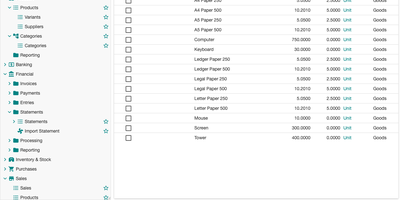
In Tryton, an invoice knows its shipment and a production order knows its stock, since accounting, inventory, purchasing, and sales are modules of one ERP rather than separate programs exchanging exports. Financial accounting posts customer and supplier invoices, reconciles bank statements imported from SEPA or configured CSV formats, manages dunning and direct debits, and produces Factur-X electronic invoices, while analytic accounting splits results across cost centers. Stock tracks goods through warehouses and locations with lots, shipments, inventories that warn when counts drift beyond tolerance, and automatic period closing, and production consumes bill-of-material inputs into finished goods with quantity checks. Sales quotations become orders, shipments, and invoices without retyping; purchases calculate real supplier lead times; point of sale records lot numbers at the till; subscriptions bill recurring services on schedule. Multi-company installations share the same database with per-company wizards, tax rules can be defined per organization for European trade, and parties, products, carriers, currencies, and customs duties are managed as shared reference data. Access happens through the browser web client, a desktop client, or scripting and REST libraries, so integrations read and write the same business objects your staff see. Running on a dedicated VPS on RepoCloud with guaranteed CPU, RAM, and SSD, full root SSH access, and a browser serial console. GPL-3.0-or-later licensed.
RefRef
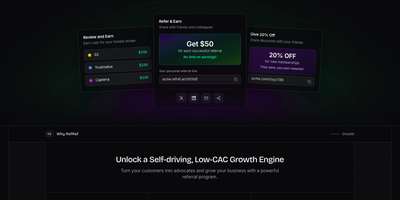
Turn your happiest customers into a tracked referral channel, with rewards, payouts, and fraud checks handled in one place. A small JavaScript snippet on your site records which referrer drove each new customer, and personalized landing pages greet visitors with the name of the friend who invited them. You design reward structures per program, mixing one-off bonuses, recurring commissions, or loyalty incentives, then decide how money moves. Manual approval queues every reward for review, or automatic rules validate and disperse payments on a schedule you set. Referrers get their own portal showing referral links, conversion counts, and reward balances, and affiliates work from a dedicated partner portal with the same visibility. Nudges automatically remind quiet referrers to share again, and fraud monitoring flags suspicious activity before it turns into payouts. Engagement analytics chart program performance across referrers, campaigns, and time, and a sandbox testing environment rehearses the whole flow before real customers arrive. Google sign-in and email delivery through Resend slot in through environment settings, and the Docker Compose deployment brings up the portal, database, and seed data in one command. Running on a dedicated VPS on RepoCloud with guaranteed CPU, RAM, and SSD, full root SSH access, and a browser serial console. AGPL-3.0 licensed.
PharosRAG
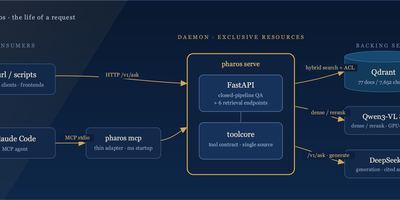
Your team's documents sit in folders nobody can search, and the answer to a simple question hides on page 40 of a PDF someone saved last year. Pharos ingests PDFs, scans, Word documents, presentations, and spreadsheets into a local knowledge base, then answers questions against that library with citations traced back to the exact page. Hybrid retrieval finds the passages that matter, and every answer carries its evidence so readers can verify the claim in the source. Access control decides visibility per person: an API key resolves to an identity with a tenant and group memberships, retrieval filters hard to only the documents that identity may see, and a document with no permissions attached stays invisible to everyone. Two doors lead into the same library. The HTTP API runs a closed question-answering pipeline that retrieves, grounds, and answers in one call, and coding agents connect through MCP to decide for themselves when to retrieve, how to rewrite a query, and when a question needs multiple hops. A resident daemon keeps the search index and models warm, so every session shares one backend instead of reloading heavy resources. The deployment scales from one machine to replicated application tiers behind a load balancer. Running on a dedicated VPS on RepoCloud with guaranteed CPU, RAM, and SSD, full root SSH access, and a browser serial console. MIT licensed.
Dock-Dploy
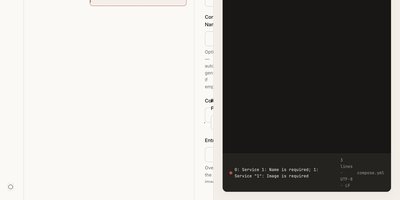
Visual drag-and-drop assembly replaces manual text editing in Dock-Dploy, a Docker Compose builder and configuration management suite that turns complex multi-service container topologies into validated YAML manifests. DevOps engineers and self-hosters can visually assemble application stacks by selecting container base images, defining healthcheck probes, mapping bridge networks, and assigning persistent volume mounts through a reactive web interface. An integrated marketplace catalog allows teams to search, preview, and import battle-tested templates for services like PostgreSQL, Redis, and Nginx with one click. Real-time Zod schema validation inspects every service parameter as you type, flagging port collisions, missing environment variables, and malformed volume syntax before deployment. A split-screen CodeMirror editor provides continuous synchronization between graphic form fields and generated YAML definitions with automatic code sanitization and clipboard exports. Beyond Compose stacks, operators can design blueprint templates, generate reverse proxy routing profiles, and assemble recurring cron schedules for automated backup and maintenance routines. Running on a dedicated VPS on RepoCloud with guaranteed CPU, RAM, and SSD, full root SSH access, and a browser serial console. AGPL-3.0 licensed.

EcomGen
Your next product listing does not need a photo studio, because EcomGen turns the product facts and photos you already have into a complete image suite you approve shot by shot. Each product becomes a project that remembers its verified facts, banned claims, brand rules, target market, and platform requirements, so generation starts from what is true about the item rather than a fresh guess every time. An agent reads the template library and drafts a storyboard with a role for every image: hero, pain point, comparison, scene, detail, trust, variant, and conversion, and you edit and confirm each final prompt before anything renders. Twenty-five built-in templates and more than 1,100 reusable suites across 24 top-level categories keep a catalog visually consistent, and the Suite Forge can reverse-engineer a winning competitor set into a reusable template of your own. Product-truth pixel protection keeps the real item intact instead of letting the model improvise a different product. Finished shots can be masked, repainted, outpainted, and split into editable PNG and PSD layers, reviewed one by one, then exported as a ZIP with a manifest, while the model library keeps virtual models consistent across poses and scenes. Running on a dedicated VPS on RepoCloud with guaranteed CPU, RAM, and SSD, full root SSH access, and a browser serial console. MIT licensed.
Keygate
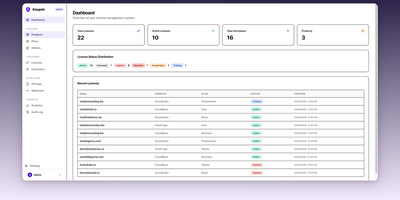
Software makers who would rather not rent a licensing backend use Keygate to issue, sell, and enforce license keys from infrastructure they control. You create desktop, SaaS, or hybrid products and sell them as subscriptions, perpetual licenses, perpetual licenses with a maintenance period, trials, or floating concurrent licenses that are checked out, heartbeated, and returned automatically. The admin dashboard manages products, plans, customers, licenses, API keys, webhooks, analytics, audit logs, team members, email templates, and branding, with search, filters, and CSV or JSON export. Your application activates and verifies keys through the license API, enforces per-device or per-user activation limits with grace periods, and can verify Ed25519 signed tokens offline with a public key. Usage metering tracks API calls, storage, bandwidth, or custom metrics against quotas with hourly, daily, monthly, or yearly reset cycles and webhook threshold warnings. Connecting Stripe makes checkout create licenses automatically, follows plan and seat changes with proration, handles refunds and cancellations, sends dunning emails after failed payments, and gives customers a billing portal and self-service license management. Team seats, feature entitlements, purchasable add-ons, scoped API keys, and optional S3-backed release hosting round out the selling stack in one binary with one PostgreSQL database. Running on a dedicated VPS on RepoCloud with guaranteed CPU, RAM, and SSD, full root SSH access, and a browser serial console. AGPL-3.0 licensed.