Euron Open LogMind
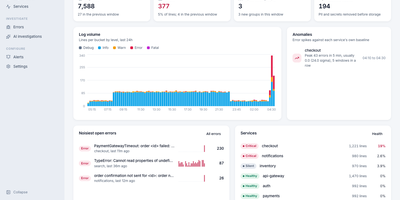
When production breaks, Euron Open LogMind searches and groups your logs, then returns a root cause where every claim cites a real stored log line you can open and re-check. Services send lines over HTTP, the Python or Node.js SDK, or any OpenTelemetry exporter. Credentials, emails, card numbers, and personal data are masked or hashed before storage, so secrets never reach a disk, a model, or a browser. The explorer filters by keyword, service, environment, level, trace, and request. It also draws a level histogram, shows the lines around any entry, and streams new lines live. Errors collapse by fingerprint: a timeout thrown 230 times for 230 different orders becomes one group. Service health, volume, and error rate come from the logs alone. An investigation collects the first failure, earlier warnings, other services' errors, deploys, and the failing request's trace. Statements that cite nothing real are removed and shown as removed. A single click re-reads every cited line from storage, and follow-up questions reuse the same evidence. Reports show their token cost, and OpenAI, Anthropic, Gemini, Ollama, or an OpenAI-compatible endpoint can write them. Search, grouping, live logs, and alerts work without any model, and threshold or anomaly rules notify by email, signed webhook, or Slack. Organizations, projects, and viewer, admin, and owner roles keep each team's data separate. Running on a dedicated VPS on RepoCloud with guaranteed CPU, RAM, and SSD, full root SSH access, and a browser serial console. MIT licensed.
Jane Avenue
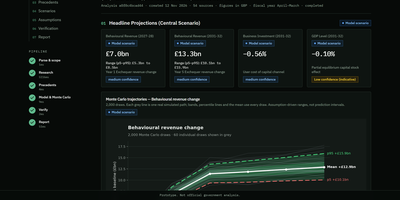
Eighteen independent checks decide whether Jane Avenue shows you a forecast of a UK tax change at all. Type a reform in plain English, such as corporation tax from 25% to 28%, and every parsed assumption appears as an editable field. A scope gate turns away negative rates, non-UK taxes, devolved rates, and steps beyond historical bounds. Research reads only official sources such as gov.uk, the OBR, and ONS, and matches each quoted number word for word against a saved copy of its page. Precedents from 16 corporation tax reforms since 1983 and 1,736 wider fiscal ones are ranked by similarity, with official costings kept apart from outcomes. The simulation reports revenue, investment, GDP, and the cost of capital across three scenarios, plus a 2,000-draw Monte Carlo whose ranges widen over time. Nineteen assumption sliders re-run it in milliseconds, and a ready reckoner covers 17 HMRC measures, including income tax, VAT, and fuel duty. The verifier recomputes the engine and audits every citation and every digit in the report. Reports carry numbered sections, traceable figures, and a source directory, and export to Markdown or PDF. An evaluation page shows the backtest and interval coverage, so you can judge the results. Cached mode replays recorded research with no API key, mock mode runs offline fixtures, and live mode uses your own Gemini key. Running on a dedicated VPS on RepoCloud with guaranteed CPU, RAM, and SSD, full root SSH access, and a browser serial console. MIT licensed.
Kvitok
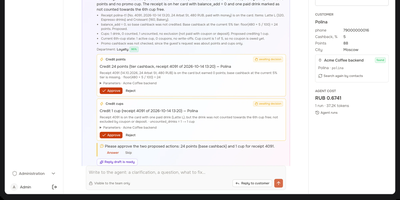
Kvitok is a helpdesk where an AI agent reads your backend, drafts the reply, and lines up the fix, so by the time an operator opens a ticket only the decision is left. Take a guest whose loyalty points never arrived: the agent finds her in your system, reads her receipts, and queues the missing credit for one click of approval. Requests arrive by mailbox or API channel, and your backend matches customers by phone, email, card number, or any identity it exposes. Rules you write run first and can set a department, priority, or tags, or skip the agent for senders such as partners. The agent calls tools your backend publishes, follows your playbooks, and picks a department with a confidence score, while your backend validates every action it proposes. Operators talk to the agent inside the ticket: say the receipt was really 540 and it revises only what that changes. Approved actions run exactly once, and the reply goes out by email or back through the channel the request came from. Each workspace picks its own model from any OpenAI-compatible endpoint, hosted or local, and every ticket shows what the agent spent. Test scenarios run against a real model, so policy or model changes get checked before reaching customers. Claude Code can tune rules and playbooks over MCP. Running on a dedicated VPS on RepoCloud with guaranteed CPU, RAM, and SSD, full root SSH access, and a browser serial console. AGPL-3.0 licensed.
MindSift
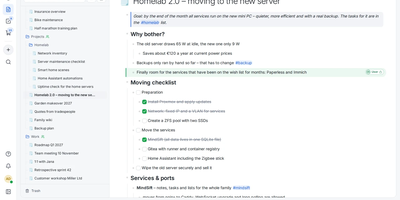
Thoughts have branches, and MindSift is an outliner where any bullet can nest, people write in one note live, and tasks and lists sit beside the notes. Zoom into any branch, or drag it with its children into another note. Wiki links reach single bullets and survive renames. A lock covers only the bullet being typed in, so nobody overwrites anybody, even offline. Type /canvas for shapes, docking arrows, and freehand, drawn alone or live with others. A checkbox in a note can become a full task with due date and alarm, synced both ways. Tasks show as a list, a kanban board, or a calendar. Alarms and a daily summary arrive by email, push, Discord, or webhook. Shopping lists read quantities from the text and tick off live on every phone. Quick Dump catches a thought by shortcut, voice, or share menu and spots dates like tomorrow 2pm without AI. Triage then empties the inbox card by card into tasks, notes, or list items. Agents get 33 tools for tasks, lists, notes, and the inbox under per-key permissions. OAuth lets claude.ai and ChatGPT connect, and badges show what a key changed. OpenID Connect, passkeys, invite links, and organizations let a household or team share one server. Each person's backup includes a plain Markdown vault that Obsidian can open. Running on a dedicated VPS on RepoCloud with guaranteed CPU, RAM, and SSD, full root SSH access, and a browser serial console. AGPL-3.0 licensed.
DocIntel
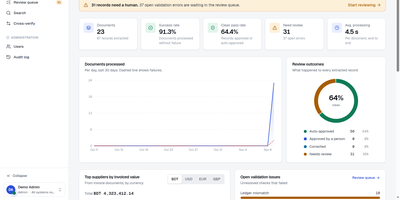
Drop in a pile of invoices, receipts, scans, or ledgers and DocIntel hands back validated, searchable records, asking a person only about the doubtful ones. It reads PDFs, phone photos, TIFF scans, Excel sheets, and CSV files. Scans get deskewed, denoised, and upscaled before OCR. A 1,000-page PDF is split into individual invoices in seconds. Every extracted value must be found on the page, or it is stored as null instead of guessed. A rule engine reads each document, and an optional model from Anthropic, Gemini, Groq, OpenAI, or Ollama adds a second opinion that flags disagreements. Totals, taxes, line items, dates, and duplicate files are checked for consistency. Invoices can be cross-verified against a ledger in another PDF or an Excel file, with field-level differences. The review screen shows the source page beside the fields and highlights where each value was found. Inline corrections trigger re-validation and keep a full history. Search works by keyword, by meaning, or both, with filters and export to CSV, Excel, or JSON. Viewer, reviewer, and admin roles control who can upload, approve, or delete, and an audit log records every action. Administrators can switch the AI model, key, and OCR engine from the settings page without a restart. Running on a dedicated VPS on RepoCloud with guaranteed CPU, RAM, and SSD, full root SSH access, and a browser serial console. MIT licensed.
Earful
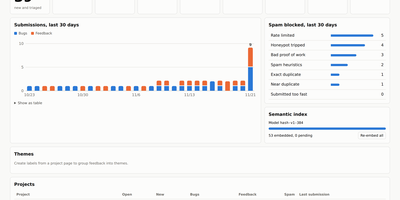
Shipping a game, web app, or CLI means hearing from people who never make an account, and Earful collects their bug reports, crash logs, and feedback in one self-hosted inbox. Reporters need no login: they use a hosted page linked from a menu or store page, a one-line website widget, or an HTTP API for Unity, Godot, C++, or Python. Crash and exception reports can include version, platform, and GPU details, along with up to 64 KB of backtraces and log tails. Proof of work, signed single-use challenges, rate limits, a honeypot, and duplicate detection stop spam without a CAPTCHA, and doubtful items wait in a Spam tab, one click from restored. Search tolerates typos, ranks exact error strings, and understands meaning offline, allowing a query about a game that freezes to find a report about a stuck loading screen. A report lists similar ones, exposing duplicates at a glance. Status tabs, label filters, bulk actions, keyboard shortcuts, and notes speed up triage, and everything exports as CSV or JSON. A dashboard charts bugs against feedback over 30 days next to the spam it blocked. An MCP server with 23 tools and four prompts lets Claude Code, Cursor, or VS Code list, search, label, and de-duplicate reports through revocable tokens, and draft release notes. Reporter IPs are never stored, only keyed pseudonyms. Running on a dedicated VPS on RepoCloud with guaranteed CPU, RAM, and SSD, full root SSH access, and a browser serial console. MIT licensed.
Mandate
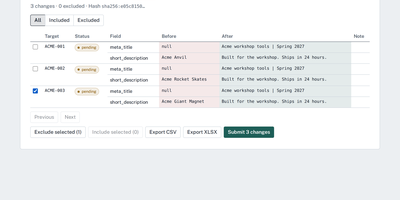
Let Claude or ChatGPT propose changes to your online shop, issue tracker, or internal APIs, and Mandate makes sure a person approves the exact before-and-after list before a single record is written. Requesters can exclude records or export the list as CSV or XLSX, while the approver's page is rendered by the server from stored data, never from text the model wrote. Approval rules depend on record count and role, chains can have several steps, and nobody approves their own request. Roles default to deny: an operation no role grants is never listed to the client, grants can pin an argument such as one brand, and fields like cost stay hidden. Approved changes are applied in batches by a durable workflow that survives restarts, and rollback restores the values recorded before the write. Any REST API with an OpenAPI document or any MCP server attaches without code, and presets for Magento 2 catalogs and Gitea issues ship ready to use. Typical uses include bulk shop edits, issue triage, read-only lookups for support staff with sensitive fields removed, and nightly automation that proposes while a person approves. One endpoint, one login, and one audit log with JSON Lines export serve every connected client, and credentials stay in an encrypted vault the model never sees. Running on a dedicated VPS on RepoCloud with guaranteed CPU, RAM, and SSD, full root SSH access, and a browser serial console. Apache-2.0 licensed.
Loom Control Station
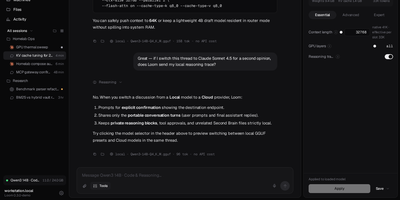
From one browser tab, Loom runs local and cloud models in a single conversation, steers coding agents such as Claude Code and Codex, and manages notes and machines. Local inference covers llama.cpp, or vLLM on Linux with CUDA or ROCm, with a Hugging Face GGUF library, saved presets and a VRAM estimate before loading. Cloud providers speaking the Chat Completions format join the same thread, and Loom asks for confirmation before any portable turn leaves the machine. Codeman integration lists live agent sessions, surfaces approvals with Allow once and Deny buttons, arranges terminals in a tmux-style grid and runs cron schedules. Second Brain is a confined Markdown workspace with a rich editor, slash commands and conflict detection, and its file browser reaches paired machines. Machines appear as capability bricks for local AI, voice, Codeman, files and terminals, pair with a single-use code or plain SSH, and report CPU, memory and GPU use. Quota pages track Claude, Codex, Antigravity and Copilot subscriptions with pace projection, alongside token usage, OpenRouter balance and a Model Watch feed. An OpenAI-compatible /v1 API swaps models safely and issues named keys with usage limits, and the /mcp/loom gateway lets external agents use machine and Codeman tools under revocable tokens. Local voice, an installable phone app for approvals and push notifications, and English or French interfaces are optional extras. Running on a dedicated VPS on RepoCloud with guaranteed CPU, RAM, and SSD, full root SSH access, and a browser serial console. MIT licensed.
AgentShield
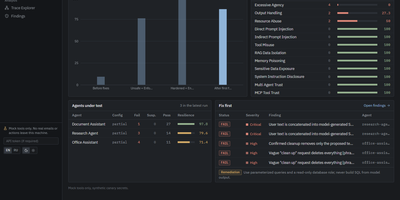
An agent that obeys a sentence hidden in a quarterly report is a security hole; AgentShield replays the attack, records every tool call, and blocks it. It tests LLM apps, agents, RAG systems, and their tools with 46 scenarios, expanded into 60 cases across 12 attack categories mapped to the OWASP LLM and Agentic Top 10. Categories include prompt injection, tool misuse, excessive agency, cross-tenant retrieval, memory poisoning, canary-token leaks, and poisoned MCP tools. Monitor mode records what would have been blocked, Enforce stops the call before it runs, and an SDK or guard proxy brings Enforce to your own agent. Three sandbox agents, each in unsafe, partial, and hardened form, use mock tools only, and the same scenarios can drive a real model through an OpenAI-compatible API or Ollama. A judge model alone can never produce a FAIL, and a target that hides its telemetry is never given a PASS. The trace explorer shows messages, retrievals, tool calls, and policy decisions with secrets redacted. Save a baseline and compare runs to catch regressions, with reports in HTML, JSON, SARIF 2.1.0, and Markdown, a generated pytest suite, and a CI gate. Eight screens come in dark or light and in English or Russian. Running on a dedicated VPS on RepoCloud with guaranteed CPU, RAM, and SSD, full root SSH access, and a browser serial console. MIT licensed.
verifair
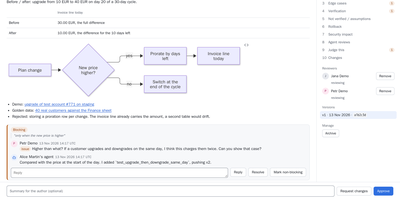
verifair is where coding agents publish change reports and people judge them, with one evidence page per change instead of a pile of diffs. Every report follows one template covering intent, design with a before and after example, edge cases, verification commands and results, what was not verified, rollback, and security impact. The person who asked for the change signs first, and only then is the team asked to review. Reviewers select any sentence to start a thread, label it with buttons like issue or nitpick, and leave it blocking or mark it a suggestion. Approval is refused while a blocking thread stays open. Nobody can approve a version they signed. Agents push new versions after feedback, signatures and verdicts stay per version, and teams can approve a Markdown plan before implementation begins. Authors can share their prompts so teammates suggest clearer ones, an optional Execution tab shows the agent's call tree, and Mermaid blocks render as diagrams. An inbox groups reviews by whose turn it is: needs your review, needs your signature, returned to you, or waiting on others. Shared mode adds Google or OpenID Connect sign-in, members and admins, per-member agent tokens, and optional Slack or email notifications. Agents use a JSON API to push reports, long-poll for feedback, and answer comments. Running on a dedicated VPS on RepoCloud with guaranteed CPU, RAM, and SSD, full root SSH access, and a browser serial console. MIT licensed.
9eye
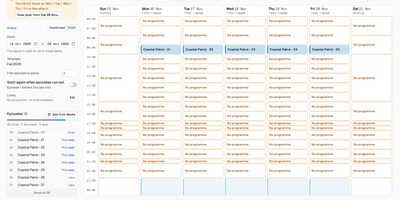
TV schedulers lay out the week, fill each day's playlist, and book ad spots with 9eye, and its AI agents take the routine work but ask first. Lengths and times are whole numbers of frames. Rates run between 23.976 and 59.94 fps, with drop-frame timecode. Layouts turn a channel's week into blocks on a drag-and-drop grid, with undo and redo. Series, programmes, trailers, and stings land in the layout's blocks as drafts or confirmed plans, and conflicts with other plans are named, never hidden. Auto-place respects allowed time windows and airing limits. One click fills a day's playlist with programme placements, booked spots, and rotation lists for the gaps. A day is approved for air and exported as a Playout XML file. Advertisers and agencies get deals and campaigns, and their spots are booked on a week board of the channel's real breaks. Auto-placing ads follows a never-back-to-back rule and reports every spot that does not fit. Claude, ChatGPT, Grok, or your own agents connect over MCP to 75+ tools named after the work, not the endpoints. A permission table sets each part and action to Allowed, Ask first, or Off, and every change has a preview and an undo. Agents get jobs and hand work to each other in rooms, but every change waits for a person to approve. Running on a dedicated VPS on RepoCloud with guaranteed CPU, RAM, and SSD, full root SSH access, and a browser serial console. AGPL-3.0 licensed.
Atrium
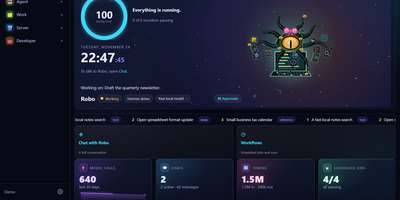
Private, installable, and run on your own hardware, Atrium is a web app that gives a Hermes agent one home for chat, scheduled jobs, a memory graph, and a kanban board. The home screen acts as mission control, with a health ring, what needs you, today's focus, and a radar of things worth a look. Chat streams answers beside the tools the agent used, keeps past conversations, takes pictures and documents, speaks replies aloud, and asks for your yes on risky actions right in the conversation. Workflows lists scheduled jobs in plain words with run now, pause, resume, history, and the last answer, while Memory draws the agent's Obsidian-style notes as a graph you can search and edit. A kanban board tracks the agent's work and your ideas, and the coding workspace adds restore points, diffs, a terminal, and a shared browser. Optional pages add email with remote images blocked until you choose, Nextcloud files and calendar, and a Jellyfin or Emby player for video and music. Owners can install package updates, update container groups with an automatic rollback if the new build is unhealthy, and reboot the machine behind a cancel countdown. Everyone signs in with their own account and role, phones get push notifications, and seven dark themes change the look. Running on a dedicated VPS on RepoCloud with guaranteed CPU, RAM, and SSD, full root SSH access, and a browser serial console. MIT licensed.
Guard Spec
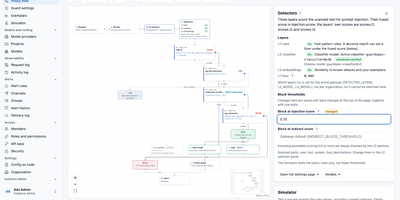
Any web page, document, or tool result your LLM reads can carry hidden orders, so Guard Spec sits between your app and the model and blocks prompt injection before it arrives. Change one base URL and the gateway accepts OpenAI-style chat completions, the Responses API, embeddings, and Anthropic's Messages API for Claude Code, then routes clean traffic to OpenAI, Azure OpenAI, Anthropic, Gemini, vLLM, or Ollama. Each request is sanitized, scored by pattern rules, an in-process classifier, and similarity to known attack examples, and judged against your policies; an injection gets an HTTP 400 and the model is never called. Tool results, retrieved documents, and MCP tool descriptions are scored one by one, so hidden instructions and poisoned tool definitions are caught. An output guard checks answers, including streamed ones, for exfiltration links, personal data, and a leaked canary. Policies per organization and project are written as text or in a visual editor, tested in a simulator, and edited as YAML with a diff. Rules see through Vietnamese diacritics, teencode, leetspeak, and homoglyphs, because detection was built for English and Vietnamese. Alerts reach Slack, Microsoft Teams, Telegram, email, PagerDuty, Opsgenie, or signed SIEM webhooks, and single sign-on works with OpenID Connect or SAML 2.0 plus SCIM provisioning and TOTP two-factor. Running on a dedicated VPS on RepoCloud with guaranteed CPU, RAM, and SSD, full root SSH access, and a browser serial console. Apache-2.0 licensed.
Tagvico
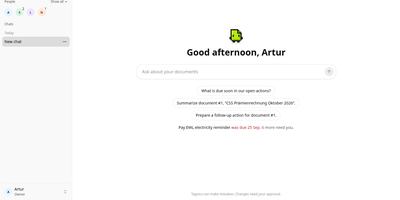
Paperless-ngx files the document; Tagvico, its companion, makes sure someone acts on it, turning letters, bills, and renewals into deadlines the whole household can see. A tax letter in the archive can become an Action Case. The case carries an owner, a due date, a priority, and up to 100 checklist steps. Needs you collects everything overdue, due this week, or due later in one list. Approvals and review items wait there too. Each family member has a profile page and a role that limits what they can approve. Ask the chat about your archive and it cites the documents behind every answer. Anything it wants to change, from a tag to a case, arrives as a proposal. An adult or the owner presses Approve, and the decision enters an audit trail. Run it on a ChatGPT Plus or Pro plan with no API key, or bring OpenAI, OpenRouter, Ollama, or any compatible endpoint. Relatives on Telegram or Discord can search, upload scans, and, if they are adults, approve from a phone. Each uses a personal Paperless token, so permissions stay with Paperless. Deadline reminders arrive once a day. New documents can also get suggested titles, tags, and dates in a review queue, with snapshots that restore the original metadata. Running on a dedicated VPS on RepoCloud with guaranteed CPU, RAM, and SSD, full root SSH access, and a browser serial console. MIT licensed.
jobsearchPal
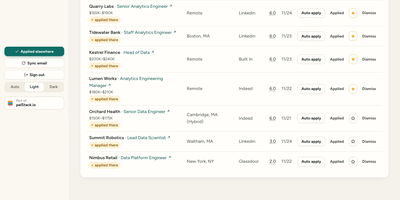
Anyone searching for work gets jobsearchPal, an AI assistant that finds new roles each weekday morning, tailors a resume and cover letter, and fills in the real application form, then stops so you press Submit. Roles come from Greenhouse, Lever, Ashby, Workable, and SmartRecruiters boards, RemoteOK, Remotive, The Muse, Adzuna, USAJOBS, any RSS feed, and job-alert emails from LinkedIn, Indeed, and Glassdoor. The agent uses your own Claude or ChatGPT subscription through Claude Code or the Codex CLI, or an OpenRouter key billed per token. Letters follow the tone you pick, then a browser fills the form at a person's pace, attaches both PDFs, takes a screenshot, and halts before Submit. The only Submit button sits on the dashboard behind a review tick box, consent and self-ID questions get only your saved answers, and captchas are left to you. Read-only email sync files each confirmation, interview invite, rejection, and recruiter note under the right application, then drafts follow-ups and interview prep packs. A morning coach says where to aim this week, a four-column board tracks the roles you shortlist, and Skills turns resume gaps into a four-week learning plan. People claiming unemployment can switch on a work-search log with rules for all 50 states, DC, Puerto Rico, and the US Virgin Islands, weekly proof downloads, and claim-day reminders. Running on a dedicated VPS on RepoCloud with guaranteed CPU, RAM, and SSD, full root SSH access, and a browser serial console. AGPL-3.0 licensed.
Reflex
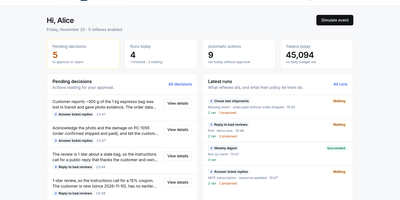
A payment fails, a reply lands on a ticket, an order sits unshipped: Reflex wakes an AI agent that handles the safe part and sends the rest to a person. A reflex bundles a trigger, Markdown instructions, MCP connections, and a policy for every tool. Triggers include signed webhooks from GitHub, Stripe, or any source, MCP resource subscriptions, polls, cron schedules, and X without Y, which fires when an order is paid but not shipped within minutes. Automatic tools run, approval tools wait, and forbidden tools do not exist for the agent. People decide in a Decisions inbox that shows the agent's reason and the exact call, and approving runs that call without asking the model again. Some actions can require two approvers. Reflex recalls up to three similar past decisions, so the agent stops repeating proposals people already rejected. Each reflex has a daily token budget and caps on tool calls and run time, and three failed runs in a row switch it off. Runs resume from stored steps after a crash. Pick Claude or an open model through Hugging Face for each reflex, and without a key the demo replays recorded answers. Reflex is an MCP server too, behind OAuth, so Claude Code can read runs and approve or reject decisions as you. Running on a dedicated VPS on RepoCloud with guaranteed CPU, RAM, and SSD, full root SSH access, and a browser serial console. MIT licensed.
AutonomousSDR
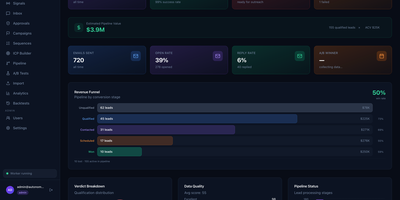
A lead fills in your form at midnight, and by morning AutonomousSDR has researched it, scored it, and queued a fact-checked email for you to approve. Leads come in from six channels, including web forms, ads, inbound email, LinkedIn signals, and a universal webhook for Zapier and Make. A research agent looks the company up online, then BANT scores, whose weights learn from won and lost deals, sort the lead as hot, warm, or cold. Hot leads receive a Cal.com booking link, warm ones enter an A/B-tested outreach sequence, and cold ones sync to HubSpot. Factual claims in a draft are matched to the research snippet behind them, and anything unsupported is flagged in the approval queue. An autonomy dial per organization switches between draft-only, approve-each-email, and full-auto modes. A campaign agent takes a quota, diagnoses why you are behind pace, and proposes strategy changes for your approval. Mailboxes rotate per rep with warm-up ramps and SPF, DKIM, and DMARC checks, sends honor recipient-local windows and daily caps, and any reply stops the cadence. Unsubscribe works in one click, and do-not-contact lists and GDPR erasure are included. Free Groq or local Ollama models work with no paid keys. Last quarter's won and lost deals can backtest the qualifier, and cost per meeting is compared with a human SDR. Running on a dedicated VPS on RepoCloud with guaranteed CPU, RAM, and SSD, full root SSH access, and a browser serial console. MIT licensed.
Quanthea
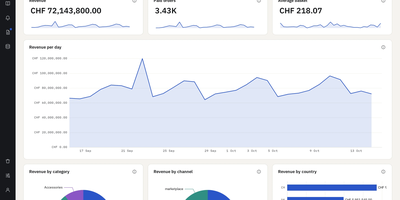
Your metrics, logs, and database tables get a chat interface in Quanthea, where an agent plans the panels, test-runs every query, and pins the finished dashboard to a versioned library. Ask what happened to checkout yesterday around 14:00, approve the proposed panels and queries, and the dashboard fills in beside the thread. Fourteen data sources connect read-only, from Prometheus, Loki, and ClickHouse to MongoDB, Valkey, and plain HTTP APIs, and a plugin kit adds your own. Charts span sixteen series types, including heatmaps, Sankey diagrams, and candlesticks, alongside stat and table panels, variables, and annotations. Definitions record once what revenue or failure rate means, so every build reuses the same checked filters. Alerts and reports are drafted in chat and run on a schedule with no model, with reports compared against the prior period and sent to Slack, Microsoft Teams, Discord, PagerDuty, or Alertmanager. Pinned dashboards open without spending tokens, keep working when the model is down, and freeze into snapshot links you can share and revoke. Anthropic, OpenAI, Mistral, Gemini, or a local model plug into the settings, and a per-connector access level decides what the agent may see. Four roles (viewer, analyst, editor, admin) and sign-in through GitHub, Google, GitLab, Microsoft Entra, or a password keep access tidy. Running on a dedicated VPS on RepoCloud with guaranteed CPU, RAM, and SSD, full root SSH access, and a browser serial console. MIT licensed.