Ybkkasi
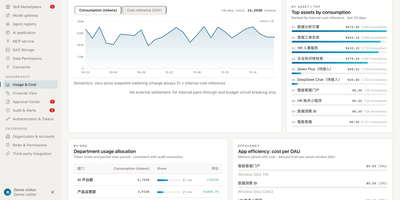
Enterprises keep buying AI tools and wondering why output does not compound, when the real gap is governance: nobody can say which agent owns what, what it may touch, or what it cost. Ybkkasi answers those three questions in one console for every MCP server, skill, agent, and AI application you run. Register each asset and move it through a lifecycle state machine from discovery to retirement, with 85 permission points deciding who can view, call, publish, or approve at every step. Work itself is organized as goals that break into projects and tasks, assigned to digital employees who each carry a home organization, a human supervisor, and a roster status. Approvals route through a dedicated center where lifecycle changes and sensitive actions wait for a human decision instead of happening silently. Every call is metered, so usage and cost reports attribute spend by department, by agent, and by skill, making showback a query rather than an argument. The audit log records who did what to which asset and when, giving compliance a trail they can actually read. Running on a dedicated VPS on RepoCloud with guaranteed CPU, RAM, and SSD, full root SSH access, and a browser serial console. MIT licensed.
Playerr
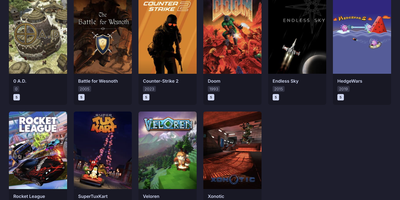
Playerr is a self-hosted library manager that organizes your game collection the way Radarr and Sonarr organize movies and shows, with scanning, metadata, and automated downloads in one web interface. Point it at your game folders and its recognition engine recursively identifies platforms and maps local files to the right titles. Each game is enriched with artwork, descriptions, ratings, and release dates pulled from IGDB and Steam, turning a pile of folders into a browsable collection. Search indexers through Prowlarr and Jackett when you want to grow the library, then hand downloads to qBittorrent, Transmission, SABnzbd, or NZBGet and watch progress from the same screen. Folders are renamed automatically from sanitized IGDB titles while the original release structure stays intact, so the library stays tidy without manual filing. Your Steam library syncs into the same unified view alongside locally stored games. Installation packages are processed automatically, with the primary executable identified to streamline setup. Remote access can be enabled from settings so the collection is reachable from phones, tablets, and laptops on your network. Running on a dedicated VPS on RepoCloud with guaranteed CPU, RAM, and SSD, full root SSH access, and a browser serial console. MIT licensed.
FlowForge
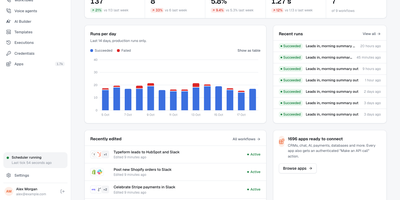
Why pay a per-task bill for workflow automation when FlowForge connects 1,690 apps, builds workflows from a plain-English sentence, and puts AI receptionists on your phone line? Drag triggers, actions, If/Else branches, and filters onto a canvas, then map data between steps by dragging fields. Type "when a Typeform comes in, add the contact to HubSpot and tell #sales" and the AI Builder drafts, links, and saves the workflow. Bring your own OpenAI, Claude, Gemini, DeepSeek, or Qwen key, or point it at Ollama. Services missing from the catalog become custom apps from their documented API or an OpenAPI file, and n8n exports are rebuilt by the AI. Voice agents answer and place calls as clinic receptionists, salon booking lines, or lead qualifiers. Test them free in the browser, then add real numbers through Vapi or ElevenLabs. Every call lands with a recording, transcript, summary, and booking. Failed runs retry from the failing step for up to six hours, and writes that may already have gone through are never repeated. Each step keeps its input, output, and HTTP request for debugging. Claude Code or Cursor can build and run workflows through an MCP endpoint with a personal token. Webhooks, plain-word schedules like every weekday at 9:00, and app polls all run from one cron job each minute. Running on a dedicated VPS on RepoCloud with guaranteed CPU, RAM, and SSD, full root SSH access, and a browser serial console. AGPL-3.0 licensed.

Tasterr
Tasterr is a self-hosted discovery front end that learns what each person in your household actually likes and fills the home screen with movie and show rails picked for them. It reads the TMDB catalog in your chosen metadata language and merges it with your Plex, Jellyfin, Seerr, and Trakt accounts, so library titles, requests, and watch history shape every recommendation. Continue Watching pulls resumable movies, episodes, and next-up picks from Plex and Jellyfin into one rail, and Because You Watched rails spin off new suggestions from finished titles. Watched titles disappear from discovery by default, a Not interested button banishes titles for good, and My List keeps the maybes one tap away. When the household gathers, Something for Everyone Tonight blends member profiles into one shared shortlist, and Picks You Wouldn't Usually Watch deliberately wanders outside each profile. Requests flow into Seerr under the signed-in member's name, availability badges show where a title already lives, and admins tune regions, streaming services, rails, language, theme, and accent color. Running on a dedicated VPS on RepoCloud with guaranteed CPU, RAM, and SSD, full root SSH access, and a browser serial console. AGPL-3.0 licensed.
TRouteAI
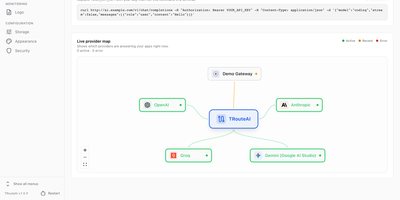
More than 290 AI providers sit behind one OpenAI- and Anthropic-compatible address in TRouteAI, and a combo moves to its next model when the current one fails or hits a usage limit. A combo is one model name that chooses among several provider models by one of 19 routing strategies, including in order, round robin, weighted, and cost-optimized. An account whose 5-hour, weekly, or daily limit is used up is skipped without a request until it resets. Chat, Responses, embeddings, images, and audio follow the OpenAI format, and /v1/messages follows Anthropic's. Any compatible server can join as a custom provider. Claude Code connects with a base URL, a key, and a combo name, /model lists the gateway's models once discovery is on, and context-limit errors arrive in wording that lets it compact and carry on. Create one API key per app to follow its requests, tokens, and estimated cost, find its calls in Logs, or switch it off at any time. When every slot of a round-robin combo is busy, requests queue for two minutes by default, a priority header or per-key default puts interactive ones first, and a busy answer carries a Retry-After. Provider credentials are encrypted at rest, nothing is sent as telemetry, and Settings swaps the app's name and logo for your own. Running on a dedicated VPS on RepoCloud with guaranteed CPU, RAM, and SSD, full root SSH access, and a browser serial console. MIT licensed.
Euron Open SupportDesk
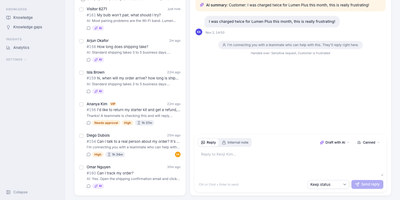
Behind one script tag on your website, Euron Open SupportDesk runs an AI help desk that answers customers from your documents, cites sources, and hands everything else to your team. Feed it PDFs, Word files, Markdown, HTML, or FAQ CSVs, or point it at a page or sitemap, and it indexes them in the background. No source, no answer. Your team gets the handoff with the transcript, a summary, and the reason. Refunds, cancellations, account changes, billing disputes, and data deletion are held for approval, and VIP or frustrated customers go straight to a person. Questions the documents miss become knowledge gaps. An agent's reply turns into the draft article, and publishing it lets the AI answer next time. Start with no API key at all, quoting your documents, or pick a local Ollama model, Anthropic, OpenAI, or vLLM. A ledger tracks tokens, cost, and delay for every model call, and daily or monthly budgets cap the spend. Around the AI sits a full helpdesk: shared inbox, views, round-robin routing by capacity, SLA timers, canned replies, and bulk actions. Customers reach you through the widget, threaded email, a magic-link portal, or a public help center. Analytics track first response, resolution time, deflection, and CSAT, and a REST API with signed webhooks feeds your other tools. Running on a dedicated VPS on RepoCloud with guaranteed CPU, RAM, and SSD, full root SSH access, and a browser serial console. MIT licensed.
CRM for WhatsApp
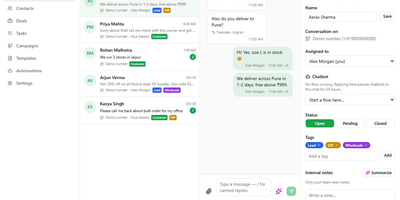
When several people answer customers on one WhatsApp number, chats get missed and replies collide, and CRM for WhatsApp fixes that with a shared real-time inbox tied to contacts, deals, campaigns, chatbot flows, and an AI assistant. Numbers connect through Meta's official Cloud API or by scanning a QR code, which is unofficial and carries a ban risk that warm-up and pacing only reduce. The inbox updates in real time with assignment, internal notes, tags, quick replies, media, and read receipts, and offers approved templates once the 24-hour window closes. Contacts carry custom fields, consent status, and segments with CSV import and export, a drag-and-drop pipeline tracks deals, and tasks send reminders. Campaigns send Meta-approved templates that can be synced or submitted from inside the app, with scheduling, throttled sending, and live delivery reports. A visual flow builder chains menus, validated questions, conditions, delays, tags, deals, webhooks, and AI replies, started by a keyword, a first message, or a campaign reply. The assistant suggests replies, rewrites and translates messages, summarizes chats, and answers from a knowledge base using the workspace's own OpenAI, Gemini, or Claude key. A REST API and signed webhooks come with every workspace. Resellers get plans, trials, coupons, invoices, four payment options, white-label branding, and a super-admin panel. Running on a dedicated VPS on RepoCloud with guaranteed CPU, RAM, and SSD, full root SSH access, and a browser serial console. MIT licensed.

LetterSpace
Keep your newsletter audience on infrastructure you own with LetterSpace, a self-hosted platform for subscriber lists, campaigns, and email analytics. Organize subscribers into lists inside your organization, enrich each address with metadata pairs, and use those values as placeholders inside the mail you send. Campaigns begin as drafts where subject, content, template, target lists, and tracking choices stay editable until you deliberately start the send. A test copy goes to your own inbox first, and a future schedule time holds the campaign until the moment arrives. Reusable HTML templates wrap every campaign in your house style, with the content injected at send time and an unsubscribe link in the footer. Once mail flows, the dashboard follows subscriber growth across six months, recent campaign delivery rates, and open and click performance compared between the last thirty days and the period before. Delivery itself runs through your SMTP settings with per-organization rate limits, retries, and concurrency controls, and provider webhooks can report bounces and confirmations back into message statuses. Signup forms and external tools connect through a REST API guarded by keys, with double opt-in available for new subscribers. Running on a dedicated VPS on RepoCloud with guaranteed CPU, RAM, and SSD, full root SSH access, and a browser serial console. MIT licensed.
tracesage
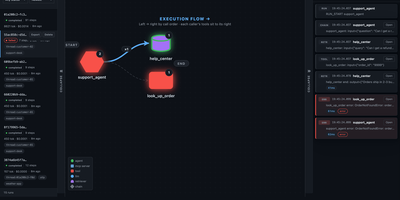
Every model call, tool call, and subagent behind an AI answer becomes a trace you can click through, replay, and search in the browser. LangChain and LangGraph runs are captured natively, Pydantic AI, OpenAI Agents SDK, CrewAI, and the OpenAI and Anthropic clients join with one line, and any OpenTelemetry exporter can post spans to the built-in collector. Run tracesage connect and Claude Desktop, Claude Code, Cursor, and Codex sessions appear as full traces, with every subagent nested under the call that spawned it. A failed tool call shows up as a red node on the exact step that broke, input and error included. A topology graph maps agents, tools, models, retrievers, and MCP servers, step-through replay walks a run at up to 5x, and a waterfall shows which step took the time and what it cost. Search covers prompts, replies, tool output, and errors across every assistant, and a Threads tab reads whole conversations as chat. Developers get terminal commands to show, watch, diff, and export runs, plus a pytest fixture that asserts which tools were called and how many tokens were used. Traces can flow out as OpenTelemetry spans to Tempo, Jaeger, Datadog, Honeycomb, or Phoenix. A bearer token protects a server exposed beyond localhost, and it refuses a public address without one. Running on a dedicated VPS on RepoCloud with guaranteed CPU, RAM, and SSD, full root SSH access, and a browser serial console. Apache-2.0 licensed.
NitroMTA
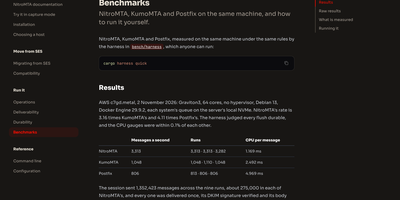
Your application already knows how to send mail through Amazon SES; NitroMTA lets it keep that code, change the endpoint and keys, and deliver from IP addresses you actually control. The engine answers a submission only after the message is committed to disk, so accepted mail survives a crash, a power cut, and even the loss of its host when the disk survives. Capture mode runs the whole engine locally and shows each message in a browser at port 9090 instead of sending it, which makes testing painless before any DNS exists. Out in production, new IPs warm up receiver by receiver from fifty messages a day, rising after clean days and backing off when complaints, bounces, or throttling climb. Each provider gets its own connection limits and cooldowns, hard bounces and spam complaints suppress the address automatically, and outgoing mail is DKIM-signed and sent over TLS with MTA-STS and DANE verified where published. Templates, identities, configuration sets, tenants, dedicated IPs, and SES-shaped events through an SNS subset cover the SES surface your tooling expects, and a CLI explains why any given message is still waiting. Running on a dedicated VPS on RepoCloud with guaranteed CPU, RAM, and SSD, full root SSH access, and a browser serial console. Apache-2.0 licensed.
Blockbusterr
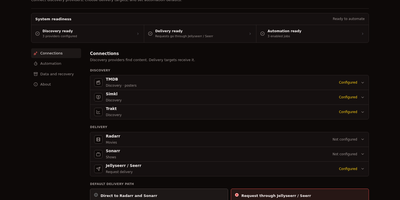
Your Radarr and Sonarr libraries only grow when someone remembers to add titles, and Blockbusterr removes that chore by discovering movies and shows on a schedule and delivering the ones that pass your rules. Jobs pull trending, popular, anticipated, box-office, and list feeds from TMDB, Simkl, Trakt, and MDBList, with experimental Letterboxd lists available when enabled. Every job applies one reusable rule set: content-rating limits, blocked and allowed titles, genre, year, runtime, language, and vote boundaries decide what qualifies before anything reaches your stack. Weighted scores blend IMDb, Trakt, TMDB, and Metacritic ratings, and Smart Popular adjusts its threshold against the feed it reads. Preview mode shows accepted, rejected, and skipped titles with the reason for each decision, so a new job can be tuned safely before it runs unattended. Delivery sends movies straight to Radarr and shows to Sonarr, or creates Jellyseerr and Seerr requests when you prefer an approval queue. Per-job caps and a rolling global budget keep a busy feed from flooding disk space, and an instance-wide dry run tests the whole setup without touching your library. Activity entries and job-run history record scores, decisions, and outcomes with posters. Running on a dedicated VPS on RepoCloud with guaranteed CPU, RAM, and SSD, full root SSH access, and a browser serial console. MIT licensed.
ibl.ai Ontology
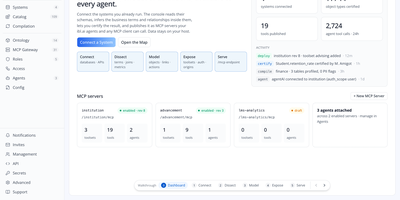
Turning a company's databases and web APIs into shared business terms, ibl.ai Ontology publishes certified tools that Claude, Codex, and other agents can call. Five pages carry the work: connect a SQL or API source, map tables under business terms, certify what the engine inferred, choose toolsets and origins, then deploy and watch calls arrive. SQL sources like MySQL, Snowflake, and ClickHouse are mapped and served as tools, while any system with an HTTP API joins through its OpenAPI document or hand-named endpoints. SQL logins are read-only, personal columns are tagged and masked before samples reach a model, and row limits come from toolset grants, fixed SQL, or sign-in claims. Callers sign in with ibl.ai credentials, Microsoft Entra ID, Google, or a custom OIDC issuer, API keys are limited to toolsets, and each caller gets 30 tool calls a minute. Each certified term becomes a tool with fixed SQL that an agent cannot widen, and the Playground runs any tool as you, showing what your grants return. Servers keep revisions with a Roll Back button, every tool call and refusal appears in an activity log, and a model key adds plain-language questions answered with the SQL that ran. Agents from ibl.ai attach in one dialog, while Claude Desktop, Codex, Cursor, Windsurf, and custom Model Context Protocol clients connect with a pasted snippet. Running on a dedicated VPS on RepoCloud with guaranteed CPU, RAM, and SSD, full root SSH access, and a browser serial console. MIT licensed.
AI API Cost Tracker
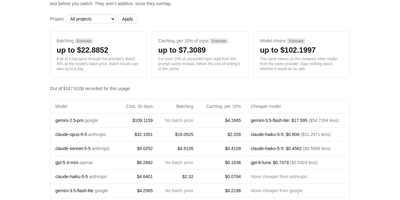
AI API Cost Tracker is an open-source ledger that prices every OpenAI, Anthropic and Gemini request and charges it to the customer, feature or agent run behind it. Apps report token counts through one HTTP endpoint, dependency-free client libraries or OpenTelemetry traces. Prompts and responses are never stored. Each request is costed at the price in force that day, so a rate change never rewrites history. Dashboards break spend down by project, provider, model, customer, feature and run, forecast month-end spend and flag spikes. Budgets, monthly or per run, alert at 80% and 100% by signed webhook, Slack or email. Agents can check a budget before they spend, or reserve it so concurrent steps cannot overspend. A "Why spend changed" page splits a rise into volume, model mix, tokens per request and price, and savings estimates size batching, caching and cheaper models. Outcomes turn spend into cost per resolved ticket. Reconciliation compares recorded costs with Anthropic's cost report, OpenAI's costs API and Google Cloud's billing export. An optional billing ledger sets each customer's revenue against their AI cost, drafts Stripe invoices and shares read-only portal links. Exports cover CSV, FinOps FOCUS and a reporting API. Roles, invitations and an audit log serve teams, with OpenID Connect sign-in for providers such as Okta or Keycloak. Running on a dedicated VPS on RepoCloud with guaranteed CPU, RAM, and SSD, full root SSH access, and a browser serial console. MIT licensed.
WebDuck
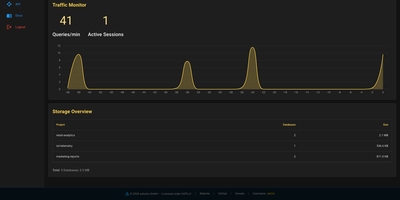
A DuckDB file is fast, but sharing one across a team usually means passing it around by hand. WebDuck puts DuckDB behind a server, so analysts and applications reach the same databases through a REST API or a dark amber web interface. Projects group databases, and each database can carry its own API password with read, write, or admin access levels. The dashboard shows server status, a live view of incoming REST traffic, and storage use. A browse view offers tree navigation, infinite scroll, and inline cell editing. The SQL editor runs multi-statement scripts, keeps a query history, accepts Alt+Enter to execute, and can load a whole SQL file. Import and export handle CSV, Parquet, and JSON up to 256 MB. Deleted databases move to a trash where they can be restored. Per-database write protection and a compression action keep files safe and small. Administrators sign in with bcrypt-hashed passwords and JWT tokens, and the interface ships in English and German. Setup comes through Docker, pip, or a YAML file, and a small command line initializes the server, adds users, and reports status. Running on a dedicated VPS on RepoCloud with guaranteed CPU, RAM, and SSD, full root SSH access, and a browser serial console. AGPL-3.0 licensed.
Euron Open ContextForge
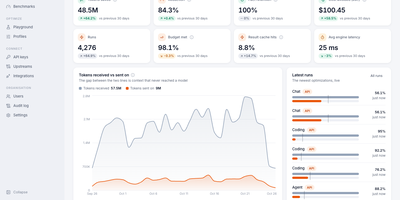
Euron Open ContextForge shrinks the history, retrieved passages, and tool output an LLM app is about to send, so each call costs fewer tokens and still carries every fact the task needs. Counts use the target model's own tokenizer, exact for OpenAI families. System instructions, recent turns, pinned messages, and tool call pairs are never rewritten, and any string you name stays intact. Duplicates go first (repeated turns, repeated test logs), then bulk tool output, with JSON kept valid and file reads kept whole. No GPU, no paid model, no network: the same input always gives the same output. What remains is ranked by relevance, recency, and importance, and older history folds into a verbatim summary of goals, constraints, decisions, facts, errors, and open questions. Six workload profiles (coding, agent, research, RAG, support, chat) split the budget differently, and a missed budget escalates balanced mode to aggressive. A citation map records whether each document id was kept, compressed, merged, or dropped, so references still resolve. Use it as a library, a REST API with optimize, count, summarize, rank, and job endpoints, or a streaming proxy that any OpenAI SDK can point at. A dashboard adds a playground with before and after panes, a per-stage trace, run history, and a benchmark against plain truncation. Budgets it cannot meet are reported, never silently cut. Running on a dedicated VPS on RepoCloud with guaranteed CPU, RAM, and SSD, full root SSH access, and a browser serial console. MIT licensed.
Euron Open AI API Gateway
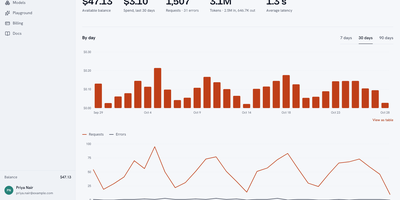
If you resell or share AI model access, Euron Open AI API Gateway turns scattered provider accounts into one key, one price list, and one prepaid balance. Point an OpenAI or Anthropic SDK at it, swap the base URL and key, and every chat model answers in either wire format, with streaming, tools, and images translated both ways. Operators connect OpenAI, Anthropic, Gemini, or hosts like Groq, OpenRouter, and a self-run vLLM, then set a margin by default, per model, account, or key; zero means at cost. Callers top up a USD balance through Stripe, or in rupees through Razorpay with UPI, cards, and netbanking at a rate locked per order. Before any provider is called, the worst-case price is reserved, so parallel requests cannot overspend. A refused request costs nothing. API keys carry a model allow-list, monthly budget, rate limits, and IP rules, and request bodies are logged only when the key's owner opts in. When a provider times out or returns a 429 or 5xx, the request moves to the next route while circuit breakers and health probes sideline the failing one. Developers get a usage log with tokens, latency, and the exact price of every request, plus a streaming playground. The admin console covers accounts, credit grants, rate-limit tiers, circuit health, revenue against provider cost, and an audit trail. Running on a dedicated VPS on RepoCloud with guaranteed CPU, RAM, and SSD, full root SSH access, and a browser serial console. MIT licensed.
Agent Fleet
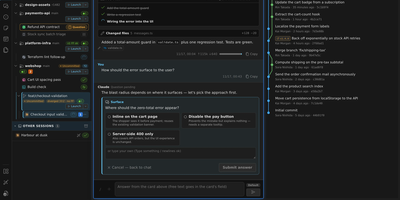
Closing the laptop no longer stops your coding agents: Agent Fleet runs Claude Code, Codex, GitHub Copilot, Cursor, and five more agent kinds on your own server, each member in a persistent, isolated workspace. One session list shows which agents are working and which are waiting on a question, a plan, or a permission prompt. Answer from a card in the browser, on a phone, or in the session's Slack or Discord thread. Each session can start in its own git worktree, and the console adds a commit graph, diffs, staging, split panes, and a live terminal. A session can hand a review to another agent kind, and a fleet graph draws who started whom. Scheduled runs wake a stopped workspace, and a turn cut short by a usage limit resumes when the limit lifts. Token use is broken down by feature, agent, and model, with calls that report no tokens counted as unmeasured. Sign-in works through Google, Microsoft Entra ID, GitHub, or any OIDC provider such as Okta or Keycloak, with tenants, roles, an audit log, and encrypted secrets. The interface switches between English and Japanese, and HTTPS certificates come from Let's Encrypt. Running on a dedicated VPS on RepoCloud with guaranteed CPU, RAM, and SSD, full root SSH access, and a browser serial console. Apache-2.0 licensed.
Euron Open AgentOS
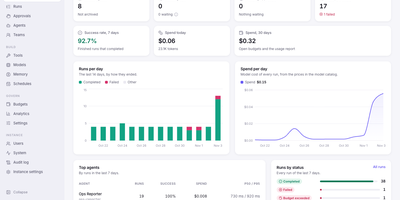
Euron Open AgentOS is a runtime for AI agents that checks every model call against a budget before it is sent and pauses risky tool calls for human approval. Define an agent with instructions, tools, memory, limits, and a model from OpenAI, Anthropic, Gemini, Ollama, or any OpenAI-compatible endpoint, then start it from the dashboard, the API, the Python SDK, a schedule, or a webhook. Budgets cap tokens and cost for a run, an agent's day, a project's day or month, and an organization's month, and a delegated team shares one pool. Any tool can require approval always or only when its arguments match a rule, and reviewers can approve, reject, or edit its arguments. Code, shell, git, and browser tools run in a separate sandbox that holds no credentials and limits browsing to an allowlist of domains. Every step is checkpointed, so a crash or a pause resumes the run where it stopped instead of repeating finished work. Teams work in sequence, in parallel, under a supervisor, or in collaborative rounds, and the Run Inspector shows every delegation as a child run. Built-in tools cover web search, files, CSV and JSON queries, read-only SQL, and email; custom HTTP tools and MCP servers add more. Organizations, projects, roles, API keys, OIDC sign-in, and an audit trail keep teams apart. Running on a dedicated VPS on RepoCloud with guaranteed CPU, RAM, and SSD, full root SSH access, and a browser serial console. MIT licensed.