Eclipse Ditto
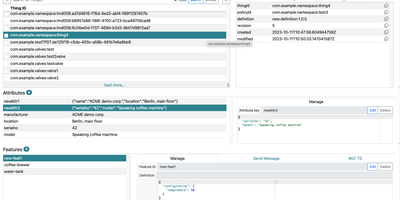
Every physical device on your network gets a living digital counterpart in Eclipse Ditto: a Thing whose Features hold its current state, desired state, and properties, readable and writable through APIs even while the device itself is offline. Your application talks to the twin over a REST-like HTTP API for CRUD and search, over WebSocket for real-time bidirectional streams, or over Server-Sent Events for change notifications, and Ditto routes commands down the live channel to the actual device when it is connected. Devices and backends connect through managed Connections to MQTT, AMQP 1.0 and 0.9.1, Apache Kafka, and HTTP endpoints, with payload mapping that translates between device formats and Ditto Protocol JSON. Fine-grained Policies decide per subject and resource who may read a temperature, change a setpoint, or receive an event, including namespace-scoped entries and partial change notifications that only reveal fields a subscriber may see. Search across millions of twins uses an RQL query language with custom MongoDB indexes, and Web of Things integration generates Thing Descriptions scoped to each requester's permissions. The bundled Explorer UI lets operators browse Things, inspect Features, and time-travel a twin's state to any past revision or timestamp to see exactly what changed and when. OpenID Connect and basic authentication protect the gateway, and Prometheus metrics expose live entity counts per namespace. Running on a dedicated VPS on RepoCloud with guaranteed CPU, RAM, and SSD, full root SSH access, and a browser serial console. EPL-2.0 licensed.
Magistrala
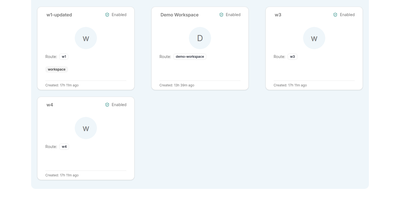
Thousands of devices speaking four different protocols is where IoT projects usually dissolve into glue code; Magistrala replaces that tangle with one platform where MQTT, HTTP, WebSocket, and CoAP clients share a single identity, provisioning, and messaging model. You organise work into domains, register clients for devices and applications, and connect them to channels that control who publishes and who subscribes, with fine-grained policies deciding which client may touch which channel. Protocol adapters bridge the transports, so a sensor publishing over MQTT and a dashboard reading over WebSocket meet in the same channel without translators in between. Telemetry lands in TimescaleDB through dedicated writer services and comes back out through reader APIs, while the bundled three-node FluxMQ cluster carries the messaging load with mutual TLS on device connections. The rules engine reacts to incoming messages with conditions and actions, alarms flag the readings that breach them, and reports package fleet data for the people who never open a terminal. A Community web UI covers domains, clients, channels, messages, and rules for day-to-day operation, and everything deploys as one Docker Compose stack with Prometheus metrics and Jaeger tracing already wired in. Running on a dedicated VPS on RepoCloud with guaranteed CPU, RAM, and SSD, full root SSH access, and a browser serial console. Apache-2.0 licensed.
EMQX
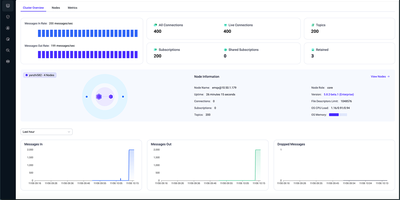
With over 16,500 GitHub stars and a track record powering connected vehicle fleets, smart city sensor networks, and industrial IoT deployments, EMQX is the MQTT messaging platform engineered to handle 100 million concurrent device connections in a single cluster while processing millions of messages per second with sub-millisecond latency. The protocol stack supports MQTT 5.0, 3.1.1, and 3.1 with full QoS 0/1/2 support, shared subscriptions, retained messages, and will messages, plus MQTT over QUIC for faster connection setup, reduced head-of-line blocking, and seamless connection migration on mobile networks. The gateway framework extends connectivity to MQTT-SN, CoAP, LwM2M, STOMP, and ExProto for bridging legacy industrial protocols. The SQL-based rule engine processes and transforms messages in real time with over 50 pre-built integrations including Kafka, PostgreSQL, MySQL, MongoDB, InfluxDB, TimescaleDB, ClickHouse, Redis, AWS Kinesis, GCP Pub/Sub, and Azure Event Hubs. The visual Flow Designer creates data processing pipelines without code. Built on Erlang/OTP with a masterless distributed architecture using Mria for state replication, the cluster separates Core nodes for data consistency and Replicant nodes for client-handling workloads. Authentication supports username/password, JWT, PSK, X.509 certificates, and LDAP with configurable ACL rules. The built-in dashboard provides real-time monitoring of connections, subscriptions, topics, message rates, and cluster health. Deployment runs via Docker, Kubernetes with the EMQX Operator, or native packages. Running on a dedicated VPS on RepoCloud with guaranteed CPU, RAM, and SSD, full root SSH access, and a browser serial console. BSL 1.1 licensed.
OpenRemote
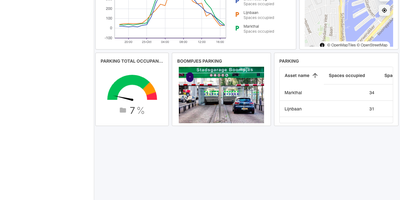
OpenRemote is an IoT platform that models every building, EV charger, solar panel, and street light as an asset in one tree, then maps, charts, and automates them from a single web dashboard. Define your own asset types, and give each attribute live readings, writable setpoints, history, and forecasts. Connect hardware with protocol agents for HTTP, MQTT, Modbus, KNX, Z-Wave, LoRaWAN, SNMP, and serial, discovering devices or importing project files where the protocol allows. Plot assets on a map with live position and heading, tint markers by attribute value, and add geofences and GeoJSON layers. Automate with When-Then rules, a drag-and-drop Flow editor, or Groovy and JavaScript rules, and run them on a schedule. Raise e-mails, push notifications, webhooks, or assignable alarms from the result. Compose shareable dashboards in Insights from nine widget types, including charts, KPIs, gauges, maps, and tables. Give each customer a realm with its own users, roles, and white-label branding. Sync edge gateways to a central instance and open them remotely through tunnels. Let devices with X.509 certificates register themselves. Read and write every attribute over REST, MQTT, or WebSocket, and let AI assistants manage assets in plain language through the MCP server. Typical projects span smart cities, building and energy management, and equipment fleets, in an interface that speaks nine languages. Running on a dedicated VPS on RepoCloud with guaranteed CPU, RAM, and SSD, full root SSH access, and a browser serial console. AGPL-3.0 licensed.
Eclipse Hono
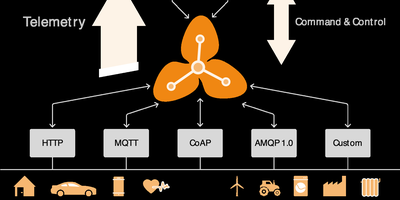
Eclipse Hono is an IoT connectivity platform that sits between device fleets and business applications, accepting connections over MQTT, HTTP, AMQP 1.0, and CoAP adapters and normalizing everything into uniform telemetry and event streams. Devices authenticate against a central registry of tenants and credentials, with X.509 client certificates, pre-shared keys, or automatic provisioning for zero-touch onboarding. Applications consume normalized data from Apache Kafka or an AMQP 1.0 messaging network, choosing per tenant which backbone carries its traffic, and send commands back down to devices through the same platform with delivery feedback. Resource limits cap how much data each tenant's devices may move, keeping one noisy fleet from crowding out the rest, while metrics and tracing follow every message hop. The 2.7 release adds preliminary MQTT 5 support with corrected connect reason codes, message tracing logs, and a hardened JDBC device registry backed by PostgreSQL for production tenant and credential management. Protocol adapters scale horizontally as stateless services, so capacity grows by adding instances behind a load balancer. Running on a dedicated VPS on RepoCloud with guaranteed CPU, RAM, and SSD, full root SSH access, and a browser serial console. EPL-2.0 licensed.