OvenMediaEngine
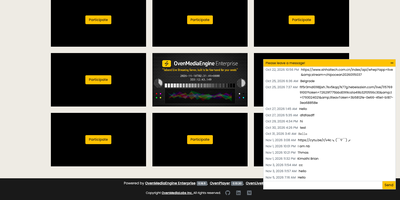
OvenMediaEngine ingests a broadcast feed once and delivers it to every viewer with sub-second delay over WebRTC and Low Latency HLS. Encoders push through WebRTC with WHIP, SRT, RTMP, or MPEG-2 TS, and the server can also pull RTSP sources and schedule pre-recorded files as live channels. The embedded transcoder converts incoming video to adaptive bitrate ladders in VP8, H.264, H.265, or AV1, so phones on weak signals and televisions on fiber each receive a rendition they can play. WebRTC delivery runs through an embedded signalling server and TURN server, with retransmission and forward error correction keeping pictures intact on imperfect networks. LLHLS streams carry DVR rewind, WebVTT subtitles, timed metadata, and DRM through Widevine, FairPlay, and PlayReady. Recordings dump finished streams to files for video on demand, thumbnails capture stills, and push publishing re-streams to other platforms over RTMP and SRT. Origin-edge clustering spreads a popular event across many servers, admission webhooks and signed policies control who may publish and watch, and a REST API plus monitoring endpoints keep the whole service observable. Running on a dedicated VPS on RepoCloud with guaranteed CPU, RAM, and SSD, full root SSH access, and a browser serial console. AGPL-3.0 licensed.
Flowcat
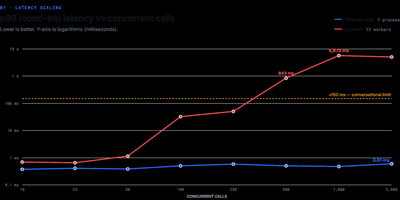
Real-time voice agents get a native Rust runtime in Flowcat: it carries a phone or WebRTC call through a composable media pipeline on your own infrastructure, so latency-sensitive audio never queues behind a managed platform. Audio flows from transport into voice activity detection and turn-taking, then through speech-to-text, an LLM, and text-to-speech, or a single speech-to-speech model, and back out to the caller, with in-process SIP and RTP for telephony. Pair it with local Whisper transcription, Kokoro, Piper, or XTTS for speech, and Ollama for reasoning, and a call's audio and transcript never leave your network; cloud providers plug in by name when you prefer them. Describe one agent in a YAML or JSON node-and-edge graph and the single flowcat-server binary serves it over HTTP, opening a browser page with microphone and live transcript, or bridging a Plivo number into the same agent. The runtime stays flat as call volume grows: benchmarked against a multiprocess Python baseline, one process holds p99 round-trip overhead at or below 0.61 milliseconds from 10 to 2,000 concurrent calls, at roughly 19.6 KB of RAM per idle session. Deploy it inside your VPC or an air-gapped environment where call recordings are sensitive. Running on a dedicated VPS on RepoCloud with guaranteed CPU, RAM, and SSD, full root SSH access, and a browser serial console. Apache-2.0 licensed.
MiroTalk C2C
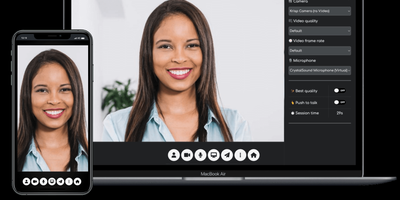
MiroTalk C2C is a self-hosted WebRTC cam-to-cam calling server that turns one private link into an encrypted one-to-one video call in the browser, with nothing for guests to download or sign up for. Create a room, pick how you want to join, and share the room ID: the other person opens it and you are face to face with video, audio, and screen sharing between desktops and phones. Push-to-talk and best-quality toggles sit next to camera, microphone and video quality controls in the in-call settings, and session time stays visible so lengthy calls never surprise you. Replace your background with the built-in Off, Blur, or Image modes processed locally in your browser, and show your camera as a picture-in-picture bubble in a corner of a shared screen so presentations keep a human face. The meeting is private by design: you choose the room and how you join before entering, and media stays encrypted between participants. Host it with the official Docker image on your own infrastructure to keep media and signaling under your control, embed calls into your own products with the direct room join and REST API, and use ngrok support for quick testing. Running on a dedicated VPS on RepoCloud with guaranteed CPU, RAM, and SSD, full root SSH access, and a browser serial console. AGPL-3.0 licensed.
Apache OpenMeetings
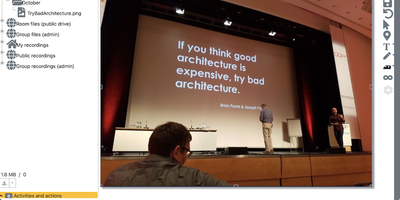
Apache OpenMeetings puts the whole meeting in the browser: cameras, a shared whiteboard, the agenda document, and recording controls, all running on your own server. Participants join rooms with audio and video, audio only, or video only, choose camera resolutions and devices, and present by sharing a screen or a single window at selectable quality. Moderators control the floor person by person: who may draw on the whiteboard, present, share or record the screen, mute others, or speak while everyone else stays muted. Multiple whiteboards hold drawings, text, clip art, and imported documents in PDF, office, and image formats, rescaling to fit every participant's screen, and boards can be saved into the drag-and-drop file explorer for the next session. Every meeting can be recorded with all audio streams exactly as heard, then downloaded as MP4 or played back in the integrated player, and the built-in calendar schedules rooms and sends invitations. Breakout rooms split classes and workshops into groups, polls gather decisions live, private and group chat runs beside the video, and telephone users can dial into rooms through the Asterisk SIP integration. Running on a dedicated VPS on RepoCloud with guaranteed CPU, RAM, and SSD, full root SSH access, and a browser serial console. Apache-2.0 licensed.
Euron Open VoiceOS
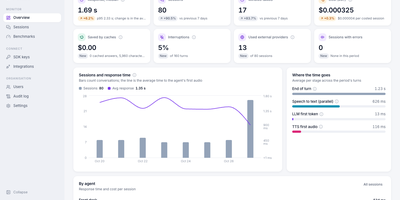
Every second of a voice conversation gets a timestamp and a price tag in Euron Open VoiceOS, a platform for building real-time voice agents that listen, think, and speak. Start from a template, such as receptionist, tutor, or meeting assistant, and talk to it in the browser. Each turn is split into end of turn, speech to text, the model's first token, and first audio, and each session adds usage and an estimated cost, so you see where time and money went. Local Whisper hears and local Kokoro speaks, so a new agent needs no cloud account, and any stage can switch to Deepgram, Sarvam, ElevenLabs, Cartesia, Anthropic, or any OpenAI-compatible endpoint. Callers can interrupt at any moment, and a failing provider earns a spoken apology instead of silence. No audio is ever stored, transcripts are redacted for emails, phone numbers, and cards, and callers are told up front when a provider runs outside your servers. A phrase cache, a response cache, and small-model routing for short turns trim the bill. Developers mint SDK keys scoped to agents and website origins, trade them for one-minute session tickets, and connect from any browser over WebRTC or WebSocket. Hindi templates come ready to use, and a bundled benchmark scores word error rate for English, Hindi, and Marathi. Running on a dedicated VPS on RepoCloud with guaranteed CPU, RAM, and SSD, full root SSH access, and a browser serial console. MIT licensed.