TYPO3
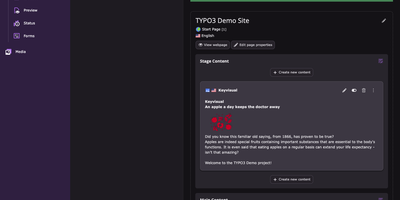
TYPO3 lets an organization run any number of multilingual websites from one installation, with editors working in a page tree and administrators deciding who may touch what. Editing happens in a context panel that slides in beside the page layout, and a guided wizard creates new pages step by step. Translations can be copied or connected to their source with change tracking, and sites can mix languages, including right-to-left scripts. Workspaces keep edits away from the live site until they are previewed and approved, while access lists, page permissions, and mounts control which parts of the tree each backend user may change. Marketing teams get a QR code module and a short URL module with hit counters and expiry dates, and redirects are created automatically whenever a page slug changes. The Form Framework builds forms with multiple file uploads in one field, CKEditor 5 text editing, and email notifications customized in the backend. A dashboard shows widgets such as recent documents and backend logins, and a Bookmark Manager groups shortcuts into large page trees. The Camino starter theme gives integrators a ready-made frontend with several color schemes, and developers shape sites further with Fluid templates and TypoScript, plus extensions from extensions.typo3.org. Running on a dedicated VPS on RepoCloud with guaranteed CPU, RAM, and SSD, full root SSH access, and a browser serial console. GPL-2.0 licensed.
Orbeon Forms
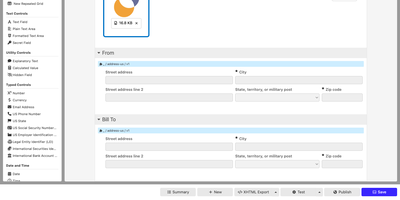
Orbeon Forms lets you design complex web forms in your browser, such as permit applications and consent forms, then collect validated data, attachments, and ready-made PDFs from the people who fill them in. The Form Builder arranges sections and grids on a twelve-column layout, and its toolbox drops in text fields, dropdowns, date fields, radio buttons, and file uploads. Validation covers required fields, data types, length limits, and custom formulas, and errors, warnings, and informational messages appear beside each answer. Repeated grids and sections handle invoice lines, dependents, or inventory rows while formulas multiply and total the numbers as people type. Long applications switch to a wizard view with a table of contents on the left, Prev and Next buttons, and red highlights on pages that still hold errors. Every form produces a read-only PDF that mirrors its on-screen look, with a default header and footer. A summary page lists saved records in a searchable table where column headers sort the rows, and records can be created, edited, duplicated, deleted, or opened as PDFs. Owner and group permissions let each person see only their own records or those of their group, and autosave protects half-finished submissions. Demo forms such as Bookshelf, Invoice, Feedback Form, Building Permit Application, and Health History give a fresh install something to click through on day one. Running on a dedicated VPS on RepoCloud with guaranteed CPU, RAM, and SSD, full root SSH access, and a browser serial console. LGPL-2.1 licensed.
Textpattern
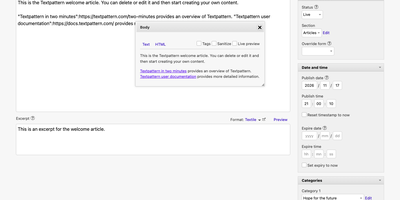
Writers who want to keep their markup in their own hands publish blogs, magazines, portfolios, and company sites with Textpattern, a lightweight open-source CMS driven by a readable tag-based template language. An author fills Title, Body, and Excerpt in the Write panel, flips between Text, HTML, and Preview tabs, formats with Textile or plain HTML, and files each piece under a section with up to two categories and a URL-only title for a clean permalink. Draft, Pending, Hidden, Live, and Sticky statuses track where a piece stands, publish and expire dates schedule its arrival and departure, and freelancers submit work as Pending for review before anything goes live. Six built-in roles (Publisher, Managing Editor, Copy Editor, Staff Writer, Freelancer, and Designer) limit each account to the panels it needs. Designers edit page templates, form templates, and stylesheets in the browser and reshape the markup without touching the server. Custom fields, an article image, and per-article form overrides make one setup work as a photoblog, a portfolio, or a news site. The Images panel creates thumbnails and stores captions and alternate text once for every place a picture appears. Plugins extend the editor and admin area, admin themes restyle the back end, the interface is translated into over 50 languages, and one codebase can power several websites, each with its own theme and admin login. Running on a dedicated VPS on RepoCloud with guaranteed CPU, RAM, and SSD, full root SSH access, and a browser serial console. GPL-2.0 licensed.
FileSharing
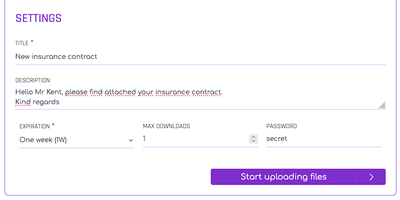
When a client needs a two-gigabyte video and your options are a consumer transfer site with a weekly cap or an FTP account older than your interns, FileSharing gives you a private WeTransfer of your own. You group files into a bundle, drag them in from your filesystem, and keep adding more days later if the project grows. Every bundle produces two links: a preview link where recipients see the file list first, and a direct link that downloads everything at once, both guarded by an authorization code. Bundle settings cover a title, a description, an expiration date, a maximum download count, and an optional password that also encrypts the ZIP archive recipients can pull down. Upload access stays yours to control through an IP allowlist, login and password accounts, or a mix of both. Optional duplicate prevention skips files you already sent, a download rate limiter keeps a single recipient from saturating your bandwidth, and a scheduled background task physically deletes expired bundles so old transfers do not pile up. There is no database to run or back up because bundle metadata lives in JSON files on disk, and the interface speaks English, French, German, and Korean. Running on a dedicated VPS on RepoCloud with guaranteed CPU, RAM, and SSD, full root SSH access, and a browser serial console. GPL-3.0 licensed.
Open SEO Crawler
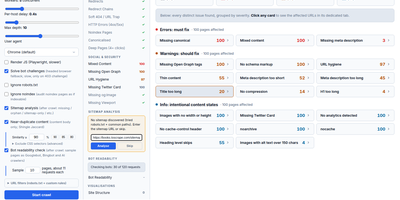
The audit starts with one URL: Open SEO Crawler spiders the entire site from your own server and groups every technical issue by severity. It crawls concurrently with per-host politeness and backoff retries, and presets adapt automatically to WordPress, Shopify, Webflow, and seven other detected CMS platforms. Every page gets checked for missing or duplicate titles, meta descriptions, H1s, and canonicals, plus thin content, redirect chains, broken links, hreflang gaps, and images without alt text. Afterwards, sample pages are fetched again as Googlebot, Bingbot, Applebot, GPTBot, and PerplexityBot, and any page a bot cannot read in full gets flagged. The Summary groups issues into errors, warnings, and info with affected page counts, and the sidebar opens bulk reports for titles, metas, canonicals, duplicates, response codes, and deep pages. Each report exports to an XLSX workbook, and the Crawl Budget page turns parameter traps into ready-to-paste robots.txt rules that stop phantom URLs from eating your budget. One click packs the crawl into a Markdown brief for any AI assistant, and the bundled MCP server lets Claude or Cursor start crawls and read issues directly. Saved crawls reopen any time, dark mode is built in, and a daily auto-update keeps the tool current with rollback if a pull ever breaks it. Running on a dedicated VPS on RepoCloud with guaranteed CPU, RAM, and SSD, full root SSH access, and a browser serial console. MIT licensed.

Tinykit
Describe the small app you keep wishing existed, and Tinykit builds it, gives it a database, and puts it live on your server. Tell it the tool you need and the agent writes the code, creates the data collections behind it, and wires the two together, then steps aside. The result is not a screenshot of an app; it is the app, served from your own server with its data syncing in real time and its files stored beside it. Open the built-in code editor to adjust the single file behind each app, or avoid code entirely: content fields let you edit text like a miniature CMS, and the design system panel restyles colors, fonts, and shadows visually. Every change takes a snapshot, so bold prompts carry an undo button and nothing is one bad idea away from lost. Hosts running errands for a household, an internal team, or a portfolio of side projects can keep adding apps, each reachable on its own domain, with token costs for every prompt shown in real money so the building budget is never a mystery. Running on a dedicated VPS on RepoCloud with guaranteed CPU, RAM, and SSD, full root SSH access, and a browser serial console. MIT licensed.
mkfd
Plenty of sites you follow have no feed, a broken feed, or announcements buried in an inbox, and mkfd turns all three into clean RSS feeds you control. You point it at a webpage, a REST API, or an IMAP mailbox and describe what counts as a story: an item selector plus selectors for title, link, date, author, and enclosures. Drill chains follow links across several pages when the real content sits deeper than the listing page, and an advanced scraping mode with a real browser handles pages that need JavaScript or your own browser extensions. An integrated selector helper helps you pinpoint elements on the target page instead of guessing. Email feeds watch a folder continuously and publish new messages as feed items the moment they arrive, with mailbox passwords encrypted before they touch disk. Every feed gets a schedule, is rebuilt in its own worker, and is served from an endpoint your reader can subscribe to, and the whole configuration lives in a portable file you can version and reuse. Access to the builder is guarded by a passkey, and feed endpoints stay open for your reader. Running on a dedicated VPS on RepoCloud with guaranteed CPU, RAM, and SSD, full root SSH access, and a browser serial console. MIT licensed.

AMC WebUI
AMC WebUI is one chat window for every Gemini trick, with your conversations kept in your own browser instead of someone else's database. Pick a model from a picker that shows context window, output limit, and capabilities, then watch its reasoning stream with adjustable thinking levels. Voice chat and screen sharing run in realtime, and code blocks can turn into interactive HTML, SVG, Mermaid, or Graphviz previews. A Python sandbox executes snippets with numpy, pandas, and matplotlib inside the page. MCP settings list built-in tool servers beside any stdio, SSE, or HTTP server you add, and tool calls wait for your approval. Upload images, PDFs, audio, video, or whole ZIP folders, search past chats, and read per-request token and pricing logs. Deep search cites sources, text to speech offers thirty voices, and image generation takes aspect ratio and size options. Switch to any OpenAI-compatible endpoint with its own keys and models, choose among four themes and seven interface languages, and install it as a PWA. Running on a dedicated VPS on RepoCloud with guaranteed CPU, RAM, and SSD, full root SSH access, and a browser serial console. MIT licensed.

NeutralPress
Bloggers and small communities who love static-site speed but miss a real admin panel get both from NeutralPress, a dynamic CMS that regenerates pages only when content changes and serves everything else like a static site. You write in a WYSIWYG editor or in Markdown and MDX, manage drafts and versions, and build custom pages by dragging components together with live preview, all inside a backend that shares the frontend's design language instead of feeling like a separate era. A media system compresses and optimizes images, shows EXIF data, builds photo walls, and guards against hotlinking, while tags and categories organize the archive. Readers get nested comments with moderation and anti-spam, full-text search tuned for content and code terms, RSS and newsletter subscriptions, and a friend-links system that checks its own links and hides the dead ones. Behind the scenes, multi-role permissions, OAuth and passkey sign-in, two-factor authentication, rate limiting, audit logs that can restore changes, visitor analytics with keyword and device breakdowns, and scheduled health checks keep the site safe and understood. Storage can live on local disk, S3, R2, or other object stores, with several strategies running side by side. Running on a dedicated VPS on RepoCloud with guaranteed CPU, RAM, and SSD, full root SSH access, and a browser serial console. MIT licensed.
Cusdis
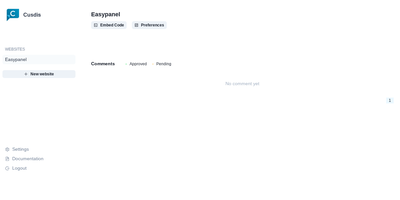
Comments for small sites without Disqus's baggage: Cusdis is a lightweight, privacy-first, open-source comment system for embedding under blog posts and articles. The embedded JavaScript SDK is about 5 KB gzipped (Disqus is roughly 24 KB), sets no cookies, runs no tracking, and does not require readers to create an account or sign in before commenting. Integration is two lines: a container div with your app ID and an async script tag, with ready-made adapters for common frameworks and static site generators. Moderation is approval-based - new comments stay hidden until you approve them from the dashboard, and email notifications include a Quick Approve link that approves or replies to a comment from your phone without logging in. A webhook fires on every new comment for integrations like Telegram notifications. The widget ships with built-in i18n and dark mode. The stack is TypeScript and Next.js with a Prisma data layer, deployable via Docker with PostgreSQL. Deliberately minimalist: no ads, no reader profiling, and your comment data lives in your own database.
Euron MemoryVault
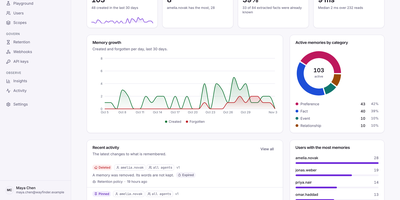
Long-term memory for AI assistants lives in Euron MemoryVault, which stores conversations as atomic facts like "Lives in Lisbon" and hands back the ones that fit the next prompt. Repeated facts reinforce the old memory. Changed facts supersede it and keep the history. A "forget that" message deletes it. Extraction runs on a rule engine with no key, and an OpenAI-compatible API or Ollama can replace it. Scopes cover organization, project, user, agent and session. Keys tied to one agent never see another project. Retention policies set half-lives, time to live per category and a per-user cap. Live previews show what would be forgotten before anything is saved. Hybrid search blends vectors with full text. The context endpoint packs the strongest memories into a token budget. Playground runs preview what a conversation would create, merge, ignore or supersede. Dry runs store nothing. The dashboard shows decay curves, version history and source conversations for each memory. Users, API keys, insights and an activity feed sit beside it. Signed webhooks announce created, updated and deleted memories, with retries, a dead-letter queue and a delivery log. Erasing a user removes memories, history, messages and queued deliveries in one transaction and returns a receipt. A client SDK offers blocking and asyncio versions. Running on a dedicated VPS on RepoCloud with guaranteed CPU, RAM, and SSD, full root SSH access, and a browser serial console. MIT licensed.

Snowshare
A dropped connection should not restart a 20 GB upload: SnowShare is a self-hosted app for sharing files, links, and pastes, with resumable transfers and an expiry date, a view limit, a password, and a QR code available on every share. Put several files into one share and let recipients preview common formats right in the browser, shorten a long address with an optional custom slug, or publish text and code with syntax highlighting. People you send a link to can open it with or without an account, depending on how you configure the instance. Give your users email and password accounts or OAuth sign-in, turn on email verification and CAPTCHA, and set separate storage quotas for anonymous visitors and registered users. Keep uploads on local disk or move them to S3-compatible storage, apply your own branding, and change quotas, sharing rules, SMTP, and storage from the admin panel without restarting. Automate sharing through the REST API with keys created from your profile, drop the generated ShareX uploader files into your capture tool, and receive signed webhook events when shares are created, opened, or deleted. Read the interface in English, French, Spanish, German, Dutch, or Polish, and let expired shares clean themselves up every hour. Running on a dedicated VPS on RepoCloud with guaranteed CPU, RAM, and SSD, full root SSH access, and a browser serial console. CC0 1.0 licensed.

KamiYomu
Manga readers use KamiYomu to build a private, self-hosted library: it fetches chapters from the websites they already follow, archives them locally, and serves everything back through a clean web reader on any device. The discovery flow runs on Crawler Agents, small plugins that teach KamiYomu how a particular source site lists series, chapters, and pages, so searching and fetching metadata happens inside the same interface as reading. Downloads land in a structured local archive, and reading picks up where you left off with history, filters for your library, and weekly views that surface new chapters and fresh releases. When a series is complete, export it as CBZ, PDF, or ZIP and take the files anywhere, no account or cloud library involved. Your e-reader and phone apps join through the built-in OPDS catalog, the same standard used by Moon+ Reader and KyBook, while a Swagger-documented API exposes the collection to your own scripts. Scheduled jobs keep watched series current in the background, checking sources and pulling new chapters without you babysitting tabs. Running on a dedicated VPS on RepoCloud with guaranteed CPU, RAM, and SSD, full root SSH access, and a browser serial console. AGPL-3.0 licensed.
Commento++
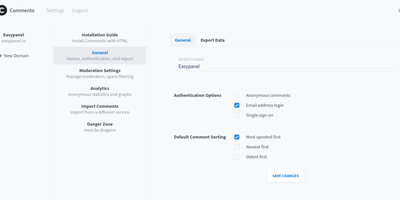
When Commento's original maintainer went quiet, Commento++ bundled the community's bug fixes and stalled merge requests into a batteries-included release of the beloved Go-based Disqus alternative - and kept building. The core promise is unchanged: an embeddable comments box that is orders of magnitude lighter and faster than Disqus, with no ads, tracking, or data sales - two lines of HTML and a PostgreSQL database. On top of Markdown comments, voting, Disqus import, OAuth login (Google, GitHub, Twitter) plus SSO, sticky comments, thread locking, and email notifications, the fork's additions are substantial: WebSocket-powered live comment updates with permalinks and highlight animations for new arrivals, guest commenting with a name, a cross-domain moderation dashboard for approving and deleting comments in one place, MathJax rendering support, wildcard domain matching, a reInit hook that makes single-page-application integration clean, and Perspective API spam scoring alongside the existing Akismet integration. Optional page-view logging graphs traffic on the dashboard, native SSL termination works without a proxy, and script-tag data attributes control fonts, CSS overrides, deleted-comment visibility, and polling-versus-WebSocket behavior.
NitroPing
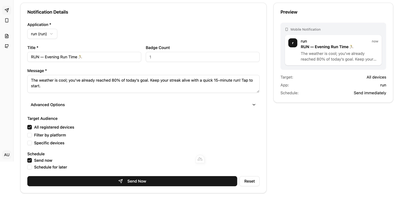
NitroPing sends push notifications to your iOS, Android, and web apps through Apple APNs, Firebase FCM, and Web Push, from a service you host yourself instead of a rented vendor. Create an app to receive its API key, register each device token with its platform, then send notifications to chosen devices with a GraphQL mutation. Provider credentials for APNs, FCM, and Web Push are stored encrypted per app, so several projects can share one instance with isolated keys and data. Delivery tracking records every send with its status, and analytics views show performance metrics and real-time updates as notifications land. Apps are managed with JWT sign-in and per-app API keys, rate limits protect the endpoints, and webhook secrets sign delivery callbacks to your servers. Native Swift and Kotlin SDKs handle registration inside iOS and Android apps, so the device side needs a few lines instead of a custom client. Running on a dedicated VPS on RepoCloud with guaranteed CPU, RAM, and SSD, full root SSH access, and a browser serial console. MIT licensed.

Pisha
When one Claude Code session is not enough, Pisha puts a coordinator in charge of a whole team of them and shows every agent live in your browser. Tell the coordinator what you want and it splits the work among workers, tracks their reports, and approves their harmless actions. Only the decisions that matter reach your inbox, each with options and a recommended pick you can answer by typing or speaking. A mosaic view lays every terminal and conversation side by side, with a timeline of orders, edits, tests, and commits for each agent. Teams appear as cards on an org chart, and dragging one onto another links their coordinators so they can trade work. Task boards with custom columns, subtasks, priorities, and due dates sync both ways with GitHub Projects, and merging a pull request that names a task moves it to done. Signed webhooks from GitHub, GitLab, or Stripe wake a coordinator with your standing instructions, such as reviewing each new pull request. Permission profiles described in plain words limit each agent, and Codex CLI or Grok CLI sessions can join a team beside Claude Code. Add any computer with one command; agents connect out, so their machines open no ports. Running on a dedicated VPS on RepoCloud with guaranteed CPU, RAM, and SSD, full root SSH access, and a browser serial console. MIT licensed.

Lumina
One click, one article: Lumina captures any web page from a browser extension, adds an AI summary, outline, and translation, and files it in a library you can read, annotate, and publish. Save a full page or a selection from the extension popup or the right-click menu. Search titles, then narrow by category, author, source, or time. Batch actions categorize, hide, or delete many articles at once. Switch between the original and the translation, or go immersive. A table of contents, notes, and highlights help you work through long articles. Code blocks, math, and common media embeds render in place. Background AI tasks write summaries, key points, quotes, and outlines. They also classify articles and suggest similar ones. Each task shows a timeline, and you can retry, repair, or cancel it. Columns turn articles, topics, and quotes into longer reading paths you can publish. Public RSS feeds cover articles and columns, and either kind of page downloads as Markdown. Readers comment after signing in with GitHub or Google, and admins moderate. The admin center manages model APIs, prompts, categories, and storage, and tracks calls, tokens, and cost. Backups run in the background, download as an archive, and import back incrementally. Running on a dedicated VPS on RepoCloud with guaranteed CPU, RAM, and SSD, full root SSH access, and a browser serial console. MIT licensed.
Thruk
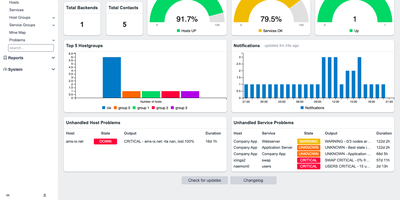
Thruk gives operations teams one fast web interface for watching hosts and services across several monitoring servers, with live status, dashboards, reports, and configuration in one place. One view combines Naemon, Icinga, Nagios, and Shinken servers, groups them by site, and reads them live. A home page of widgets shows host and service totals, gauges, notification charts, and unhandled problems, and a tactical overview adds outages and network health. Users filter, bookmark, and export status tables to Excel, and a mine map shows every host against its services as colored squares. A host page lists performance data beside actions to reschedule a check, submit a passive result, send a custom notification, or schedule downtime. Panorama dashboards place icons, graphs, and widgets on a free canvas or an OpenStreetMap, then share them with contact groups. A business process editor models an application as a tree of nodes with worst-of or best-of rules, and notifications can fire for individual steps. SLA reports in HTML and PDF go out by email on a schedule, and any page can become a recurring email report. A config tool edits hosts, services, commands, and contacts, manages users and teams, and reloads the monitoring core. Scripts reach status and commands through the REST API with API keys or through the command-line client. Running on a dedicated VPS on RepoCloud with guaranteed CPU, RAM, and SSD, full root SSH access, and a browser serial console. Artistic-1.0-Perl OR GPL-1.0-or-later licensed.