Open Design
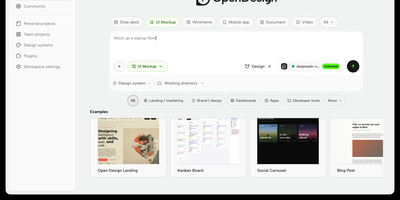
With over 84,000 GitHub stars since its April 2026 launch, Open Design has emerged as the definitive open-source alternative to Anthropic's Claude Design. Rather than shipping its own language model, Open Design acts as an agent-agnostic design orchestration layer that auto-detects 25+ coding CLI executables on your PATH — including Claude Code, Codex, Cursor, Gemini CLI, OpenCode, Qwen, GitHub Copilot CLI, Hermes, and Kimi — or connects to any OpenAI-compatible endpoint via its built-in BYOK proxy at /api/proxy/stream. The platform introduces a file-based protocol where SKILL.md files define composable design workflows and DESIGN.md files establish version-controlled brand systems, currently shipping 31 first-party skills and 72 brand-grade design systems. Output spans web and mobile prototypes, live dashboards, presentation decks, raster images, video, and HyperFrames motion graphics, with export pipelines for HTML, PDF, PPTX, MP4, and ZIP. The daemon architecture uses SQLite for project state and serves a sandboxed iframe preview renderer with vendored React and Babel for JSX artifacts. Deployment options include the native desktop app for macOS, Windows, and Linux, local daemon mode via pnpm tools-dev, a single-container Docker Compose path serving both API and Next.js frontend on port 7456, and Vercel deployment for the web layer. On RepoCloud, deploy Open Design on a dedicated VPS with full root SSH access, persistent storage for your design systems and generated artifacts, and complete control over which AI providers and agent CLIs your instance connects to, all under the Apache-2.0 license.
Bolt.diy
Prompt, run, edit, and deploy full-stack Node.js applications from a browser tab: Bolt.diy is the official open-source version of Bolt.new's AI coding agent. Its foundation is StackBlitz's WebContainer technology - a sandboxed in-browser Node.js environment where the AI controls the whole stack: filesystem, npm, dev servers, terminal, and browser console. That means the agent does not just generate code; it installs dependencies, runs Vite or Next.js, reads errors, and fixes them. The defining difference from Bolt.new is model choice per prompt: 19+ providers including OpenAI, Anthropic, Gemini, DeepSeek, Groq, Mistral, Amazon Bedrock, and local models via Ollama or LMStudio, extensible through the Vercel AI SDK. Development ergonomics include live preview, a diff view of AI changes, codebase search, file locking to prevent generation conflicts, 15+ starter templates (React, Vue, Next.js, Astro, Svelte, Expo), and MCP support for external tools. Projects integrate with Git and Supabase, and deploy in one click to Vercel, Netlify, or GitHub Pages.
Open Lovable
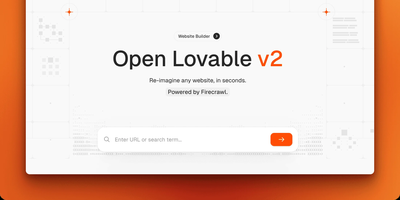
Open Lovable from the Firecrawl team delivers the first truly open-source alternative to Lovable.dev — a chat-driven AI copilot that takes any website URL and regenerates it as a complete, editable React application with TypeScript and Tailwind CSS in seconds. The pipeline combines Firecrawl's intelligent web scraping for JavaScript-rendered pages and single-page applications with your choice of AI provider — Claude, GPT-4, Google Gemini, or Groq — to analyze HTML structure, extract layouts and styling, decompose pages into proper React components, and generate production-ready code following modern best practices. Live preview runs in a secure sandbox environment using Vercel Sandbox with OIDC authentication or E2B Cloud, letting you see results immediately and iterate through natural language chat to request changes like Tailwind migration, componentization, SEO improvements, accessibility fixes, or custom form implementations. The optional Morph LLM fast-apply path accelerates small edits by applying diffs directly without full regeneration. The provider-agnostic architecture means you control costs by routing to different models — use Groq for fast iterations and Claude for complex layouts. Project structure follows Next.js conventions with organized app, components, atoms, styles, utils, and hooks directories. Deploy via pnpm with Node.js 18+ requiring only a Firecrawl API key, one AI provider key, and a sandbox provider configuration. Running on a dedicated VPS on RepoCloud with guaranteed CPU, RAM, and SSD, full root SSH access, and a browser serial console. MIT licensed.
n8n
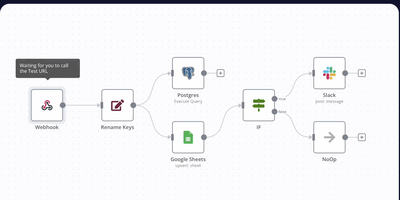
Webhooks, cron schedules, and app events trigger chains of nodes that fetch, transform, and route data: n8n is a workflow automation platform built around a visual, node-based editor. It ships with 400+ built-in integrations covering databases like Postgres, SaaS tools like Slack and HubSpot, and every major AI provider. When a pre-built node does not exist, the HTTP Request node calls any REST API, and the Code node runs JavaScript or Python inline, so you are never blocked by a missing connector. Workflows execute as directed graphs with branching, loops, error handling, and sub-workflows, and every run is logged for inspection and replay during debugging. It also includes LangChain-based nodes for building AI agents with tool calling and memory. Self-hosting on RepoCloud gives you unlimited workflow executions with no per-task pricing, and all data stays on your instance. Runs on Node.js with SQLite by default; add Postgres and Redis queue mode when you need to scale workers horizontally.
Plausible
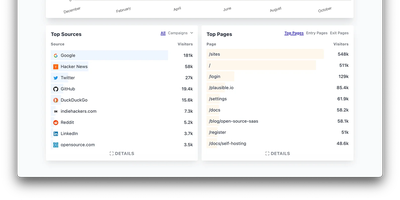
Built as a direct rejection of the adtech model, Plausible is the best-known privacy-first web analytics tool - lightweight, cookie-free, and open-source. It sets no cookies and stores no personal data: unique visitors are counted via a hash of IP plus User-Agent that rotates every 24 hours and is never stored raw, so no consent banner is required and GDPR compliance is structural rather than contractual. The tracking script is under 1 KB - orders of magnitude lighter than GA - and the dashboard is a deliberate contrast to GA4's sprawl: one fast-loading page with visitors, sources, top pages, countries, devices, and UTM breakdowns, filterable by any dimension. Custom events and goals track signups and clicks, Google Search Console integration pulls in search queries, scheduled email reports keep stakeholders updated, and the Stats API (v2) plus CSV export feed data anywhere. This is the AGPL-licensed Community Edition, the same Elixir codebase that powers Plausible's cloud service, running as three containers: the web app, PostgreSQL for accounts, and ClickHouse for event storage - which means self-hosters get direct SQL access to raw analytics data the cloud version never exposes. Traffic data stays entirely on your server, with no visitor caps or per-pageview pricing.

openGym
openGym is a self-hosted gym and body-weight tracker that plans your weekly routines, guides every set with pre-filled weights and rest timers, and keeps your training data on a server you control instead of inside a subscription app. Over 5,600 exercises come with animated demos, searchable by body part and the equipment you own, and you can add custom ones with your own photo or video. Progression follows a rule you pick per routine (linear, Greyskull LP, double, triple, or added time), and each target explains where it came from. Supersets, warm-ups, drop sets, rest-pause, timed planks, and cardio by time and speed all log properly, and plate math shows what goes on each side of the bar. A muscle map shows where your volume went, what is still recovering, and what went untrained, beside estimated one-rep maxes, a year-long heatmap, and body weight charted against your goal. Imports from FitNotes, Strong, and Hevy carry your history over. Several people can share one server, each with a private passkey profile, and an optional admin dashboard handles invite-only signup. An optional AI coach, off by default, drafts routines and suggests changes through your own Anthropic, OpenAI, Gemini, or Ollama endpoint, and nothing applies without your approval. The interface speaks 19 languages. Running on a dedicated VPS on RepoCloud with guaranteed CPU, RAM, and SSD, full root SSH access, and a browser serial console. AGPL-3.0 licensed.
Piik
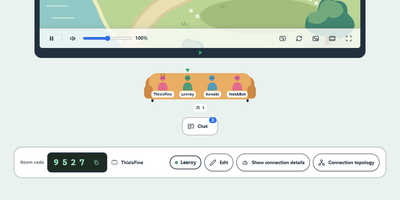
Share a game, a film, or your holiday photos with up to 20 friends, and let them watch from a browser tab with nothing to install. The host picks a screen, window, browser tab, or camera, then sends an invite link or a four-digit room code, with an optional room password. Friends open it on a desktop or phone, press Play, and chat or react while it runs, with optional on-screen chat. A microphone switch adds spoken commentary, with a choice of input device and voice volume. Video travels directly between participants where possible, and a self-hosted server can add automatic forwarding for networks that block direct links. Sharing settings cap resolution from 480p to 1440p, frame rate up to 60 fps, and audio at 64, 128, or 192 kbps, with Clarity, Balanced, and Fluency presets and a choice of VP8, H264, or automatic codecs. Viewers get playback controls, picture-in-picture, fullscreen, light and dark themes, and a connection topology view. The interface follows the system language in Chinese or English, with a visual-only mode for a text-free look. Piik App adds native capture on Windows, macOS, and Linux, while a hosted site works from any desktop browser. A self-hosted site can set a site passphrase, a viewer limit per room, and automatic cleanup of empty rooms. Running on a dedicated VPS on RepoCloud with guaranteed CPU, RAM, and SSD, full root SSH access, and a browser serial console. MIT licensed.
Pumpkin
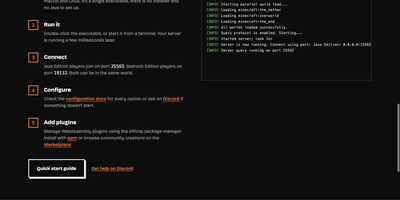
Why keep a Java runtime on the server just to host Minecraft, when Pumpkin runs from a single native executable and lets Java and Bedrock players share a world? Java Edition clients join on port 25565 and Bedrock clients on 19132, although Bedrock support is still marked work in progress. Builds exist for Windows, Linux, macOS, and Android. On launch, the console reports the worlds loaded and the server ready within milliseconds. Plugins are sandboxed WebAssembly modules that raise console permission prompts and pass signature checks, and authors can write them in Rust, Kotlin, Python, Go, C#, C/C++, D, Zig, or TypeScript. The ppm package manager searches and installs community plugins from the Pumpkin Market, and PatchBukkit loads some Bukkit and Paper plugins, with expected gaps. One pumpkin.toml file holds ports, MOTD, view distance, whitelist, authentication, compression, PvP, chat, resource packs, and world options, while chunks save in Anvil, Linear, or the native Pump format. Velocity and BungeeCord forwarding fit proxy networks, and the Query protocol plus Minecraft Server Management Protocol cover monitoring and remote administration. A public parity tracker lists every vanilla block, entity, item, and command as implemented, partial, or planned, so gaps are easy to spot before a world moves. Today it suits private survival worlds, test servers, and plugin development. It is early software, so the project advises backups. Running on a dedicated VPS on RepoCloud with guaranteed CPU, RAM, and SSD, full root SSH access, and a browser serial console. GPL-3.0 licensed.
UWAS
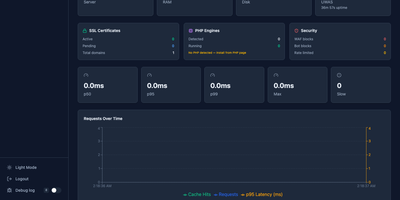
One 18 MB Go binary does the job of Apache, Nginx, Varnish, Caddy, and cPanel combined. Point UWAS at your /var/www directory and it auto-detects sites, provisions Let's Encrypt certificates, enables HTTP/3 via QUIC, and activates a two-tier caching engine with L1 memory shards and L2 disk storage, all before you write a single line of configuration. The React 19 admin dashboard provides 42 management pages for domains, PHP versions, databases, cron jobs, DNS records, file management, backup and restore, SFTP users, and uptime monitoring with real-time SSE updates. PHP sites run through FastCGI with connection pooling and full .htaccess compatibility, so WordPress, Laravel, and legacy applications work without migration effort. The built-in WAF catches SQL injection, XSS, path traversal, and shell exploits, while per-domain rate limiting and bandwidth caps protect against abuse. Reverse proxy mode supports five load balancing algorithms, circuit breakers, canary deployments, and mirroring for blue-green rollouts. Git deploy clones your repository, runs the build, checks health, and restarts the service with rollback on failure. An MCP server lets AI agents manage domains, cache, and deployments through natural language. The Nginx and Apache migration CLI converts existing configurations to UWAS format automatically. Deploy on a dedicated VPS on RepoCloud with guaranteed CPU, RAM, and SSD, full root SSH access, and a browser serial console. AGPL-3.0 licensed.
Hoppscotch
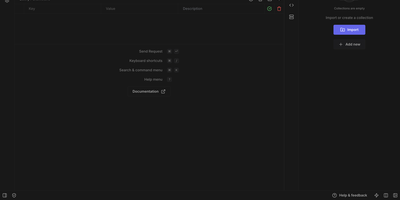
Backed by nearly 80,000 GitHub stars and recognized as one of the most popular developer tools in the open-source ecosystem, Hoppscotch delivers a complete API development platform that runs instantly in any browser with zero installation. The platform supports six protocols out of the box including REST with full HTTP method coverage, GraphQL with schema introspection and multi-column documentation, WebSocket for full-duplex communication, Socket.IO, MQTT for IoT messaging, and Server-Sent Events for real-time streaming. Request collections organize your API calls into logical groups with support for sub-folders, environment variables with scope inheritance, pre-request scripts and post-request test scripts written in JavaScript, and automatic code snippet generation in over twenty languages and frameworks. Teams can collaborate in real-time with shared workspaces, role-based access controls, and cloud synchronization across devices. Migration from Postman, Insomnia, or OpenAPI specifications happens with a single click import. The self-hosted edition deploys via Docker Compose with PostgreSQL for data persistence, supporting SSO authentication through SAML and OAuth providers, SMTP configuration with OAuth2, and admin dashboard for user management. The platform also ships as a native desktop application for macOS, Windows, and Linux with offline support, plus a CLI tool for running collections in CI/CD pipelines. A built-in proxy mode bypasses CORS restrictions during development, and an interceptor enables request debugging and response modification. Running on a dedicated VPS on RepoCloud with guaranteed CPU, RAM, and SSD, full root SSH access, and a browser serial console. MIT licensed.

Thumbor
Born at Brazilian media giant Globo.com, Thumbor answers imaging CDNs like Imgix and Cloudinary with an HTTP service where every image variant is just a URL. Ask for /300x200/smart/your-image.jpg and Thumbor fetches the original, crops and resizes on demand, and caches the result - one source file, unlimited renditions, no batch pre-generation pipeline. The "smart" in the URL is the signature feature: OpenCV-based face detection finds people in the frame and crops around them (no more thumbnails with severed heads), and when no faces exist, feature detection finds visually important corners and computes a weighted center of mass as the focal point. Beyond cropping, a chainable filter pipeline handles brightness, contrast, grayscale, blur, red-eye removal, rounded corners, rotation, watermarks, and format conversion with quality control - applied in order via URL segments. All common image formats work out of the box, and every layer is pluggable: loaders (HTTP, local, S3), storages and result storages (local, S3, Ceph, and community backends), engines, optimizers, filters, and even custom detectors, with the awesome-thumbor list cataloging the ecosystem. URL signing prevents abuse of your processing capacity. Integrations exist for Django, Rails, Node, WordPress, and most frameworks. MIT-licensed, battle- tested for over a decade.
Fess
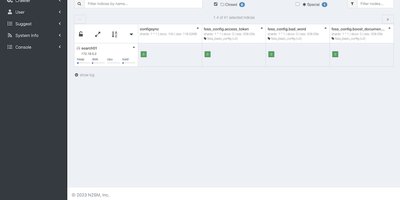
Eliminate indexing blind spots across fragmented company networks with Fess, a distributed enterprise search engine that crawls internal document repositories, corporate intranets, and cloud services to provide employees with instant, permission-aware file discovery. Organizations can schedule automated crawlers across web pages, network shares, databases, and third-party storage platforms to extract text and generate visual thumbnails from PDFs, spreadsheets, presentations, and compressed archives. Users can search indexed records using natural language queries, filtering results by file metadata, creation dates, categories, and geographic coordinates while viewing contextual snippets with highlighted keyword matches. Granular role-based permissions mirror directory security structures from Active Directory and LDAP so staff only see search results for documents they have explicit authorization to inspect. The browser-based administrative console lets operations teams define path mapping rules, manage virtual hosts, monitor active crawl jobs, inspect error logs, and configure scheduled re-indexing workflows without modifying server configuration files. Security teams can establish single sign-on across the organization using SAML or OpenID Connect authentication providers to secure administrative workflows and search portals. Running on a dedicated VPS on RepoCloud with guaranteed CPU, RAM, and SSD, full root SSH access, and a browser serial console. Apache 2.0 licensed.
Google Maps Scraper
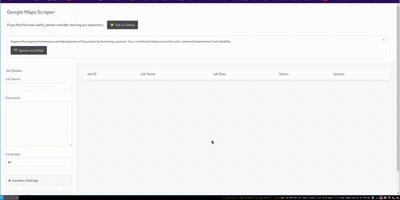
The leading open-source tool for extracting business leads from Google Maps at production scale. The Go-based engine processes approximately 120 places per minute with optimized concurrency, extracting 33+ data points per listing including business name, address, phone number, website URL, rating, review count, latitude and longitude, opening hours, price level, and optionally crawling business websites for email addresses. Three interfaces serve different workflows: the CLI accepts query files for cron jobs and CI/CD pipelines with output to CSV, JSON, PostgreSQL, S3, or LeadsDB; the Web UI provides a browser-based dashboard with real-time job monitoring, a map view of scraped places, and interactive query submission; and the REST API at /api/v1 enables programmatic integration with full Swagger documentation at /api/docs. Built-in proxy rotation supports SOCKS5, HTTP, and HTTPS with authentication for large-scale runs, while the architecture scales from a laptop to Kubernetes clusters with queue-based worker distribution. The SaaS edition adds multi-user access with API key management, admin UI with 2FA, job queue orchestration, and one-command cloud deployment via an interactive wizard. An AI Agent Skill enables coding agents to run scrapes programmatically. Deploy via Docker or build from source requiring Go 1.26.5+. Running on a dedicated VPS on RepoCloud with guaranteed CPU, RAM, and SSD, full root SSH access, and a browser serial console. MIT licensed.
Screego
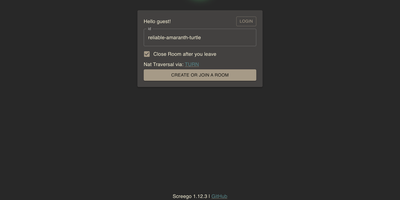
With over 10,000 GitHub stars and a reputation forged in the frustration of laggy corporate screen sharing, Screego delivers what Microsoft Teams and Zoom screen share consistently fail to provide: instant, high-resolution screen streaming that lets remote colleagues actually read your code. Built on WebRTC peer-to-peer connections, Screego transmits screen data directly between browsers without routing through centralized servers, achieving sub-second latency and native-resolution quality that makes pair programming and code reviews genuinely productive. The server component, written in Go with a TypeScript frontend, deploys as a single binary or Docker container with minimal configuration — set your external URL, generate a secret key, and you're live. An integrated TURN server handles NAT traversal automatically, eliminating the need for separate STUN/TURN infrastructure, with configurable UDP port ranges and support for external TURN servers when scaling beyond a single instance. Authentication supports three modes — requiring login for all actions, only for TURN connections, or none — with user management via simple credential files. Rooms are created instantly and support multiple simultaneous viewers, with system and tab audio sharing available for demonstrations that need sound. The architecture supports reverse proxy deployment behind Nginx, Caddy, or Apache with automatic TLS termination, and recent releases added riscv64 architecture support alongside existing amd64 and arm64 builds. Running on a dedicated VPS on RepoCloud with guaranteed CPU, RAM, and SSD, full root SSH access, and a browser serial console. GPL-3.0 licensed.
Steel Browser
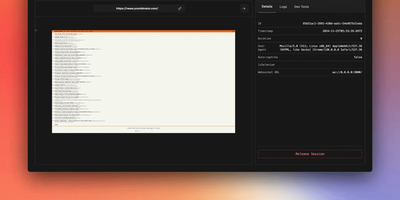
With over 7,400 GitHub stars and benchmarked at 0.89 seconds average session lifecycle — 1.7x to 9x faster than competing browser automation platforms — Steel Browser delivers production-grade headless Chrome infrastructure purpose-built for AI agents that need to interact with the modern web. The TypeScript-based server exposes a REST API providing on-demand browser sessions with full CDP (Chrome DevTools Protocol) access, allowing connections from Puppeteer, Playwright, or Selenium through standard WebSocket endpoints without framework lock-in. Each session maintains persistent state including cookies, localStorage, IndexedDB, and authentication credentials across requests, enabling stateful multi-step agent workflows that survive session restarts. Built-in anti-detection includes stealth plugins, browser fingerprint randomization, and configurable user-agent rotation, while the proxy chain manager handles IP rotation through residential, datacenter, or custom proxy pools. CAPTCHA solving integrates natively so agents encounter fewer blocking interrupts during autonomous navigation. The Session Viewer provides real-time WebRTC-streamed visual debugging of live sessions and playback of recorded sessions with full network request logging. Browser Tools APIs convert any page to clean Markdown, readability-optimized text, PDF documents, or high-resolution screenshots with a single API call. The MCP Server integration exposes Steel sessions as tools accessible to Claude, Cursor, and other Model Context Protocol-compatible AI agents. Deploy via Docker with a single container or use Docker Compose for production configurations with automatic resource cleanup and session lifecycle management. Running on a dedicated VPS on RepoCloud with guaranteed CPU, RAM, and SSD, full root SSH access, and a browser serial console. Apache 2.0 licensed.
LiveKit
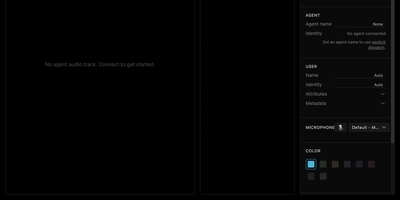
With over 20,000 GitHub stars and adoption by companies building everything from telehealth platforms to AI voice agents, LiveKit is the most widely deployed open-source real-time communication server available. The Go-based Selective Forwarding Unit handles hundreds of concurrent participants per node with adaptive bitrate streaming, simulcast layers, SVC codec support for VP9 and AV1, and end-to-end encryption. Client SDKs span JavaScript, Swift, Kotlin, Flutter, React Native, Rust, Python, Unity, and ESP32 embedded devices, while server-side APIs cover Node.js, Go, Ruby, Java, Python, Rust, PHP, and .NET. The Agents framework enables building AI-powered voice and video applications — real-time speech-to-text, LLM-driven conversations, and computer vision pipelines — running as server-side participants in any room. Egress records sessions to S3-compatible storage or streams to RTMP endpoints, while Ingress pulls external feeds from OBS via RTMP, WHIP, or SRT into LiveKit rooms. The SIP bridge connects traditional telephony to WebRTC rooms for hybrid conferencing. JWT-based authentication, webhook notifications, room-level moderation APIs, and selective subscription give operators granular control. Deploy as a single binary for development, Docker Compose for production single-node, or Kubernetes with the official Helm chart for distributed multi-region clusters using Redis for state coordination. Running on a dedicated VPS on RepoCloud with guaranteed CPU, RAM, and SSD, full root SSH access, and a browser serial console. Apache 2.0 licensed.
Jitsi Meet
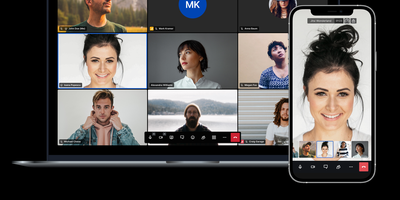
Backed by nearly 30,000 GitHub stars and powering millions of meetings through meet.jit.si, Jitsi Meet is the open-source video conferencing platform that runs entirely in the browser with no plugins or downloads required. The WebRTC-based architecture delivers HD audio and video through the Jitsi Videobridge selective forwarding unit, while Prosody handles XMPP signaling and Jicofo manages conference focus and orechestration. End-to-end encryption uses AES-GCM 128-bit keys exchanged via the Olm protocol, protecting audio, video, and screen sharing through the Insertable Streams API in Chromium-based browsers. Moderators can split participants into breakout rooms with individual password protection, enable lobby waiting rooms for admission control, set meeting passwords, and track speaker statistics with per-participant talk time metrics. Virtual backgrounds leverage TensorFlow.js body segmentation with WebGPU and WebGL acceleration, automatically adapting quality through device tier detection. Server-side recording and YouTube live streaming run through Jibri, while Jigasi provides a SIP gateway for PSTN dial-in and speech-to-text transcription. The platform includes in-meeting chat with private conversations, polls, raise-hand functionality, emoji reactions, and tile and speaker view layouts. Mobile applications for iOS and Android complement the web client, and both web and native SDKs enable embedding video conferences into custom applications. Running on a dedicated VPS on RepoCloud with guaranteed CPU, RAM, and SSD, full root SSH access, and a browser serial console. Apache-2.0 licensed.
Open Agent Builder
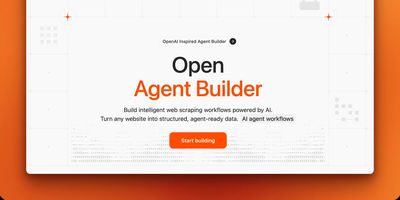
Open Agent Builder delivers a visual canvas for orchestrating AI agent workflows without writing Python scripts or managing complex codebases. The React Flow-powered drag-and-drop interface supports seven node types — Agent, Scraper, Transform, If/Else, Loop, User Approval, and MCP Tool — each configurable with provider-specific settings for Anthropic Claude (Haiku 4.5 and Sonnet 4.5), OpenAI GPT-5, Groq, or any OpenAI-compatible endpoint. The LangGraph orchestration engine handles state management, conditional routing, and human-in-the-loop approval gates while Firecrawl integration converts any website into structured, LLM-ready data through scrape, crawl, and map operations. E2B sandboxed code execution powers Transform nodes for secure data manipulation without risking host system integrity. Real-time streaming updates show execution progress node-by-node as workflows run, with Convex providing reactive database synchronization for workflow state and execution history. The TypeScript-first architecture (96.8% TypeScript) built on Next.js 16 App Router with Tailwind CSS delivers a responsive interface across devices. Clerk handles multi-user authentication with JWT integration for secure workspace isolation. Deploy via npm install and environment configuration with Firecrawl, Convex, and Clerk API keys. Running on a dedicated VPS on RepoCloud with guaranteed CPU, RAM, and SSD, full root SSH access, and a browser serial console. MIT licensed.