Redlib
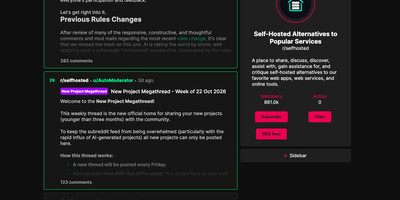
Redlib lets you read Reddit without an account, ads, or trackers, through a clean page served from a machine you control. Open any subreddit, user profile, or comment thread and the server fetches the content and relays every image and video itself, so your browser never talks to Reddit directly. Pages need no JavaScript, unless you opt in to HLS video playback with sound. Choose card, clean, or compact layouts, a wide interface, and one of more than a dozen themes, from Dracula and Nord to Gruvbox and Tokyo Night. Post and comment sorting, a search box scoped to the current subreddit, a wiki tab, and subreddit filters help you find and tame your feed. Subscriptions build a personal home page with no login. Spoilers and NSFW previews can be blurred or hidden, and an SFW-only mode blocks mature content for the whole instance. Optional RSS feeds let a feed reader follow subreddits. Links to removed posts open in a configurable undelete viewer. Operators set defaults through environment variables, add an instance banner, discourage search indexing, and route outbound traffic through an HTTP or SOCKS proxy. Settings live in a browser cookie and can be exported or imported between devices. Running on a dedicated VPS on RepoCloud with guaranteed CPU, RAM, and SSD, full root SSH access, and a browser serial console. AGPL-3.0 licensed.
Etude
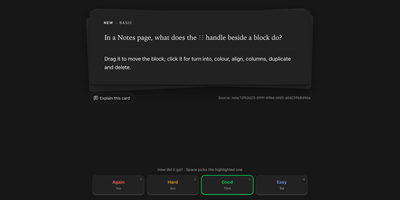
Because every flashcard is a small program, Etude can ask for a fresh calculation on each review, play a chord on a piano, pose a chess puzzle, or grade a proof by what you wrote. A card is graded by self rating, by a script, by AI that explains what you missed, or by a hybrid that hands the hard cases to the model. Math answers are compared by equivalence, so x(x+1) matches x^2+x. FSRS-6 schedules the reviews. Give a deck an exam date and every card is pulled in before the day. Anki .apkg decks import with their review history. The Market installs shared decks, card types, and themes, and an in-app editor with live preview lets you design your own. Notebook pages hold equations, runnable code, canvases, kanban boards, and a link graph. The Ask assistant builds decks from your notes or a PDF. Every action is also a CLI command with JSON output, so Claude Code or Codex can quiz you and flag weak topics, and an MCP server opens your collection and notes to them. AI grading stays off until you add an API key or sign in with ChatGPT, and any address other than localhost requires an access token. Running on a dedicated VPS on RepoCloud with guaranteed CPU, RAM, and SSD, full root SSH access, and a browser serial console. AGPL-3.0 licensed.
Bloomberg Terminal
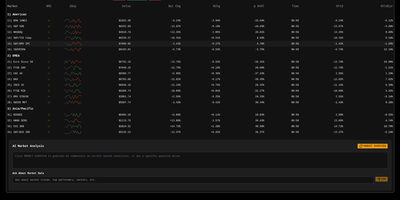
With 1,450+ GitHub stars and a live demo on Vercel, this Bloomberg Terminal clone delivers a professional-grade financial dashboard without the $24,000 annual seat license. The Next.js 15 App Router with React 19 and TypeScript serves a single-page terminal interface optimized for constantly mutating financial data, with partial pre-rendering enabling sub-500ms initial loads even on data-heavy views. Upstash Redis caches AlphaVantage market data to minimize API calls while maintaining sub-second update latency through React Query polling with configurable refresh rates. OpenAI integration provides AI-powered market insights, sentiment analysis, and trend interpretation directly within the terminal interface. Multiple specialized views cover market data tables with bid/ask spreads, financial news aggregation with category filtering, market movers highlighting top gainers and losers, and volatility analysis with historical comparison charts. Jotai atoms manage local state for watchlists, layout preferences, and terminal sessions while React Query handles server-state synchronization with aggressive stale-while-revalidate caching. The shadcn/ui component library with Tailwind CSS delivers accessible, keyboard-navigable interface elements styled after Bloomberg's iconic dark terminal aesthetic. Security features include origin restriction, rate limiting via Redis, and Zod-based input validation on all API routes. Motion (formerly Framer Motion) animates transitions between views and data updates without layout shift. Running on a dedicated VPS on RepoCloud with guaranteed CPU, RAM, and SSD, full root SSH access, and a browser serial console. MIT licensed.
AgentRun
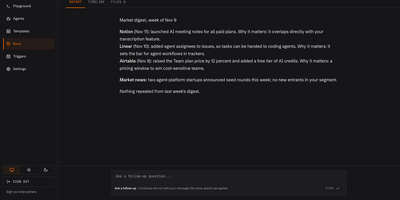
A control room for AI agents, where every run is recorded, capped, and ready to resume after a crash. Mission Control opens first with agent and run counts, tokens, success rate, and cost per day. A Templates page applies ready-made agents for code review, KYB due diligence, lead scoring, market monitoring, and release notes in a single screen. Every run gets a Report tab with the finished answer and a Timeline tab with each message, tool call, and charge. Tools are set to allow, ask, or deny. Spend caps pause a run instead of failing it. An agent can stop and ask a person a question. The Playground starts a run from a form and shows the same request as curl, so each agent doubles as an API. Triggers start capped runs on a schedule, from a signed webhook, or on a GitHub pull request. Learning mode keeps notes, skills, and workflows from each job so repeat work needs fewer tokens. Automated code review, customer research, and competitor digests are typical recurring jobs to hand it. Running on a dedicated VPS on RepoCloud with guaranteed CPU, RAM, and SSD, full root SSH access, and a browser serial console. Apache-2.0 licensed.
MCPProxy
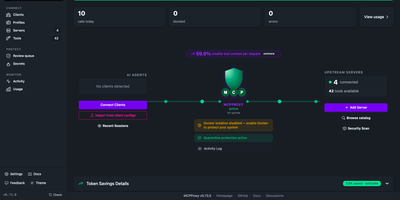
MCPProxy puts one safe endpoint in front of every MCP server your AI agents use, and it holds each new server in quarantine until a person approves it. Add stdio or HTTP servers on the Servers page, then review the captured tool definitions and scanner findings in the Review queue before any agent can call them. The Tools page lists every tool with a Read, Write, or Destructive tier, an approval state, and a usage count, plus switches to hide whatever you do not want exposed. Agents see a short set of discovery and call tools instead of the full catalog, and the Home dashboard estimates how much context that saves per request. The Activity Log records each call with its server, intent, status, and duration, and exports for audits. The Usage page charts calls per tool, response sizes, errors, latency, and activity over time, filtered by profile, client, or token. Profiles and agent tokens scope what each client may reach, a Secrets page keeps credentials out of config files, and a setup wizard connects Claude Code, Claude Desktop, Cursor, Windsurf, and VS Code. Platform teams and solo builders get one place to see and control everything their agents can touch. Running on a dedicated VPS on RepoCloud with guaranteed CPU, RAM, and SSD, full root SSH access, and a browser serial console. MIT licensed.
Orchard
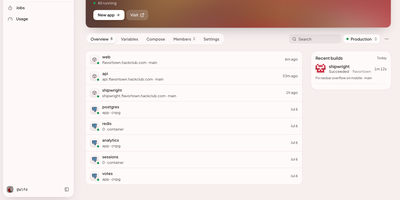
With one command, Orchard turns a bare Linux server into a private deployment platform that builds your Git repositories, serves each app over HTTPS, runs managed Postgres beside it, and rolls back bad releases. Connect GitHub, GitLab, Gitea, Forgejo, Codeberg, or Bitbucket Cloud, enable auto-deploy, and every push builds from a Dockerfile or automatic language detection and starts new pods before the old ones stop. Prebuilt images, Compose files, Score files, and more than 90 ready-made templates, including n8n, Open WebUI, and Minecraft servers, cover everything else. Postgres comes with continuous backups to S3-compatible storage, restore to any moment in the last 30 days, forks for safe testing, standby failover, read replicas, and a connection pooler. Live logs, a shell inside a running container, CPU, memory, and request metrics, alert rules, and Slack, Discord, email, or webhook notifications show how each app behaves. Organizations, projects, roles, SAML and OIDC sign-in, SCIM provisioning, quotas, and audit logs let a team share one instance, while cron jobs, custom domains with self-renewing certificates, Tailscale-only private apps, and public status pages cover daily operations. The orchard CLI and a Terraform provider script deployments, an MCP server lets Claude, Cursor, or another agent deploy apps and read logs, and grafts add extras such as Greenhouse for running coding agents on cloud machines. Running on a dedicated VPS on RepoCloud with guaranteed CPU, RAM, and SSD, full root SSH access, and a browser serial console. AGPL-3.0 licensed.
Hexclave
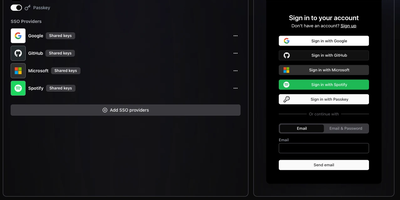
When a product needs sign-in, teams, permissions, and user analytics, Hexclave (formerly Stack Auth) delivers all of it from one admin dashboard, so nobody on your team hand-rolls another password reset flow. Sign-in methods are switches, each flipped on or off without a redeploy: email and password with secure reset, magic links, passkeys, TOTP two-factor, any of 12 OAuth providers including Google, GitHub, Microsoft, Apple, and Discord, or your own OpenID Connect provider. Sign-up rules allow, reject, or hold accounts by email domain, country, auth method, or fraud risk score. The user directory searches, filters, edits, and exports every profile, custom metadata included. Teams bring workspaces, email invites, and nested roles checked the same way on server and client. API keys belong to users or teams, auto-revoke when leaked, and reveal their secret only once. Themed templates send transactional and marketing email with open and click tracking. Analytics show live active users and session replays and store the SQL queries you write, and every user event can fire a signed webhook with automatic retries. Standard JWTs verify locally against a JWKS endpoint, and SDKs cover Next.js, React, and plain JavaScript. Self-host the dashboard and API on your own server and export your users whenever you like, with no lock-in. Running on a dedicated VPS on RepoCloud with guaranteed CPU, RAM, and SSD, full root SSH access, and a browser serial console. MIT and AGPLv3 licensed.
phpMyAdmin
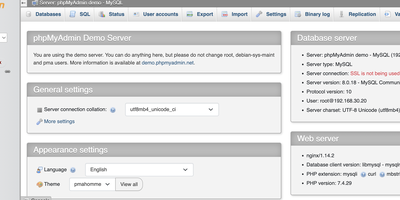
Since 1998, phpMyAdmin has been the standard web interface for MySQL and MariaDB - the tool millions of developers, DBAs, and hosting companies reach for when a database needs inspecting, fixing, or migrating. Written in PHP, it covers effectively the entire administration surface: create, browse, alter, and drop databases, tables, views, columns, and indexes; insert and edit rows through a tabular editor; manage user accounts and granular privileges; and maintain stored procedures, triggers, and events - all without touching a command line. The SQL editor executes arbitrary queries with syntax highlighting, autocompletion, history, and bookmarkable statements, including batch queries. Import/export is a migration workhorse: read SQL, CSV, XML, and OpenDocument spreadsheets in; write out to SQL dumps, CSV, JSON, XML, PDF, Word, LaTeX, and more - the fastest path for moving a WordPress database or handing a schema to a colleague. The Designer view renders your schema as an interactive ER diagram with drag-and-drop relationship editing, and data transformations display BLOBs as images or download links inline. Server maintenance views surface configuration suggestions. Multi-server support, dark mode, and translations into 72 languages round out a tool that earns its ubiquity. GPL-licensed.
Dify
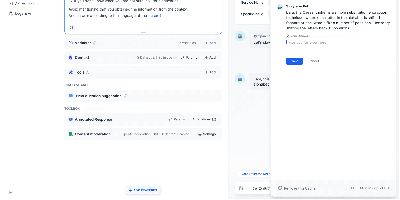
Dify turns the notoriously complex process of building production-grade AI applications into a visual drag-and-drop experience that teams can actually ship and maintain. With over 87,000 GitHub stars and backing from prominent investors, the platform has become the go-to open-source LLMOps solution for organizations that refuse to be locked into proprietary AI stacks. The visual workflow canvas lets developers wire together LLM calls, conditional logic, iteration loops, tool invocations, and human-in-the-loop checkpoints without writing boilerplate integration code. Its RAG pipeline engine handles the full document lifecycle from ingestion of PDFs, Word documents, and HTML through configurable chunking strategies, embedding with models from OpenAI or open-source alternatives, vector storage in Weaviate, Qdrant, Pinecone, or pgvector, and hybrid semantic-plus-keyword retrieval with citation tracking. Dify integrates with hundreds of model providers including OpenAI GPT-4o, Anthropic Claude, Google Gemini, Mistral, Llama, and any OpenAI-compatible endpoint like Ollama for fully local inference. The agent framework supports both ReAct and function-calling strategies with 50-plus built-in tools spanning Google Search, DALL-E, Stable Diffusion, WolframAlpha, and custom API definitions. Published apps can be deployed as hosted web interfaces, embedded chat widgets, REST API endpoints, or MCP-compatible tools. Enterprise features include role-based access control, SSO integration, and audit logging. A built-in marketplace enables teams to share and reuse model providers, tools, and workflow templates across projects. Running on a dedicated VPS on RepoCloud with guaranteed CPU, RAM, and SSD, full root SSH access, and a browser serial console. Apache 2.0 licensed with an open-source community edition.
DocuSeal
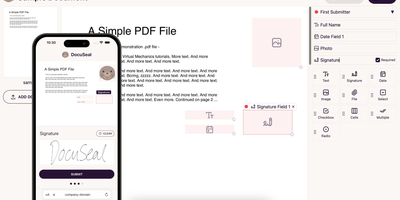
Contracts signed on your own server: DocuSeal is the most feature-complete open-source, self-hosted alternative to DocuSign. A WYSIWYG builder turns any PDF into a fillable form with 14 field types: signature, initials, date, file upload, checkbox, dropdown, radio, stamp, and more. Documents route to multiple submitters in sequence or parallel, with automated SMTP email notifications, reminders, and a mobile-optimized signing experience that works on any device without an account. Every completed document carries an automatic PDF eSignature with verification and an audit trail. Templates are reusable and can also be generated programmatically - from HTML via API or from PDFs and DOCX files with embedded field tags - and the REST API plus webhooks drive full workflow automation, with embedded signing forms and form builders for React, Vue, Angular, and plain JavaScript. Files store on disk or in S3, Google Cloud Storage, or Azure. The UI ships in 7 languages with signing in 14. Runs on SQLite, PostgreSQL, or MySQL; AGPL-3.0 licensed with unlimited documents and no per-signature fees.
FoxProfile
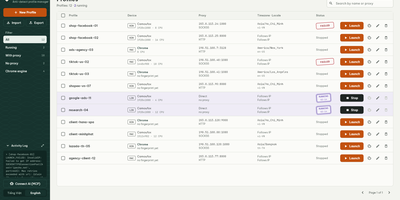
Every account you run deserves its own browser identity, and FoxProfile keeps those identities permanently separate instead of letting them bleed into one another. Create a profile once and it remembers its device: screen, GPU, CPU cores, fonts, and canvas noise are generated on first launch and reused on every later one, so the fingerprint a site saw yesterday is the fingerprint it sees tomorrow. Sessions stick too: history, cookies, and logins live in the profile directory, and the tabs you left open reopen where you left them. Each profile carries its own proxy (HTTP, HTTPS, SOCKS4, or SOCKS5, with a built-in checker) while timezone and locale follow the exit IP automatically or stay pinned to your choice, and the Check IP button compares the exit address across three services and flags mismatches or datacenter addresses. Cookies move in and out as standard editor JSON or Netscape files, whole profiles travel as ZIP archives, and bulk actions launch, stop, or delete fleets at once. On a server, the web panel runs profiles headlessly so you can manage them and view their screens from anywhere, the REST API scripts everything, and the MCP server lets AI agents drive the browsers directly. Running on a dedicated VPS on RepoCloud with guaranteed CPU, RAM, and SSD, full root SSH access, and a browser serial console. MIT licensed.
Manifest LLM Gateway
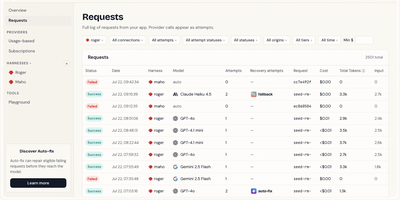
Manifest LLM Gateway is a self-hosted gateway that puts every model you pay for behind one OpenAI- and Anthropic-compatible endpoint. Connect provider API keys, reuse subscriptions like ChatGPT Plus or Claude Max, or point it at Ollama and LM Studio on your own hardware. Send a request with the model set to auto and your routing rules choose the target by model, header, complexity, or task type, with fallbacks that take over the instant a model fails. Each agent or app gets its own harness, a named connection with a private key, spending limits, and notifications when usage climbs. The Requests view logs every call and every retry attempt, with status, cost, tokens, and the full request and response body readable as a conversation. Autofix repairs a malformed request, for example one using a renamed parameter, and resends it before your app ever sees an error. A Playground tests models from the dashboard, a command line tool and MCP server handle setup from a terminal or an AI assistant, and an n8n node plugs it into automations. Over 35 provider connections cover more than 300 models. Running on a dedicated VPS on RepoCloud with guaranteed CPU, RAM, and SSD, full root SSH access, and a browser serial console. MIT licensed.
Token Bank
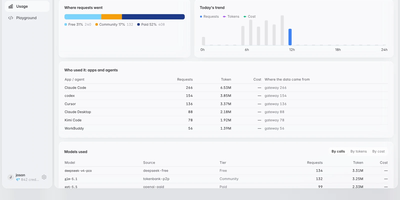
Run one local gateway and every AI coding agent you use shares the same address, key, and usage ledger. Token Bank onboards Claude Code, Codex CLI, Kimi Code, OpenCode, Claude Desktop, OpenClaw, and WorkBuddy in one click by injecting base-URL variables or patching configs, and Revert restores the official settings. Agents keep native model names while the gateway quietly reroutes requests to Ollama, Groq, Cerebras, or DeepSeek, converting between Anthropic Messages, OpenAI Chat, and Codex Responses. Route chains step from local models to free APIs, subscriptions, and pay-as-you-go keys with failover, scene and task presets, and optional lossless JSON compression. Every call is traced with route, model, tokens, latency, and cost, local session logs are imported, and signed-in devices merge into one dashboard. An assets library holds MCP servers, skills, prompts, and agent templates, projects them onto each installed runtime, and a rule-driven butler repairs broken projections. The unified agent API dispatches tasks to local apps, professional templates, external agents joined by pairing code, or agents hired per task, returning results synchronously, in the background, or as a stream. A credit-based market lets you rent out idle quota while keys stay on your machine. The container build serves the desktop interface in a browser on port 11431, with the gateway on 11430 and access control left to your firewall or proxy. Running on a dedicated VPS on RepoCloud with guaranteed CPU, RAM, and SSD, full root SSH access, and a browser serial console. Apache-2.0 licensed.
MCPJam Inspector
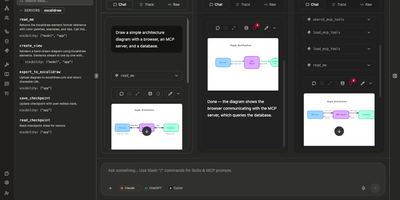
Every AI client reads a Model Context Protocol (MCP) server a little differently, and MCPJam Inspector is the testing platform that shows exactly where yours breaks before your users find out. Connect a remote HTTP server or a local STDIO one, then send a single prompt to Claude, ChatGPT, and Cursor panes side by side and compare answers, tool calls, token counts, and latency in Chat, Trace, and Raw views. MCP App widgets render inline in a device emulator with locale, light and dark mode, and safe-area controls. The OAuth Debugger walks authorization one request at a time across the 2025-03-26, 2025-06-18, 2025-11-25, and draft 2026-07-28 spec versions, with dynamic client registration, pre-registered clients, and client ID metadata documents. Conformance runs score protocol, apps, tasks, and OAuth checks in one report, and Evals turn expected tool calls into repeatable test cases that models must pass. Run tools, resources, prompts, and elicitation flows by hand with every JSON-RPC message logged, script the same checks from the CLI and SDK, and gate pull requests in GitHub Actions or GitLab CI. Chat uses free hosted models or your own OpenAI, Anthropic, Google, xAI, Groq, or Mistral keys. Running on a dedicated VPS on RepoCloud with guaranteed CPU, RAM, and SSD, full root SSH access, and a browser serial console. Apache-2.0 licensed with an enterprise-licensed evals and services module.
OpenAgentCore
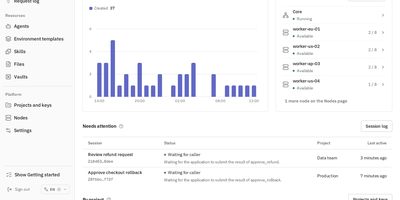
OpenAgentCore puts Codex, Claude Code, and MiniMax Code behind one self-hosted Agents API, so your applications start agent sessions through the official OpenAI SDK while the work runs on machines you control. Set OPENAI_BASE_URL to your installation and issue a Project API key, and the same client code that talks to OpenAI now talks to your Core. Each session runs a native harness, exactly as it runs on a developer's machine, with the model provider, model ID, and protocol you configure per harness or per session. Choose where sessions execute: microsandbox nodes you operate, Docker, E2B, or a self-hosted workstation, VM, or container connected by the oac-daemon with a credential scoped to one environment. Idle microsandbox sessions release their compute and resume on a compatible node with workspace files intact, so long investigations do not rent a machine while they sleep. The Web console walks operators through setup, tracks sessions and turns, manages models and credentials, and issues keys, while the separate Core API serves operators and the Agents API serves applications. Durable execution state in PostgreSQL keeps events, results, and schedules recoverable across restarts. Sandbox providers, workspace filesystems, harnesses, and model providers all plug in through defined protocols, so every layer can be replaced on its own. Running on a dedicated VPS on RepoCloud with guaranteed CPU, RAM, and SSD, full root SSH access, and a browser serial console. MIT licensed.
Bisibility
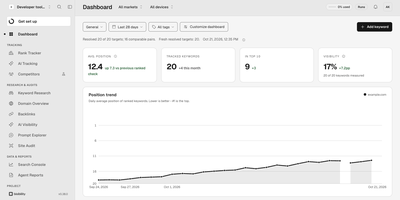
Bisibility puts your Google rankings, keyword research, and backlink profile in one application that runs on your server instead of behind a per-seat subscription. Track every keyword by market and device, watch positions move over time, and open the stored snapshot of the actual results page behind any check to see exactly what Google showed. Alerts flag the movements that matter, while competitor share of voice shows whose visibility is growing at your expense. The keyword explorer surfaces suggestions with search volume, trends, cost per click, difficulty, and intent, and shows the estimated price before a lookup runs, so research never surprises your wallet. Backlink and domain views break down referring domains, anchors, and new and lost links next to estimated traffic and top pages for any site you type in. Search Console clicks, impressions, and queries are kept beyond the usual retention window, and a recurring prompt tracker follows how AI answer engines cite your brand over time. Results flow outward through a versioned API, MCP access, signed webhooks, and CSV exports. Running on a dedicated VPS on RepoCloud with guaranteed CPU, RAM, and SSD, full root SSH access, and a browser serial console. AGPL-3.0 licensed.
Clay Studio
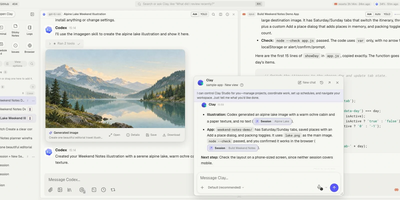
Clay Studio is a self-hosted workspace where your team and its coding agents share projects, live sessions, and project knowledge in one browser interface instead of scattering them across terminals. You organize several repositories in one sidebar and run sessions in parallel while teammates watch live activity, enter the same session, hand work off, and answer permission requests from wherever they are. Ten agent runtimes plug into the same workspace, Claude Code, Codex, Grok Build, Kimi Code, GitHub Copilot CLI, Qwen Code, Junie CLI, Antigravity CLI, OpenCode, and Kiro CLI, each keeping its own authentication and models. Persistent Mates give AI collaborators an identity, instructions, memory, direct messages, and roles in structured debates that survive beyond a single chat. Worktrees, paired sessions, spawned workers, scheduled tasks, and Ralph Loops let background jobs proceed without losing sight of what is running. You browse and edit files, inspect diffs and history, open terminals, install skills, connect MCP servers, and manage project knowledge without leaving the workspace. The installable PWA works on mobile and pushes notifications for approvals, failures, and finished work. Sessions and knowledge stay on your disk as portable JSONL and Markdown, so switching providers never means migrating your workspace. Running on a dedicated VPS on RepoCloud with guaranteed CPU, RAM, and SSD, full root SSH access, and a browser serial console. AGPL-3.0-only licensed.

SnapOtter
Fifty-plus image processing tools in a single Docker container, with no Redis, no Postgres, and no external dependencies: SnapOtter is a self-hosted image toolkit. The everyday operations are all here: resize, crop, compress, watermark, vectorize, meme generation, GIF creation, and format conversion spanning 55+ input formats (including 23 camera RAW formats) to 14 output formats. What sets it apart is the local AI layer: background removal, photo upscaling and restoration, object erasing, face blurring, OCR, and canvas expansion all run on locally hosted models, so no image ever leaves your server - a hard guarantee that cloud tools like remove.bg or Canva can't make. Optional NVIDIA GPU support accelerates those AI tasks substantially when hardware is available, but everything works on CPU. A built-in layer-based editor handles composition work directly in the browser, and screenshot beautification turns plain captures into polished visuals with backgrounds, shadows, and padding - useful for docs and marketing alike. Batch operations process unlimited images simultaneously, and the full REST API with OpenAPI documentation exposes every tool for pipelines and automations: thumbnail generation on upload, bulk RAW conversion, automated watermarking. For teams processing sensitive imagery or anyone tired of per-image SaaS pricing, SnapOtter replaces a stack of subscriptions with one private container.