Eclipse Ditto
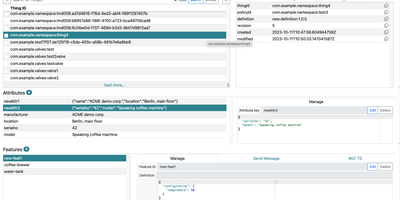
Every physical device on your network gets a living digital counterpart in Eclipse Ditto: a Thing whose Features hold its current state, desired state, and properties, readable and writable through APIs even while the device itself is offline. Your application talks to the twin over a REST-like HTTP API for CRUD and search, over WebSocket for real-time bidirectional streams, or over Server-Sent Events for change notifications, and Ditto routes commands down the live channel to the actual device when it is connected. Devices and backends connect through managed Connections to MQTT, AMQP 1.0 and 0.9.1, Apache Kafka, and HTTP endpoints, with payload mapping that translates between device formats and Ditto Protocol JSON. Fine-grained Policies decide per subject and resource who may read a temperature, change a setpoint, or receive an event, including namespace-scoped entries and partial change notifications that only reveal fields a subscriber may see. Search across millions of twins uses an RQL query language with custom MongoDB indexes, and Web of Things integration generates Thing Descriptions scoped to each requester's permissions. The bundled Explorer UI lets operators browse Things, inspect Features, and time-travel a twin's state to any past revision or timestamp to see exactly what changed and when. OpenID Connect and basic authentication protect the gateway, and Prometheus metrics expose live entity counts per namespace. Running on a dedicated VPS on RepoCloud with guaranteed CPU, RAM, and SSD, full root SSH access, and a browser serial console. EPL-2.0 licensed.
Zigbee2MQTT
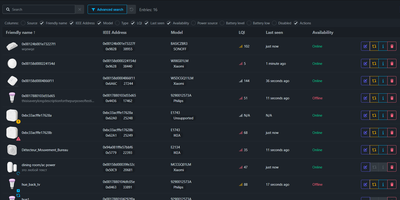
Zigbee2MQTT bridges a Zigbee smart home network to MQTT so bulbs, switches, sensors, and locks from hundreds of vendors work with your own automation server instead of each manufacturer's cloud bridge. It supports 5,798 devices from 608 vendors, so a Philips Hue bulb, an IKEA TRÅDFRI switch, an Aqara sensor, and a Tuya plug can all join one coordinator and speak one protocol. The built-in frontend on port 8080 shows every paired device with its link quality, battery level, and live state, and lets you rename, reconfigure, bind, or remove devices without editing YAML. A network map view charts which routers carry traffic for which end devices, making weak spots and dead zones visible before automations start failing. Groups collect devices that should act together, scenes capture lighting states for a room, and bindings let a switch talk directly to a bulb even when the server is briefly offline. Firmware stays current through over the air updates you can trigger or schedule per device from MQTT topics or the frontend, including downgrades when a new release misbehaves. Home Assistant picks everything up automatically through MQTT discovery, while openHAB, Domoticz, and Node-RED flows subscribe to the same plain JSON topics. The coordinator plugs into the host by USB or joins over the local network, while the bridge, frontend, and broker traffic run headlessly beside Mosquitto or EMQX. Running on a dedicated VPS on RepoCloud with guaranteed CPU, RAM, and SSD, full root SSH access, and a browser serial console. GPL-3.0 licensed.
evcc
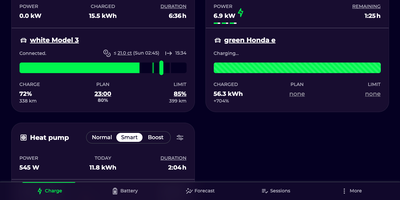
evcc turns surplus rooftop solar and the cheapest hours of a dynamic tariff into cheap, clean kilometers by coordinating an EV charger, heat pump, and home battery from one local dashboard. Each charging point offers Off, Smart, and Fast modes. In Smart mode, charging starts once the surplus covers the car's minimum power, follows the sun up and down, pauses when clouds win, and can switch between one and three phases on wallboxes that allow it. A solar share slider lets small systems start earlier, and Always charge keeps fussy cars from being interrupted. Set a departure time and a target charge, and a charging plan picks the cheapest or cleanest hours before it, repeating weekly if you like. Tibber, Awattar, fixed and time-based rates, dynamic feed-in prices, and CO2 and solar forecasts all feed those decisions. A home battery can claim the surplus first or lend a boost for fast charging, and load management keeps several chargers inside a circuit's current limit while honoring grid operator dimming. Hundreds of wallboxes, inverters, meters, heat pumps, and vehicle APIs are supported, including Tesla, BMW, Mercedes-Benz, Skoda, and Volkswagen. Sessions land in a history with charts and CSV export, and REST, MQTT, InfluxDB, Grafana, Home Assistant, and openHAB link evcc to the rest of the house. Running on a dedicated VPS on RepoCloud with guaranteed CPU, RAM, and SSD, full root SSH access, and a browser serial console. MIT licensed.

OpenHAB
Over 400 technologies and thousands of smart devices from any manufacturer, unified under one roof: openHAB is the vendor-neutral home automation platform with a pluggable binding architecture. Each binding translates a device or service into openHAB's clean abstraction: Things expose Channels, Channels link to Items, and Items feed a rules engine that runs your home. That engine meets you at your skill level: Blockly gives non-programmers drag-and-drop visual logic, JS Scripting (GraalJS with the openhab-js library) is the modern text-based standard, the classic Rules DSL remains supported, and JSR223 opens the door to Python, Ruby, and Groovy. Time- and event-based triggers, scripts, notifications, and voice control compose into automations of any complexity, and users report decade-old rule sets still running rock solid. The Main UI handles configuration, semantic modeling, and now built-in charting - no external Grafana required. Built in Java on Apache Karaf's OSGi runtime and stewarded by the non-profit openHAB Foundation, it requires no cloud to function: everything runs locally, talking directly to your devices. Optional connectors bridge to Alexa, Google Assistant, and HomeKit, with iOS, Android, and web apps for control from anywhere.
Home Assistant
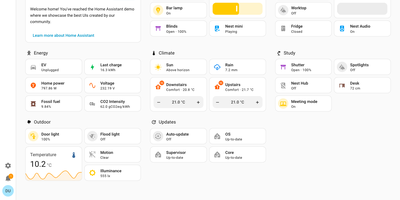
Your house already has lights, locks, sensors, thermostats, and speakers from many brands, and Home Assistant gives them one local control room with no vendor cloud in the loop. To close the shutters when the outdoor temperature holds above 25 °C, or to be alerted when the garage door is left open, build the routine in the visual editor: When, And if, Then do. Scenes, scripts, and blueprints package it for reuse, and run traces show what it did. More than 1,500 integrations cover Zigbee, Z-Wave, Matter, Thread, MQTT, ESPHome, Bluetooth, Hue, and Sonos, and network discovery offers known devices for one-step setup. To see the house at a glance, drag tile, thermostat, gauge, graph, and map cards into a dashboard, then put it on a TV with Home Assistant Cast. The Energy dashboard answers where the power goes, drawing solar, grid, battery, gas, and water as one distribution diagram with cost totals and per-appliance tracking. To talk to the house, use Assist: natural-language commands, wake words, and custom sentences run locally or through Home Assistant Cloud. The map panel shows who is home, plotting people against zones such as Home, Work, and School from the iOS and Android companion apps. Areas and labels keep large setups tidy, and multi-factor authentication guards each account. Running on a dedicated VPS on RepoCloud with guaranteed CPU, RAM, and SSD, full root SSH access, and a browser serial console. Apache-2.0 licensed.
EverShelf
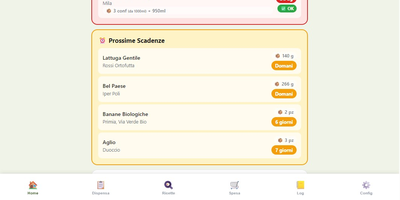
That yogurt hiding behind the ketchup expired three weeks ago, and the flour you bought "just in case" has been sitting in the pantry since last winter. EverShelf replaces mental guesswork with a structured inventory system that tracks every item across pantry, fridge, freezer, and custom locations with precise quantities, expiry dates, and consumption patterns. Scan barcodes with your phone camera to add products instantly, or let the Gemini AI identify items from a photo and estimate shelf life based on storage location. The dashboard surfaces expired items and upcoming expirations with color-coded urgency badges, while anomaly detection flags suspicious quantities and consumption predictions that deviate from your history. Opened products get reduced shelf-life calculations; vacuum-sealed items get extended dates automatically. The recipe engine generates context-aware meal suggestions from your current inventory, prioritizing ingredients approaching expiry so nothing goes to waste; each recipe includes step-by-step cooking mode with text-to-speech narration and timer integration. A smart shopping list auto-populates when stock hits zero and syncs bidirectionally with the Bring! app, with AI-estimated prices per item and consumption forecasts showing when you will need to restock. For Home Assistant users, a native HACS integration provides 22 sensors, expiry calendars, bidirectional todo-list sync, and voice assistant support for adding items hands-free. A dedicated Kiosk mode optimizes the interface for wall-mounted tablets with BLE scale integration. Running on a dedicated VPS on RepoCloud with guaranteed CPU, RAM, and SSD, full root SSH access, and a browser serial console. MIT licensed.