MiroTalk
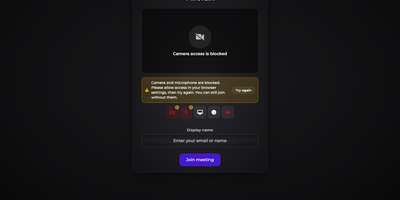
MiroTalk P2P gives your team browser meeting rooms with video, screen sharing, and chat, where the media travels directly between participants instead of through a rented cloud. Create a room, send the link, and guests join from any modern browser with nothing to install and no account to create. Calls carry video at high frame rates, and anyone can share a full screen, one window, or a browser tab to walk through documents and slides. The built-in recording captures screen, camera, and audio in the browser, ready to download and pass along after the meeting. Chat supports Markdown formatting and emoji, and the room also packs a collaborative whiteboard, a shared text editor, live polls, and breakout rooms. Files move between participants inside the call, and speech recognition plus voice commands keep hands free during long sessions. Hosts lock rooms with passwords, hold arrivals in a lobby, and require approval before strangers wander in. Sign-in through OIDC, per-room JWT credentials, and host protection controls keep recurring meetings behind your own identity provider. A full REST API creates rooms from your own tools, Slack and Mattermost commands start calls from chat, and an iframe embed drops meetings into existing pages. The interface speaks 133 languages, and an optional ChatGPT assistant joins rooms to answer questions in the conversation. Running on a dedicated VPS on RepoCloud with guaranteed CPU, RAM, and SSD, full root SSH access, and a browser serial console. AGPL-3.0 licensed.
Filex
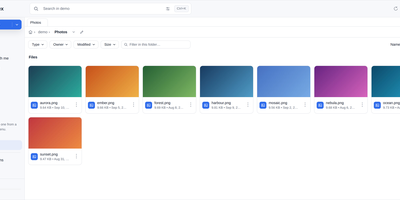
Your files already live in five places; filex puts them in one tree and serves that tree back out through almost any protocol. Mount local disks, S3 buckets, SFTP servers, WebDAV shares, FTP sites, and SMB network drives side by side, then copy in one storage and paste into another without thinking about where anything physically sits. The same tree is reachable as S3, SFTP, FTPS, NFS, and WebDAV, so rclone, restic, the AWS CLI, WinSCP, or FileZilla all work against it with the same per-user and per-folder permissions as the web interface. Sharing leaves the server under your control: public links carry a PIN, an expiry, and a download limit, and file-request links let people upload into a folder without seeing its contents. Anything deleted stays recoverable inside a retention window, overwritten files keep version snapshots, and encrypted folders are sealed in the browser so the server never receives a key. People sign in with OIDC single sign-on, LDAP or Active Directory, or the host machine's own accounts, with roles, groups, and tenants plus folder-level exceptions. A desktop app keeps chosen folders in sync within about a second, the file manager embeds into other products as a web component, and an MCP server plus REST API let agents work the same tree. It runs from one static binary or container on port 5212. Running on a dedicated VPS on RepoCloud with guaranteed CPU, RAM, and SSD, full root SSH access, and a browser serial console. MIT licensed.
Hopp
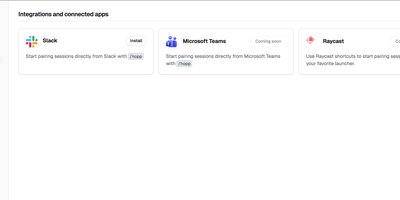
Meeting-app screen sharing was built for slide decks, and it shows when two engineers chase a bug across a codebase together; Hopp rebuilds screen sharing for exactly that job. Click a teammate and their screen opens in under a second: no meeting links, no calendar invites, no "can you see my screen?" ritual. Both sides get real keyboard and mouse control with sub-100ms latency, so guests type, click, and navigate instead of dictating instructions. Rooms hold up to 10 people for mob programming, code reviews, and onboarding, all with shared cursors so everyone can point at the line they mean. When words fail, draw or type annotations directly on the shared screen. The stream defaults to 4K, so small fonts and subtle diffs stay readable, and noise-cancelling audio keeps voices clear with no separate call app. You share any application, not just a browser tab, so debugging in Grafana or reviewing a design works as well as editing code. App Veil hides the windows you pick, such as password managers or chat, from the shared screen. Slack starts sessions with one /hopp command, and custom keyboard shortcuts keep frequent actions in flow. The server is yours: a Docker Compose stack with PostgreSQL, Redis, LiveKit, and Caddy auto-TLS serves the web dashboard and media, and the desktop app points at your backend, not a vendor cloud. Running on a dedicated VPS on RepoCloud with guaranteed CPU, RAM, and SSD, full root SSH access, and a browser serial console. AGPL-3.0 licensed.
Trackarr
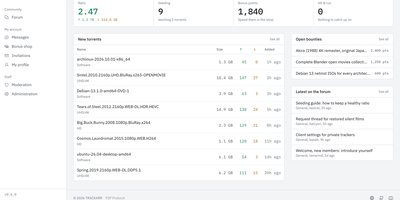
Trackarr gives a community everything it needs to run its own private BitTorrent tracker, from torrent uploads and member ratios to forums, messaging, and moderation. Members land on a home page showing their ratio, seeding count, bonus points, and hit-and-run status next to the newest torrents, open bounties, and forum threads. Browse torrents by category with search by name or hash, open a torrent for its swarm stats, description, and comments, and request missing titles by posting a bounty backed by a pot of points. Seeding earns bonus points to spend in the shop on upload credit, invites, and avatars, and admins can declare timed or open-ended freeleech. Private messages, invitations, reports, and a moderation queue keep the community orderly. Sonarr, Radarr, and Prowlarr connect through the Torznab API, and personal RSS feeds cover everything else. The admin area charts peers, seeders, and growth, and a panic button encrypts sensitive data on demand. Running on a dedicated VPS on RepoCloud with guaranteed CPU, RAM, and SSD, full root SSH access, and a browser serial console. MIT licensed.
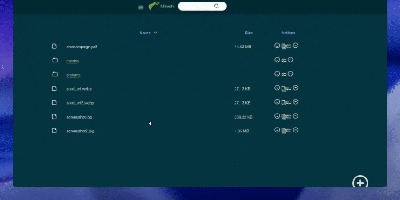
Mikochi
Point a browser at your server's folders and skip the FTP clients, the SSH tunnels, and the heavyweight cloud clones: Mikochi turns any directory on your machine into a clean web file browser you can open from anywhere. You browse nested folders in a fast list view, jump to files with fuzzy search, upload new material, create folders, rename items, and delete what is no longer needed. Whole directories come down as a single tar.gz archive, which makes backups and bulk transfers painless. Media files get a smarter treatment: Mikochi generates streaming links that open directly in VLC or mpv, so a film or album stored on the server plays on your screen without downloading gigabytes first. Access stays protected behind a username and password login with JWT sessions, and you can serve everything over TLS with your own certificates or disable authentication entirely on a trusted private network. Deployment takes one Docker command with a mounted data directory, and Kubernetes users get an official Helm chart. Homelab owners point it at a NAS share, developers drop it on a build box, and anyone tired of scp commands gets a permanent window into their files. Running on a dedicated VPS on RepoCloud with guaranteed CPU, RAM, and SSD, full root SSH access, and a browser serial console. MIT licensed.
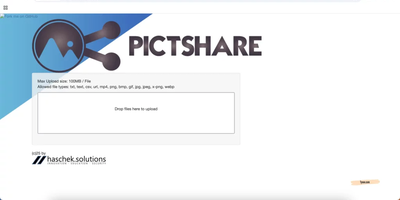
PictShare
Every screenshot, GIF, short video, audio clip, and block of text you share can live at a clean link on your own server, with the URL itself acting as the editing tool. Upload an image once and ask for any size, crop, or filter by changing the address, with WebP conversion handled automatically for browsers that support it and GIFs convertible to MP4 for quieter sharing. Photos arrive stripped of EXIF data, so phone pictures stop broadcasting GPS coordinates and camera models to everyone you share with. Uploading the same file twice costs no extra space, and delete codes at individual or global level keep takedown control with you rather than a platform. Several uploads combine into an immutable album with a single gallery link, a "My Uploads" tab in the browser tracks what you sent for later copying, deleting, or bundling, and playful extras generate identicons and placeholder images straight from URL patterns. Text bins, Markdown rendering, a URL shortener, and an upload API for scripts round out a tool that replaces the screenshot-upload step of a dozen workflows. External storage, optionally encrypted, takes over when the local disk outgrows the habit. Running on a dedicated VPS on RepoCloud with guaranteed CPU, RAM, and SSD, full root SSH access, and a browser serial console. AGPL-3.0 licensed.
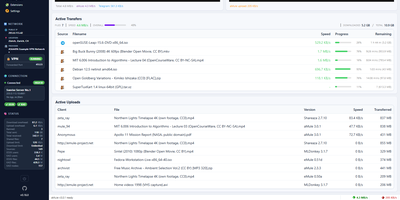
Mularr
Classic eD2k and Kad downloading gets a browser interface with the look of Windows XP, Windows Classic, a clean modern dashboard, or green-on-black Hacker mode. Mularr wraps an aMule daemon and shows live download and upload graphs, active transfers with progress and remaining time, and the uploads other clients are pulling. Transfers can be started, paused, stopped, categorized, and bulk imported from ED2K links. Servers, search, shared files, categories, and extensions each get their own page. For automation it presents itself as a qBittorrent download client and a Torznab indexer, so Sonarr and Radarr can use it with their standard settings. Extensions for Sonarr and Radarr read the Wanted list and publish matches into a feed the apps can poll. Telegram can act as an extra download provider and notification channel, and Hispashare releases appear in search results next to aMule's. A VPN panel reports Gluetun health and the forwarded port, and the settings page covers ports, bandwidth limits, IP filters, a blacklist, and shared folders. One container image and a single data volume are enough to get started. Running on a dedicated VPS on RepoCloud with guaranteed CPU, RAM, and SSD, full root SSH access, and a browser serial console. MIT licensed.
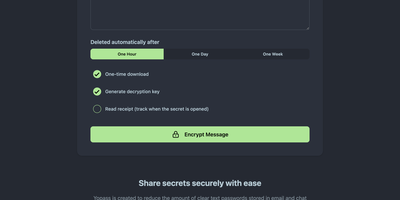
Yopass
With nearly 3,000 GitHub stars and active development since 2014 through version 14.2.0, Yopass eliminates the universal bad habit of sharing passwords and API keys through Slack messages, email threads, and ticket systems by encrypting secrets entirely in the browser using OpenPGP before anything reaches the server. The Go backend stores only ciphertext — it never sees plaintext — while the React frontend handles all encryption and decryption client-side, generating one-time URLs that self-destruct after a single viewing or when the configured expiration of one hour, one day, or one week passes. File upload support streams encrypted files with configurable size limits, and optional custom password protection adds a second encryption layer beyond the URL-embedded key. The server supports Redis or Memcached as storage backends with automatic key expiration, deploying via Docker Compose in under five minutes or as Kubernetes manifests for production environments. Built-in TLS support works alongside reverse proxy configurations for Nginx, Caddy, and Traefik with automatic Let's Encrypt certificate provisioning. Prometheus metrics expose HTTP request counts, latency histograms, and secret lifecycle counters for Grafana dashboard integration and alerting. Read-only mode enables split-instance deployments separating secret creation from retrieval across different network zones. Multi-language support localizes the interface for international teams. The open-source core under Apache 2.0 provides full self-hosted functionality with no account management required. Running on a dedicated VPS on RepoCloud with guaranteed CPU, RAM, and SSD, full root SSH access, and a browser serial console. Apache-2.0 licensed.
DashBeam
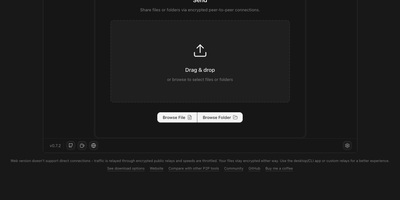
DashBeam sends files and folders of any size straight from one device to another, end to end encrypted, with no cloud account, no size limits, and nothing parked on a third party server in between. Drop in a file and share it through a short code, a link, or a QR scan; whoever receives it needs no account and can collect it in a plain browser tab with nothing installed. On the same network, nearby machines appear on their own, so pairing two devices and sending between them takes a couple of clicks instead of a cable or a memory stick. Pair a device once and it stays reachable by its identity, so your machines can exchange files from anywhere without swapping fresh tickets every time. Interrupted transfers resume where they stopped, and hopping from Wi-Fi to cellular mid-send does not drop the connection. One share can fan out to several receivers at once, and devices you mark as trusted can accept files automatically, which suits pushing builds, media libraries, or backups around a small fleet. You can preview what is arriving before downloading it, and a local history records every completed transfer. The repository also ships Docker Compose stacks for your own relay and discovery server, so even the encrypted fallback path can run entirely on machines you own. Running on a dedicated VPS on RepoCloud with guaranteed CPU, RAM, and SSD, full root SSH access, and a browser serial console. AGPL-3.0 licensed.
Screego
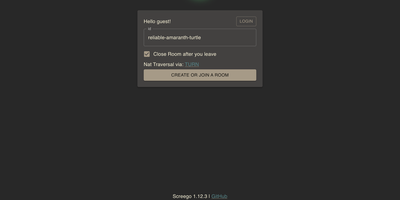
With over 10,000 GitHub stars and a reputation forged in the frustration of laggy corporate screen sharing, Screego delivers what Microsoft Teams and Zoom screen share consistently fail to provide: instant, high-resolution screen streaming that lets remote colleagues actually read your code. Built on WebRTC peer-to-peer connections, Screego transmits screen data directly between browsers without routing through centralized servers, achieving sub-second latency and native-resolution quality that makes pair programming and code reviews genuinely productive. The server component, written in Go with a TypeScript frontend, deploys as a single binary or Docker container with minimal configuration — set your external URL, generate a secret key, and you're live. An integrated TURN server handles NAT traversal automatically, eliminating the need for separate STUN/TURN infrastructure, with configurable UDP port ranges and support for external TURN servers when scaling beyond a single instance. Authentication supports three modes — requiring login for all actions, only for TURN connections, or none — with user management via simple credential files. Rooms are created instantly and support multiple simultaneous viewers, with system and tab audio sharing available for demonstrations that need sound. The architecture supports reverse proxy deployment behind Nginx, Caddy, or Apache with automatic TLS termination, and recent releases added riscv64 architecture support alongside existing amd64 and arm64 builds. Running on a dedicated VPS on RepoCloud with guaranteed CPU, RAM, and SSD, full root SSH access, and a browser serial console. GPL-3.0 licensed.
SkySend
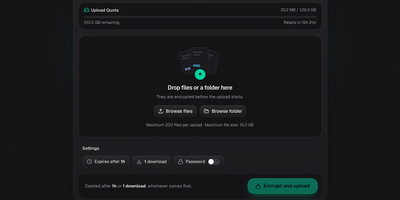
Only the person holding the link can open what you share with SkySend, a self-hosted file and note sharing service that encrypts everything in the browser before it leaves your device. Sending a contract? Drop in the file, several files, or a whole folder, and share the link. Need documents from a client? Send an upload link instead, and whatever comes back is encrypted for you alone. Handing over a password or an SSH key? Write it into a note that burns after reading. Notes can mix text, Markdown, generated passwords, and highlighted code in a single page. Every share can expire by time, stop after a set number of downloads or views, and carry an optional password as a second lock. The command-line client uploads, downloads, and reads notes with the same encryption, and its full-screen mode shows each link as a QR code. No accounts are needed: My Links keeps your shares in the browser, and optional OIDC sign-in limits who may create them. Encrypted uploads sit on local disk or any S3-compatible bucket, and the interface offers 13 languages and three themes. Running on a dedicated VPS on RepoCloud with guaranteed CPU, RAM, and SSD, full root SSH access, and a browser serial console. AGPL-3.0 licensed.
Transfer.sh
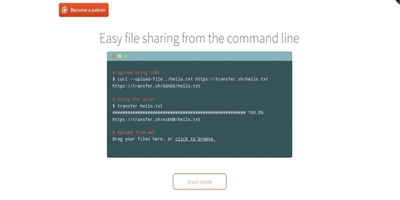
Transfer.sh is a file sharing service you host yourself, where sending a file to anyone is one curl command and receiving it is one link. Upload from the terminal with a plain PUT request or drop files into the web front end, then share the returned address with teammates, clients, or your future self on another machine. Every upload can carry its own expiry rules: cap the number of downloads, set the number of days before deletion, and let the automatic purge clean up what nobody needs anymore. A private delete link travels back with each upload, so the sender can pull a file down early without asking an administrator. Passwords can encrypt content on the server with AES256 before storage, and command line users can encrypt locally with GPG before anything leaves their machine. Uploads can be scanned through VirusTotal or a local ClamAV daemon before they are shared, which suits support desks trading log bundles and installers with people outside the company. Storage is your choice: a folder on the server disk, an S3 bucket including MinIO and other S3 compatible stores, Google Drive, or Storj, picked by configuration rather than code changes. Basic authentication, rate limiting, and automatic HTTPS through Let's Encrypt round out a service that runs as one small container on port 8080. Running on a dedicated VPS on RepoCloud with guaranteed CPU, RAM, and SSD, full root SSH access, and a browser serial console. MIT licensed.
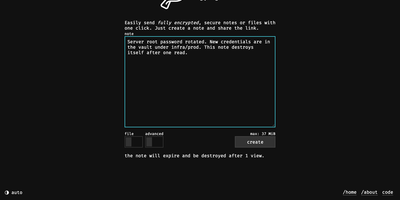
Cryptgeon
Passwords pasted into chat live forever, but a Cryptgeon note vanishes the moment it has been read. You type a note or pick a file, press create, and get a share link with a QR code to hand over. Encryption happens in the browser with XChaCha20-Poly1305, so the server holds only ciphertext and never sees the key that sits after the hash in the link. Advanced options set the number of views or a lifetime in minutes, and a custom password can be required on top of the generated key. Everything is kept in memory in a Valkey or Redis cache, so nothing is written to disk. Operators tune limits with environment variables for note size, maximum views, maximum expiration, file uploads, and ID length. The interface is a calm monospace page with dark and light themes. A command-line client sends notes from a terminal, and a Raycast extension covers the macOS launcher. Theme text, logo, favicon, and an imprint page can be customized to match a team or company. A health endpoint reports status to proxies and orchestrators. Running on a dedicated VPS on RepoCloud with guaranteed CPU, RAM, and SSD, full root SSH access, and a browser serial console. MIT licensed.
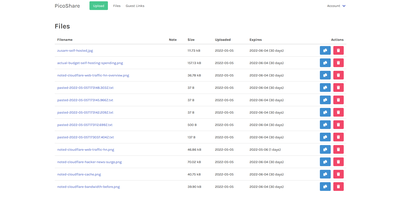
PicoShare
PicoShare is a minimalist file-sharing service you host yourself: upload any file and get a direct download link that anyone can open, with no ads, no signups, and no size or format restrictions. Send a client a 4 GB video or a raw photo archive and they download the exact bytes you uploaded, because PicoShare never resizes or re-encodes media while sharing. Every upload can carry an expiration, from a day to never, and an optional private note that only you can see. When other people need to send files to you, create a guest link instead of asking for email attachments: guests upload through the link with no account, and you set the maximum file size, the total number of uploads, and an expiry date for each link. The files list shows everything you have shared with sizes, upload dates, and expirations, and every entry offers one-click link copying and deletion. A single shared secret guards the admin side, and all data lives in one SQLite database file that you can back up or replicate to cloud storage automatically. Run it as one small Docker container on your own domain and your download links stay yours. Running on a dedicated VPS on RepoCloud with guaranteed CPU, RAM, and SSD, full root SSH access, and a browser serial console. AGPL-3.0 licensed.
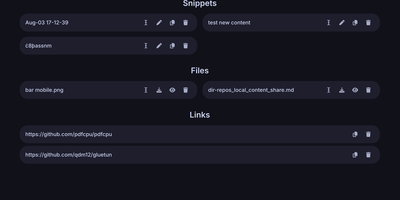
Local Content Share
The file is on your laptop, the laptop is downstairs, and cloud drives are still syncing yesterday; Local Content Share ends that dance by giving every device on your network one shared page on port 8080. Type or paste a snippet and it appears instantly on your phone, tablet, and work machine, because Server-Sent Events push every upload, edit, and deletion to all open browsers without a refresh. Files ride along three ways: pick them, drag several at once onto the text area, or paste straight from the clipboard, screenshots included. A separate notepad holds Markdown with edit and preview modes, auto-saving as you type so a thought started on the couch continues at the desk. Links get their own newest-first section, everything can be renamed or edited in place, and each item carries an expiration clock you can set to an hour, a day, or a custom span like 34m or 2w, after which it quietly deletes itself. The interface follows your system light or dark theme, installs as a phone PWA, and needs no accounts and no internet, which is also the honest catch: there is no login, so keep it on trusted networks or behind an authenticated proxy. Running on a dedicated VPS on RepoCloud with guaranteed CPU, RAM, and SSD, full root SSH access, and a browser serial console. MIT licensed.
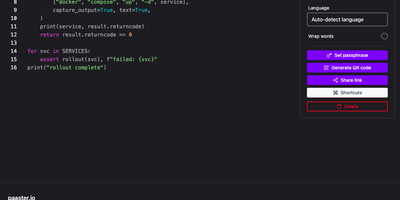
Paaster
Paaster is the pastebin for snippets too sensitive for a public paste site: every paste is encrypted in your browser before upload, so the server only ever stores ciphertext it cannot read. Paste code or logs and the text is sealed with libsodium the moment you stop typing, with the secret riding in the link fragment that browsers never send to a server. Share the link and only its holder can open the paste; share it as a QR code, or beam it to your other device with a five-minute code using Send to device. Set a paste to delete after its first view or after a chosen time, protect it with an access code, and let automatic language detection syntax-highlight the result. Your own pastes stay browsable in a local history, themes and keyboard shortcuts keep the editor fast, and drag-and-drop file sharing works the same encrypted way. Upload from the terminal with the companion CLI or the REST API, and store everything in MongoDB with MinIO, S3, or Cloudflare R2 holding the encrypted blobs. Running on a dedicated VPS on RepoCloud with guaranteed CPU, RAM, and SSD, full root SSH access, and a browser serial console. AGPL-3.0 licensed.
Pingvin Share X
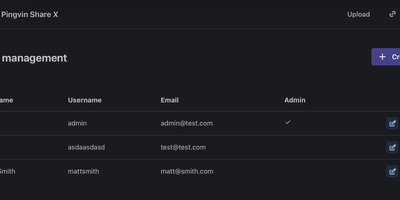
Pingvin Share X is your own WeTransfer, running on your server, with none of the transfer limits or expiring-link anxiety of the free tiers. Drop in a file of any size, get a link, and decide exactly how it behaves: an expiration date after which it vanishes, a password gate, a cap on how many visitors may open it, or all three. Email the link straight to recipients from the share dialog, and get notified when they download. Reverse shares flip the flow around: send someone a link and they upload files to you through it, which is perfect for collecting client deliverables, application documents, or the family photo archive without a single email attachment thread. Attachments can be scanned with ClamAV before anyone touches them, and storage lives on your disks or in S3-compatible buckets. Accounts connect through OIDC or LDAP single sign-on for teams, and an extensive admin panel tunes everything from password policy to upload chunk sizes. Registration rules decide whether your instance is a private family tool or an open drop point for your whole crew. Running on a dedicated VPS on RepoCloud with guaranteed CPU, RAM, and SSD, full root SSH access, and a browser serial console. BSD-2-Clause licensed.
Zusam
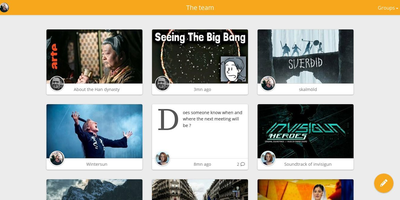
From the German "zusammen," together: Zusam is a private social space for a group of friends - a self-hosted alternative to the family WhatsApp group or the friends Facebook group, with no ads, algorithms, or data harvesting in between. The AGPLv3 project is deliberately modest in scope and stack: a Symfony PHP backend exposing a REST API over SQLite, with a lightweight Preact single-page frontend, designed for a low server footprint that runs comfortably on small hardware. Groups post messages into shared feeds that handle real life well: video and image uploads (with FFmpeg processing), photo albums for trips and events, and rich link previews with inline embeds for YouTube, Vimeo, Imgur, SoundCloud, Twitch, and Bandcamp - so sharing a song or a clip looks the way it should. When something needs to leave the circle, public link generation exposes a single message to non-members without opening the group. The interface is fully responsive and mobile-friendly, targeting Firefox ESR and recent Chrome. It is the small-web answer to a real question: where does a group chat's shared history live when you want it owned by the group instead of a platform?