Categories
Self-Hosted Developer Tools WebRTC Screen Sharing Pair Programming Remote Collaboration LiveKitStars
Forks
Watchers
Developer links
Hopp
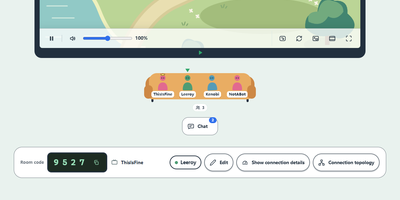
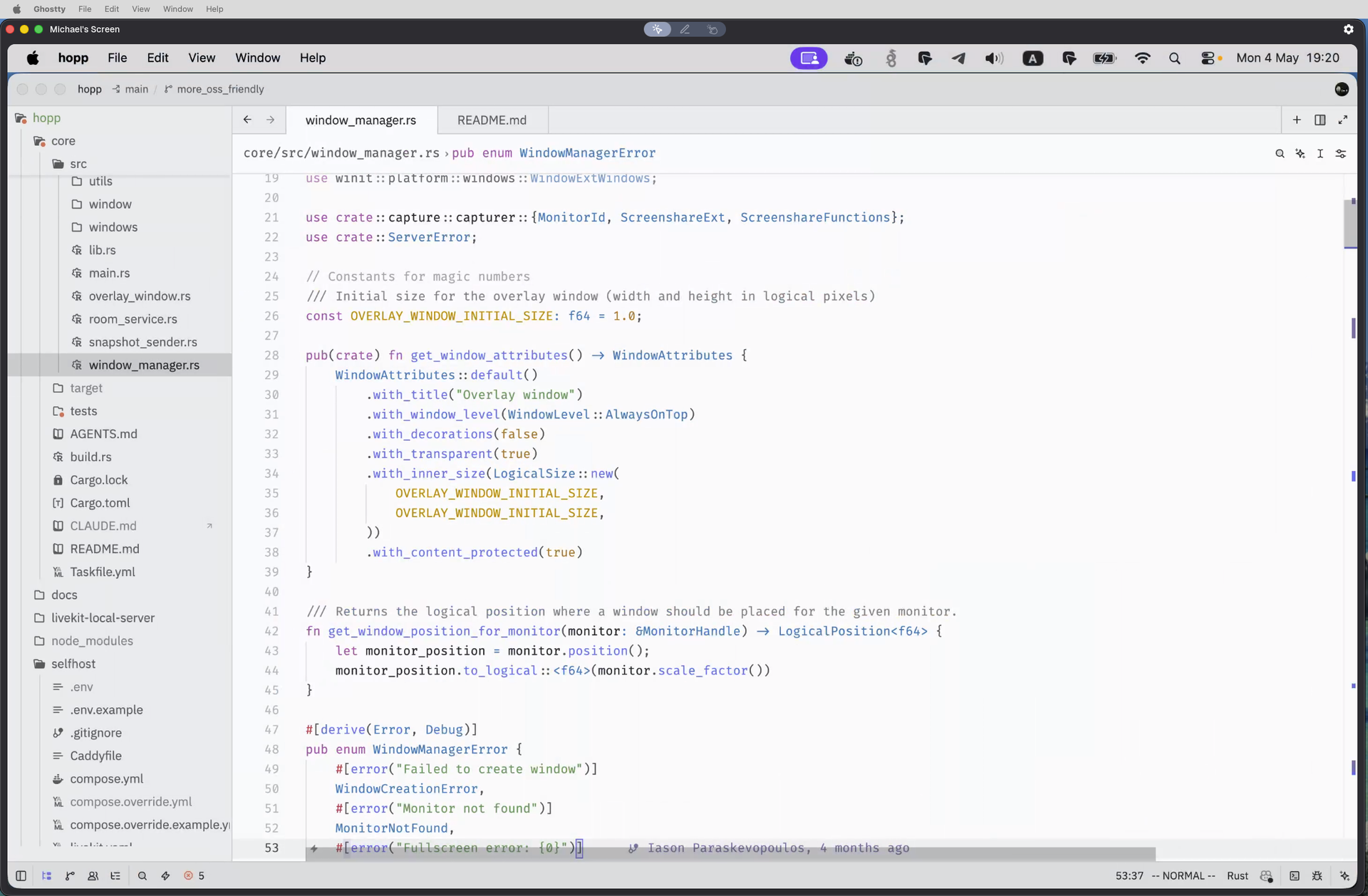
Meeting-app screen sharing was built for slide decks, and it shows when two engineers chase a bug across a codebase together; Hopp rebuilds screen sharing for exactly that job. Click a teammate and their screen opens in under a second: no meeting links, no calendar invites, no "can you see my screen?" ritual. Both sides get real keyboard and mouse control with sub-100ms latency, so guests type, click, and navigate instead of dictating instructions. Rooms hold up to 10 people for mob programming, code reviews, and onboarding, all with shared cursors so everyone can point at the line they mean. When words fail, draw or type annotations directly on the shared screen. The stream defaults to 4K, so small fonts and subtle diffs stay readable, and noise-cancelling audio keeps voices clear with no separate call app. You share any application, not just a browser tab, so debugging in Grafana or reviewing a design works as well as editing code. App Veil hides the windows you pick, such as password managers or chat, from the shared screen. Slack starts sessions with one /hopp command, and custom keyboard shortcuts keep frequent actions in flow. The server is yours: a Docker Compose stack with PostgreSQL, Redis, LiveKit, and Caddy auto-TLS serves the web dashboard and media, and the desktop app points at your backend, not a vendor cloud. Running on a dedicated VPS on RepoCloud with guaranteed CPU, RAM, and SSD, full root SSH access, and a browser serial console. AGPL-3.0 licensed.
Benefits
- Control, Not Just Watching
- Guests get genuine keyboard and mouse control with sub-100ms latency instead of narrating clicks, so a pairing partner can drive the editor, terminal, or debugger directly from their own machine.
- Rooms For The Whole Team
- Up to 10 people join one room with shared cursors and full control, turning code reviews, mob programming, and remote onboarding into a single click instead of a scheduled meeting.
- Your Server, Your Sessions
- The self-hosted Docker stack (PostgreSQL, Redis, LiveKit, Caddy auto-TLS) keeps screen shares and team data on your infrastructure, and the desktop app connects to your backend URL.
- Readable 4K, Clear Audio
- Screen sharing defaults to 4K so fine code details stay legible, while built-in noise-cancelling audio removes the need to run a separate voice call alongside the pairing session.
Features
- One-Click Pairing
- Launch a session from the menu bar by clicking a teammate; no links or invites. Rooms support up to 10 participants with shared cursors and simultaneous control.
- Latency-Tuned WebRTC
- A fine-tuned libwebrtc build on LiveKit infrastructure delivers sub-100ms shared control and 4K screen streams, with LiveKit media on TCP 7881 and UDP 50000-60000.
- Screen Annotations
- Draw or type directly on a teammate's shared screen to highlight a line or sketch an idea, and hide sensitive windows from the share with App Veil.
- Slack Integration
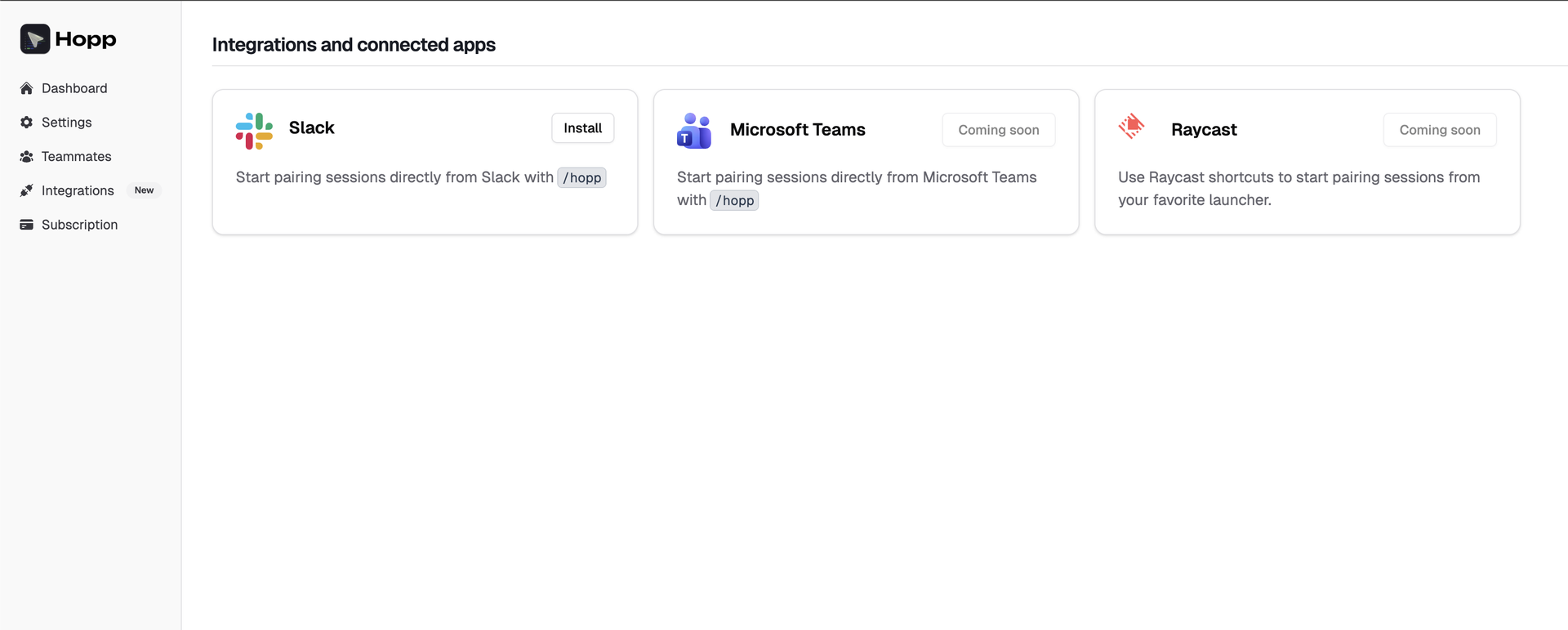
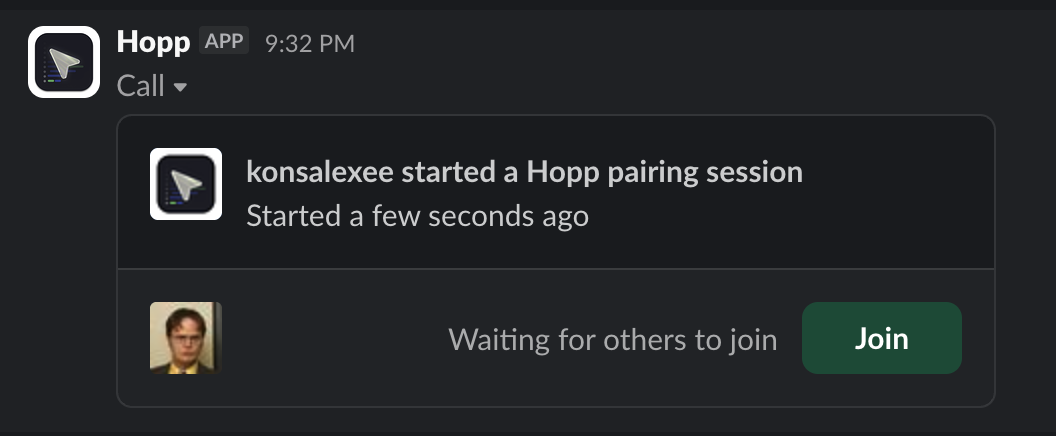
- Start a pairing session from any Slack channel with the /hopp command; teammates join from the posted session card. The web dashboard manages integrations and teammates.
- Self-Hosted Stack
- Docker Compose runs the Go backend with PostgreSQL and Redis behind Caddy auto-TLS; the first registered account becomes team admin, and telemetry is off by default.