plumio
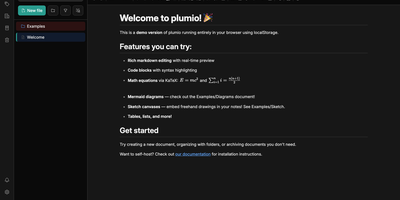
Notes belong on a server you control, and plumio gives them a quiet, fast home there with a polished markdown editor and a live preview. Write headings, task lists, tables, code blocks, math equations, and Mermaid diagrams in one document, then add a freehand sketch canvas for quick drawings. Each change saves as you type. Folders, tags, and custom colors keep a growing library tidy, favorites keep the important pages close, and full-text search finds a half-remembered phrase in seconds. Turn on AES-256 encryption and every document is protected at rest on disk. One instance can host several users and several organizations, so a family, a study group, or a small company each gets a separate workspace with roles for admins and members. Deleted notes land in a trash and archived ones stay out of the way until needed. Export everything as a zip of plain markdown files, or import a folder from another editor, Obsidian included. Webhooks announce document events to other services, API keys let scripts create and search notes, and optional SMTP email handles password resets. A daily backup job keeps compressed copies with automatic retention, and a desktop app can connect to your server. Running on a dedicated VPS on RepoCloud with guaranteed CPU, RAM, and SSD, full root SSH access, and a browser serial console. AGPL-3.0 licensed.
Eidon
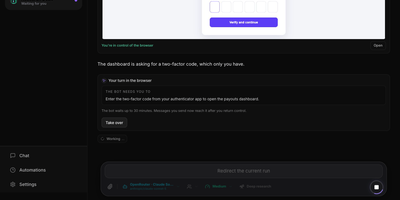
Beyond a plain chat for quick questions, Eidon gives you a team of AI agents, each with its own browser, workspace, and memory, and a Chief of Staff that routes your requests. Ask for anything and it answers, hands the job to a specialist, or creates a new agent for it, and agents message each other and report back. Open an agent's live browser view and watch it work. At a sign-in, a two-factor code, a CAPTCHA, or a payment it stops and waits for you, and you hand control back with a note. Passwords come from an encrypted vault and are typed into the page, never passed to the model. Shell commands and MCP tools run only after you allow them once, always, or never, and emails and Slack messages arrive as drafts to edit. Chat lets you rewind, branch, edit, or regenerate any message, queue follow-ups while a reply streams, and share a read-only link. Deep research drafts an editable plan of up to twelve steps and returns a cited report. Memories wait for your approval. Automations run on an interval, daily, weekly, or once, and alert you through ntfy, Pushover, webhooks, or web push. Connect OpenAI-compatible or Anthropic providers, MCP servers, web search, image generation, and voice dictation, with a private account for each person. Running on a dedicated VPS on RepoCloud with guaranteed CPU, RAM, and SSD, full root SSH access, and a browser serial console. AGPL-3.0 licensed.
Storyden
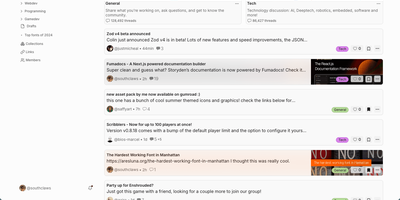
Think of Storyden as running your own small Reddit, except the knowledge your community produces does not scroll away and die in the feed. Discussion happens in threaded forums organized by categories and tags, where posts collect replies, likes, emoji reactions, and saves into personal collections. Beside the chatter sits the Library, a tree of rich pages your members build together into wikis, directories, catalogs, and guides that stay findable. Library pages carry typed properties, attached files, and table views, so a car club can track vehicles as data instead of arguing over a spreadsheet. Threads can reference Library pages and pages can link back to threads, letting a great answer graduate into permanent knowledge. Optional AI assistance helps organize titles, tags, and summaries, while the recommendation engine surfaces posts each member is likely to care about. The first account registered becomes admin, roles and permissions govern who can post or moderate, and community settings live in the admin panel rather than config files. One container starts everything with an embedded database and local file storage, and OpenAPI documentation is served from the same address. Running on a dedicated VPS on RepoCloud with guaranteed CPU, RAM, and SSD, full root SSH access, and a browser serial console. MPL-2.0 licensed.
Depl0y
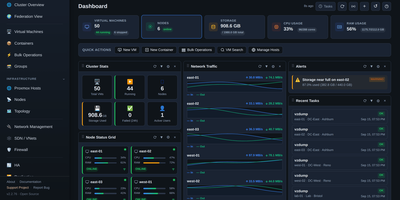
Three Proxmox sites, a lab host in the corner, and a rack of Dell and HPE servers can all share one screen when Depl0y runs the show. The dashboard totals virtual machines, containers, CPU, RAM, storage, and network traffic across every registered endpoint, with draggable widgets, alerts, and recent task feeds. Virtual machine pages cover start, stop, restart, snapshots, cloning, migration, templates, and a browser console, and node pages add metric charts, storage, networking, and update status. A guided failover wizard checks quorum, storage, and disks, then protects a guest so it restarts on another node if its host fails. A topology view maps hosts, guests, bridges, storage, and BMCs, with PNG, SVG, and draw.io export. Hardware pages poll iDRAC and iLO for health, temperature, power draw, DIMMs, drives, and firmware, and power controls reach machines that are fully off. Deployment tools build VMs from cloud images, import OVA, VMDK, and QCOW2 files, and launch self-hosted LLM guests. Admin, Operator, and Viewer roles, TOTP, host pinning, and a searchable audit log keep access tidy. MSPs managing client clusters, homelabs with several nodes, and data center teams that want hypervisor and hardware status together are the target audience. Running on a dedicated VPS on RepoCloud with guaranteed CPU, RAM, and SSD, full root SSH access, and a browser serial console. MIT licensed.
Aizen
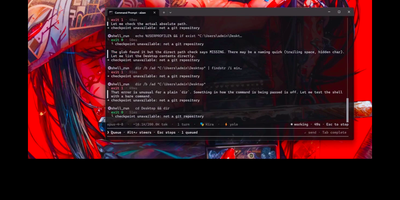
Aizen is a coding agent that actually lives on your server: one small binary you can message from your phone, which fixes code, runs the tests, and reports back before you are anywhere near a keyboard. Leave it running on the box and drive it from Telegram or Discord, approving risky edits with a tap while it works behind NAT with no inbound port to expose. In the terminal it is a single chat and agent loop with a live heads-up display of model, tokens, and context, reading files in parallel, editing symbolically through the language server, and running your shell under an approval layer with a hard floor that refuses catastrophic commands even on auto-approve. It does not get to claim done early: a verify gate runs your typecheck and test suite and sends it back to fix what it broke, git-backed checkpoints let you rewind a bad turn, and seven capability-scoped sub-agents can fan out across finding, planning, building, reviewing, testing, research, and recall when a job wants a team. Point it at any OpenAI-compatible endpoint, from hosted models to your own local server, extend it with MCP servers and slash-command macros, and let the sandbox keep every child process away from your API keys with the network denied by default. Running on a dedicated VPS on RepoCloud with guaranteed CPU, RAM, and SSD, full root SSH access, and a browser serial console. Apache-2.0 licensed.
Omnom
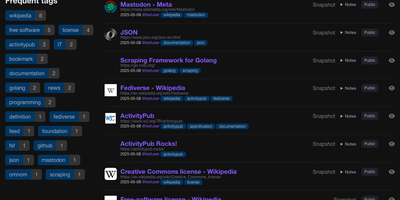
Omnom saves the pages you bookmark as full rendered snapshots, so the article, thread, or documentation page you kept is readable years later even if the original site changes or disappears. Bookmarks accumulate multiple snapshots over time, and the compare view shows two side by side or as a unified diff, revealing what an edited page used to say. Images and other media are downloaded and stored alongside each snapshot, keeping saved pages complete offline. The Firefox and Chromium extensions send pages exactly as your browser rendered them, capturing dynamic content a simple link saver would lose. A built-in reader aggregates your RSS and Atom subscriptions into one stream, where you can archive items individually or page by page and search feeds and bookmarks together. Through ActivityPub, other people can follow your public bookmarks from Mastodon or Pleroma, and you can follow Fediverse accounts in the same stream. Bookmarks can stay private or be shared publicly, organized with tags and nested collections, and filtered by date, domain, owner, or free text across saved content. Your dashboard tracks weekly, monthly, and yearly bookmark counts beside your most used tags, while a documented API and command line tools handle imports, tokens, and feed updates. Sign-in relies on one-time email tokens, OAuth, or a trusted Remote-User header from your reverse proxy, so no password is ever stored. Running on a dedicated VPS on RepoCloud with guaranteed CPU, RAM, and SSD, full root SSH access, and a browser serial console. AGPL-3.0 licensed.
Aeterna
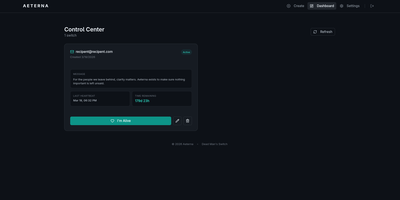
Some messages should only arrive if you cannot send them yourself, and Aeterna is a self-hosted dead man's switch that makes sure they do. You write the messages, attach the files that matter, name the people who should receive them, and check in on a rhythm you choose. Keep checking in and nothing happens. Stop, and Aeterna delivers what you left behind. Each switch pairs your words with documents, photos, or instructions for specific recipients, and switches can address multiple recipients so one message can reach a partner, a sibling, and a lawyer at the same time. File attachments are stored encrypted and are automatically deleted from the server right after delivery, so sensitive material does not linger once it has done its job. Check-ins take seconds through the web interface or a quick link in your email, which keeps the heartbeat habit painless. When a switch fires it can also call webhooks, triggering home automation or custom scripts alongside the emails. Your SMTP settings live in the settings screen with live testing, and reverse proxy templates for Nginx, Traefik, and Caddy help you put the service behind your own domain with proper certificates. Running on a dedicated VPS on RepoCloud with guaranteed CPU, RAM, and SSD, full root SSH access, and a browser serial console. GPL-3.0 licensed.
GitArena
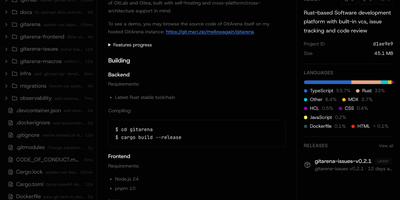
GitArena gives your team its own place to host code, combining repository hosting, issue tracking, and code review in one lightweight service you run yourself. Push and pull over HTTP or SSH, browse code in the browser with syntax highlighting, blame, and raw views, and follow commit history with diffs branch by branch. Repositories can be forked, archived, tagged, and released with downloadable assets, and every project gets an issue tracker with labels, milestones, assignees, and a kanban board. Issues are stored natively in Git using the git-bug format, so they travel with the repository and remain readable offline with the git-bug CLI. Merge requests collect changes for review before they land, while organizations and teams control who can see and change each project. Search spans code, repositories, issues, and users from one box, profiles show contribution graphs and activity, and sign-in supports passwords, SSH keys, passkeys, and OAuth single sign-on. A REST API exposes the platform to your own tooling, and the whole service runs from a single Docker Compose stack or a compiled binary with a separate frontend build. Running on a dedicated VPS on RepoCloud with guaranteed CPU, RAM, and SSD, full root SSH access, and a browser serial console. MIT licensed.
Octo Server
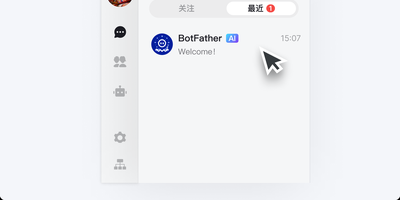
Most team chat keeps people in one app and AI agents in another; Octo Server is the backend that puts both in the same conversation. It powers the OCTO workplace, where Lobsters, the platform's OpenClaw-powered AI agents, sit in channels as first-class participants that read context, run tool calls, and report back alongside their human teammates. Every request flows through one pipeline: token and cookie authentication, organisation-aware role checks and per-channel permissions, business logic that can start or resume an agent session, then fan-out through WuKongIM for real-time delivery. Channels support threaded subspaces, shared files, and a GROUP.md document that stores the group's standing context where the whole team can edit it. The smart summary service reads busy channels and produces structured digests, so catching up means reading one brief instead of hundreds of messages. External bridges connect conversations to GitHub, WeCom, Feishu, and Loop through adapters, and webhooks push group events to your own systems. The official one-command deployment runs the server with the web client, admin console, task service, WuKongIM, MySQL, Redis, and MinIO behind nginx, scaling as one backend that every client speaks to. Running on a dedicated VPS on RepoCloud with guaranteed CPU, RAM, and SSD, full root SSH access, and a browser serial console. Apache-2.0 licensed.
Talkyard
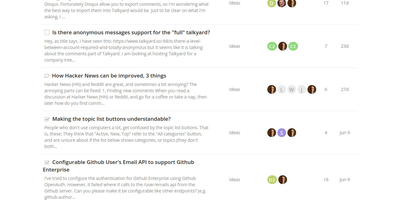
Talkyard combines five discussion formats in one platform: StackOverflow-style Q&A with accepted answers, Reddit-like upvote sorting for ideas, threaded forums, real-time chat channels, and embeddable blog comments. Running separate tools for each conversation type fragments community knowledge across disconnected systems, but Talkyard keeps it all searchable in one place. Question askers mark accepted answers, and community voting surfaces the best solutions for future visitors. Idea topics sort by upvotes for crowdsourced feedback prioritization and product decisions. Chat channels handle real-time day-to-day conversation, while forum threads preserve important discussions that need to remain findable months later. The embedding capability goes beyond blog comments: entire Talkyard forums can live inside iframes on your existing website with automatic deep-linking and iframe auto-resizing, adding community discussion to any page without rebuilding your site. Docker Compose containers run with dropped capabilities, no-new-privileges enforcement, non-root processes, health checks, and automatic log rotation. Multi-site hosting serves multiple communities from one installation with isolated databases and separate domains. Automated upgrades pull new images and restart services without intervention. ElasticSearch indexes every discussion format for instant full-text search. The Scala backend with TypeScript frontend stores data in PostgreSQL with automatic Let's Encrypt HTTPS. Runs on a RepoCloud VPS with guaranteed CPU, RAM, SSD, root SSH, and browser console. AGPL licensed.
Ties
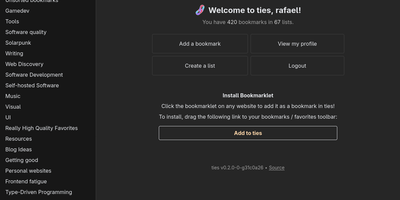
A federated bookmark manager written in Rust: Ties (formerly linkblocks) is your own small corner of the web for saving, organizing, and sharing good pages, connected to the fediverse over ActivityPub. Instead of rigid folders, bookmarks live in arbitrarily nested lists that link together into a knowledge graph. Saved pages are fetched, converted to a readable archived version, and stored in the database, so full-text search covers titles, URLs, and the actual page text - and the content survives if the original disappears. The federation model is deliberately anti-viral: there is no global timeline and no algorithmic feed. You publish public lists for anyone, follow users whose taste you trust, and mark trusted users whose bookmarks become part of your search range - extendable to trusted-users-of-trusted-users for a wider net. Public bookmarks post to Mastodon timelines, and WebFinger lookup makes your handle discoverable across fediverse platforms. Operationally it is about as light as web software gets: a single binary with all assets baked in, integrated TLS so it can run without a reverse proxy, PostgreSQL as the only dependency, OIDC single sign-on, and a bookmarklet for one-click saves. Note the project is alpha: single-user instances only, and all data should be considered public. AGPL-3.0 licensed, built with Rust and htmx.
Scrumboy
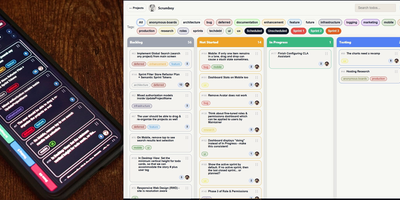
Scrumboy is a Kanban and sprint management tool that ships as a single Go binary backed by SQLite, deploys in under ten seconds via Docker, and uniquely integrates with AI coding agents through a standards-compliant MCP JSON-RPC endpoint. The dual-mode architecture supports Full mode with bootstrapped authentication, TOTP two-factor auth, OIDC/SSO integration through Keycloak, Authentik, Auth0, or Entra ID, role-based access control across Owner, Admin, User system tiers plus per-project Maintainer, Contributor, and Viewer roles, and Anonymous mode that generates instant shareable boards accessible via unique URLs with zero signup requirement. Custom workflows allow user-defined lane configurations per project including designated "Done" lanes, while sprints with configurable one or two-week cycles include board-level sprint filtering and the ability to disable and re-enable sprint tracking without losing history. Real-time Server-Sent Events power instant multi-user board updates, and outbound webhooks deliver JSON payloads to registered URLs when domain events fire with HMAC signature verification. The MCP endpoint at /mcp/rpc enables native integration with Cursor, Claude Code, and other AI agents through OAuth 2.1 with PKCE authorization, while API access tokens support CLI automation and CI/CD pipelines. Additional capabilities include VoiceFlow voice commands, per-project sticky-note walls, Markdown and Mermaid diagram support in task notes, append-only audit trails, VAPID Web Push notifications, SMTP password reset, Trello import, JSON backup with merge/replace/copy strategies, and 22-language internationalization. Running on a dedicated VPS on RepoCloud with guaranteed CPU, RAM, and SSD, full root SSH access, and a browser serial console. AGPL v3.0 licensed.

Jetlog
A personal flight logbook you host yourself, Jetlog draws every route you have flown on a pannable world map and turns the totals into charts. The home page opens with counts of flights, airports, hours, distance, and countries above that map, where dots mark visited airports and lines trace each trajectory. Settings let markers and lines grow with visit frequency and shade the countries where you have landed. Logging a flight takes only two airports and a date. Type a flight number and press Fetch to pre-fill the origin, destination, and airline, and a utility links connection flights automatically. Duration and distance are calculated for you and stay editable, with an option to use airport time zones. The All Flights table lists route, times, duration, distance, seat, class, and airline with filters and configurable columns, and each flight opens a detail page with airport data, a route map, tail number, and aircraft. A Statistics page charts flights per month, cumulative distance, most visited airports, most common airlines, ticket class, and seat for any time frame. History arrives through MyFlightRadar24 or custom CSV imports and leaves as CSV or iCal. Family members can share one install with separate logbooks, an admin manages the accounts, and the responsive layout works on a phone at the gate. Running on a dedicated VPS on RepoCloud with guaranteed CPU, RAM, and SSD, full root SSH access, and a browser serial console. GPL-2.0 licensed.
deco Studio
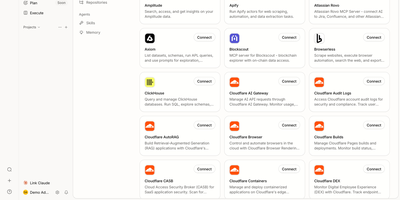
Roll out AI across a whole company without handing a single API key to anyone. deco Studio gives teams a shared chat workspace, and the admin keeps control of which models, tools, and data every agent can touch. Register MCP servers once from a catalog of ready-made connections, including Amplitude, Apify, Atlassian Rovo, ClickHouse, and a long list of Cloudflare services, then grant tool-level access by organization, role, or agent. Tokens stay in an encrypted vault, so teammates share capabilities and never credentials. Agents bundle instructions, skills, files, and approved tools, then publish as their own MCP endpoint that Cursor, Claude Desktop, or custom code can call. A built-in skills library ships with dozens of reusable playbooks, and Memory keeps facts the whole organization should remember. Model choice stays open through OpenRouter, Anthropic, OpenAI, Google Gemini, or any OpenAI-compatible server, and engineers can link a Claude Code or Codex session they already use. Projects group agents and connections around a goal, with Monitor dashboards for orders, visitors, logs, and deploys, and an Execute board for tasks and epics. Running on a dedicated VPS on RepoCloud with guaranteed CPU, RAM, and SSD, full root SSH access, and a browser serial console. MIT licensed.
CompDesk
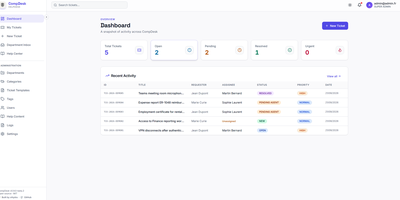
CompDesk is a self-hosted help desk that gives small organizations department-based ticket queues, role-based access control, and a public Help Center without a per-agent subscription. Tickets land in department inboxes where agents work searchable queues with templates, custom fields, tags, and internal notes that customers never see. SLA policies set response and resolution targets per queue, and escalation rules push overdue tickets upward before they go stale. Requesters follow their own tickets, join public comment threads, and browse Help Center articles in English or French; agents keep the full immutable timeline behind each case. Private attachments stay out of the public file space, pass signature validation and quota checks, and can be scanned by ClamAV before anyone downloads them. Sign-in works with local accounts, Microsoft Entra ID, or any OpenID Connect provider, and four roles (User, Agent, department Admin, Super Admin) decide exactly who sees which tickets. Email notifications flow through SMTP or Microsoft 365, signed webhooks announce ticket events to other systems, and department-scoped API clients give external tools a way to open and update tickets. Runtime branding restyles the portal with your organization name, logo, and colors, and a guided setup wizard creates the first Super Admin and locks itself away when finished. Running on a dedicated VPS on RepoCloud with guaranteed CPU, RAM, and SSD, full root SSH access, and a browser serial console. MIT licensed.
Memora
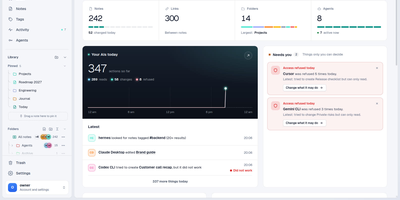
Memora is a self-hosted second brain where Claude Code, Cursor, ChatGPT, and your other AI agents share one memory made of plain Markdown notes that never leave your server. Agents read and write those notes through 77 tools on a Model Context Protocol endpoint, authenticating with a scoped API key per agent or with OAuth approved in the browser. Every change is committed to git, so any revision can be listed, diffed, and restored, and wikilinks and backlinks turn the vault into a navigable graph. The web UI shows a 3D brain with a region per folder, force, radial, and cluster graph layouts, and a canvas with a frame per folder, beside a reader and editor with reading settings. A live activity timeline records every read, write, search, and sign-in, with filters and JSON or CSV export. Mnemo, a built-in notes agent, finds, writes, tags, links, and tidies notes with your own OpenAI, Anthropic, or OpenAI-compatible key, shows every step, and hands tasks to sub-agents. Privacy rules hide folders from chosen agents, scopes and tool lists limit each key, and access rules allow or block by IP, CIDR, or domain. Images pasted into a note stay in its folder, and the interface installs as a PWA. Install with npm, Docker, or a systemd installer, then claim the instance with a one-time setup code. Running on a dedicated VPS on RepoCloud with guaranteed CPU, RAM, and SSD, full root SSH access, and a browser serial console. AGPL-3.0 licensed.
Terrapod
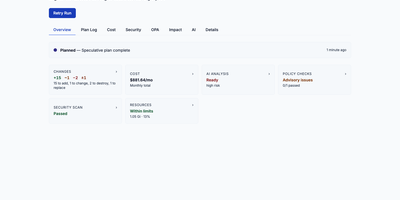
Terrapod gives you the Terraform Enterprise control plane on your own Kubernetes cluster, with remote state, run approvals, and policy checks, and no per-resource bill at the end of the month. Point your existing cloud block at it and terraform or tofu keep working unchanged, because Terrapod answers the same backend protocol the CLI already speaks. Workspaces isolate state, variables, and runs per team or environment, with versioned state you can lock, inspect, and roll back. Server-side agent pools execute plans and applies on ephemeral Kubernetes jobs, while CLI-driven runs stay available for local workflows. Approvals gate every apply, and conditional auto-apply only proceeds when a plan adds or updates resources without destroying anything. Label-based RBAC decides who may read, plan, write, or administer each workspace, with OIDC and SAML single sign-on on top. A private registry hosts your own modules and providers with GPG signing, and OPA Rego policy sets enforce rules as mandatory or advisory checks before apply. Drift detection flags infrastructure that wandered from its state, run triggers chain dependent workspaces, and an interactive impact graph shows a plan's blast radius before you approve it. Optional AI review summarizes each plan's changes and risks, and an MCP server lets AI assistants inspect workspaces and runs under the same permissions. Running on a dedicated VPS on RepoCloud with guaranteed CPU, RAM, and SSD, full root SSH access, and a browser serial console. MPL-2.0 licensed.

SyncTube
SyncTube turns any browser into a shared movie room where one link opens a synchronized player and live chat for the whole group. Paste a YouTube, Twitch, Vimeo, or PeerTube URL, or a direct mp4 or m3u8 link, and the room watches the same frame at the same moment. A leader takes global control of play, pause, seeking, and playback rate, and smaller groups can open pausing or resuming to everyone. Local files start playing for the room while they upload, and external subtitle files plus separate audio tracks cover voiceovers and fan translations. Chat doubles as a remote control: timed commands jump the whole room forward or back, skip a sponsored segment, boost quiet audio, or return to the moment before an accidental rewind. Playlists accept ranged link patterns for episode batches, viewers vote to skip, and keyboard shortcuts drive fullscreen, refresh, and sync toggles without leaving the player. Operators can cache supported site videos on the server, restyle every front-end file, and extend subtitle rendering or quality switching through plugins. Admins moderate with bans and kicks from chat, and the whole service runs from one small server that fits a private friends-only room or a public community channel. Running on a dedicated VPS on RepoCloud with guaranteed CPU, RAM, and SSD, full root SSH access, and a browser serial console. MIT licensed.