GoAccess
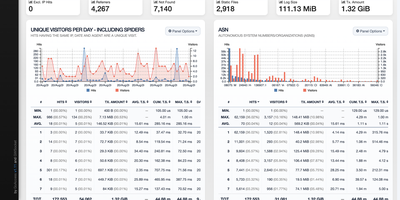
GoAccess processes millions of web log entries in seconds and renders the results as interactive dashboards that update every 200 milliseconds in the terminal or every second via WebSocket-connected HTML reports. Written entirely in C with only ncurses as a dependency, it achieves exceptional performance even on resource-constrained servers, reducing memory usage by approximately 20% and parsing time by 35% in recent releases through optimized in-memory hash tables with on-disk persistence support. The analyzer parses virtually every web log format out of the box (Apache Combined and Common, Nginx, Amazon CloudFront, Amazon S3, AWS Elastic Load Balancing, Google Cloud Storage, Squid, W3C IIS, Caddy JSON, and Traefik) while supporting fully custom log format strings for non-standard configurations. The self-contained HTML dashboard displays 15+ interactive panels covering unique visitors, requested files, static files, 404 errors, referring sites, search keyphrases, geographic location with city-level GeoIP resolution, operating systems, browsers, HTTP status codes, time distribution, and virtual host metrics. WebSocket authentication via JWT provides secure remote access, and incremental log processing ensures data continuity across daemon restarts. Docker deployment requires a single command with volume-mapped access logs. Over 20,800 stars with active development since 2010. Running on a dedicated VPS on RepoCloud with guaranteed CPU, RAM, and SSD, full root SSH access, and a browser serial console. MIT licensed.
TeamPass
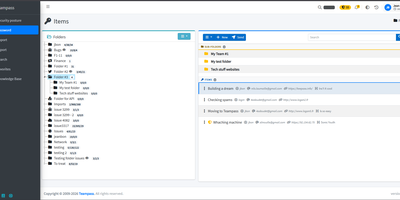
TeamPass is a dedicated on-premise password manager built specifically for teams that need collaborative credential sharing with fine-grained access controls. Role-based access control defines user permissions through hierarchical folder trees where each folder and item can be independently set to write, read, or no access against assigned roles, enabling organizations to segment credentials across departments without exposing sensitive data. Passwords are encrypted in the database using Defuse PHP Encryption with per-installation unique saltkeys, while two-factor authentication supports configurable RFC 6238 TOTP profiles with custom digits, period, and algorithm settings alongside Duo Security and Yubico hardware key integration. LDAP and Active Directory native integration enables enterprise SSO with automatic user provisioning. The Security Posture Dashboard surfaces weak, reused, breached, overdue, no-expiry, widely-shared, and unreadable credentials through indicator cards that filter and deep-link directly to items. Secure Send creates expiring, view-count-limited one-time links optionally protected by recipient passphrases for sharing credentials with external users. Import from Bitwarden, LastPass, 1Password, and KeePassXC through a unified source selector, with export to encrypted offline files. Email notifications, password expiration policies, custom fields, and attachment support round out item management. Running on a dedicated VPS on RepoCloud with guaranteed CPU, RAM, and SSD, full root SSH access, and a browser serial console. GPL-3.0 licensed.
GlobaLeaks
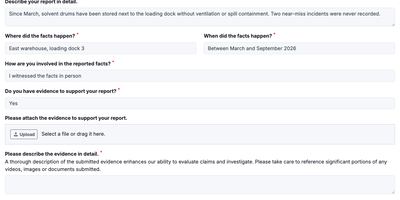
A secure drop box for tips and misconduct reports, GlobaLeaks lets organizations, newsrooms, and public institutions receive anonymous submissions and reply to the people behind them. Whistleblowers answer a questionnaire, attach files, and leave with a unique 16-digit receipt that reopens their report later for replies, comments, and the choice of whether and when to reveal their identity. Administrators build the intake form with a questionnaire builder, route reports through channels by topic or department, and host several branded whistleblowing sites from one installation in more than 90 languages. Recipients triage in a searchable inbox with labels, reminders, and customizable case statuses. Analysts, custodians, and administrators get separate roles, and the custodian role can gate access to a reporter's identity. Reports and messages are encrypted, an automatic Tor onion service gives whistleblowers an anonymous way in, two-factor authentication protects staff logins, and PGP secures email notifications. Audit logs track staff actions, and retention rules expire old reports to support GDPR duties and EU Directive 2019/1937 workflows. Running on a dedicated VPS on RepoCloud with guaranteed CPU, RAM, and SSD, full root SSH access, and a browser serial console. AGPL-3.0 licensed.
Password Pusher
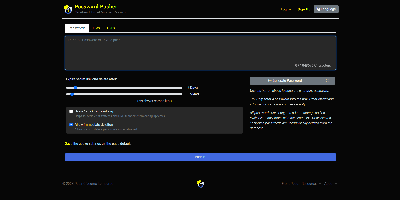
Credentials sitting forever in email threads and chat scrollback - Password Pusher solves that everyday security failure. Instead of pasting a password into Slack, you push it - a password, note, file, URL, or QR code - and share a unique one-time link that expires after a set number of views, a time limit, or both. Content is encrypted at rest with AES-GCM under a configurable master key, optionally guarded by a passphrase, and permanently deleted from the database the moment it expires; a retrieval-step option keeps URL-scanning bots from consuming views. Full audit logs record when each link was created and viewed (and by whom, with logins), and TOTP two-factor authentication can be required instance-wide. The delivery page is deliberately unbranded - no logos or confusing links for recipients - and the interface ships in 31 languages with light and dark themes. Automation runs through a JSON API (v2), an official CLI for pushing and expiring secrets from the terminal, a Chrome extension, and a catalog of third-party integrations. Apache-2.0 licensed Ruby on Rails, deployable via Docker, Kubernetes, or Helm, with SQLite or PostgreSQL storage - the sysadmin staple for sending credentials that clean up after themselves.
TgWitness
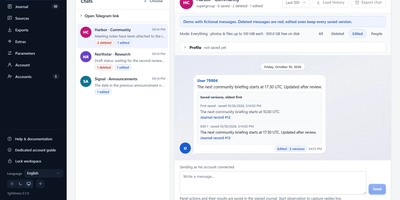
TgWitness preserves what your Telegram account actually saw, even when a message is edited three times and deleted before breakfast. A collector watches the chats, folders, or whole account you choose and records every captured message, edit version, and deletion notice in a local journal. The workspace reads like a familiar conversation view, with captured edits and deletion markers alongside the messages, and a searchable journal timeline ties observations together across chats. Open the edit history to compare versions side by side without overwriting the earlier observation. Connect people, replies, and shared links across recorded chats to trace how a claim travelled. Each account gets an isolated workspace with its own session and signing key, so separate investigations never contaminate each other. When a case moves, export the record as readable HTML, structured JSON or CSV, or a signed ZIP bundle whose hash-linked, Ed25519-signed records expose any tampering, verifiable offline with an independent fingerprint. Optional local OCR and transcription make media searchable, signed webhooks announce new observations, and encrypted backups copy the journal and timestamped checkpoints to S3-compatible storage. Read-only MCP access lets approved tools query the archive without touching the collector. Coverage reports show honestly where downtime left gaps. Running on a dedicated VPS on RepoCloud with guaranteed CPU, RAM, and SSD, full root SSH access, and a browser serial console. MIT licensed.
Nora
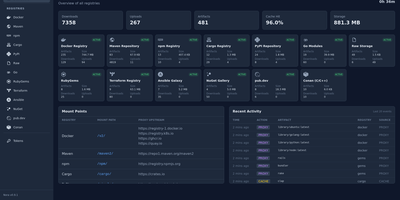
Public registries rate-limit your CI, log every pull, and pick the worst moment to go down; Nora replaces that dependency with a self-hosted artifact registry that hosts and caches seventeen package formats behind a single address. Point Docker, Maven, npm, pip, Cargo, and eleven other clients at one endpoint, and Nora serves your private artifacts while transparently caching upstream packages fetched from Docker Hub, Maven Central, npmjs, and crates.io. Each base image or library downloads once and is then served locally, so builds get faster, stop tripping rate limits, and survive upstream outages. Curation rules decide what is allowed to reach your builds: allowlists and blocklists filter packages by name, minimum release-age rules hold back freshly published versions, and new digests can wait in quarantine until approved. Anything you publish keeps its name: a hosted package is never silently replaced by an upstream package sharing it. Pipelines publish without stored secrets through OIDC identity from GitHub Actions and GitLab CI, and API tokens with read, write, and admin roles cover the rest. A web dashboard shows downloads, cache hit rates, storage usage, and recent activity for every registry, and audit logs plus Prometheus metrics feed your monitoring. For disconnected networks, a mirror command prefetches whatever your lockfiles name, an import tool migrates Artifactory or Nexus repositories, and backup and restore keep a spare copy. Running on a dedicated VPS on RepoCloud with guaranteed CPU, RAM, and SSD, full root SSH access, and a browser serial console. MIT licensed.
Agentic SOC Platform
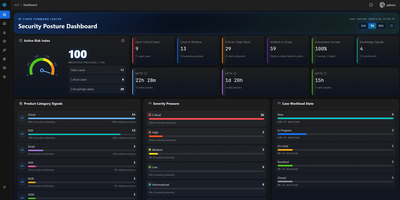
Agentic SOC Platform compresses hours of manual security analysis into seconds by deploying specialized AI agents that autonomously triage, investigate, and enrich security alerts. The Python/Django backend processes SIEM webhooks through Redis Streams into a modular pipeline where LangGraph-orchestrated agents extract IOCs, correlate signals, and generate Cases with severity, confidence, impact, priority, and structured verdicts. The built-in SIRP provides full case management with Alerts, Artifacts, Enrichments, Tickets, and a Knowledge base that accumulates institutional memory for both human analysts and LLM agents. Native Splunk and Elasticsearch/Kibana integrations deliver unified log search through a standardized interface so agents and analysts share identical security context. The playbook engine combines traditional SOAR automation with AI-powered investigation — launching threat hunting agents, knowledge extraction, threat intelligence enrichment, and CMDB lookups from a single orchestration layer. MCP Plugin support exposes ASP capabilities to Claude Code, Codex, and OpenCode, enabling external AI agents to operate cases, search logs, query threat intelligence, and write custom modules directly. Python Modules adapt new alert sources while Playbooks orchestrate LLM analysis and automated response actions, scaling the platform with your security scenarios. Deploy via Docker Compose with all data staying inside your network. Running on a dedicated VPS on RepoCloud with guaranteed CPU, RAM, and SSD, full root SSH access, and a browser serial console. MIT licensed.
TapMap
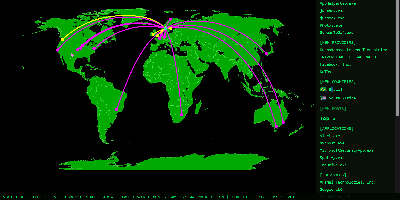
TapMap draws a computer's live network connections on an interactive world map, so you can watch which applications are talking to which services, where those services sit, and what normal looks like for that machine. A local pipeline scans active sockets, extracts the remote addresses, and enriches them with geolocation from databases stored on the machine itself. Every connection carries the owning application or process, its network operator, and the operating system's verification status for that app, and places that share a location are highlighted when connections overlap. The same view lists local open ports, both TCP listeners and bound UDP sockets, established services on your LAN, and public services whose location could not be mapped. A rolling 30-day history turns raw connections into awareness: an Insights panel surfaces new applications, providers, countries, and ports, plus the most frequent activity, while a Significant Connections log records first sightings and failed verifications. A Daily Activity Report goes further, sorting applications into seen-once, occasional, recurring, and stable patterns, analyzing provider concentration, and charting country activity with detailed timelines. New significant connections can raise a desktop notification or publish to an MQTT broker you configure. Nothing is sent anywhere by default: processing happens locally, with no telemetry. Running on a dedicated VPS on RepoCloud with guaranteed CPU, RAM, and SSD, full root SSH access, and a browser serial console. MIT licensed.
Stalwart
With 14,000 GitHub stars and 81 releases since March 2023, Stalwart is the most protocol-complete open-source mail server available — delivering JMAP, IMAP4rev2, IMAP4rev1, POP3, SMTP, CalDAV, CardDAV, and WebDAV from a single Rust binary that compiles to a memory-safe, zero-garbage-collection executable with predictable latency under load. The SMTP server implements DMARC, DKIMv2, DKIMv1, SPF, and ARC for complete message authentication with automatic DKIM key rotation, while transport security enforces DANE, MTA-STS, and SMTP TLS reporting to prevent downgrade attacks. Built-in spam filtering with statistical classifiers, DNS blocklists, and collaborative reputation databases eliminates the need for external Rspamd or SpamAssassin deployments. Encryption at rest protects stored messages with S/MIME or OpenPGP, and automatic TLS certificate provisioning via ACME supports TLS-ALPN-01, DNS-01, and HTTP-01 challenges without manual certificate management. The ManageSieve server enables server-side email filtering rules, while full-text search indexes message bodies and attachments for instant retrieval. Pluggable storage backends support RocksDB for embedded deployments, PostgreSQL, MySQL, and S3-compatible object storage for distributed architectures. LDAP and SQL-based authentication integrate with existing directory services, and the web administration panel manages domains, accounts, quotas, and DKIM keys. Security audited with memory safety guaranteed by Rust's ownership model. Running on a dedicated VPS on RepoCloud with guaranteed CPU, RAM, and SSD, full root SSH access, and a browser serial console. AGPL-3.0 licensed.
Open Kritt
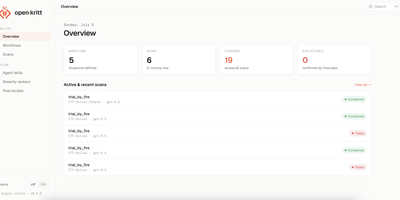
Big repositories, small questions: Open Kritt is a self-hosted platform that splits vulnerability research into focused tasks for AI agents and returns ranked, de-duplicated findings. Build a workflow as a tree of prompt steps, where each step declares the structured output it must produce and the next level launches one fresh agent per result. Scan remote or local repositories along with their dependencies, using Codex, Claude Code, or Grok Build as the harness. Every workflow ends in one fixed finding schema covering file, line, vulnerability type, trigger flow, and a malicious input example. Post-scripts then validate each finding, build a proof of concept, or write the report. Markdown severity rankers tell the model how to prioritize for your bounty program, and repeated findings collapse automatically. Model access comes from a Codex login or OpenAI, Anthropic, DeepSeek, OpenRouter, or xAI keys, with an Active switch to choose which accounts take new work. A dashboard tracks blueprints, scans, and findings, a headless command-line tool imports workflows and launches scans on servers without a browser, and finished scans export as one ZIP with a share-safe manifest. Built-in workflows, including an entry-point-driven hunt, give you a starting point. Running on a dedicated VPS on RepoCloud with guaranteed CPU, RAM, and SSD, full root SSH access, and a browser serial console. AGPL-3.0 licensed.
Fail2Ban Report
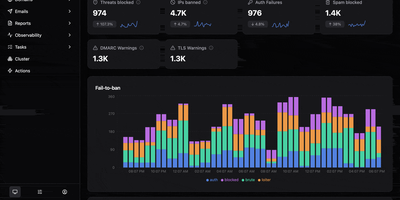
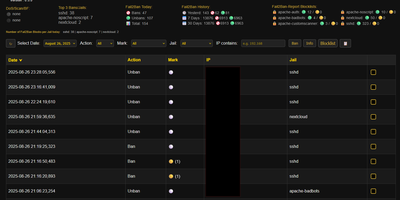
Fail2Ban quietly bans thousands of bots on a typical VPS and just as quietly keeps the whole story buried in a log file nobody reads, and Fail2Ban Report digs that story out into a dashboard you will actually open. Shell scripts convert each day of fail2ban.log into JSON, and the web interface lays every ban and unban on a searchable, filterable timeline you can slice by jail, server, or time window. Aggregated statistics for today, yesterday, seven days, and thirty days show which jails absorb the most attacks, while markers flag repeat offenders and escalating ban counts so persistent scanners stand out from one-time noise. Blocklists live per jail and per server as plain JSON, and ban or unban actions execute through UFW, giving you permanent bans that survive independently of jail restarts. Bulk actions handle whole ranges at once, with a pending state until the next sync applies them. Multiple servers feed one console through a pull-based HTTPS endpoint, so a fleet of small machines reports to a single pane without exposing SSH. Optional AbuseIPDB and IP-Info lookups add reputation and region context to any address. Running on a dedicated VPS on RepoCloud with guaranteed CPU, RAM, and SSD, full root SSH access, and a browser serial console. GPL-3.0 licensed.
LogTide
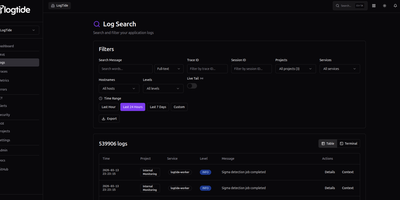
Every production incident starts the same way: someone asks "what do the logs say?" and the answer takes 45 minutes to find. LogTide collapses that search into seconds with a unified observability platform that indexes logs, traces, and metrics into a single queryable interface, backed by your choice of TimescaleDB, ClickHouse, or MongoDB. The log search interface supports full-text queries across millions of entries with filters for trace ID, session ID, project, service, hostname, and severity level, plus a live tail mode that streams new log lines as they arrive. Distributed traces render as waterfall timelines showing every span, its duration, and cross-service dependencies, while correlated logs for each trace are one click away. The metrics explorer visualizes OTLP gauge and counter data from your applications with system CPU, memory, disk, and network panels that update in near real-time. Where LogTide diverges from standard observability is its built-in SIEM engine: Sigma-compatible detection rules scan incoming logs for security threats like SQL injection, privilege escalation, lateral movement, and C2 communication, surfacing findings on a dedicated security dashboard with severity distribution, detection timelines, and affected service breakdowns. Alerting pushes notifications to Email, Slack, or Discord webhooks when thresholds trip or security rules fire. Native SDKs for Node.js, Python, Go, PHP, Kotlin, and Ruby ship logs with retry logic and circuit breakers, and the platform accepts OpenTelemetry data natively. Running on a dedicated VPS on RepoCloud with guaranteed CPU, RAM, and SSD, full root SSH access, and a browser serial console. AGPL-3.0 licensed.
SonarQube Community
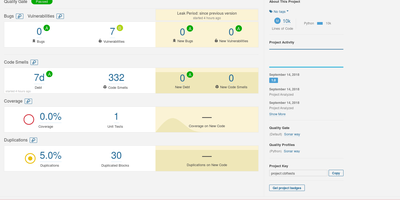
Trusted by over seven million developers worldwide with 310+ contributors and more than 10,600 GitHub stars since 2011, SonarQube has become the industry standard for automated code review and continuous code quality inspection. The platform performs deep static analysis across Java, JavaScript, TypeScript, Python, C#, C++, PHP, Kotlin, Go, Ruby, Swift, and 30+ additional languages, detecting bugs that cause runtime failures, security vulnerabilities exploitable by attackers, security hotspots requiring manual review, code smells degrading maintainability, and code duplications increasing technical debt. Quality Gates define pass-fail thresholds on metrics like coverage, duplications, reliability rating, and security rating, failing CI/CD pipelines when new code introduces issues below organizational standards. Pull request analysis decorates GitHub, GitLab, Bitbucket, and Azure DevOps merge requests with inline issue annotations and overall quality summaries before merging. Built-in quality profiles provide curated rule sets per language following the Sonar Way methodology, with dedicated profiles for AI-generated code that target patterns commonly introduced by agentic coding workflows. Infrastructure-as-Code analysis covers Terraform, Kubernetes, Docker, Ansible, CloudFormation, and Helm charts with supply-chain security rules for CI/CD pipelines. The companion IDE plugin delivers real-time analysis with quick-fix guidance directly in VS Code, IntelliJ, and Eclipse. Running on a dedicated VPS on RepoCloud with guaranteed CPU, RAM, and SSD, full root SSH access, and a browser serial console. LGPL-3.0 licensed.
AgentMesh
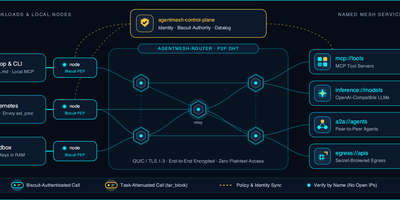
A node beside each AI agent gives your fleet a private network where agents publish tools and models, discover what other nodes offer, and call those services under policy you control. Nothing is reachable by default, because a node exposes no service until its configuration says so, and no node may call a service your mesh policy has not granted. Identity comes from your own identity provider, since a node enrolls with an OpenID Connect or bootstrap token and receives a short-lived credential bound to its own key that peers can verify offline. Nodes connect directly when they can and relay through well-known routers when NAT or firewalls say no, so the same mesh stretches across laptops, containers, clusters, and phones. The node beside your agent exposes the mesh as a local MCP server and an OpenAI-compatible endpoint, so model requests route to whichever node serves that model. The control plane verifies who is joining, issues the credentials, and holds the grants, which are evaluated on service names rather than network addresses. For small deployments, a single binary bundles the control plane, a router, and a web console, so a private mesh for your agents runs on one modest host. A shared developer testnet lets you rehearse the whole enrollment and calling flow in minutes before standing up infrastructure of your own. Running on a dedicated VPS on RepoCloud with guaranteed CPU, RAM, and SSD, full root SSH access, and a browser serial console. Apache-2.0 licensed.
Kopia
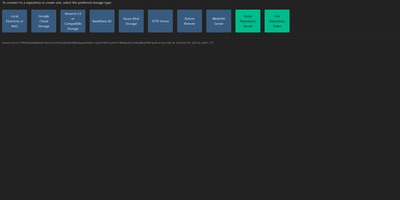
Engineers who have outgrown Duplicati or rsync scripts tend to appreciate Kopia's design: encrypted, compressed, content-deduplicated snapshots in Go, stored in a repository on any storage you control - S3, Google Cloud Storage, Azure Blob, Backblaze B2, SFTP, WebDAV, or a plain filesystem. Encryption is mandatory and end-to-end: every block is encrypted client-side with AES-256-GCM or ChaCha20-Poly1305 using keys derived from your repository password, and even file names never leave the machine in plaintext. Blocks are packed into 20-40 MB blobs with random names, so the storage provider learns nothing about content or structure. Deduplication is automatic and content-based - identical data across files, snapshots, and even multiple machines backing up to the same repository is stored once. Policies govern everything per-directory: compression choice, retention (hourly through annual), scheduling, and ignore rules. Incremental snapshots are point-in-time records you can mount and browse like a filesystem. This deployment runs the Kopia repository server with its web UI, centralizing backups from multiple client machines over an authenticated API - each client connects with the server URL and certificate fingerprint, and users only see their own snapshots. Error correction, high-latency-tolerant caching, and both CLI and GUI round it out.
ServiceRadar
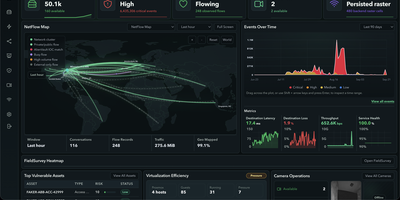
Most teams juggle five consoles to watch one network, and ServiceRadar replaces them with a single operations dashboard for flows, topology, logs, metrics, and alerts. Agents deployed at remote sites keep collecting checks even when the link drops, then deliver their stored records once the connection returns. Discovery over SNMP, LLDP, and CDP builds a topology map that shows traffic between devices, and a NetFlow map traces conversations across the world. Telemetry arrives from OpenTelemetry, syslog, GELF, SNMP polling and traps, BGP, and NetFlow or IPFIX exporters, and a short key:value query language filters any of it. An anomaly engine groups spikes and drift into episodes, so operators get one durable alert instead of a hundred noisy ones. Notification routes with escalation policies page people through Slack, Discord, email, or webhooks, and a delivery log records every attempt. Security views gather scanner findings, threat intelligence matches, and DNS activity, and Ansible playbooks run against inventory devices with live per-host results. Custom checks run as sandboxed plugins, and teams can publish their own dashboards. Managed service providers, multi-site businesses, remote field operations, and homelabs that outgrew a status page are the natural fit. Running on a dedicated VPS on RepoCloud with guaranteed CPU, RAM, and SSD, full root SSH access, and a browser serial console. Apache-2.0 licensed.
Blocky UI
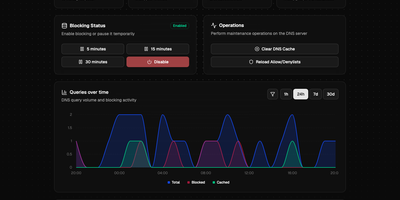
BlockyUI gives your Blocky DNS server a clean browser dashboard for seeing what gets queried, what gets blocked, and how quickly answers come back. Overview cards show total queries, blocked requests, cache hit rate, listed domains, and average response time. Pause blocking for 5, 15, or 30 minutes with one click, or disable it outright, then let it return on its own. Clear the DNS cache and reload allow and deny lists without touching the command line. A queries over time chart switches between 1 hour, 24 hours, 7 days, and 30 days, with filters for a single domain or client. Paginated top lists rank the busiest domains and devices and offer a blocked-only view. The query tool tests how any domain resolves, so a new filtering rule can be checked in seconds. Query logs are searchable and filterable by reason and record type, and they read from MySQL, PostgreSQL, Timescale, SQLite, CSV, or VictoriaLogs. Panels that depend on logging or statistics appear when your Blocky instance supports them, and the dashboard adapts otherwise. Settings live in one YAML file that points at your Blocky server. Running on a dedicated VPS on RepoCloud with guaranteed CPU, RAM, and SSD, full root SSH access, and a browser serial console. MIT licensed.
LaraOwl
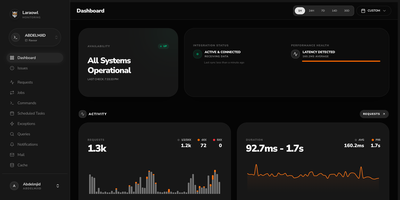
LaraOwl watches your Laravel applications from your own server, streaming every request, exception, slow query, and attack attempt into one live dashboard. Install one Composer package in each app, point it at your LaraOwl server, and requests arrive with method, path, status, duration, and middleware timing attached. Exceptions group themselves by fingerprint with stack traces, occurrence counts, and first and last seen times, so a resolved bug that comes back announces itself. Slow queries and N+1 patterns are flagged with execution times, jobs report failures and retries, and scheduled tasks check in like heartbeats that complain when they stop. A built-in security lens scores threats such as SQL injection, cross-site scripting, and path traversal, tracks hostile IPs, and can push a block into your Cloudflare firewall in one click. Uptime checks run every thirty seconds, alerts fan out to Slack, Discord, Telegram, email, or any webhook, and throttles keep a bad night from becoming a thousand messages. Teams organize multiple projects with their own tokens, thresholds, and retention policies, and daily pruning keeps last quarter's noise from filling the disk. Running on a dedicated VPS on RepoCloud with guaranteed CPU, RAM, and SSD, full root SSH access, and a browser serial console. Apache-2.0 licensed.