Apache Solr
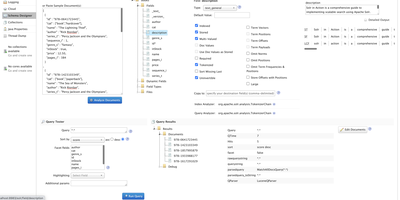
Product catalogs, help centers, and document archives all fail the same way: visitors type a few words, get the wrong results, and leave. Apache Solr is the search platform behind fast, relevant answers, returning ranked matches with faceted filters, highlighted snippets, spell suggestions, and geospatial distance in a single query. Index documents through HTTP updates or data import handlers, shape fields in the schema, and watch changes appear through near-real-time indexing without rebuilding the corpus. SolrCloud turns one index into a distributed collection: shards split large corpora across nodes, replicas copy each shard for failover and query load, and ZooKeeper coordinates configuration so every node serves the same schema. Dense vector fields store embeddings beside your text, and the KNN parser retrieves nearest neighbors through HNSW graphs, so semantic search runs in the same engine as keyword search instead of a second system. A combined query handler merges keyword and vector rankings with reciprocal rank fusion, and an enrichment processor can call language models at index time to tag or summarize documents as they arrive. Streaming expressions add analytics over results, from rollups and percentiles to joins across collections, while JWT authentication and authorization rules protect the admin console and APIs. Running on a dedicated VPS on RepoCloud with guaranteed CPU, RAM, and SSD, full root SSH access, and a browser serial console. Apache-2.0 licensed.
MongoDB
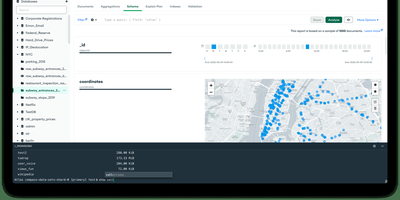
Used by over 46,800 companies including Forbes, Toyota, and Cisco, MongoDB stores data as flexible JSON-like BSON documents that eliminate rigid table schemas and support rapid application iteration. Its aggregation pipeline processes complex data transformations through composable stages including $match, $group, $lookup for joins, $unwind, and $project, operating directly within the database engine. Horizontal scaling is built in through automatic sharding, which distributes data across nodes using range-based, hashed, or zone-based shard keys, while replica sets provide automatic failover with configurable read preferences and write concerns. Multi-document ACID transactions span multiple collections and shards since version 4.0, enabling relational-style consistency guarantees within a document model. Starting with Community Edition 8.2, native full-text search and vector search are available directly in the database through $search and $vectorSearch aggregation stages, supporting RAG patterns, semantic retrieval, and hybrid search without external dependencies. Change streams provide real-time event-driven data access by tailing the oplog through the aggregation framework, enabling reactive architectures without polling. Time series collections offer optimized columnar storage for IoT sensor data and metrics with automatic bucketing and compression. Official drivers exist for Python, Node.js, Java, Go, C#, C++, Rust, Swift, and PHP, with MongoDB Compass providing a GUI for visual schema exploration and query building. Running on a dedicated VPS on RepoCloud with guaranteed CPU, RAM, and SSD, full root SSH access, and a browser serial console. SSPL v1 licensed.
Farfalle
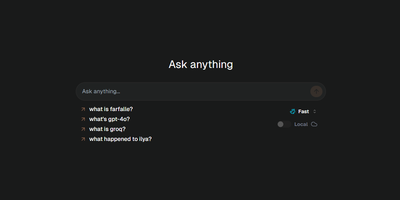
Live web search plus an LLM of your choice: Farfalle is an open-source, self-hosted answer engine in the Perplexity mold. Queries route through one of several search providers - self-hosted SearXNG for a fully independent stack, or Tavily, Serper, and Bing APIs - and the model composes a cited answer from the retrieved results. Model flexibility is the core design: run llama3, mistral, gemma, or phi3 locally through Ollama for zero per-query cost and full privacy, use cloud models like GPT-4o or Groq-hosted Llama 3 for speed, or route to any provider via LiteLLM. An Expert Search mode uses an agent that plans a multi-step search strategy and executes it for harder questions, and chat history keeps prior research sessions available. The stack is a Next.js and shadcn/ui frontend over a FastAPI backend with Redis rate limiting, shipped as a pre-built Docker image. A browser search-engine entry pointing at your instance makes it the default search from the address bar. Paired with SearXNG and Ollama, the whole pipeline runs with no external API at all.
ExtendDB
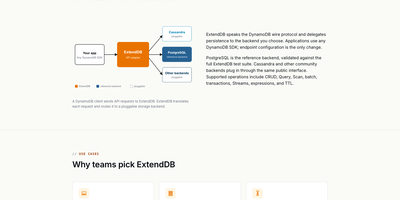
ExtendDB is a DynamoDB-compatible database server that answers the DynamoDB wire protocol from your own infrastructure, so applications written for DynamoDB run unchanged against a database you operate. Any AWS SDK, the AWS CLI, or DynamoDB tooling points at the ExtendDB endpoint and keeps working: tables, items, Query and Scan with key conditions and filters, batch reads and writes, and transactions all behave as the SDK expects. Streams feed change data to your own consumers, TTL expires items on schedule, vector indexes add cosine, Euclidean, and dot product search to on-demand tables, and point-in-time export and import move data in and out. Storage is pluggable, with PostgreSQL as the reference backend, SQLite embedded for small installs, and MongoDB and Cassandra for teams already running them. Every request is SigV4-signed and evaluated by a built-in IAM-style engine with users, groups, roles, policies, permission boundaries, and access keys, and TLS is mandatory on every connection. A web management console administers accounts and credentials, and a JSON metrics endpoint reports DynamoDB-style CloudWatch metric names and dimensions. The server runs as a daemon or in the foreground under Docker, Kubernetes, or systemd, healthchecks without extra tooling, and keeps serving in air-gapped environments with no internet connection at all. Running on a dedicated VPS on RepoCloud with guaranteed CPU, RAM, and SSD, full root SSH access, and a browser serial console. Apache-2.0 licensed.
AI Real Estate Assistant
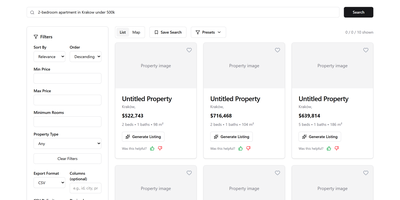
AI Real Estate Assistant puts a conversational search engine on top of your own property catalogue, so buyers type a request in plain language and receive matched listings in return. A query about a two-bedroom apartment in a named city under a price limit becomes extracted filters, semantic ranking over the catalogue, and a shortlist that matches the words instead of a rigid form. Behind the chat sits a working toolbelt: a mortgage calculator, a rent-versus-buy comparison, ROI and total-cost-of-ownership estimates, and an AI valuation that projects a property value one, three, five and ten years ahead with a confidence band. Every listing card shows an estimated monthly payment, and every property page carries an AI neighbourhood summary covering district character, nearby amenities and ease of getting around. Interactive maps cluster markers by area, a city overview page compares markets across districts, and a documents section accepts uploaded files that visitors can question in the same conversation. An agent directory presents the people behind the listings together with their stock, and the interface speaks nine languages with compliance labels on AI output. The demo mode answers with a local model and needs no paid key, and a real deployment routes each request to any of sixteen providers. Running on a dedicated VPS on RepoCloud with guaranteed CPU, RAM, and SSD, full root SSH access, and a browser serial console. MIT licensed.
Uwazi
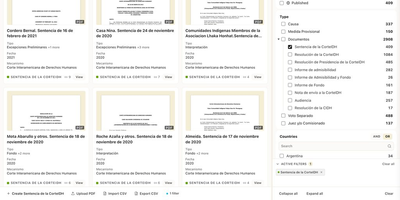
Human rights teams, legal researchers, and archivists use Uwazi to turn scattered documents and case records into searchable, structured collections that the public or trusted partners can explore online. You design templates that define exactly which fields each record carries, from dates and locations to people, organizations, and document types, then import material through the interface or in bulk from CSV files. Uploaded PDFs and documents become full-text searchable, so a phrase buried inside a scanned report is as findable as the metadata typed beside it. Relationships connect related entities across the collection, letting you trace how a person, an event, and a piece of evidence fit together instead of keeping them in isolated folders. Curators build public pages with live filters, maps, and visualizations drawn directly from collection data, while granular permissions decide which records stay private, which are shared with specific groups, and which are published for everyone. Multi-language support lets the same collection serve readers in several languages, and activity logs keep an audit trail of edits. Running on a dedicated VPS on RepoCloud with guaranteed CPU, RAM, and SSD, full root SSH access, and a browser serial console. MIT licensed.
Hister
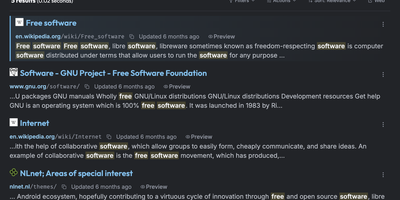
Hister is a private search engine for everything you have read or saved, indexing the full text of visited pages, local files, and imported browser history so one query finds the page you only half remember. Firefox and Chrome extensions capture each page as you browse, while a crawler and importers for browser history and bookmarks backfill earlier reading. Watched directories add local files to the same collection. Queries accept field filters, quoted phrases, wildcards, negation, date ranges, and aliases, with a readable stored preview beside each result. Opt-in semantic search matches documents by meaning through an Ollama, llama.cpp, or OpenAI-compatible embeddings endpoint. The same index answers in the browser, a terminal interface, the command line, an HTTP API, and an MCP server for AI assistants. Multi-user mode gives each person separate documents, rules, and access tokens, with password or OAuth sign-in, and public mode lets anonymous visitors search a curated index. Rebuild a research trail, recover a half-remembered article, or share one searchable knowledge base, with no telemetry. Running on a dedicated VPS on RepoCloud with guaranteed CPU, RAM, and SSD, full root SSH access, and a browser serial console. AGPL-3.0 licensed.
Rootprint
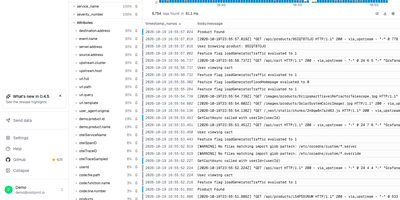
A year of searchable logs and traces no longer needs a metered logging service, because Rootprint keeps the whole index in a storage bucket you already own. A search matches any word on any line, since every log is indexed in full and no service name, stream, or label is needed first. A frequency histogram, one-click field filters, and saved views narrow the results, a fold mode collapses repeated lines, and exports arrive as NDJSON, CSV, or plain text, or as a share link. Open a trace from the log that emitted it, or paste a trace ID, and a waterfall shows per-span timing, attributes, events, and database calls grouped by query, with each span linking back to its logs. The trace explorer charts span volume, error rate, and p50, p95, and p99 latency, ranks the busiest operations, and filters spans by service, duration, and status. Every service gets its own page with request rate, error rate, operations, dependencies, and errors. Data arrives over OpenTelemetry from the Collector, Vector, or Fluent Bit, through a plain HTTP gateway, or by pulling from Kafka, Kinesis, or SQS, with guided setup for nine integrations. Indexes can live in S3, Google Cloud Storage, R2, MinIO, or Azure Blob. Teammates sign in with Google, GitHub, or any OpenID Connect provider, and scoped API keys serve scripts. Running on a dedicated VPS on RepoCloud with guaranteed CPU, RAM, and SSD, full root SSH access, and a browser serial console. Apache-2.0 licensed.
AKB
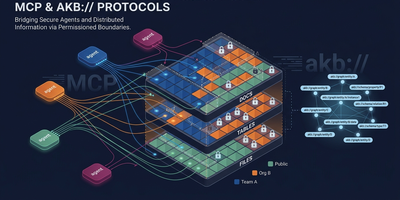
Achieving 98.4% Recall@5 on LongMemEval-S without a reranker, AKB is the agent-native knowledge infrastructure giving Claude Code, Cursor, Windsurf, and any MCP-aware agent persistent organizational memory — a drop-in replacement for Confluence or Notion where AI agents read and write directly rather than scraping human-formatted pages. Documents are stored as Markdown with YAML frontmatter in Git bare repositories (full version history, branching, diff), while PostgreSQL 16 serves as source of truth for chunk text, metadata, and BM25 vocabulary, with dense embeddings handled by a pluggable vector store (pgvector default, Qdrant optional, or managed Seahorse). Agents interact through 20+ MCP tools — akb_put, akb_search, akb_browse, akb_relations, akb_sql, akb_edit, akb_history — performing hybrid dense plus BM25 search fused via Reciprocal Rank Fusion in one call. The URI graph (depends_on, related_to, implements relations) lets agents traverse knowledge connections without external graph databases. Multi-tenant vault isolation is enforced at the PostgreSQL ACL level with per-user roles and SET LOCAL ROLE for SQL sandboxing. Event fanout streams structured events to Redis Streams for external consumers (synthesis bots, digest agents, audit trails), and a hash-chained append-only audit log integrates with enterprise SIEMs. Ships with agent plugins for Claude Code and Codex (session capture, wiki ingest, lifecycle hooks), Kubernetes kustomize manifests, and Open Knowledge Format export. Running on a dedicated VPS on RepoCloud with guaranteed CPU, RAM, and SSD, full root SSH access, and a browser serial console. BSL 1.1 licensed (free under 100 seats, auto-converts to Apache 2.0 after four years).
JobNavigator
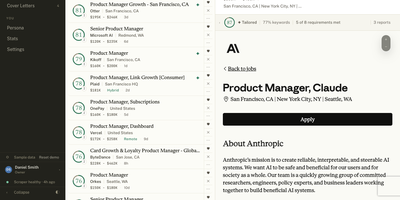
JobNavigator runs your whole job hunt as an automated pipeline, scraping career pages and job boards, scoring every posting against your résumés, and tracking each application to its outcome. Discovery fans out across company career pages through twelve ATS handlers, aggregators like LinkedIn, Indeed, and ZipRecruiter, and a Chrome extension that saves any posting you stumble on. Each new job is scored against your base résumés, lightly for a quick number or in full, with keyword coverage and requirement mapping that show exactly where you match and where you do not. Strong matches get a tailored résumé from eight PDF templates and a cover letter written from your persona, ready for your review before anything is sent. The extension then auto-fills application forms and drafts answers to free-text questions from your stored Q&A bank. Every application moves through stages and interviews in one tracker, while Gmail polling spots replies and updates the status for you, and Telegram delivers new-job alerts and a daily digest. A household can share one install with up to five accounts, each keeping its own jobs, résumés, and PIN, while scraping runs once for everyone. Running on a dedicated VPS on RepoCloud with guaranteed CPU, RAM, and SSD, full root SSH access, and a browser serial console. MIT licensed.
Elasticvue
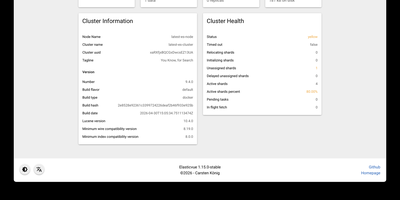
Elasticvue is a graphical interface for Elasticsearch where you can inspect cluster health, browse indices, search and edit documents, and send REST queries. Start on the Home tab, which summarizes status, nodes, shards, indices, document counts, and disk usage. Nodes shows load, CPU, RAM, heap, and disk for each member, and Shards lays out every primary and replica in a grid with a switch for shard allocation. Indices handles creation, aliases, templates, and bulk actions. Search runs query string searches across an index pattern, opens any hit in a JSON editor for updates or deletion, and downloads results as JSON. Rest sends any request from tabbed editors with history, saved queries, and examples, while Snapshots manages repositories and backups. Version 1.16 adds user and role management for Elasticsearch clusters. Secured clusters connect with basic authentication, API keys, or AWS IAM credentials, and the Docker image preloads cluster definitions from an environment variable or a mounted JSON file. Elasticvue supports every Elasticsearch version, even end-of-life releases, and speaks English, Chinese, French, Russian, Japanese, and Italian. Running on a dedicated VPS on RepoCloud with guaranteed CPU, RAM, and SSD, full root SSH access, and a browser serial console. MIT licensed.
LogicalDOC
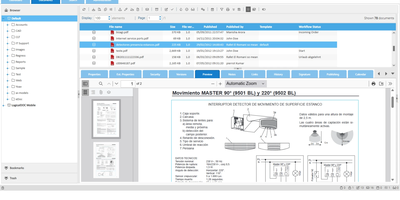
LogicalDOC is a document management system that gives a company one controlled home for its files instead of letting contracts, invoices, and procedures scatter across drives and inboxes. Staff store any kind of document in a repository organized on multiple levels, then find it again through advanced search that reaches inside document content, not just filenames. Colleagues collaborate on the same documents and projects while version control keeps the history straight, so nobody works from last quarter's draft by accident. Administrators define roles for different users, set access control and user quotas, and choose the security level for each area, with detailed activity logs showing who opened, changed, or shared what. Automations handle the routine flow of documents through the business, and the web services API lets an ERP or other systems integrate document management into existing processes. Information can be collected from any digital source, knowledge gets reused instead of recreated, and mobile apps for phones and tablets keep the repository reachable away from the desk. The official Docker image and Tomcat bundles make the Community Edition straightforward to run on your own infrastructure. Running on a dedicated VPS on RepoCloud with guaranteed CPU, RAM, and SSD, full root SSH access, and a browser serial console. LGPL-3.0 licensed.
Deep Research Web UI
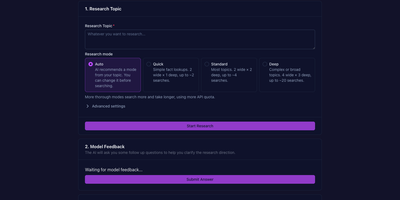
Ask a hard question and get back a cited report instead of a chat answer: Deep Research Web UI plans its own searches, reads the pages it finds, checks claims against the sources, and shows its work as it goes. The research unfolds as a live tree in your browser, each branch a search direction with streaming responses, so you watch a broad question narrow into answerable parts. When snippets are not enough, it fetches full source pages and extracts verbatim evidence, sharing one token and request budget across the run. Every claim cites its source inline, and clicking a citation opens an evidence panel with the source, retrieval time, and the excerpt behind the finding. Findings can be followed up: name what to verify and the agent searches again, updating only the passages that cite that finding while the original report stays untouched in your history. You bring the models, from OpenAI-compatible endpoints, DeepSeek, and OpenRouter to a local Ollama or LiteLLM proxy, paired with Tavily, Firecrawl, Google PSE, You.com, or Serply for the searching. Finished reports export as Markdown or PDF, search separates your question from time and source filters and retries once with a revised query when evidence is thin, and Server Mode keeps the team's API keys in environment variables behind an optional access password instead of in every visitor's browser. Running on a dedicated VPS on RepoCloud with guaranteed CPU, RAM, and SSD, full root SSH access, and a browser serial console. MIT licensed.
Magnetissimo
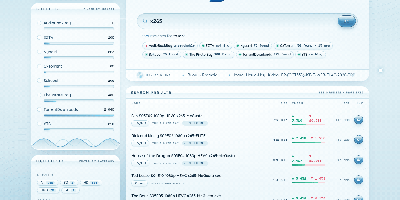
Magnetissimo is a self-hosted torrent indexer that searches eight public sources at once and remembers everything they return, so the release you hunted for across half a dozen sites last week is already waiting in your own index when you look for it again. A search answers from the local database immediately and asks YTS, Nyaa, Sukebei, TorrentDownloads, AudioBookBay, The Pirate Bay, EZTV, and OxTorrent in parallel; every answer is filed into the index as it lands and streams into the results page with size, seeders, leechers, and age attached. The query language goes further than any single source: exact quoted text, exclusions, alternatives, wildcards, and filters for file size, seeder count, and age, with matching that copes with dotted scene release names and titles without spaces. An optional DHT crawler walks the peer-to-peer network in the background at a rate you choose, discovering torrents and their file lists around the clock and showing arrivals live on its own page. Media automation connects natively: the Torznab endpoint feeds Sonarr, Radarr, Lidarr, Prowlarr, and book managers with standard categories, and a JSON API serves the latest and best-matching torrents to scripts. Everything lives in one SQLite database inside a single container, search and paging work without JavaScript, and upgrades are a pull and a restart. Running on a dedicated VPS on RepoCloud with guaranteed CPU, RAM, and SSD, full root SSH access, and a browser serial console. MIT licensed.

DocsMint
DocsMint is a self-hosted knowledge workspace where your team writes documentation once and both people and AI agents retrieve it through hybrid search and a built-in MCP server. Documents live in a rich visual editor with Markdown import and export, organized by folders, categories, and tags, with sharing and version history. Search blends exact title matches, multilingual keyword search, typo-tolerant fuzzy matching, and semantic vectors, then widens results through graph relationships between documents, so a query in one language or phrasing still finds the right page. Every edit quietly refreshes the index in the background; nothing needs manual re-embedding. Agents connect through 22 MCP tools covering search, reading, creation, updates, folders, snapshots, and export, over a local stdio bridge or the HTTP endpoint on your own installation. Category-scoped API keys hand each integration only the slice of the library it may read, edit, or write, while a global key serves trusted automation. The same operations are available through the REST API, a typed TypeScript SDK, and a terminal CLI for scripts. The web application installs as a PWA with offline reading, and AI features run on your choice of an OpenRouter key or a fully local Ollama setup. Running on a dedicated VPS on RepoCloud with guaranteed CPU, RAM, and SSD, full root SSH access, and a browser serial console. Apache-2.0 licensed.
RushDB
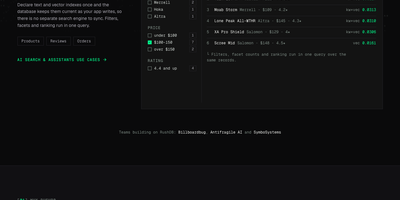
RushDB is a database your AI agents can actually understand, because it remembers the shape of everything you write. Send nested JSON and each object becomes a record, automatically linked to its parent, while field names, types, and values are cataloged on every write. Agents introspect that catalog before querying, so they ask questions the data can answer instead of hallucinating tables that never existed. The same records answer five query styles: a JSON query language, SQL over the PostgreSQL wire protocol, Cypher over HTTP or Bolt, Gremlin, and Mongo-style document queries. Vector, full-text, and hybrid search run against the same store, so an agent can find the record that mentions a phrase and the records merely similar to it. Everything ships as one binary with one data directory, speaking HTTP on port 3000, PostgreSQL on 5432, and Bolt on 7687 to the drivers and tools you already use. Point your SDKs, SQL clients, BI tools, or local MCP-connected agents at it, and back it up, replicate it, or restore to a point in time with the engine's own tooling. Running on a dedicated VPS on RepoCloud with guaranteed CPU, RAM, and SSD, full root SSH access, and a browser serial console. Apache-2.0 licensed.
Searcharvester
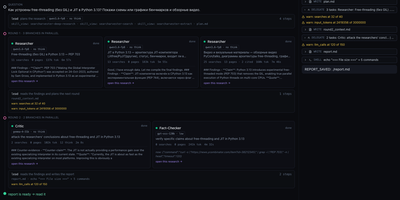
Searcharvester gives your AI agents a private search and research backend that runs entirely on your server, with a web UI where you watch every research job unfold. The search endpoint speaks the Tavily schema, so existing agent code points at your host and queries more than a hundred SearXNG engines without API keys or quotas. Send a URL to the extract endpoint and it returns clean markdown with navigation, footers, and ads stripped, sized in presets from five thousand characters to fully paginated long documents. Three extractors compete on each page and a quality gate keeps the best result, so hard pages still yield readable text. For bigger questions, the research endpoint runs a team of agents: a lead plans sub-questions, researchers gather in parallel, a critic tries to disprove the findings, and a fact-checker re-verifies numbers and dates before the final report arrives with clickable citations. You assign a different model and reasoning level to each role, follow agent branches, the reading graph, sources, and media live, then read the finished report in the same UI. Search settings let you toggle engines per category, test proxies, and apply changes with a targeted restart. A loop guard enforces budgets for calls, tokens, searches, and page reads across the whole job. Running on a dedicated VPS on RepoCloud with guaranteed CPU, RAM, and SSD, full root SSH access, and a browser serial console. AGPL-3.0 licensed.
Atomic
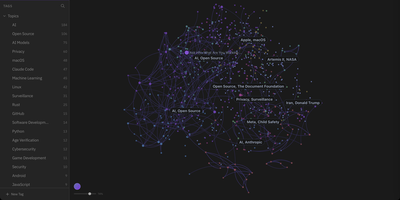
Atomic transforms collections of personal Markdown notes into an AI-augmented knowledge graph by breaking documents down into semantically linked conceptual units. Users capture thoughts, research excerpts, and web clippings as modular notes that the system automatically chunks, embeds, and categorizes with hierarchical tags. An interactive force-directed canvas maps out the entire knowledge base, positioning related ideas closer together based on embedding cosine similarity rather than manual folder hierarchies. Built-in vector search queries across text embeddings directly within SQLite, retrieving precise contextual snippets in response to natural language prompts. The automated wiki engine synthesizes disparate notes into comprehensive reference articles equipped with verifiable inline citations back to original source materials. Integrated conversational agents leverage retrieved knowledge context to answer research questions, surface contradictions across past entries, and draft structured daily briefings. External AI tools can read, search, and update stored knowledge through an embedded Model Context Protocol server endpoint. Running on a dedicated VPS on RepoCloud with guaranteed CPU, RAM, and SSD, full root SSH access, and a browser serial console. MIT licensed.