Nautilo
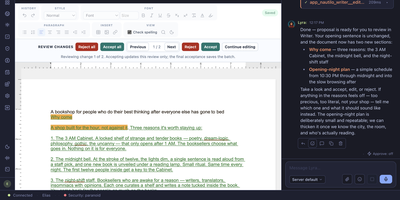
Most AI tools give one person one chat window; Nautilo is built for the room where your whole team, and each person's own AI Genie, work on the same thing at the same time. Give your Genie a personality, memory, face, and voice, then bring colleagues and their Genies into a shared Room to pull an idea apart, draft it, and send an agent off to research the missing piece. Six bundled creative apps cover the work itself: Writer for documents, Sheets for spreadsheets, Slides for decks, Board for planning, Design for visuals, and Video for clips, all editable by people and agents side by side. When the agent's draft misses, you grab the controls and rewrite the paragraph or move the lettering yourself instead of begging a prompt for a three-inch nudge. You choose the models and plug in your own provider API keys, connect tools through MCP, and let Genies operate connected workstations when a task needs real computer use. Membership, access, and tool permissions stay under your server's rules, and web, desktop, and mobile clients all connect to the same self-hosted instance. Running on a dedicated VPS on RepoCloud with guaranteed CPU, RAM, and SSD, full root SSH access, and a browser serial console. MIT licensed.
Oksskolten
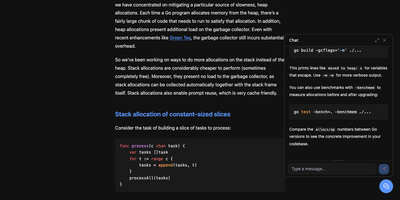
Subscribe to a feed and Oksskolten fetches the complete text of every new article, cleans it, and files it as Markdown in a library you can read without leaving the app. About 500 cleanup patterns strip ads, navigation, and tracking, with no per-feed toggles or selectors to maintain. No feed on the site? Auto-discovery goes first, then RSS Bridge, then LLM-inferred CSS selectors, while FlareSolverr gets past bot protection. Every feed is checked on its own schedule, somewhere between every 15 minutes and every 4 hours. Inbox, Read Later, Liked, and Read views keep the queue tidy. Clip any URL as a standalone article. Likes and bookmarks feed an engagement score that shapes search ranking and recommendations. One click summarizes or translates an article through Anthropic, Gemini, OpenAI, Ollama, or vLLM, with Google Translate and DeepL as translation engines. Ask the chat questions about your archive, or point Claude Code or Codex at the built-in MCP server to use the same tools. Search forgives typos and covers every stored article. Login works with a password, a passkey, or GitHub. Pick from four layouts and fourteen color themes, import custom themes as JSON, rebind keyboard shortcuts, and keep reading offline as a progressive web app. Running on a dedicated VPS on RepoCloud with guaranteed CPU, RAM, and SSD, full root SSH access, and a browser serial console. AGPL-3.0 licensed.
Taskuary
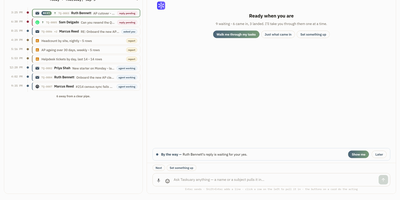
Mail, chats, tickets, alerts, and reports stop being five inboxes to check and become one sorted rail in Taskuary, your self-hosted AI work partner. A triage pass reads each arrival and gives it one verdict: nothing to do, a sentence settles it, an agent should work it, talk it through, or it is yours. The rail groups what survives into Urgent, On you, Goals, Agents working, For later, Reports, Advisor ideas, and FYI, and a morning card recaps what changed overnight, what was learned, and today's meetings. The Assistant can walk you through the pile one task at a time, presenting each card with Next, Write reply, Send to agent, and Mark done actions. Coding jobs go to the CLI you already run (Claude Code, Codex, Gemini, Cursor, Copilot, Qwen Code, OpenCode, or Kimi Code) inside your checkout; general jobs open a conversation instead. Results return as drafts attached to the task, and nothing leaves until you approve: replies, comments, invoices, and posts all wait for your click. Disagreeing with a verdict teaches the triage, and learned memory carries your preferences into the next decision. Running on a dedicated VPS on RepoCloud with guaranteed CPU, RAM, and SSD, full root SSH access, and a browser serial console. MIT licensed.
Mission Control
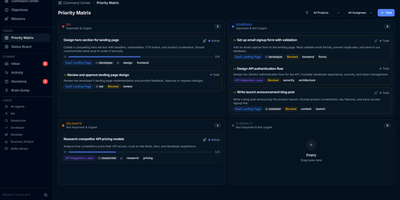
With over 600 GitHub stars and a featured Show HN launch, Mission Control is the agent-first command center that replaces the chaos of manually shepherding AI agents with structured delegation, approval workflows, and autonomous execution. The Next.js 15 web UI delivers an Eisenhower priority matrix with drag-and-drop quadrants, a Kanban board tracking tasks through Not Started, In Progress, and Done columns, and a goal hierarchy with milestone progress bars — powered by shadcn/ui, Radix UI, and @dnd-kit. Six built-in agent roles — Researcher, Developer, Marketer, Business Analyst, Tester, and You — receive tasks through a token-optimized API compressing context by 92 percent to approximately 50 tokens versus 5,400 unfiltered. The autonomous daemon polls task queues on cron schedules, spawns Claude Code sessions via the official CLI, enforces concurrency limits, and auto-retries with loop detection that escalates to human decisions after three failures. Field Ops extends execution to 64 external services across 16 categories with working X, Ethereum with MetaMask signing, and Reddit adapters, protected by AES-256-GCM encrypted vault with scrypt key derivation, per-service and global spend limits, a circuit breaker, and three autonomy levels. All data lives in local JSON files with Zod validation and async-mutex locking ensuring safe concurrent writes, backed by 193 automated Vitest tests. Running on a dedicated VPS on RepoCloud with guaranteed CPU, RAM, and SSD, full root SSH access, and a browser serial console. AGPL-3.0 licensed.
Edi Life OS
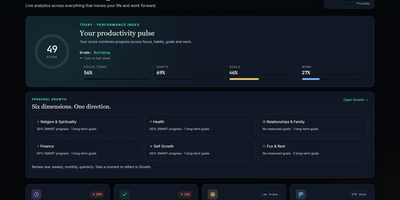
Edi Life OS puts the habits, goals, projects, money, focus sessions, and notes that usually live in five separate apps into one calm dashboard on your own server. Start the day from an Overview that rolls focus, habit trends, goals, finances, and the week ahead into one readable score. Connect long-term goals to six life areas, drive progress from a checklist, a measure, or a habit you actually keep, and use weekly, monthly, or quarterly reviews to choose the next honest step. Log daily habits with streaks and monthly progress, run timed focus sessions with short and long breaks, and keep a history of the deep work you finished. Track expenses, income, budgets, debts, and credits in your chosen currency, including recurring entries that land straight in the ledger. Plan projects on draggable Kanban boards with labels, priorities, due dates, checklists, comments, and attachments, then see card deadlines and money dues together in one calendar. Capture Markdown notes with preview and export, pin sticky notes with colors and connections, and give each account its own private workspace, theme, and currency. Ask an AI assistant through the optional MCP server to read your dashboard, create goals, log habits, or record expenses through a token-protected API that never touches the database directly. Running on a dedicated VPS on RepoCloud with guaranteed CPU, RAM, and SSD, full root SSH access, and a browser serial console. MIT licensed.
LanQin Email
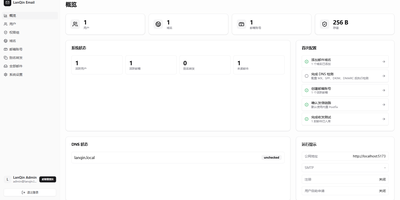
Running your own mail server usually means assembling five services and praying over DNS records; LanQin Email ships the whole stack in one container. Readers switch between mailboxes, search, label, star, and file messages into folders, then compose with a rich-text editor that handles fonts, colors, code blocks, attachments, emoji, and scheduled sending. Contacts, signatures, inbox rules with automatic forwarding, sender blacklists, and mail statistics make it a daily client rather than a demo. Administrators run the postal side from the same panel: add domains and generate DKIM keys, follow the DNS record checklist the system verifies for you, create mailboxes, set delivery aliases and catch-all addresses, and audit every message on the server. Accounts sign in with passwords or OAuth single sign-on, protected by TOTP two-factor codes and bot checks, while permission groups cap attachment size, sending rate, and mailbox count per user. Users can even request their own mailbox and wait for approval instead of filing a ticket. For programs, an Open API with bearer tokens sends mail idempotently and reports delivered, bounced, complained, rejected, and deferred events back through webhooks. External Gmail and Outlook accounts can be aggregated over IMAP, and a client-configuration page shows every IMAP, POP3, and SMTP setting in one place. A multi-container layout remains for debugging the stack piece by piece. Running on a dedicated VPS on RepoCloud with guaranteed CPU, RAM, and SSD, full root SSH access, and a browser serial console. GPL-3.0 licensed.
Kurrier
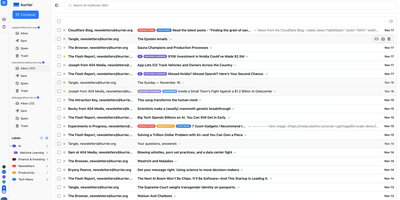
Kurrier unifies email, calendars, contacts, and file storage in a single web interface that connects to any email provider you already use. The Next.js frontend with Nitro API worker deploys via Docker Compose on PostgreSQL and Redis, delivering a cohesive workspace where IMAP/SMTP mailboxes from Gmail, Outlook, or corporate servers sit alongside transactional providers like AWS SES, SendGrid, Mailgun, and Postmark. Automatic inbox building handles threads, attachments, sent items, and deletion sync through persistent background polling. The CalDAV backend enables full two-way calendar synchronization with iOS, macOS, Android via DAVx5, and Thunderbird, supporting event invitations, RSVP processing through the inbox, timezone-aware scheduling, and contact-aware attendee linking. CardDAV contacts sync bidirectionally across all devices with unified name, avatar, and email resolution. Kurrier Drive provides integrated file storage through WebDAV locally or S3-compatible backends for cloud storage. Multiple identities and domains let you manage several email accounts from different providers in one interface, with fast local search indexing subjects, senders, and content without dependency on external APIs. The API-first architecture exposes clean endpoints for automation and custom integrations. Running on a dedicated VPS on RepoCloud with guaranteed CPU, RAM, and SSD, full root SSH access, and a browser serial console. AGPL-3.0 licensed.
Xiryn
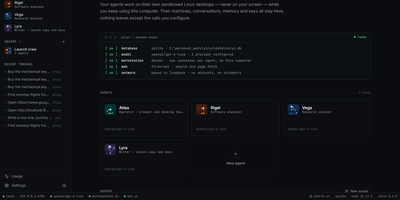
Picture a small staff of AI agents clocking in on your own server, each with a name, a specialty, its own model, and a private Linux desktop it can click around in. Every agent works inside a disposable Docker workstation with a shell, persistent files, and a Chromium browser, so it can research the web, write and run code, and finish multi-step tasks without touching your own files. You watch an agent click and type in real time, and when a login, payment, or one-time code needs a human, you take over the desktop, then hand it back with a note and let it continue. Pair a Telegram bot by scanning a QR code and you can assign work, answer questions, and receive results from your phone, with no public URL or port forwarding. Routines turn recurring requests into schedules, so a morning briefing, a price watch, or a weekly report runs by itself and reports back when it is done. Each agent can use a different model, from OpenAI, Anthropic, Google, xAI, Groq, Mistral, or DeepSeek to a local Ollama endpoint, and every reply shows its cost while a monthly budget pauses paid models automatically. Agents remember what matters about you across every thread, and logins or cards you save sit in an encrypted vault the agents themselves never see. Running on a dedicated VPS on RepoCloud with guaranteed CPU, RAM, and SSD, full root SSH access, and a browser serial console. MIT licensed.
MIND
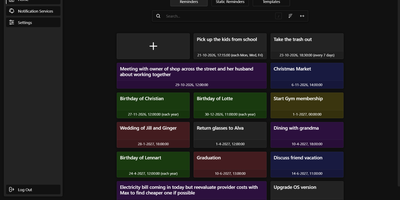
Unlike a calendar alert that rings on one phone, a MIND reminder reaches any of 100+ services, including email, Pushbullet, BlueSky, Cisco Webex Teams, and SMS gateways, from a self-hosted reminder app that you control. Normal reminders fire with second precision once or repeat every few days, once a year, on chosen weekdays, or on a custom cron schedule, while static reminders wait for a button press, so a single tap can tell the family that you are running late. Templates store colour, title, services, and text for fast creation, and the colour-coded library can be searched and sorted, with each reminder enabled, disabled, or tested on demand. Time zone changes, including daylight saving shifts, are accounted for, and sends that fail on a connection error are retried every two minutes until they succeed. Several users can share one instance: the admin panel handles accounts and registration, login lifetime, reverse-proxy URL prefix, debug logs, and scheduled database backups that can be exported and imported, and sign-in supports two-factor authentication. A documented REST API covers reminders, templates, notification services, and static triggers, and the web interface adapts to phone screens. Running on a dedicated VPS on RepoCloud with guaranteed CPU, RAM, and SSD, full root SSH access, and a browser serial console. GPL-3.0 licensed.
Monetr
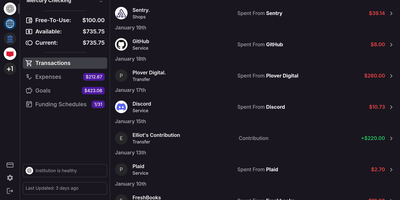
After the bills are covered, how much is actually safe to spend? monetr organizes an entire budgeting application around that one question. Inspired by the defunct Simple bank, it budgets paycheck by paycheck rather than month by month. Funding schedules encode when you get paid - including multiple schedules per account and a weekend-exclusion option for deposits that land early - and every expense or savings goal is tied to one. monetr then calculates how much of each recurring obligation (rent, car payment, subscriptions, on any repeat interval) to set aside from each paycheck, so a large bill never has to come out of a single check. What remains after allocations is surfaced as Free-To-Use, and a forecasting timeline projects contributions, due dates, and leftover funds forward so low-balance periods are visible before they happen. Transactions arrive either as OFX uploads from your bank or automatically through a Plaid connection using your own API credentials, keeping balances and transactions synced without manual entry. The app is mobile-friendly and installable as a PWA on desktop or phone. Self-hosting via Docker Compose is completely free, with all source code public and your financial data on your own hardware.
ScribeWizard
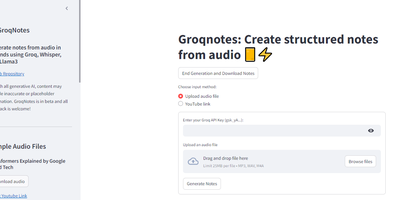
Audio lectures become structured, Markdown-formatted notes in about a minute with ScribeWizard (also known as GroqNotes). Upload an MP3, WAV, or M4A file - or paste a YouTube link - and the app runs a three-stage pipeline on Groq's LPU inference hardware: Whisper Large v3 transcribes the audio, a larger Llama model drafts a comprehensive outline of the material, and a faster Llama model fills each section with detailed content. This scaffolded prompting strategy is the core idea: the strong model handles structure where quality matters most, the fast model handles volume, and Groq's 1200+ tokens-per-second inference keeps the whole process near real time. Output renders as clean Markdown with support for tables and code blocks, and finished notes download as text or PDF. Model selection is configurable - swap in other Groq-hosted open models like Mixtral or Gemma to trade speed against quality or work around rate limits. Built as a single Streamlit app by Benjamin Klieger at Groq, it needs only a Groq API key to run, making it one of the simplest self-hosted AI tools to operate.
Thunderbird Appointment
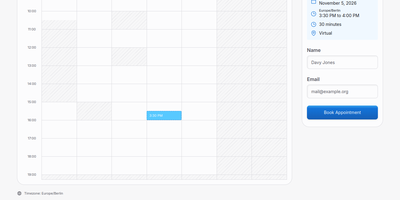
One link replaces the scheduling dance: Thunderbird Appointment publishes your availability as a booking page where visitors choose a slot and the meeting lands on your calendar. You connect the calendars you already keep, Google Calendar or any CalDAV server, and the service reads your busy times and writes new bookings back as real events. Weekly schedules define the days and hours on offer, the length of each slot, and how far ahead or how last-minute a booking may be. Each booking page carries its own title, agenda, and location, from a street address to a Zoom link created for the meeting automatically. Visitors see open times in their own timezone, pick one, and leave their name and email; no account is required on their side. Requests can land as confirmed bookings right away or wait for your approval first, and every booking appears in your bookings list with attendee details. Your own calendar view gathers every connected calendar in one place, so personal and work commitments stop colliding. The interface speaks several languages, honors light and dark themes, and lets each user set the week start and 12 or 24 hour clocks. Self-hosters sign in with a password, and larger deployments can plug in an OIDC provider for single sign-on. Running on a dedicated VPS on RepoCloud with guaranteed CPU, RAM, and SSD, full root SSH access, and a browser serial console. MPL-2.0 licensed.
OpenTranscribe
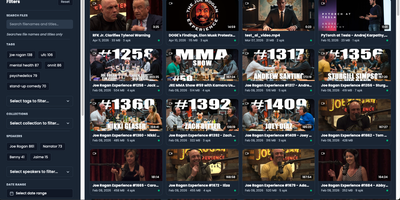
OpenTranscribe is a self-hosted transcription platform that converts your audio and video library into searchable, speaker-labeled transcripts, then lets you summarize and chat with those recordings. Upload files up to 15 GB, record from the browser microphone, or paste a link from YouTube and a thousand other sites, and playlists queue up for batch processing automatically. WhisperX produces word-level timestamps in over 100 languages, while the diarization engine works out who spoke when, corrects turn boundaries, and recognizes the same voice again across different recordings. Speaker profiles accumulate a voice fingerprint, speaking-time analytics, and merged identities, so a regular guest is named correctly in every episode without relabeling. Point it at an LLM and recordings gain structured summaries with action items, suggested tags and collections, and a chat interface that answers questions about your transcripts with citations, grouped into projects that pin their source recordings and standing instructions. Leave the model unconfigured and transcription, diarization, full-text and semantic search, and redaction still run entirely on local models. Watch folders, S3 buckets, and network shares import new media on a schedule with three-layer deduplication and automatic stitching of split recordings, and everything exports as subtitles, Word or PDF documents with citeable numbered lines, or Markdown. Running on a dedicated VPS on RepoCloud with guaranteed CPU, RAM, and SSD, full root SSH access, and a browser serial console. AGPL-3.0 licensed.
Yep Anywhere
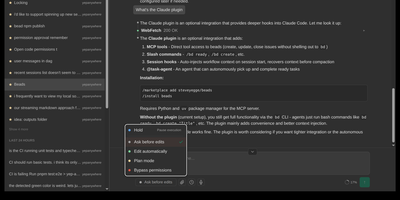
Designed for developers on the go, Yep Anywhere turns any smartphone browser into a full-featured control center for supervising, steering, and reviewing autonomous AI coding agents. Operators can monitor live execution across multiple active projects simultaneously without sitting at a desktop terminal. Real-time reasoning feeds. Instant push alerts for permission prompts. One-tap tool approvals. Developers can unblock pending tasks mid-turn, redirect active workflows, or queue sequential follow-up prompts for automatic delivery at the next safe milestone. An integrated source control viewer displays syntax-highlighted working-tree and commit diffs, allowing reviewers to attach line-level comment bundles directly back into the agent context. Mobile voice transcription lets users dictate instructions straight into running sessions, while photo library integration makes uploading bug screenshots effortless. All agent credentials, CLI configurations, and repository data remain private on the host server without requiring third-party cloud database accounts or proprietary device pairing. Running on a dedicated VPS on RepoCloud with guaranteed CPU, RAM, and SSD, full root SSH access, and a browser serial console. MIT licensed.
Octobox
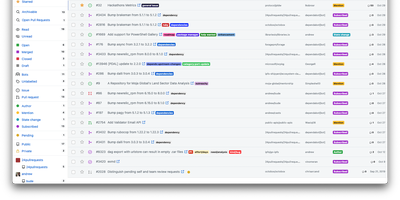
What Gmail did for email, Octobox does for GitHub notifications: an ephemeral, unmanageable stream becomes an inbox you can actually triage. GitHub marks notifications read the moment you glance at them and lets old ones vanish days later; heavy maintainers end up building elaborate Gmail filter systems just to cope. Octobox - a Ruby on Rails app over PostgreSQL - syncs your notifications into a persistent inbox with an explicit archived state: mark a thread done, and if the issue or PR sees new activity, it pops back automatically, so nothing silently falls through. Triage is keyboard-driven with Gmail-style shortcuts (j/k to navigate, e to archive, m to mute, s to star), and multi-select clears noisy repositories in bulk. Filtering is where it earns its keep: slice by repository, organization, type, action, state, reason, CI status, labels, author, assignee, or bot origin, combine prefix search filters, and pin favorite searches to the sidebar. The optional GitHub App enriches entries with live PR/CI status and labels so you can decide without clicking through. Auto-archive rules clear merged PRs and closed issues; muting and snoozing silence the rest. A REST API supports integrations. Self-hosting keeps your notification metadata - a map of everything you work on - on your own server.
Initiative
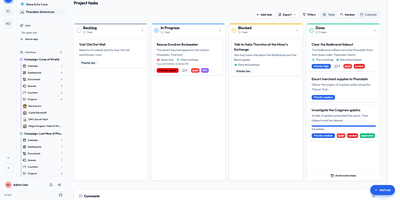
Initiative is a self-hosted, multi-tenant project management platform that organizes projects, tasks, collaborative documents, and schedules into strictly isolated community workspaces without enterprise complexity. Users create distinct communities where data remains strictly partitioned across separate database schemas, allowing agencies, volunteer groups, and gaming guilds to manage multiple client environments from a single deployment. Within each community, initiatives group related projects and documents while interactive drag-and-drop Kanban boards track task progression across custom columns, priorities, and deadlines. Integrated collaborative documents enable team members to co-author notes, project briefs, and meeting minutes in real time with threaded inline discussions and user mentions. Granular role-based permissions let administrators specify exact view and edit privileges down to individual items, while a recoverable trash system prevents accidental deletions from interrupting live operations. Curated marketplace apps supply customizable analytics dashboards, and optional bring-your-own-key artificial intelligence integrations generate task suggestions and summarize lengthy discussion threads. Running on a dedicated VPS on RepoCloud with guaranteed CPU, RAM, and SSD, full root SSH access, and a browser serial console. GNU AGPLv3 licensed.
Whirl
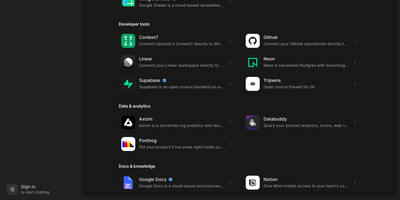
Whirl puts every top AI model in a single conversation and remembers what you were working on last week, so you can switch models mid-thought without losing the thread. Ask for a report, a chart, or a small interactive page and it appears as a living artifact in a side panel, still editable while you keep chatting, and shareable by link when it is ready to leave the conversation. Connect your own tools over MCP, with OAuth sign-in handled for you, or install skills that teach the app new tricks your team relies on. Long-term memory carries your preferences and project context from chat to chat, and live web search with page reading grounds answers in today's pages instead of the model's training data. Sensitive threads can be locked with a password that encrypts them on your device, where the server never sees the key and only zero-retention models may answer. Around those headline pieces sits the everyday kit: incognito mode, a message queue for when you think faster than the model replies, voice input, image generation, file attachments, folders, and sharing controls. An admin console manages the model catalog, integrations, and skills, and the interface itself switches between light and dark with your choice of accent color, installable as a mobile web app. Running on a dedicated VPS on RepoCloud with guaranteed CPU, RAM, and SSD, full root SSH access, and a browser serial console. MIT licensed.
Glean
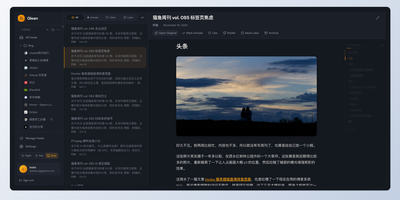
Information overload is the default state of the modern internet, and Glean exists to tame it by pulling every blog, newsletter, and news source you follow into a single, organized reading experience with an interface that prioritizes clarity over clutter. Subscribe to RSS and Atom feeds, import your existing subscriptions via OPML, and organize everything into multi-level folders with a flexible tagging system that lets you slice your reading list by topic, priority, or mood. A three-pane layout presents your feed list, article summaries, and full content side by side, with one-click actions for marking articles as read, saving them for later, bookmarking favorites, or archiving what you have already processed. Background workers fetch new articles every 15 minutes so your feeds stay current without manual refreshes. The preference learning engine (backed by Milvus vector embeddings) scores incoming articles against your reading history and surfaces a personalized Smart Feed of content you are most likely to care about, reducing the time spent scrolling past irrelevant posts. A built-in MCP server lets AI assistants like Claude Desktop search and interact with your feed library directly. The admin dashboard on a separate port provides user management, system monitoring, and configuration controls for multi-user deployments. Bookmark external URLs from any browser with the Chrome extension, or access your feeds on mobile through the Progressive Web App. Running on a dedicated VPS on RepoCloud with guaranteed CPU, RAM, and SSD, full root SSH access, and a browser serial console. AGPL-3.0 licensed.