Twenty screenshot thumbnail

Twenty

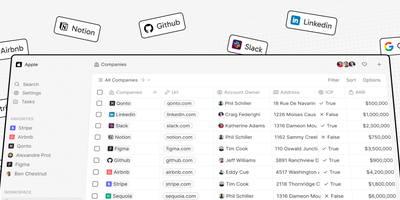
Salesforce's core workflow, open-source and on your own server: Twenty is a modern CRM built as exactly that alternative. It ships the standard CRM objects out of the box: people, companies, opportunities, notes, and tasks, displayed in table and kanban views with drag-and-drop and real-time updates. Its defining technical feature is a metadata-driven data model: you define custom objects and fields in the UI, and the backend regenerates its GraphQL schema at runtime, so a new object gets working queries, mutations, filters, and sorting within seconds, with no migrations to run - adapting the CRM to your sales process never requires code changes. A REST API is auto-generated from the same schema, GraphQL subscriptions push real-time updates, and webhooks fire on record changes for external integration. A visual workflow builder automates actions like notifications and field updates, TypeScript-based apps extend the platform with custom logic and frontend components, and email and calendar sync pulls Gmail messages and meetings onto contact timelines so communication history sits next to the record. The stack is NestJS with TypeORM, PostgreSQL, Redis, and BullMQ on the backend, React with Jotai on the frontend. Self-hosting on RepoCloud means unlimited users with no per-seat licensing - the pricing model that penalizes growing teams on commercial CRMs - and your pipeline, contacts, and deal history live in your own PostgreSQL database rather than a vendor's.

Deploy
Krayin CRM screenshot thumbnail

Krayin CRM

Krayin CRM gives sales teams a visual Kanban pipeline where leads flow through configurable stages — new, contacted, qualified, proposal, won, lost — with deal values tracked per stage, drag-and-drop transitions, and AI-powered document import that extracts contact details from uploaded PDFs, DOCs, and images without manual data entry. Built on Laravel 12 with a Vue.js frontend and MySQL database, the platform delivers complete customer lifecycle management through a two-stage contact model separating unqualified Leads from qualified Persons linked to Organizations, with a unified timeline displaying associated activities, notes, emails, and deals. The activity module schedules calls, meetings, and tasks on a drag-and-drop calendar with reminders and team assignment. A built-in product catalog supports line-item quoting with pricing and quantities. Email integration connects via SMTP, IMAP, and SendGrid parsing, linked to leads and contacts automatically. Workflow automation triggers actions on conditions and pushes events to external systems via webhooks. The dashboard visualizes pipeline performance, top customers, top products, and email engagement with pie charts and trend widgets. Custom attributes add text, number, date, boolean, and dropdown fields to any entity. Role-based ACLs manage team permissions per module. Extensions add multi-tenant SaaS, WhatsApp lead generation, and VoIP calling. Deploy via Docker Compose. Running on a dedicated VPS on RepoCloud with guaranteed CPU, RAM, and SSD, full root SSH access, and a browser serial console. MIT licensed.

Deploy
Customermates screenshot thumbnail

Customermates

Customermates delivers a modern CRM purpose-built for teams who want practical customer management without enterprise-heavy complexity. The platform manages contacts, organizations, deals, services, and tasks through clean pipeline workflows while integrating AI agent capabilities, REST API access, webhook events, n8n automation connections, and Model Context Protocol tooling for AI-native operations. Team collaboration features include role-based permissions, comprehensive audit logging tracking every data change, and workspace organization for multi-team deployments. The deal pipeline provides customizable stages with drag-and-drop management, while task assignments and service tracking connect directly to contact and organization records for complete relationship context. API-first architecture exposes all CRM data through documented endpoints enabling custom integrations, reporting dashboards, and third-party tool connections. The n8n integration enables no-code workflow automation for lead routing, follow-up sequences, notification triggers, and cross-system data synchronization. Self-hosting requires only two files — a Docker Compose configuration and environment variables — with the published image at ghcr.io/customermates/customermates:latest running database migrations automatically on first boot. PostgreSQL provides the data layer with no additional infrastructure dependencies beyond a reverse proxy for TLS termination. The Community Edition includes unlimited users, unlimited records, full API access, n8n automation, and audit logging at zero cost. Running on a dedicated VPS on RepoCloud with guaranteed CPU, RAM, and SSD, full root SSH access, and a browser serial console. AGPL-3.0 licensed.

Deploy
Frappe CRM screenshot thumbnail

Frappe CRM

With 3,300+ GitHub stars, 200+ releases, and v1.77 shipping in July 2026, Frappe CRM delivers enterprise CRM capabilities without per-seat licensing costs that plague Salesforce and HubSpot deployments. The Python backend running on Frappe Framework v15/v16 with MariaDB and Redis pairs with a Vue 3 frontend using Pinia state management, Vue Router, and the Frappe UI component library styled with Tailwind CSS v3. All-in-one lead and deal pages consolidate activities, comments, notes, tasks, call logs, and email history into a single scrollable view while the drag-and-drop Kanban board provides visual pipeline tracking across configurable stages. Built-in Twilio integration enables click-to-call with recording directly from deal pages, Exotel routes calls through agent mobile phones, and WhatsApp messaging connects via the Frappe WhatsApp module for conversational sales. A visual field layout editor lets non-technical users customize CRM forms, sidepanels, and grid views with real-time drag-and-drop without writing code. The Service Level Agreement engine tracks first-response and rolling-response times against configurable policies with automatic escalation. Meta integration captures leads from Facebook and Instagram ad campaigns directly into the pipeline. ERPNext connectivity extends CRM into invoicing, accounting, inventory, and purchasing with native data flow. Docker Compose deployment with a single command provisions a production-ready instance. Running on a dedicated VPS on RepoCloud with guaranteed CPU, RAM, and SSD, full root SSH access, and a browser serial console. AGPL-3.0 licensed.

Deploy