OpenMAIC
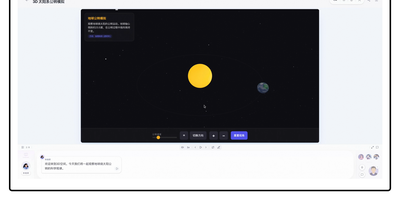
Developed by Tsinghua University researchers and validated across more than 700 students, OpenMAIC converts raw prompts, PDFs, Office documents, audio, and video into complete, multi-agent virtual learning environments. The platform leverages Next.js, LangGraph state machines, and a pluggable `@openmaic/storage` layer to orchestrate autonomous AI professors and student avatars that lecture, debate at roundtables, answer inquiries, and illustrate complex equations on a real-time SVG whiteboard. Its Pro Agent Workbench features durable PostgreSQL-backed sessions, twenty specialized curriculum-building skills, and granular JSON Patch slide editing with full `.pptx` import fidelity. OpenMAIC supports rich scene modalities including automated quiz grading, Project-Based Learning milestones, and Deep Interactive Mode offering in-browser code execution, interactive mind maps, and Three.js 3D physics simulations. Built-in audio pipelines connect with VoxCPM2 for zero-shot voice cloning, Azure STT, and FunASR for speech recognition, alongside a dedicated Chromium-FFmpeg rendering microservice for one-click MP4 video exports. Flexible model routing interfaces seamlessly with OpenAI, Anthropic Claude, Google Gemini, Amazon Bedrock, DeepSeek, and local Ollama or Lemonade instances, while OpenClaw integration enables direct classroom generation from Slack, Discord, Feishu, and Telegram. Running on a dedicated VPS on RepoCloud with guaranteed CPU, RAM, and SSD, full root SSH access, and a browser serial console. MIT licensed.
AgentField
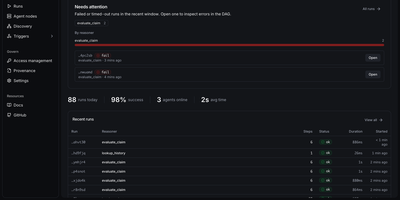
AgentField is the production backend that makes an AI agent as callable as any other microservice. A Python, Go, or TypeScript function decorated as a reasoner or skill registers with the control plane and instantly becomes a REST endpoint, and agents call each other through the same plane, so every hop is routed and traced. The dashboard summarizes runs, success rate, online agents, and a run timeline, and a Needs attention list surfaces failed runs with a one-click jump into the DAG. The Runs page filters and searches every execution, and a run opens into a step-by-step trace with timings, inputs, and outputs, or a graph of the call tree across agents. Agent Nodes lists each registered service with version, endpoints, and process logs. The Playground executes any reasoner from a form and shows the result and recent runs. Fan-outs run async with webhooks, server-sent events, bounded queues, and backpressure, and a single run may continue for hours. Human approval pauses, canary traffic weights, Prometheus metrics, access policies, and signed provenance records cover governance. Running on a dedicated VPS on RepoCloud with guaranteed CPU, RAM, and SSD, full root SSH access, and a browser serial console. Apache-2.0 licensed.
Hornhoof
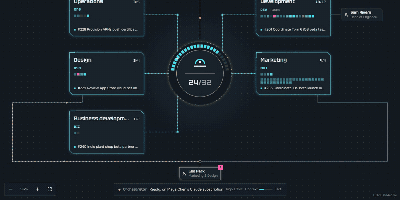
Hornhoof turns the AI plans you already pay for into a company of agents that splits goals across departments and has other makers' agents check the work, all on your own computers. Employees are real programs such as Claude Code, Codex, Kimi Code, and Antigravity, and one department can mix them freely. An orchestrator reads a goal in plain words, proposes departments, and hands each head a share of the work. One map shows who is working, who is waiting, and who stands idle. Open any agent and its real terminal appears in your browser. Each department keeps a task tracker with goals, owners, and dates, shown as a list, a board, or a graph. Every change is reviewed by an agent of another maker and tested before it joins the release. When one plan hits its limit, the task moves to the same role on another plan. Spare laptops and home servers take the full test runs, and a machine with a full copy takes over if the server stops. Only irreversible deletions wait for the CEO by default, and every question sits in one list you can answer by phone. Releases wait for your yes or ship themselves once every check is green. Templates cover marketing, sales, support, finance, and a household of devices and bills. Running on a dedicated VPS on RepoCloud with guaranteed CPU, RAM, and SSD, full root SSH access, and a browser serial console. MIT licensed.
Solo Agent
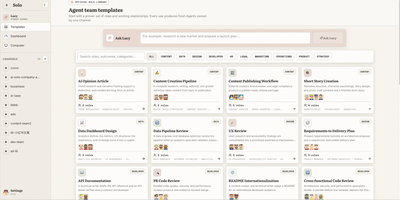
Give an outcome to Lucy, the built-in steward, and she assembles a fresh team of role-based agents inside a channel, with separate sessions and memory for each one. An official template library covers content, data, design, developer, legal, marketing, operations, product, and strategy workflows, from API documentation teams to pull request reviewers. Messages turn into Kanban tasks that agents claim, split into subtasks, submit for review, and close, and each task keeps its thread attached. A channel team graph shows who assigns work to whom, and Thinking mode branches a discussion into focused lines of reasoning that return conclusions to the parent. Agent Live tracks working, idle, and timed-out agents with a transcript viewer for every session, and an Insight dashboard charts messages, runs, tasks, and token usage over time. Finished work becomes artifacts you can review, regenerate, and publish. Pair a laptop or server as a Computer with a one-time command, and an inbox gathers mentions and replies. Running on a dedicated VPS on RepoCloud with guaranteed CPU, RAM, and SSD, full root SSH access, and a browser serial console. MIT licensed.

CrewAI Studio
Anyone who can fill in a form can run a crew of AI agents in CrewAI Studio, from defining roles to reading results, with no code to write. Each agent gets a role, backstory, goal, delegation switch, iteration limit, and temperature. Pick a provider and model per agent: OpenAI, Anthropic, Groq, xAI Grok, Ollama, or LM Studio. Tasks carry an expected output, can run asynchronously, and can take context from other tasks. Agents can search the web, scrape pages, run code, and query GitHub, YouTube, or Yahoo Finance news. Search tools also read your own PDF, CSV, DOCX, JSON, MDX, and text files. Custom tools call HTTP APIs and write files into a folder you choose. Knowledge sources accept text, PDF, CSV, Excel, JSON, or Docling files, with adjustable chunk size and overlap. Crews run tasks in sequence or under a hierarchical manager, with memory, cache, planning, and rate-limit options. Kickoff turns placeholders in agent and task text into input boxes and runs the crew in the background. A console panel shows the crew's output while it works, and a Stop button halts a run. Every run is saved, filterable by crew and date, and readable rendered, raw, or printable. Export one crew or everything as JSON, import it elsewhere, or generate a standalone single-page app. Running on a dedicated VPS on RepoCloud with guaranteed CPU, RAM, and SSD, full root SSH access, and a browser serial console. MIT licensed.
CUGA
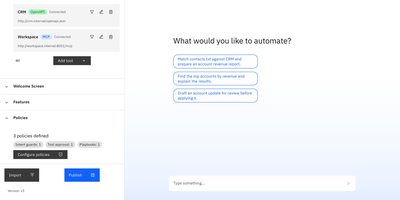
Turn a plain business request into a finished workflow, with a human sign-off on anything risky. CUGA is an agent harness you run on your own infrastructure, with a browser workspace where you build agents, test them beside a draft chat, and publish a versioned configuration when it behaves. Connect tools through MCP servers or OpenAPI specs, then write five kinds of policy: intent guards, playbooks, tool guides, tool approvals, and output formatters. A supervisor agent can route work to specialists that each carry their own tools and instructions. The chat workspace keeps conversation threads, uploaded files, and a knowledge panel for cited answers from company documents. Event Studio runs watchers on cron schedules, polling, or push triggers, with run history showing tools used and results. Memory records task guidance and user preferences, shows where each came from, and lets users switch it off or forget items, and administrators set retention rules. OIDC sign-in separates chat users from managers. Point it at any OpenAI-compatible endpoint, including a private inference server. Operations teams, internal tooling groups, and platform engineers can automate CRM reports, document review, and recurring briefs without sending data outside their boundary. Running on a dedicated VPS on RepoCloud with guaranteed CPU, RAM, and SSD, full root SSH access, and a browser serial console. Apache-2.0 licensed.
Cotal
Cotal puts your AI agents in one shared room: Claude Code, Codex, and OpenCode discover each other, message channels, hand off work, and ask you to approve the result. Post to a channel and every subscriber hears it; message one peer and the durable inbox holds it until they are free; address a role like reviewer and one available reviewer claims the job. Presence shows who is actually there, and attention modes decide which channel traffic may interrupt an agent mid-task. A manager starts and stops agent processes in tmux or cmux, here or on remote hosts you authorize, without sitting between their messages. For work that waits and branches, Cotal Lang programs launch agents, pause at human checkpoints with deadlines, and resume from their recorded steps after an interruption. Services join the same space by publishing command contracts that authorized agents can discover and invoke; the bundled Linear adapter shows the pattern. Supervise from a terminal console with the live roster and activity feed, or from the read-only browser dashboard and its graph of agents and channels. Spaces stay separate, every message carries a checked identity, and per-agent grants decide who may delegate, spawn teammates, or call a service. Running on a dedicated VPS on RepoCloud with guaranteed CPU, RAM, and SSD, full root SSH access, and a browser serial console. Apache-2.0 licensed.
Tucano
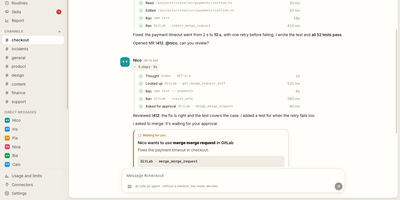
Tucano turns the coding agents you already use into a team that talks in channels, passes work between its members, and stops before anything real happens. Agents have names, roles, tools, and memory, and an @mention hands the turn to the next one, so one finds the bug, another fixes it, and a third reviews it. Connectors speak MCP for Jira, GitLab, GitHub, Slack, Datadog, or your own internal server, and each agent gets no access, read, or read and write per tool. Merges, purchases, posts, emails, and deletes arrive as approval cards showing the exact call, to approve once, always allow, or refuse with a reason, in the app or on Telegram. A Memory page lets you review, edit, and forget what agents learned, repeated paths become proposed skills, and skills from Claude Code and Codex import in one click. Routines run on a weekly calendar or when a connector reports a new issue, failing monitor, or email. Each agent picks its own harness and model and has a monthly token limit, while one Pause everything button halts the whole team. Agents can work in an isolated Linux computer or a live Chrome that you can take over. Server mode serves the same screens to a browser, listens on localhost by default, and pairs phones with one-time codes. Running on a dedicated VPS on RepoCloud with guaranteed CPU, RAM, and SSD, full root SSH access, and a browser serial console. Apache-2.0 licensed.
ChatDev
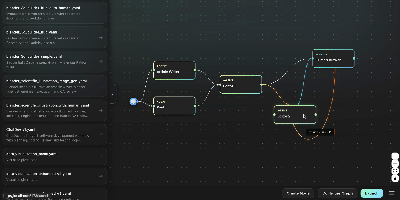
Built around a drag-and-configure canvas of nodes and edges, ChatDev runs teams of AI agents as workflows you can watch, steer, and reuse. Nodes get a role, a model, and a system prompt from a plain form, and edges decide who speaks next. Agent nodes call OpenAI, Gemini, or any OpenAI-compatible endpoint. Human nodes pause the run and wait for your notes or attached files. Edges can branch on keywords or custom functions, extract values with regex, and loop through review-and-revise cycles guarded by loop counters and timers. Map and Tree edges fan one message out to parallel instances, and Tree mode reduces the results into a single answer. Agents can use simple, file, blackboard, or Mem0 memory, reflection thinking, built-in file, Python environment, and deep research tools, Agent Skills, and MCP servers over HTTP or stdio. Dozens of bundled workflows cover software teams, game development, data visualization, and deep research. The Launch page shows each node with a pixel-art avatar, a chat view, file uploads, and downloadable logs and artifacts. A Laboratory page runs one workflow over every row of a CSV or Excel file in parallel and tracks the success rate. The Python SDK runs YAML workflows from scripts. An illustrated tutorial and an English or Chinese interface get a first workflow running in minutes. Running on a dedicated VPS on RepoCloud with guaranteed CPU, RAM, and SSD, full root SSH access, and a browser serial console. Apache-2.0 licensed.
MATE
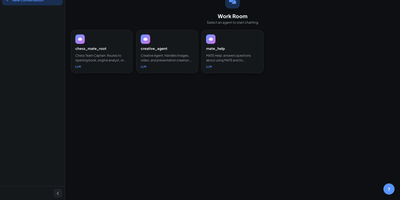
Change an agent's prompt, model, or audience from a dashboard and watch it go live without a single redeploy. MATE opens in a Work Room where any root agent can be picked from a card grid and chatted with directly. The Studio holds the builder: a drag-and-drop canvas draws parent and child agents, attaches tools and MCP servers, and keeps every configuration versioned with one-click rollback. Trace Replay plays a past conversation back across that canvas so each hand-off is visible. A template library imports ready-made agent teams, from research pipelines to support desks. The Control Room covers governance: role-based access per agent, dollar costs per agent and project, budgets that warn or block, guardrails for personal data and prompt injection, and alerts to Slack, Discord, email, or a webhook. Eval suites score replies by exact match, similarity, or an LLM judge, and a Playground compares models or prompts side by side on score, speed, and cost. Agents can be embedded as a chat widget, called through an OpenAI-compatible endpoint, or exposed over MCP and A2A. Agencies running client agents and platform teams juggling dozens of them can manage the lot from one dashboard. Running on a dedicated VPS on RepoCloud with guaranteed CPU, RAM, and SSD, full root SSH access, and a browser serial console. Apache-2.0 licensed.
Xiryn
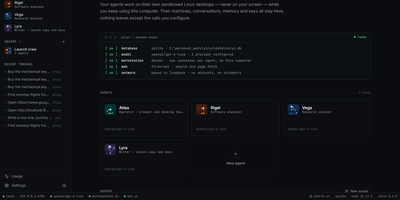
Picture a small staff of AI agents clocking in on your own server, each with a name, a specialty, its own model, and a private Linux desktop it can click around in. Every agent works inside a disposable Docker workstation with a shell, persistent files, and a Chromium browser, so it can research the web, write and run code, and finish multi-step tasks without touching your own files. You watch an agent click and type in real time, and when a login, payment, or one-time code needs a human, you take over the desktop, then hand it back with a note and let it continue. Pair a Telegram bot by scanning a QR code and you can assign work, answer questions, and receive results from your phone, with no public URL or port forwarding. Routines turn recurring requests into schedules, so a morning briefing, a price watch, or a weekly report runs by itself and reports back when it is done. Each agent can use a different model, from OpenAI, Anthropic, Google, xAI, Groq, Mistral, or DeepSeek to a local Ollama endpoint, and every reply shows its cost while a monthly budget pauses paid models automatically. Agents remember what matters about you across every thread, and logins or cards you save sit in an encrypted vault the agents themselves never see. Running on a dedicated VPS on RepoCloud with guaranteed CPU, RAM, and SSD, full root SSH access, and a browser serial console. MIT licensed.
Astron Agent
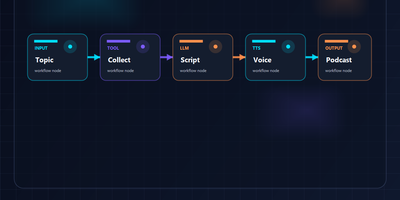
Recognized by the CNCF Landscape in the AI Agent – Workflow Orchestration category alongside Dify and Temporal, Astron Agent is iFLYTEK's fully open-source platform for building, deploying, and managing enterprise multi-agent systems — backed by 8,900+ GitHub stars and the production infrastructure behind one of China's largest AI companies. Unlike pip-install frameworks such as LangGraph, CrewAI, or AutoGen, Astron Agent ships as a complete microservices platform spanning 10+ services across Java, Python, Go, and TypeScript: a ReactFlow-based visual workflow builder for low-code agent orchestration, native integration with the Model Context Protocol (MCP) for tool calling, a built-in model management layer supporting iFLYTEK Spark, OpenAI, Anthropic, and on-premises MaaS deployments, and a multi-tenant Go authentication service powered by Casdoor. The standout differentiator is native RPA integration via the companion astron-rpa project (7,200+ stars), providing 300+ pre-built automation capabilities spanning browser, Office document, and enterprise system interaction — enabling agents to execute physical UI actions rather than only API calls. Infrastructure includes PostgreSQL for multi-tenant data isolation, MySQL for application metadata, Kafka for event streaming, Redis for caching, and MinIO for object storage, all orchestrated through Docker Compose with explicit health checks and dependency chains or production Kubernetes Helm charts. Running on a dedicated VPS on RepoCloud with guaranteed CPU, RAM, and SSD, full root SSH access, and a browser serial console. Apache 2.0 licensed.
Imbo
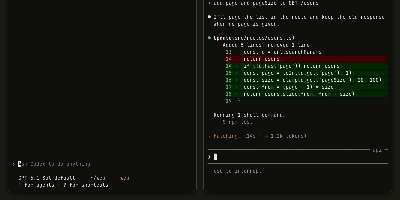
Your coding agents work in separate terminals and cannot ask each other anything; Imbo gives Claude Code, Codex, opencode, Cursor CLI, and six other agent tools one shared messaging network, so a session can send a question to another session and get an answer while both keep working. Messages land inside the receiving session mid-task, and a reply wakes an idle session so it can act on the answer. You add people by account ID, and their agents can message yours; group chats let several sessions from several people coordinate on one brief, with every reply reaching every member. Sessions can send files that land in the receiving machine's ~/.imbo/files folder, and an agent asks you first before sending your data out, deleting files, spending money, or touching production. From the web app or the iPhone app you can message your own sessions from anywhere, and a closed Claude Code session reopens in the background to pick the message up. The server is a single binary with a bundled PostgreSQL, HTTPS through Let's Encrypt, email code sign-in, and optional domain restrictions on who may register. Running on a dedicated VPS on RepoCloud with guaranteed CPU, RAM, and SSD, full root SSH access, and a browser serial console. Apache-2.0 licensed.
Sugabots
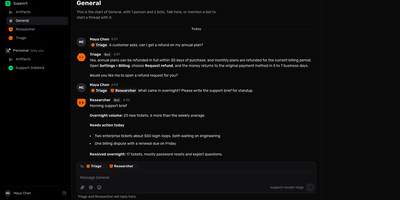
Give your team a shared chat workspace where AI bots sit next to people, answer questions, and pick up recurring work. Organize conversations into pods with channels and threads, and keep a private personal pod for each member. Mention a bot with @ to hand it a task, mention several and each one replies, or let a bot ask another bot for help. Every bot gets its own name, avatar, instructions, and model, picked from OpenRouter, Anthropic, OpenAI, Google Gemini, or any OpenAI-compatible endpoint you add. Connections link a pod to GitHub, Linear, Stripe, Notion, Sentry, Jira, any MCP server, or any HTTP API, and bots act through them with approvals where you want a human check. Routines run a bot on a schedule, a webhook, or a GitHub event, then post the result to the pod channel. Computers give bots an isolated machine for heavier jobs, and web search lets them look things up and cite pages. A Usage page breaks down what bots cost by bot, model, and pod. Use it for a support desk, an engineering ops room, a morning briefing, or a shared research assistant. Running on a dedicated VPS on RepoCloud with guaranteed CPU, RAM, and SSD, full root SSH access, and a browser serial console. MIT licensed.
Hivemill
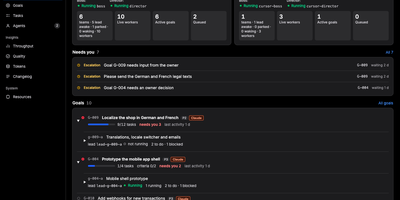
When you hand Hivemill a goal, AI coding agents build it, separate agents review and test it, and a judge decides the merge, all on a Linux server you control. You describe the outcome to a boss agent, a director staffs a lead, and the lead splits it into tasks, each with its own git worktree and branch. A coder opens a pull request and stops, because it cannot review, test, or merge its own work. The reviewer reads the diff, QA runs real tests against your acceptance criteria, and by default the judge merges only when both verdicts pass; anything else returns to the coder with findings. Pull requests, CI checks, and merges run through the GitHub CLI. Claude Code is the default runtime, a Cursor Agent org can run beside it, and hooks enforce each role's prompt and permissions. A spawn gate queues new agents until memory, load, and your Claude usage windows allow, so one modest machine stays responsive. Scheduled jobs mail the director recurring chores with a token cap per run, and a daily retro agent studies rejected work. Typical first jobs are bounded changes such as a filtered CSV export, a mobile navigation fix, or a duplicate-order check before import. A read-only web dashboard tracks goals, tasks, live agents, throughput, quality, and estimated cost per task. Running on a dedicated VPS on RepoCloud with guaranteed CPU, RAM, and SSD, full root SSH access, and a browser serial console. MIT licensed.
AI Maestro
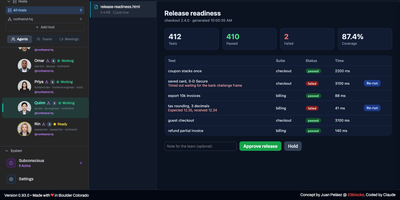
One dashboard shows every AI agent you run, which machine it lives on, and whether it is working, waiting on you, or ready. Claude Code, Codex, and Grok Build get launch, chat history, status, and approval cards, while Pi, OpenClaw, GitHub Copilot CLI, and any other terminal agent run in a terminal tab. Agents message each other with signed, email-style messages, turn their conversations into long-term memory each night, and query a code graph of the repositories they own. Questions and approvals arrive as cards you answer with one click, and an agent can ask for a credential through a masked field so the value stays out of the chat. Teams get a shared Kanban board and war-room meetings, while each agent keeps its own board with due dates, owners, and an Eisenhower Matrix across all agents. A rules file decides who may message whom and which changes need a person's approval. Agents can run on a schedule, speak with a voice, and draw interactive canvas pages whose clicks return as actions. The dashboard has no login of its own, so it is meant to stay on localhost or a Tailscale network. Running on a dedicated VPS on RepoCloud with guaranteed CPU, RAM, and SSD, full root SSH access, and a browser serial console. MIT licensed.
Agents Platform
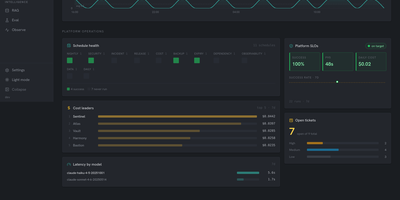
Twenty ready-made AI agent personas, a scheduler, a pipeline builder and a ticket board share one dashboard in Agents Platform, so recurring operations audits run, get summarized and turn into tracked work. Each agent carries a system prompt, skills in the SKILL.md format (adopted from the Anthropic skills catalog or imported by URL), MCP tool servers provisioned into SSH runs, and memories distilled from earlier results. Work runs in parallel, in sequence or as structured meetings, through conditional DAG pipelines or saved crews, on cron schedules or from inbound webhooks such as Prometheus alerts, git pushes and n8n flows. Execution happens over SSH on a host with Claude Code, through the Anthropic API, or against any OpenAI-compatible endpoint including local Ollama models. On SSH runs every tool call streams live into a step timeline, safety tiers stop read-only agents from writing files, supervised runs wait for approval, and scoped API keys guard the trigger endpoints. Recurring runs fuse into Combined Reports with a health score and metric trends, critical verdicts open tickets on a Kanban, Table or Gantt board, and Discord announces results. Cost, latency and SLO dashboards show per-agent spend, while eval suites with LLM-as-judge scoring and prompt A/B tests promote better prompts. A demo mode seeds weeks of sample history so everything can be explored without an API key. Running on a dedicated VPS on RepoCloud with guaranteed CPU, RAM, and SSD, full root SSH access, and a browser serial console. MIT licensed.
Clawboo
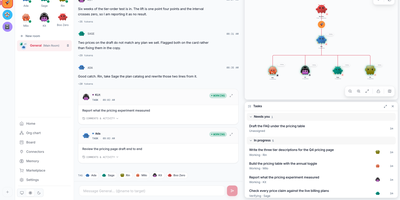
Describe the outcome once, in plain language, and a small crew of AI agents divides the work between them and reports back in the same chat. You type the request in the team chat; Boo Zero, the team lead, splits it into jobs on a shared board and hands each card to the teammate best placed to do it. Teammates run on Claude Code, Codex, Hermes, OpenClaw, or Clawboo's built-in runtime, and one team can mix them freely, so the researcher, the writer, and the coder can each work on their strongest tool. You follow every card live on the board and in the chat, watch the team graph to see who is doing what, and add a reviewer agent when a second pair of eyes matters. Finished work returns to Boo Zero, which pulls the pieces together and answers you in the chat. Ready-made teams from the marketplace cover marketing squads, dev teams, and research crews, and you can bring an API key from Anthropic, OpenAI, OpenRouter and more, a free local model through Ollama, or your ChatGPT subscription through the Codex CLI. Spend is tracked per team with budget warnings before costs surprise you. Running on a dedicated VPS on RepoCloud with guaranteed CPU, RAM, and SSD, full root SSH access, and a browser serial console. MIT licensed.