Zulip
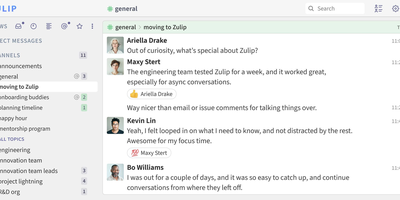
Used by the Rust language community, NASA, Dropbox, and thousands of organizations worldwide with over 25,600 GitHub stars and 1,500+ contributors, Zulip is the only modern team chat app designed from the ground up for both real-time and asynchronous communication through its unique topic-based threading model where every message belongs to a named topic within a channel. This eliminates the context collapse of linear chat by letting teams follow specific conversations without scrolling through unrelated messages, resume threads days later without losing context, and catch up on missed discussions at per-topic granularity. Server 12.0 introduced end-to-end encryption for mobile push notifications, AI-powered search ranking, channel folders for workspace organization, and expanded video conferencing with Jitsi, BigBlueButton, and Zoom integration. Over 100 native integrations connect GitHub, GitLab, Jira, Sentry, PagerDuty, Travis CI, Redmine, dbt, Nextcloud, and n8n with bidirectional notifications, while LLM-driven agents access web-public channels via a standard llms.txt interface. Full-text search covers unlimited message history across all plans, code blocks render with syntax highlighting for 250+ languages, and LaTeX math expressions display inline. The REST API with typed Python and JavaScript SDKs enables custom bots, webhook integrations, and programmatic administration. Import tools migrate entire workspaces from Slack, Microsoft Teams, Mattermost, and Rocket.Chat. Running on a dedicated VPS on RepoCloud with guaranteed CPU, RAM, and SSD, full root SSH access, and a browser serial console. Apache 2.0 licensed.
TextBee
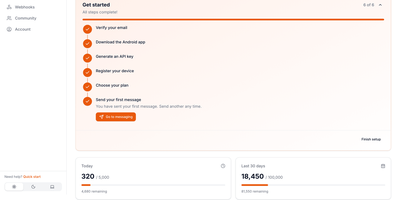
TextBee turns an Android phone with a SIM card into an SMS gateway your applications can call, so one-time codes, alerts, reminders, and two-way conversations go out as ordinary texts from a real number. Pair a phone by scanning a QR code in the dashboard, then send messages from the REST API, the dashboard, or the JavaScript SDK. Bulk campaigns load from a CSV file and are paced to stay within carrier limits, and any message can be scheduled up to 72 hours ahead. With several phones or SIM cards attached, each message can name the device and SIM it should use. Every message moves through pending, dispatched, sent, delivered, or failed, and the history view lists all devices together. Incoming texts appear in the dashboard and the API, and webhooks push received messages and delivery reports to your server with an HMAC-SHA256 signature you can verify. An official MCP server lets AI assistants send texts and read replies. API keys, devices, usage, and webhook subscriptions are all managed from one web interface. Running on a dedicated VPS on RepoCloud with guaranteed CPU, RAM, and SSD, full root SSH access, and a browser serial console. MIT licensed.
Dittofeed
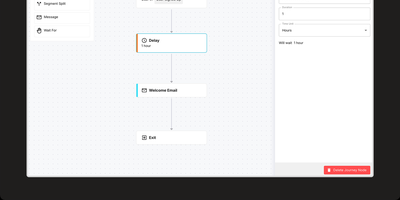
Automate transactional and marketing messages across email, SMS, mobile push, WhatsApp, Slack, and custom webhooks from a single visual journey canvas. Dittofeed provides the capabilities of Customer.io or Braze while keeping customer PII within your own infrastructure and eliminating volume-based pricing entirely. The drag-and-drop journey builder creates multi-trigger automations with branching logic, wait nodes, random cohort splits for A/B testing, and local timezone delivery without writing code. User segments combine trait conditions, event history, and array-based filtering through AND/OR operators with real-time evaluation. Template authoring supports both a low-code visual editor and direct HTML/MJML input, with templates reusable across journeys and one-off broadcasts. Data flows in through Segment integration, Reverse ETL connections, or the REST API with Web, Node.js, and React Native SDKs. Message delivery routes through SendGrid, Amazon SES, Twilio, or SignalWire with per-channel analytics tracking opens, clicks, bounces, and unsubscribes. Authentication supports Keycloak, AWS Cognito, and GCP OAuth for enterprise SSO. Embeddable iframe and headless React components let SaaS platforms white-label journey builders into their own products. Deploy on RepoCloud with a dedicated VPS for full GDPR compliance under the MIT license.
Waxum
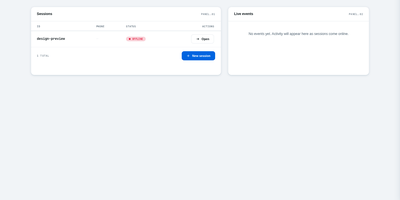
WhatsApp is where your customers already are, and Waxum is the self-hosted gateway that lets your own software talk to them there without renting a per-message platform. One REST API fronts two providers at once: multi-device sessions paired by QR code or pairing code, and Meta's official Cloud API, sharing the same message routes and webhook events. Send text, media, locations, contact cards, polls, reactions, and broadcast lists, schedule messages for later, or run paced bulk blasts with deduplication, retries, and a dead-letter queue when a send fails. Voice and video calls ring, play audio, speak text in hundreds of voices, record the peer side, and stream media over WebSocket, while groups, contacts, blocking, privacy settings, and presence are all manageable per session. Signed webhooks with event filters and circuit breakers push receipts and replies into your app, and a failed delivery can be replayed from the queue instead of lost. The built-in ops console shows your whole session fleet, and each session opens a playground covering dozens of endpoints, so you can test a send from the browser before writing code. Sessions export and import between instances as zip files, and Prometheus metrics with health probes keep the fleet observable. Running on a dedicated VPS on RepoCloud with guaranteed CPU, RAM, and SSD, full root SSH access, and a browser serial console. MIT licensed.
Eclipse Hono
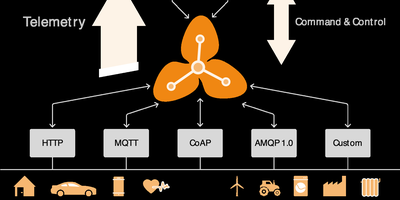
Eclipse Hono is an IoT connectivity platform that sits between device fleets and business applications, accepting connections over MQTT, HTTP, AMQP 1.0, and CoAP adapters and normalizing everything into uniform telemetry and event streams. Devices authenticate against a central registry of tenants and credentials, with X.509 client certificates, pre-shared keys, or automatic provisioning for zero-touch onboarding. Applications consume normalized data from Apache Kafka or an AMQP 1.0 messaging network, choosing per tenant which backbone carries its traffic, and send commands back down to devices through the same platform with delivery feedback. Resource limits cap how much data each tenant's devices may move, keeping one noisy fleet from crowding out the rest, while metrics and tracing follow every message hop. The 2.7 release adds preliminary MQTT 5 support with corrected connect reason codes, message tracing logs, and a hardened JDBC device registry backed by PostgreSQL for production tenant and credential management. Protocol adapters scale horizontally as stateless services, so capacity grows by adding instances behind a load balancer. Running on a dedicated VPS on RepoCloud with guaranteed CPU, RAM, and SSD, full root SSH access, and a browser serial console. EPL-2.0 licensed.
Chitchatter
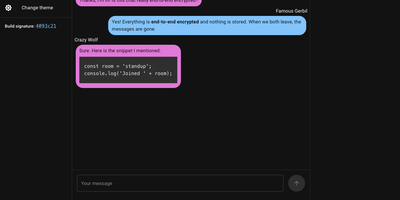
Chitchatter is a browser-based chat room for text, voice, video, screen sharing, and file transfers that exists only while its members are connected and keeps no record of what was said. Every visit starts with a random room name generated on your device, a UUID or a readable passphrase, and you invite people with the link or a QR code. Public rooms admit anyone with the link; private rooms also require a matching password. Messages support Markdown, multiline text, and code blocks, and clicking a name opens a direct conversation. Newcomers to public rooms receive the earlier conversation from peers already there, and typing indicators show who is writing. Start an audio or video call, share your screen to walk a relative through a settings problem, or hand over a file of any size, encrypted before it leaves your browser. Public-key checks verify each peer automatically, with a green lock marking everyone who passes and an icon showing whether the link is direct or relayed. Embed a room in any web page with an iframe or a web component that takes a room name, user name, and color mode. Light and dark themes are built in, and notifications and sounds announce new messages while you work in another tab. Close the tab and the transcript disappears. Running on a dedicated VPS on RepoCloud with guaranteed CPU, RAM, and SSD, full root SSH access, and a browser serial console. GPL-2.0 licensed.
Campfire Rust
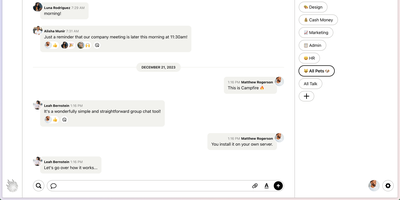
Your team chat can be one executable on your own server: Campfire Rust runs rooms, direct messages, attachments, and search as a single binary that replaces the whole Ruby, Puma, Redis, Resque, and Thruster stack. Create rooms with access controls for projects, departments, or a private board discussion, and keep direct messages beside them for quick questions. File attachments arrive with previews, mentions pull the right person into a thread, and search finds the decision someone made months ago. Web Push notifications reach browsers and phones, so a quiet room still finds its people when it matters. Chatbots connect through a simple HTTP API for sending and receiving messages and attachments, which makes Campfire a home for build alerts, deploy notices, and support pings. Existing Campfire installs upgrade in place because the Rust binary reads the same SQLite database, storage layout, and signed cookies, with no data migration and no mass sign-out. Automatic TLS with Let's Encrypt certificates, HTTP/2, and Action Cable-compatible WebSockets are built in, and the whole system works on air-gapped networks that never touch the internet. Run it as your primary chat, as a backup for the day a hosted service goes down, or as a walled garden for executives and events. Running on a dedicated VPS on RepoCloud with guaranteed CPU, RAM, and SSD, full root SSH access, and a browser serial console. MIT licensed.
MongooseIM
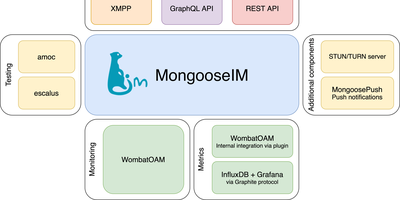
Running chat for a dozen people is easy; running it for a city-sized crowd, on servers you control, with group rooms, archived history, and phones that still buzz when the app is closed, is the job MongooseIM was built for. MongooseIM is an XMPP server at the core of a messaging platform, so any standard XMPP client on desktop, mobile, or web can connect, and browser clients reach it over WebSockets or BOSH. Group conversations run in multi-user chat rooms, message archive management keeps searchable history on the server, and message carbons deliver real-time copies to every signed-in device a person owns. Offline messages wait for reconnecting clients, rosters carry contact lists and presence, and privacy settings plus vCard profiles round out the everyday chat features. Operators manage users, rosters, messages, and settings through a GraphQL API over HTTP or the mongooseimctl command line, and more than fifty built-in metrics show what is happening inside each node. Accounts authenticate against internal storage, MySQL, PostgreSQL, Cassandra, LDAP, or external scripts, and multi-tenancy support creates thousands of chat domains dynamically on one deployment. Adding cluster nodes raises capacity as the audience grows, and the companion push component wakes mobile apps through push notifications. Running on a dedicated VPS on RepoCloud with guaranteed CPU, RAM, and SSD, full root SSH access, and a browser serial console. GPL-2.0 licensed.