Tracim
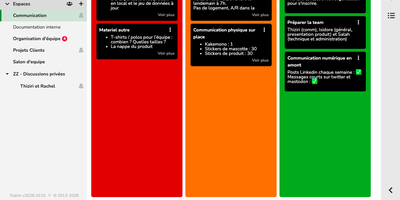
Combining threaded discussions, versioned documents, Kanban boards, and shared calendars in one platform, Tracim keeps every decision and file in a single searchable place. Each space gathers the discussions, notes, files, and tasks of one team or project, and members hold a reader, contributor, content manager, or workspace manager role. Comments, status labels, tags, and an automatic version history travel with every document, and several people can edit the same text at once. Kanban boards track tasks, logbooks record events and decisions, and templates keep recurring documents consistent. Shared calendars cover one-time and recurring events with reminders, and they sync to Thunderbird, Outlook, or any CalDAV client. Files go out as share links, mount through WebDAV, or sync to a desktop folder, and outside partners can join a single space with limited rights. Each space sets its own notification rhythm, from hourly to never, and a reply to a notification email is posted straight into the thread. Administrators plug in LDAP, SAML, or web-server remote authentication for sign-in, recolor the interface to match their brand, and script anything else through the REST API or plugins. The interface is available in Arabic, English, French, German, Portuguese, and Spanish. Running on a dedicated VPS on RepoCloud with guaranteed CPU, RAM, and SSD, full root SSH access, and a browser serial console. MIT, LGPL-3.0, and AGPL-3.0 licensed.
Euron Open AI API Gateway
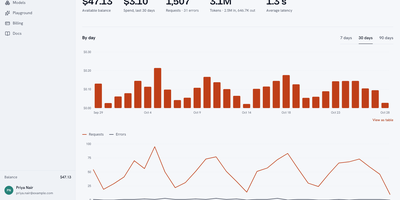
If you resell or share AI model access, Euron Open AI API Gateway turns scattered provider accounts into one key, one price list, and one prepaid balance. Point an OpenAI or Anthropic SDK at it, swap the base URL and key, and every chat model answers in either wire format, with streaming, tools, and images translated both ways. Operators connect OpenAI, Anthropic, Gemini, or hosts like Groq, OpenRouter, and a self-run vLLM, then set a margin by default, per model, account, or key; zero means at cost. Callers top up a USD balance through Stripe, or in rupees through Razorpay with UPI, cards, and netbanking at a rate locked per order. Before any provider is called, the worst-case price is reserved, so parallel requests cannot overspend. A refused request costs nothing. API keys carry a model allow-list, monthly budget, rate limits, and IP rules, and request bodies are logged only when the key's owner opts in. When a provider times out or returns a 429 or 5xx, the request moves to the next route while circuit breakers and health probes sideline the failing one. Developers get a usage log with tokens, latency, and the exact price of every request, plus a streaming playground. The admin console covers accounts, credit grants, rate-limit tiers, circuit health, revenue against provider cost, and an audit trail. Running on a dedicated VPS on RepoCloud with guaranteed CPU, RAM, and SSD, full root SSH access, and a browser serial console. MIT licensed.
Labby
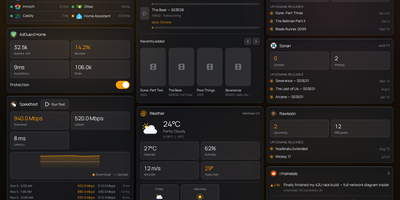
Labby gathers a whole homelab onto one live dashboard you host yourself, covering services, containers, downloads, and media servers. Widgets watch your service monitor, Docker containers, qBittorrent or Transmission queues, SABnzbd, AdGuard Home, Jellyfin, Emby, Plex, Beszel, Radarr, Sonarr, plus weather, calendar, speedtest, bookmarks, Reddit, and Hacker News, and the server pushes every change to your browser over server-sent events so nothing waits on a refresh timer. The dashboard is not a read-only poster: start and stop containers, pause and resume torrents, and toggle AdGuard protection straight from its widgets. Everything configures from the in-app Manage Services page, where service URLs, API keys, poll intervals, and multiple instances of the same integration (two Radarr servers, say) live in a small SQLite database instead of scattered environment files. Named color schemes restyle the board and save with the config, and icon sources span dashboard-icons, selfh.st, Lucide, or your own URLs. Login is off by default for trusted home networks, with a clear warning to keep it behind a LAN, VPN, or forward-auth proxy, and optional OIDC sign-in through Authentik, Authelia, Keycloak, or Pocket ID when you want a real front door. One container, one volume, and your lab finally explains itself at a glance. Running on a dedicated VPS on RepoCloud with guaranteed CPU, RAM, and SSD, full root SSH access, and a browser serial console. MIT licensed.
Hitobito
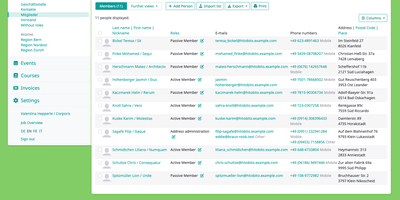
For clubs, associations, and federations, Hitobito replaces the member spreadsheets, sign-up forms, and mailing tools with one web application that mirrors how the organization is actually built. Chapters, regions, committees, and boards sit in a single group tree, and each person holds one or more roles that decide what they can see and change. People tables filter, import, and export to CSV, Excel, vCard, and PDF. Each record carries households, tags, notes, qualifications, and history, and a duplicates view helps clean up double entries. Events and courses accept online registrations, send overflow to a waiting list, and award qualifications that expire or renew by rule. Messages reach mailing lists as bulk e-mail, PDF letters, or SMS, and bounces are collected. The invoicing module issues single invoices and invoice runs, follows each through draft, issued, partially paid, paid, and reminded states, and can import bank payments over EBICS. Administrators edit texts, labels, tags, and course categories without writing code. Other systems sign in through an OAuth 2.0 and OpenID Connect provider and read data through a JSON:API with personal tokens or service accounts. The interface switches between German, English, French, and Italian. Running on a dedicated VPS on RepoCloud with guaranteed CPU, RAM, and SSD, full root SSH access, and a browser serial console. AGPL-3.0 licensed.
Hotsauce
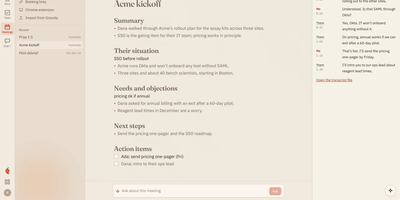
Hotsauce is an office suite for small teams that keeps every doc, meeting note, task, and saved link as a plain Markdown file in git. Meetings record in the browser, with the Chrome extension, or from the Mac app, and no bot ever joins the call. Jotted notes plus the live transcript turn into clean write-ups from customer-call, interview, or stand-up templates. The Ask assistant answers questions across every past meeting and doc, linking the sources it used. A Today page lines up the day's meetings, due and overdue tasks, and an agent brief on tiles you can rearrange. Tasks read quick-add text like "Send the deck fri p1 #Launch", and talking through your day splits it into tasks. Docs are edited together, every save is a git commit, and any doc downloads as Word or PDF or presents as slides. Links is a read-later list that keeps a clean copy and the page as you saw it, with highlights. Dictate types cleaned-up speech into any Mac app, and Clips records screen videos with a camera, transcript, and summary. A built-in MCP server lets Claude, ChatGPT, Cursor, or Codex search and edit the workspace with your permissions, and history shows which tool changed what. Booking links, forms, boards, and PDF signing round out the suite. Running on a dedicated VPS on RepoCloud with guaranteed CPU, RAM, and SSD, full root SSH access, and a browser serial console. AGPL-3.0 licensed.
PlikShare
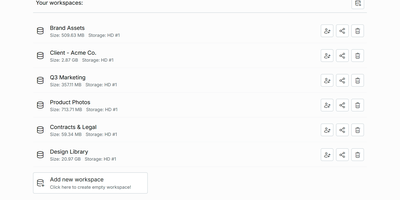
Sending a client a big file should not mean renting seats on someone else's cloud, and PlikShare turns your own server into a file sharing platform with unlimited users, unlimited workspaces, and no per-seat pricing. Its central idea is the box: a controlled gateway between your folders and the outside world, where you invite collaborators, mint anonymous links, and decide who may upload, download, preview, or drop files into an upload-only inbox. Quick share links carry custom slugs, expiry dates, passwords, and download caps, and every box can embed into another website as a live widget whose permissions update the moment you change them. Storage is your choice per workspace, from the server's own disk to S3, Cloudflare R2, Backblaze B2, Azure Blob, Google Cloud Storage, or any S3-compatible server, and each storage picks one of three encryption modes, including full encryption where names and contents are sealed with keys derived from each user's password. Bulk uploads arrive as a single zip that rebuilds its folder structure on landing, bulk downloads assemble from an explorer tree, and previews cover video, audio, PDFs, Markdown with diagrams, and even the inside of zip archives. Single sign-on through multiple OIDC providers, granular admin roles, an optional MCP server for scoped AI agents, and OCR or chat integrations round out a platform that stays lean on a small server. Running on a dedicated VPS on RepoCloud with guaranteed CPU, RAM, and SSD, full root SSH access, and a browser serial console. AGPL-3.0 licensed.
LogicalDOC
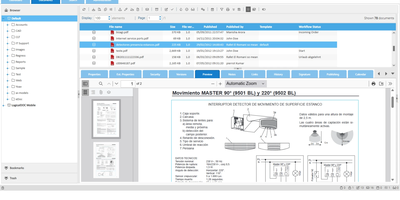
LogicalDOC is a document management system that gives a company one controlled home for its files instead of letting contracts, invoices, and procedures scatter across drives and inboxes. Staff store any kind of document in a repository organized on multiple levels, then find it again through advanced search that reaches inside document content, not just filenames. Colleagues collaborate on the same documents and projects while version control keeps the history straight, so nobody works from last quarter's draft by accident. Administrators define roles for different users, set access control and user quotas, and choose the security level for each area, with detailed activity logs showing who opened, changed, or shared what. Automations handle the routine flow of documents through the business, and the web services API lets an ERP or other systems integrate document management into existing processes. Information can be collected from any digital source, knowledge gets reused instead of recreated, and mobile apps for phones and tablets keep the repository reachable away from the desk. The official Docker image and Tomcat bundles make the Community Edition straightforward to run on your own infrastructure. Running on a dedicated VPS on RepoCloud with guaranteed CPU, RAM, and SSD, full root SSH access, and a browser serial console. LGPL-3.0 licensed.
BackupX
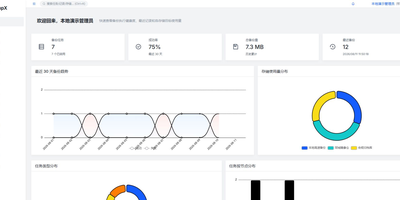
BackupX puts every server backup you are responsible for into one web console, so cron lines scattered across machines become scheduled, visible, and verifiable tasks. Files and directories from multiple sources, MySQL, PostgreSQL, SQLite, SQL Server, and SAP HANA databases all back up on cron schedules you can also build in a visual editor, with automatic retention by days or count cleaning up what expires. More than seventy destinations are reachable through rclone, from S3 and other object stores to Google Drive, WebDAV, FTP, SFTP, Azure Blob, Dropbox, and OneDrive, and storage targets show connection health and live capacity before a job ever fails against a full disk. A master and agent design lets remote servers poll outward only, even through proxies, private certificate authorities, or SSH bastions, so agents run tasks locally with no inbound connectivity to defend. Per-node bandwidth caps and concurrency limits keep a small node polite and a big node busy, each at its own pace. Success and failure notifications arrive by email, webhook, or Telegram, while Prometheus metrics, health probes, an SLA breach gauge, and a full audit log keep the platform observable, and signed audit webhooks forward events to SIEM or WORM storage for compliance records. Running on a dedicated VPS on RepoCloud with guaranteed CPU, RAM, and SSD, full root SSH access, and a browser serial console. Apache-2.0 licensed.
killBottleneck
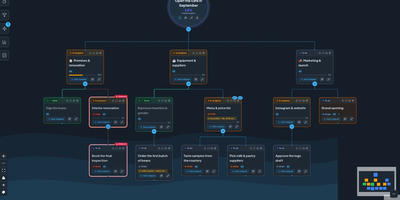
Somewhere in every project one step holds up all the others, and killBottleneck draws your goals as a map that flags that step as a bottleneck. A goal is flagged when it is overdue or stalled while other steps wait on it, and each goal carries an owner, deadline, status, progress, notes, and attachments. The same map switches to a Process style whose recurring steps (every weekday, every Friday, monthly) renew themselves, and an organization map holds positions, functions, and deputies. My day lists what is overdue, due today, or due within a week, beside a team calendar with shared calendars for the company, the meeting room, and time off. Automation rules (WHEN, IF, DO) hand over goals, set deadlines, notify people, offer the assistant, or run an agent, and signed webhooks start n8n workflows or your own agents. An AI assistant in a side panel plans mornings and evenings, sorts notes from a photo, PDF, or voice note, and drafts whole projects, and every change is a card you confirm; it runs on OpenAI, OpenRouter, Groq, Mistral, vLLM, llama.cpp, or a local Ollama model. A REST API and a 20-tool MCP server let Claude Desktop, Claude Code, or the claude.ai connector build maps by conversation. Twelve skins, a simplified phone view, Asana and Trello import, and encrypted backups round it out. Running on a dedicated VPS on RepoCloud with guaranteed CPU, RAM, and SSD, full root SSH access, and a browser serial console. MIT licensed.
Model Hotel
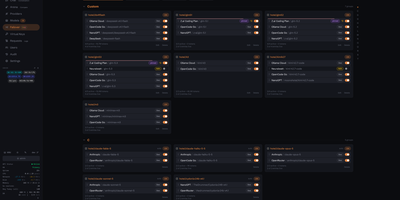
One OpenAI-compatible endpoint fronts every LLM provider you use, hosted or local, and fails over when a quota runs out or a provider goes down. Offer one model through two providers and a failover group forms by itself; the hotel/ prefix tries them all in your priority order. Anthropic, OpenAI, Google AI Studio, and OpenRouter sit beside Ollama, LM Studio, and TabbyAPI, plus any custom OpenAI-compatible API. Errors, timeouts, and rejected keys retry on the next provider, and a per-model circuit breaker benches repeat offenders. Models are discovered the moment a provider is added. Each client gets a virtual key with rate limits, a daily, weekly, or monthly dollar budget, and a list of allowed providers. Prompts and replies are never logged, and the request log records timing, tokens, cost, and gateway overhead for every call. A chat playground, a side-by-side compare grid, and blind bracket tournaments help you pick the best model. Claude Code, Codex CLI, and the OpenAI and Anthropic SDKs connect unchanged, alongside embeddings, rerank, image, and speech endpoints. Sign in with a passkey, an authenticator app, OpenID Connect, or GitHub, and give teammates named accounts with limited access. Prometheus metrics and Apprise alerts keep operators informed, and Traefik-balanced instances with an Android companion app cover high availability. Running on a dedicated VPS on RepoCloud with guaranteed CPU, RAM, and SSD, full root SSH access, and a browser serial console. MIT licensed.
Atlas
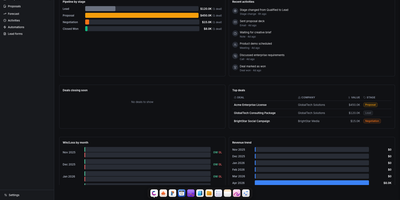
Atlas delivers a complete business operations platform in a single Docker Compose deployment, replacing the need for separate CRM, HRM, project management, invoicing, and file storage subscriptions. The CRM module provides pipeline management with Kanban views, contacts, companies, deals, leads, forecasting, saved views, and web-to-lead forms with Gmail integration for per-user email tracking inside deal timelines. HRM handles employees, departments, org charts, leave management, and attendance tracking. The invoicing system generates professional invoices with recurring billing, customizable templates, and payment tracking. Agreements provides PDF contract generation with legally-binding e-signatures, sequential signing workflows, counterparty linking, audit trails, and automated reminders. Projects integrates time tracking, billing, client management, budgets, and reporting in one view. Drive offers file storage with versioning, sharing, comments, activity logs, and password-protected links with Google Drive import and export. The calendar syncs bidirectionally with Google Calendar across month, week, day, year, and agenda views. Write provides rich text documents with cover images, comments, and templates, while Draw adds an Excalidraw-based whiteboard canvas with PDF export and presentation mode. The platform supports five languages, multi-tenant isolation, role-based permissions, and includes an Odoo importer that ingests res.partner, crm.lead, and CRM activity CSV exports for migration. Built on React, TypeScript, Vite, TanStack Query, and Zustand on the frontend with Express, Drizzle ORM, PostgreSQL, Redis, and BullMQ on the backend. Running on a dedicated VPS on RepoCloud with guaranteed CPU, RAM, and SSD, full root SSH access, and a browser serial console. AGPL-3.0 licensed.
Twigex
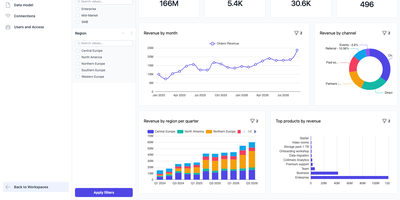
Teams that juggle a file drive, a chat app, a task tracker, and a dashboard tool can fold all four into one self-hosted workspace. Twigex stores files on local disk or S3-compatible storage, shares them with users, groups, or public read-only links, and opens office documents in EuroOffice or Collabora for simultaneous editing. Chat offers channels and direct messages with reactions, mentions, and link previews. Video calls and scheduled meetings run through LiveKit, and guests can join a channel by link. Projects organize work as tables of tasks with custom fields and subtasks, viewable as a grid, kanban board, Gantt timeline, or calendar. Collimato, the analytics module, connects to databases and APIs, models the data, and builds charts and dashboards with filters and KPI cards. The admin area covers users, groups, roles, storage backends, SMTP, office editing, and security settings. The Community Edition is free to run from one binary, a Docker Compose stack, or a Helm chart on Kubernetes. Running on a dedicated VPS on RepoCloud with guaranteed CPU, RAM, and SSD, full root SSH access, and a browser serial console. AGPL-3.0 licensed.
FastLLM Proxy
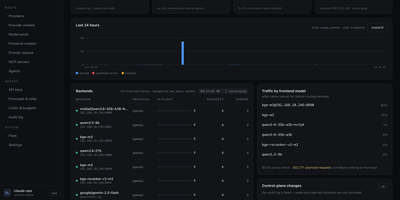
Local vLLM and llama.cpp boxes and hosted providers like OpenRouter, Anthropic, Bedrock, and Gemini all answer to one OpenAI-compatible address once FastLLM Proxy sits in front of them. Clients ask for a frontend model by name, and ordered rules pick the target by caller, prompt size, headers, budget spent, time of day, or how busy a backend is. Prompts that share a prefix return to the node holding their cache, and semantic routing sends coding questions one way and chat another using example prompts you write. API keys carry per-model grants, rate limits, and token or spend budgets, and the management console shows traffic, usage and spend, an append-only audit log, and a fleet topology. Failures fall through to the next target before a byte reaches the caller, and an admission gate turns a flooded engine into a bounded queue. An MCP gateway and an A2A agent endpoint put tool servers and agents behind the same address. Existing LiteLLM configs import unchanged. Running on a dedicated VPS on RepoCloud with guaranteed CPU, RAM, and SSD, full root SSH access, and a browser serial console. Apache-2.0 licensed.
OmniSight
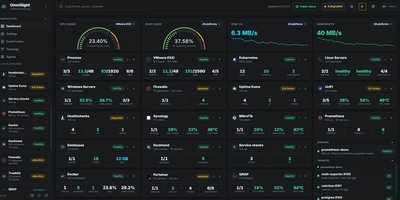
OmniSight ends the homelab ritual of a dozen admin panels open in a dozen tabs, each with its own login and its own idea of what healthy looks like. It folds all of them into one page that answers the only question you actually have: is everything fine? Watch Proxmox nodes with their VMs, containers, backup status, and Ceph health next to VMware hosts and datastores, Linux and Windows servers, and Kubernetes pods with live log viewing. Add Docker hosts and see container status, ports, resource use, and image updates, check OPNsense firewalls, TrueNAS and QNAP storage, and PostgreSQL, MySQL, and MongoDB databases without leaving the dashboard. A small push agent installs with one copied command and self-registers within seconds, needing no inbound firewall rules, so machines behind NAT report in on their own. Follow relationships on the topology map, restart a service from the detail view, export a full backup, and publish a read-only public status page for anyone who asks how things are running. Running on a dedicated VPS on RepoCloud with guaranteed CPU, RAM, and SSD, full root SSH access, and a browser serial console. GPL-2.0 licensed.

CollectiveAccess Providence
For a museum, archive, or research collection that must describe everything it holds in its own metadata terms, CollectiveAccess Providence offers a web-based catalogue that needs no custom programming. Objects, entities, places, collections, storage locations, and loans link through bi-directional relationships with configurable types such as creator, donor, or subject, and DACS, Dublin Core, and VRA Core come pre-loaded. Fields, entry screens, search displays, and reports are defined in the web interface or an XML installation profile with validation for dates, measurements, and URLs; images, video, audio, PDFs, and 3D scans open in browser viewers with pan and zoom. Mapping files import Excel, CSV, XML, and MARC data in bulk, exports cover OAI-PMH formats such as EAD and Dublin Core plus finding aids and reports, and Getty vocabularies and Library of Congress services supply controlled terms. Staff check items in and out like a library, follow location and provenance history over time, and share sets of records with collaborators. Access can be limited by user or group down to specific fields or record types, logins can use LDAP, and every edit is logged with a user and timestamp. MD5 fixity checks arrive by email, BagIt packages support preservation, an optional GraphQL API handles search, browse, and editing, and a separate companion, Pawtucket2, can publish the catalogue as a public website. Running on a dedicated VPS on RepoCloud with guaranteed CPU, RAM, and SSD, full root SSH access, and a browser serial console. GPL-3.0 licensed.

Saki Panel
Saki Panel is a self-hosted operations console that manages your game servers, containers, and background processes across multiple Linux machines, with an AI assistant sitting inside the workspace when something breaks. Start, stop, restart, and monitor nine kinds of instances, from Minecraft and Steam game servers to Docker containers, Compose stacks, Node and Python apps, and plain shell commands. Remote nodes connect over SSH and report CPU, memory, and disk metrics to a cluster dashboard, so every machine is visible in one place. When an instance crashes, Saki Watch records the exit and its error fingerprint, then helps diagnose the cause from live logs, files, and metrics instead of making you copy text between a terminal and a chat window. Proposed fixes appear as diffs that need your approval, are graded by risk level, and can roll back automatically if verification fails after a patch. Day to day work happens in the same console: a web terminal, a file manager with an editor and archive support, database tools for SQLite, MySQL, PostgreSQL, and Redis, and cron-scheduled tasks with full run history. Role-based access with dozens of permission codes, audit logs, and incident notifications through webhooks or Telegram keep a small team in control. Running on a dedicated VPS on RepoCloud with guaranteed CPU, RAM, and SSD, full root SSH access, and a browser serial console. Apache-2.0 licensed.
DodoGuard
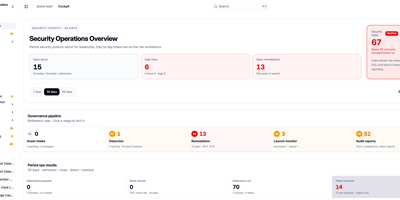
Before an AI agent meets real users, put it through a security checkup it cannot sweet-talk. DodoGuard is a web console and command line where teams register their agents, run evaluation and red-team tasks against them, and decide if each one is cleared for launch. The overview page shows a security index, open risks, remediation counts, and a pipeline that runs from asset intake through detection and remediation to launch monitoring and audit reports. An asset ledger lists every managed agent with its platform, environment, and risk level. A guided wizard creates assessment tasks that pick a test library for prompt injection, instruction leakage, tool misuse, and output risks, then runs black-box conversations against the agent. Evaluation configs cover prompts, providers, variable cases, and several assertion types, with OpenAI, Anthropic, Azure, Bedrock, Ollama, and any OpenAI-compatible endpoint supported. Findings land in a closed-loop board where owners confirm, fix, retest, and close each risk, and finished tasks export as reports for release evidence. Docker Compose with SQLite brings up the web UI on port 3000, and the same engine runs in continuous integration. Security teams use it for launch gates, platform owners use it for regression checks after prompt changes, and auditors use it for evidence. Running on a dedicated VPS on RepoCloud with guaranteed CPU, RAM, and SSD, full root SSH access, and a browser serial console. MIT licensed.
LapisLLM
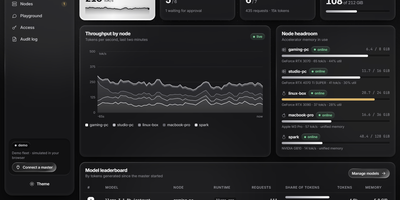
Behind one OpenAI-compatible endpoint, LapisLLM turns the old gaming PC, the work laptop, and the Apple Silicon Mac you already own into a single self-hosted model fleet. A master keeps the registry and routes every request to the right machine, and a small agent on each box runs llama.cpp, vLLM, or MLX and reports its GPU or unified memory. Clients need one base URL and one API key, pick models by name, and see which machine answered in an X-Lapis-Node header. Admission checks free memory minus a reserve before any model starts, first on the master and again on the agent, and a refusal states the numbers. Best-fit placement packs small models onto small machines so the big box stays free, and previews each decision before you commit. New machines stay pending until an admin types the fingerprint printed on that machine, and scoped API keys are shown exactly once. Self-healing brings back the models that should be running after a restart, one at a time per node, while models you stopped stay stopped. Drain a machine out of rotation without clients noticing, export the fleet to JSON without secrets, and scrape Prometheus metrics. The lapis demo command runs a real master with five simulated nodes, so the console can be explored without a GPU. Running on a dedicated VPS on RepoCloud with guaranteed CPU, RAM, and SSD, full root SSH access, and a browser serial console. MIT licensed.