RAGFlow
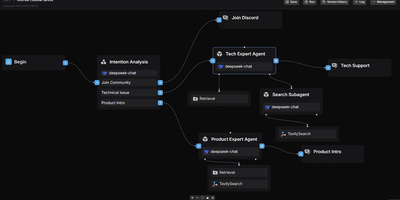
RAGFlow has established itself as one of the most widely adopted open-source RAG engines available, powering production AI systems that demand traceable, hallucination-free answers from complex enterprise data. The platform processes PDF, DOCX, Excel, and PPT files through vision-based deep document understanding with layout analysis and OCR, extracting structured knowledge from tables, charts, and images that simpler parsers miss entirely. RAGFlow's hybrid retrieval pipeline combines vector search with BM25 keyword matching and multi-stage reranking across configurable document stores including Elasticsearch, InfiniFlow's Infinity engine, OpenSearch, and OceanBase. Developers connect any combination of LLM providers — OpenAI, DeepSeek, Anthropic Claude, Google Gemini, and locally-hosted models via Ollama — through a unified configuration layer. The visual agent workflow system enables multi-step reasoning chains with persistent memory, tool calling, and pre-built templates for common enterprise scenarios. RAGFlow synchronizes data from Confluence, S3, Notion, and Google Drive, and delivers answers through chat integrations with Feishu, Discord, Telegram, and Line. The Python SDK and RESTful API on port 9380 provide programmatic access to knowledge base management, document parsing, and conversational retrieval. The full stack deploys via Docker Compose with MySQL for metadata, Redis for task orchestration, and MinIO for object storage. Running on a dedicated VPS on RepoCloud with guaranteed CPU, RAM, and SSD, full root SSH access, and a browser serial console. Apache 2.0 licensed.
Milvus
With over 45,000 GitHub stars and 100 million Docker pulls, Milvus is the most widely adopted open-source vector database, powering production AI systems at NVIDIA, Salesforce, eBay, Airbnb, and DoorDash. The distributed architecture separates compute and storage with stateless microservices on Kubernetes, horizontally scaling query nodes for read-heavy workloads and data nodes for write-heavy ingestion independently. Milvus 3.0 introduces lake-native retrieval that builds and serves indexes directly over vector data in object storage and open formats including Parquet, Lance, Iceberg, and Vortex without maintaining separate copies. Native hybrid search unifies lexical BM25 full-text retrieval and semantic vector search in a single engine with metadata filtering, eliminating the need for separate search infrastructure. Hardware-accelerated ANN indexing supports IVF, HNSW, DiskANN, and GPU-based indexes with BitQ 1-bit quantization cutting memory usage by 72 percent. SDKs for Python, Go, Node.js, and Java provide programmatic access, while Milvus Lite offers lightweight embedding for local development via pip install. Server-side aggregation, sorting, faceted search, StructArray for nested document structures, and ColBERT multi-vector scoring move ranking and result processing into the engine. The Path Index enables 100x faster JSON filtering with support for 100,000+ collections per cluster for multi-tenant deployments. Self-hosting deploys via Docker Standalone or Kubernetes with Helm charts using S3-compatible, GCS, or Azure Blob storage backends. Running on a dedicated VPS on RepoCloud with guaranteed CPU, RAM, and SSD, full root SSH access, and a browser serial console. Apache 2.0 licensed.
BitRouter
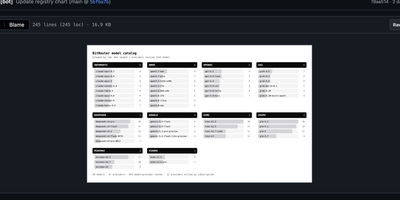
BitRouter is a context-aware LLM router that learns which model delivers the cheapest successful outcome per workflow step, cutting agent costs by up to 80% while maintaining 96% quality versus all-frontier baselines. Point any agent runtime at http://localhost:4356 with a one-line OPENAI_BASE_URL change and BitRouter routes to OpenAI, Anthropic, Google, Groq, DeepSeek, Mistral, Moonshot, MiniMax, Nvidia, and any OpenAI-compatible endpoint simultaneously, normalizing authentication, streaming, and cross-protocol translation between wire formats. The act-observe-evaluate-learn loop traces every hop with cost, tokens, and latency attribution, scores each decision against a versioned policy-lock.yaml, then tightens routes automatically with no LLM judge in the path. Native MCP gateway auto-discovers tools from connected servers and makes them routable and governed alongside model calls. Agent Client Protocol integration enables the TUI to manage Claude Code, Codex, OpenCode, OpenClaw, Gemini, and Copilot sessions in real time with inline tool-call approval and live streaming. Built-in guardrails inspect, redact, or block risky content before requests leave your network. Virtual keys scope API access per agent or user without exposing upstream credentials. Per-agent spend caps and loop guards contain runaway cost automatically. Multi-account failover reroutes mid-run so rate limits never re-pay completed work. Ships as a single Rust binary via npm or Cargo. Running on a dedicated VPS on RepoCloud with guaranteed CPU, RAM, and SSD, full root SSH access, and a browser serial console. Apache 2.0 licensed.
LibrePhotos
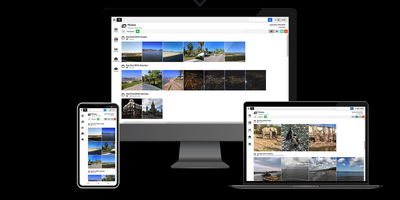
With over 8,000 GitHub stars and continuous development since 2020, LibrePhotos delivers the core intelligence of Google Photos — face recognition, object detection, semantic search, and automatic album generation — entirely on your own hardware without sending a single photo to a third-party server. The Django 5 backend processes uploaded media through a machine learning pipeline that runs face detection via the face_recognition library, clusters identified faces using scikit-learn and HDBSCAN, generates image captions through BLIP and Moondream 2, and classifies scenes using Places365 or Google's SigLIP 2 vision-language model with zero-shot classification against 900+ real-world tags. Semantic search lets you find photos by natural language queries like "sunset at the beach" without manual tagging, while metadata search filters by person, camera, lens, file type, and filesystem path. The React 18 frontend built with Vite presents a timeline view, fullscreen lightbox with slideshow mode, photo detail sidebar showing location and people, and a folder navigation view with breadcrumb paths. RAW files from any camera are converted via ImageMagick, videos processed through FFmpeg, and Live Photos paired with their RAW+JPEG counterparts as unified entries. Public album sharing via link provides fine-grained privacy controls, and duplicate detection uses perceptual hashing to identify near-identical images. Deployment runs as a single unified Docker container or via Docker Compose with Kubernetes manifests also available. Running on a dedicated VPS on RepoCloud with guaranteed CPU, RAM, and SSD, full root SSH access, and a browser serial console. MIT licensed.
Inference Gateway
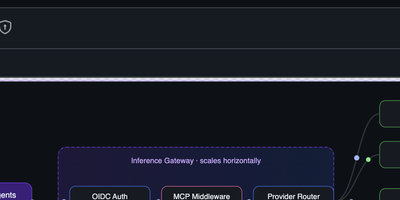
Inference Gateway puts a single OpenAI-compatible API endpoint in front of OpenAI, Anthropic, Groq, Cohere, Ollama, DeepSeek, Google, Mistral, MiniMax, Moonshot, Nvidia, and llama.cpp, so your application code never changes when you switch models or providers. The Go binary starts on port 8080 and normalizes authentication, streaming protocols, and response formats across all backends transparently. Native Model Context Protocol support auto-discovers tools from connected MCP servers and injects them into LLM requests without client-side management, enabling server-side tool execution across any provider that supports function calling. Agent-to-Agent protocol integration allows distributed agent communication through a declarative Agent Definition Language that generates production-ready Go or Rust servers from a single YAML manifest. The dedicated Kubernetes Operator manages Gateway, Agent, MCP, and Orchestrator custom resources with automatic HPA scaling, OIDC authentication, and service discovery that rebuilds MCP configurations when the discovered server set changes. Prometheus metrics and OpenTelemetry tracing provide full request-level observability across the entire inference pipeline. Middleware controls enable per-request provider selection, model routing, and fallback strategies. Official SDKs in Go, Python, TypeScript, and Rust provide typed client interfaces with streaming support. Docker Compose deployment requires only environment variables for API keys. A CNCF Sandbox applicant. Running on a dedicated VPS on RepoCloud with guaranteed CPU, RAM, and SSD, full root SSH access, and a browser serial console. Apache 2.0 licensed.
Mage
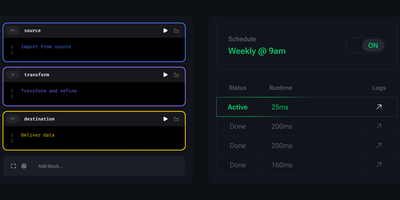
Backed by 8,700+ GitHub stars and designed as a modern alternative to Apache Airflow, Mage delivers the open-source data pipeline platform that combines the interactive flexibility of notebooks with production-grade orchestration in a single self-hosted environment accessible at port 6789. The modular block architecture lets data engineers compose pipelines from Python, SQL, and R code blocks with instant data previews, live execution logs, and visual debugging at each step. Over 100 prebuilt integrations connect sources and destinations including PostgreSQL, MySQL, Snowflake, BigQuery, Redshift, S3, Kafka, MongoDB, Amplitude, Salesforce, and Stripe with parallel stream synchronization for high-throughput data movement. Batch pipelines run on cron schedules or event triggers while streaming pipelines process real-time data from Kafka, Kinesis, and RabbitMQ with stream mode reducing memory usage by approximately 90 percent compared to batch processing. Native dbt integration builds, tests, and runs dbt models directly inside the pipeline editor alongside custom transformation blocks. Spark, Snowpark, and Databricks runtimes handle large-scale distributed processing. AI-assisted development generates code, fixes errors, and optimizes queries within the notebook interface. Monitoring dashboards track pipeline health with integrations to Datadog, Prometheus, New Relic, and OpenTelemetry. Terraform templates deploy production environments to AWS, GCP, or Azure with two commands, while Helm charts support Kubernetes clusters. Running on a dedicated VPS on RepoCloud with guaranteed CPU, RAM, and SSD, full root SSH access, and a browser serial console. Apache 2.0 licensed.
OpenLIT
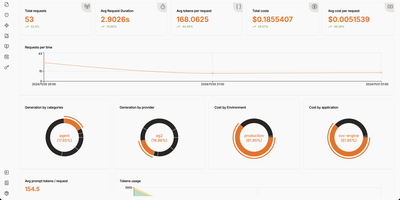
Your AI application is burning through API tokens faster than you can refresh the billing page, and you have no idea which prompt template is responsible. OpenLIT plugs that visibility gap with a self-hosted observability platform built specifically for LLM workloads. Add one line of code to instrument 90+ LLM providers, agent frameworks, and vector databases, then watch every request flow through a tracing dashboard that shows tokens consumed, latency measured, and dollars spent per call, per model, per environment. The requests view lists every LLM interaction with provider, model, cost, and token breakdown in a filterable table, while the trace detail panel lets you drill into individual spans to read the exact prompt sent and response received. Prompt Hub turns prompts into versioned artifacts you deploy, rollback, and A/B test without touching application code. OpenGround compares models side by side on the same input, so you can evaluate cost-versus-quality tradeoffs before committing to a provider. Automated evaluations run LLM-as-a-judge scoring on live production traces, flagging hallucinations, bias, and toxicity in real time. The Vault stores and rotates API keys centrally so secrets stay out of your codebase. Custom dashboards let you build drag-and-drop monitoring views with charts, stat cards, and tables backed by SQL queries against ClickHouse. GPU utilization, memory, temperature, and power metrics feed into the same platform for end-to-end infrastructure visibility. Running on a dedicated VPS on RepoCloud with guaranteed CPU, RAM, and SSD, full root SSH access, and a browser serial console. Apache 2.0 licensed.
Doccano
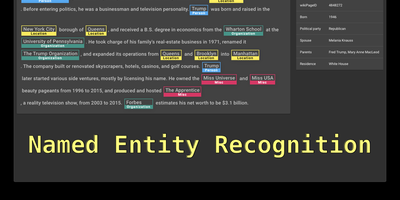
Doccano is a text annotation platforms for building machine learning training datasets. The web-based interface supports text classification for sentiment analysis and document categorization, sequence labeling for named entity recognition with overlapping entity support and relation extraction between labeled spans, and sequence-to-sequence annotation for text summarization and machine translation pairs. Collaborative annotation enables multiple annotators to work on the same project simultaneously with per-user progress tracking, annotation guidelines, example assignment to specific members, and filtering by assignee. Auto-labeling integrates with external machine learning model APIs through configurable request and response mapping templates, allowing pre-annotation that annotators can review and correct. Data import accepts plain text, JSONL, CoNLL, and Excel formats, while export produces JSONL and CoNLL datasets compatible with spaCy, Hugging Face Transformers, PaddleNLP, and other training frameworks through the doccano-transformer library. The Django backend with Django REST Framework exposes a complete RESTful API for programmatic project creation, dataset management, and annotation retrieval via the official doccano-client Python library. Celery handles background tasks including dataset import and export processing with Flower providing task monitoring. One-click deployment supports AWS CloudFormation and Heroku alongside Docker Compose for self-hosted environments. Running on a dedicated VPS on RepoCloud with guaranteed CPU, RAM, and SSD, full root SSH access, and a browser serial console. MIT licensed.
Forge
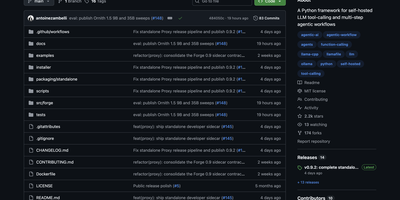
Forge intercepts failing LLM tool calls and fixes them before they derail your agent workflow, applying rescue parsing, retry nudges, response validation, and step enforcement between your AI clients and local model backends. The proxy server mode drops in as a transparent intermediary speaking both the OpenAI chat-completions API and the Anthropic Messages API, so tools like Aider, Claude Code, Continue, and opencode connect through it without configuration changes. Under the hood, the WorkflowRunner provides a complete agentic loop manager with system prompt injection, tool execution, context compaction with configurable thresholds, and VRAM budgeting for consumer GPUs with 12-32 GB. SlotWorker enables priority-queued access to shared inference slots with automatic preemption for multi-agent architectures. The guardrails middleware exposes a two-method check-and-record API that wraps into any existing orchestration loop, providing malformed tool-call rescue parsing, retry nudge generation, required step enforcement, and prerequisite ordering without taking over execution control. Backend adapters support generic OpenAI-compatible endpoints, Ollama, llama-server, Llamafile, vLLM, and Anthropic with automatic model discovery and health checking. Architecture Decision Records document every design choice. Launched February 2026, already at 2,200+ GitHub stars. MIT licensed.
Farfalle
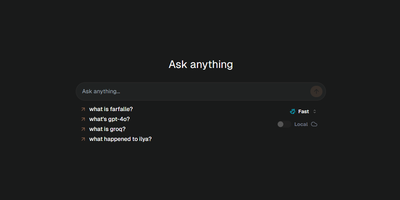
Live web search plus an LLM of your choice: Farfalle is an open-source, self-hosted answer engine in the Perplexity mold. Queries route through one of several search providers - self-hosted SearXNG for a fully independent stack, or Tavily, Serper, and Bing APIs - and the model composes a cited answer from the retrieved results. Model flexibility is the core design: run llama3, mistral, gemma, or phi3 locally through Ollama for zero per-query cost and full privacy, use cloud models like GPT-4o or Groq-hosted Llama 3 for speed, or route to any provider via LiteLLM. An Expert Search mode uses an agent that plans a multi-step search strategy and executes it for harder questions, and chat history keeps prior research sessions available. The stack is a Next.js and shadcn/ui frontend over a FastAPI backend with Redis rate limiting, shipped as a pre-built Docker image. A browser search-engine entry pointing at your instance makes it the default search from the address bar. Paired with SearXNG and Ollama, the whole pipeline runs with no external API at all.