MateClaw
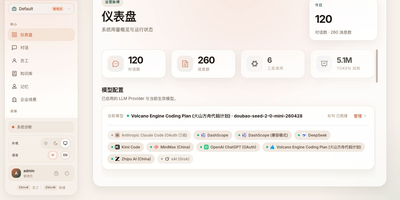
MateClaw delivers a multi-agent AI platform where digital employees run as persistent team members with roles, goals, and accumulated skills rather than stateless chat completions. The Spring Boot backend on Spring AI Alibaba provides ReAct iterative reasoning and Plan-and-Execute decomposition on a StateGraph runtime, with parallel delegation between employees and dynamic context pruning for multi-step tasks. Five career templates ship ready (Product Researcher, Customer Support, Knowledge Curator, Data Analyst, Executive Assistant) while custom employees inherit configurable backstories, pixel-art avatars, and dedicated tool bindings. The MCP integration supports stdio, SSE, and Streamable HTTP transports with per-employee tool isolation preventing capability bleed between agents. ACP bridges bring Claude Code, Codex, and other coding agents in as first-class employees. Workflow orchestration composes multiple employees and system actions into publishable linear DSL processes with seven step modes: sequential, fan_out, collect, conditional, await_approval, dispatch_channel, and write_memory. The trigger system wires cron schedules, webhooks, channel messages, employee lifecycle events, content matches, and workflow completions to automated flows. The Admin Runtime Console provides real-time visibility into running employees with token usage tracking and one-click force-recycle. Spring Boot Actuator monitoring, full audit trail, and per-channel error isolation deliver production-grade reliability. Running on a dedicated VPS on RepoCloud with guaranteed CPU, RAM, and SSD, full root SSH access, and a browser serial console. Apache-2.0 licensed.
Leon
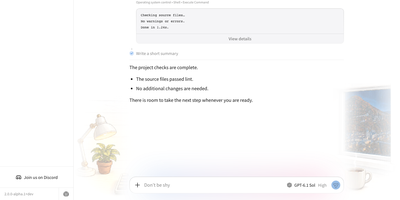
Leon is a personal AI assistant that lives on your own server, remembers what matters to you, and finishes real tasks with tools instead of just chatting. Ask for something in the browser web app and Leon plans the work, runs tools in isolated workers, checks the results, recovers from failures, and writes a short summary. Agent mode handles open-ended requests, controlled mode follows predictable native skills, and smart mode picks the better route for each task. Layered memory keeps durable facts and preferences, daily summaries, and recent discussion context, and Leon can search earlier conversations when exact details matter. Answers can arrive as interactive charts with region toggles, forms, and calculators instead of walls of text, and generated files become downloadable artifacts. Setup cards guide you through connecting services such as Spotify, owner-installed MCP servers add more tools, and a browser tool and computer use handle web pages and desktop applications. Pick models per profile, from a local llama.cpp model to OpenAI, Anthropic, DeepSeek, Groq, or OpenRouter. Profiles keep config, secrets, sessions, and memory separate, so one server can serve several people, with optional token authentication for remote clients. Workspaces group conversations under a shared brief, and Leon Satellite lets a remote Leon use enabled tools on your own device. Running on a dedicated VPS on RepoCloud with guaranteed CPU, RAM, and SSD, full root SSH access, and a browser serial console. MIT licensed.
Pad
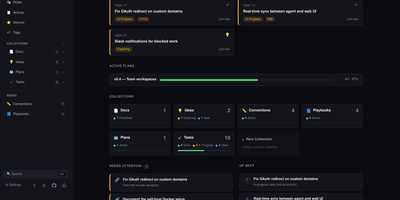
Your coding agents finish a session, close the laptop, and forget everything; Pad is where the project remembers. It holds the tasks, plans, bugs, ideas, and decisions in one workspace that you drive from a browser while your agents drive it from the terminal, so the next session, human or machine, picks up exactly where the last one stopped. You plan on boards, lists, and tables with drag-and-drop status columns, rich item pages, comment threads, and a dashboard that answers what needs attention and what to do next. Your agents read the queue, claim items, leave checkpoints, link their pull requests, and mark work fixed with the fixing PR attached. Conventions teach them the house rules once, like running tests before calling a task done, and playbooks hand them repeatable multi-step workflows they can invoke by name. Every change is versioned with its author, a person or a named agent, and new items appear in the browser the moment an agent creates them in the terminal. The same workspace is reachable three ways: the web interface, the pad CLI, and a bundled MCP server with a natural-language skill that plugs into Claude Code, Cursor, Codex, Windsurf, OpenCode, Copilot, Amazon Q, and Junie. Running on a dedicated VPS on RepoCloud with guaranteed CPU, RAM, and SSD, full root SSH access, and a browser serial console. Apache-2.0 licensed.
MATE
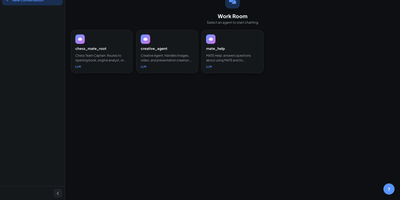
Change an agent's prompt, model, or audience from a dashboard and watch it go live without a single redeploy. MATE opens in a Work Room where any root agent can be picked from a card grid and chatted with directly. The Studio holds the builder: a drag-and-drop canvas draws parent and child agents, attaches tools and MCP servers, and keeps every configuration versioned with one-click rollback. Trace Replay plays a past conversation back across that canvas so each hand-off is visible. A template library imports ready-made agent teams, from research pipelines to support desks. The Control Room covers governance: role-based access per agent, dollar costs per agent and project, budgets that warn or block, guardrails for personal data and prompt injection, and alerts to Slack, Discord, email, or a webhook. Eval suites score replies by exact match, similarity, or an LLM judge, and a Playground compares models or prompts side by side on score, speed, and cost. Agents can be embedded as a chat widget, called through an OpenAI-compatible endpoint, or exposed over MCP and A2A. Agencies running client agents and platform teams juggling dozens of them can manage the lot from one dashboard. Running on a dedicated VPS on RepoCloud with guaranteed CPU, RAM, and SSD, full root SSH access, and a browser serial console. Apache-2.0 licensed.
Slashdocs
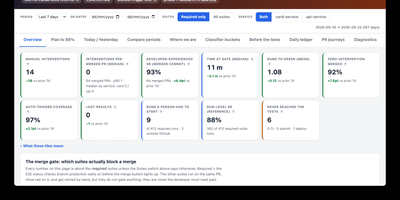
Slashdocs gives AI agents and the people who supervise them one shared home for finished work, replacing reports pasted into chat threads with reviewable HTML documents that live at a permanent address. An agent publishes a single self-contained HTML file, an architecture review, incident postmortem, product spec, data analysis, or QA report, and teammates open it in the browser to read the rendered page rather than raw markup. Reviewers anchor comments to exact words, resolve or reopen threads, and follow links straight to a heading or discussion, while Slack notifications announce new activity with personal mute controls for quieter channels. Every publish creates an immutable version guarded by optimistic concurrency, so an agent can read the feedback and push the next revision without overwriting anyone's copy. Agents connect through a remote MCP endpoint with browser OAuth or service-account keys, and people sign in through OpenID Connect with providers such as Google, Okta, Entra ID, or Keycloak. The companion CLI creates, pulls, pushes, and comments on documents with compact output or JSON for scripts, and folders plus sharing controls keep a growing library organized. Running on a dedicated VPS on RepoCloud with guaranteed CPU, RAM, and SSD, full root SSH access, and a browser serial console. MIT licensed.
OASM
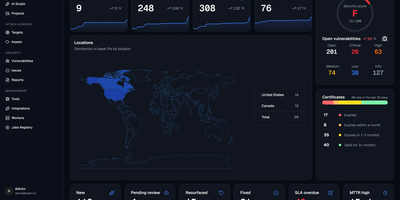
Know every internet-facing asset your team exposes, and which weakness to fix first, before an attacker maps them for you. Add domains, IP addresses, CIDR ranges, or Git organizations as targets, with internal or external scope, and OASM builds one searchable inventory of hosts, ports, services, technologies, URLs, TLS certificates, and screenshots, with a topology graph and CSV export. Scanners such as Nuclei, Nmap, OWASP ZAP, Nikto, WPScan, and Gitleaks install from a marketplace as isolated connector containers, and distributed workers run them on demand or on a schedule. Findings move through new, active, resurfaced, and fixed states with CVSS, EPSS, and SLA timers, and teams accept risk, dismiss, or open remediation issues with priority, assignee, and due date. Projects keep chosen assets scanned on a schedule, when new assets join, or when a vulnerability appears. AI Studio is a security agent that runs on the model you connect: it answers questions from workspace data, writes a plan for your approval, dispatches parallel subagents, runs commands on your workers, and drives a headless browser, filing its findings as proposals a reviewer must approve. An MCP server opens the same workspace data to Claude, Cursor, and VS Code with a workspace API key. Assets sync from AWS, Cloudflare, and Vercel, and alerts reach Slack, Discord, Telegram, or webhooks. Running on a dedicated VPS on RepoCloud with guaranteed CPU, RAM, and SSD, full root SSH access, and a browser serial console. AGPL-3.0 licensed.
FLUJO
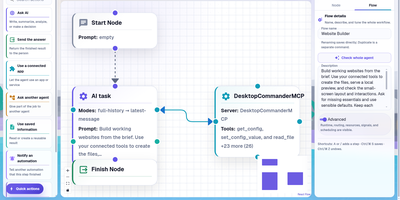
Building an AI agent in FLUJO means saving a model connection once, adding plain-language steps or dragging nodes onto a visual graph, and attaching tools from any MCP server, all inside one open-source workspace you host yourself. Connections cover OpenAI, Azure OpenAI, Anthropic, Google Gemini, xAI, OpenRouter, and local Ollama models, with ordered fallback connections for rate limits and outages plus a built-in connection test. The Connected Apps screen imports MCP servers from curated apps, the MCP Registry, a remote URL, a GitHub repository, or a local command, then lets you call their tools and read their resources before an agent touches them. Easy mode assembles an agent one recipe step at a time, Expert mode exposes Start, AI, connected-app, Static, and Subflow nodes with branching handoffs and loops, and both open the same saved agent. Talk runs agents in a live chat with a context-window meter, optional tool approvals, file and audio attachments, message editing, and a visual debugger that sets breakpoints and steps through nodes. Triggers start flows from schedules, webhooks, file changes, polled MCP tools, changed websites, or another flow finishing. Experimental Personas keep memories and goals between sessions, and Meetings seat several agents in one conversation. Any saved flow answers as a model on an OpenAI-compatible /v1 endpoint, so Cline, Cursor, or SDK clients can call it. Running on a dedicated VPS on RepoCloud with guaranteed CPU, RAM, and SSD, full root SSH access, and a browser serial console. MIT licensed.
BokeBox
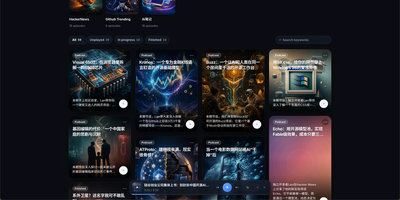
BokeBox turns the read-later pile into private podcast episodes you can finish on a commute. Upload a video or audio file, paste a link, or drop in a draft, and the pipeline runs transcription, a spoken-style rewrite, cover art, notes, flashcards, and voice synthesis, with progress shown on the home screen. A host persona sets name, role, tone, and speaking style, and each episode can override it with a preset voice or a voice described in words. The player shows scrolling lyrics, notes, flashcards, and an outline, remembers where you stopped, and offers speed control and a sleep timer. Albums queue episodes for continuous play, and the Star Map links episodes by shared tags. Schedules pull RSS feeds, URL lists, GitHub Trending, and Hacker News on a cadence and create episodes automatically. Plugins add new content sources, speech recognition engines, and voices. An MCP endpoint lets Cursor, Claude, or Codex create podcasts from a URL or text and check job status. Running on a dedicated VPS on RepoCloud with guaranteed CPU, RAM, and SSD, full root SSH access, and a browser serial console. LGPL-3.0 licensed.
Ybkkasi
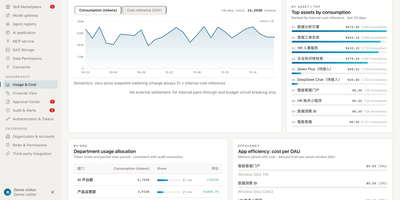
Enterprises keep buying AI tools and wondering why output does not compound, when the real gap is governance: nobody can say which agent owns what, what it may touch, or what it cost. Ybkkasi answers those three questions in one console for every MCP server, skill, agent, and AI application you run. Register each asset and move it through a lifecycle state machine from discovery to retirement, with 85 permission points deciding who can view, call, publish, or approve at every step. Work itself is organized as goals that break into projects and tasks, assigned to digital employees who each carry a home organization, a human supervisor, and a roster status. Approvals route through a dedicated center where lifecycle changes and sensitive actions wait for a human decision instead of happening silently. Every call is metered, so usage and cost reports attribute spend by department, by agent, and by skill, making showback a query rather than an argument. The audit log records who did what to which asset and when, giving compliance a trail they can actually read. Running on a dedicated VPS on RepoCloud with guaranteed CPU, RAM, and SSD, full root SSH access, and a browser serial console. MIT licensed.
LISA
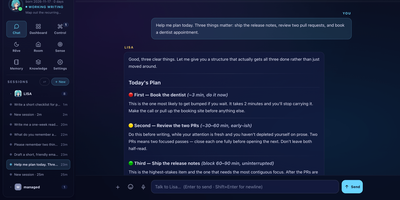
An open-source AI personal assistant that plans your day, drafts your messages, and remembers how you like to work, LISA keeps her memory as plain files you can read and restore. Ask for a plan and she replies in chat with tool activity visible, and any reply can be cancelled or retried. After a conversation she may refine her memories, and Rêve lists each change with its source conversation and a recoverable previous version. Links, articles, and video transcripts go into a searchable linked wiki, and daily briefs come from the RSS and Atom feeds you configure. Twenty-two read-only connectors reach GitHub, Google Calendar, Gmail, Linear, Google Drive, Slack, Box, and Obsidian; you authorize each account and pick what she may read. Telegram, Discord, Slack, Feishu, and webhooks put her on your phone, with allow-lists and a remote-safe toolset by default. Durable goals, scheduled routines, and local watchers keep working between chats. MCP servers, skills, and plugins add tools. Run chat on Anthropic, OpenAI, Gemini, an OpenAI-compatible service, or a local model through Ollama or LM Studio, so you decide which provider sees your context. A pixel-art room shows what she is doing, and the optional Warden policy adds an approval inbox with scoped grants and audit records. Running on a dedicated VPS on RepoCloud with guaranteed CPU, RAM, and SSD, full root SSH access, and a browser serial console. MIT licensed.
Kompl
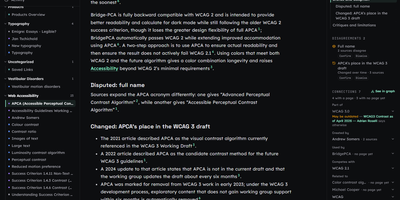
Save a link, a PDF, a YouTube video, or a bookmark export to Kompl and it reads the material on arrival, then writes it into cross-linked wiki pages instead of leaving it in a folder you never reopen. Save more on the same subject and the existing pages are rewritten, so source number fifty improves the pages it touches. Every claim carries a numbered citation back to the original text, and when two sources disagree the page records both sides with a confirm or dismiss button. A knowledge graph shows how topics connect, each link backed by the sentence that states it. An onboarding wizard stages pasted text, URLs, uploaded files, browser bookmarks, Twitter exports, Apple Notes, and Upnote exports for review before anything is compiled. Settings pick the compile model from DeepSeek or Gemini, cap daily spend, and show wiki health. Eight MCP tools let Claude Code, Cursor, Codex, and other agents search, read, and cite pages. Full backups export as one zip that restores without further model calls. Running on a dedicated VPS on RepoCloud with guaranteed CPU, RAM, and SSD, full root SSH access, and a browser serial console. Apache-2.0 licensed.
Quire Ink
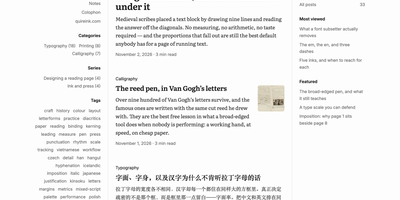
Quire Ink is a long-term blog for a single writer, with a built-in MCP server so an AI assistant can draft, schedule and publish posts on your behalf. You write in the browser with an autosaving Markdown editor that handles tables, footnotes, callouts, maths, galleries and video, and it keeps every revision. Pressing Publish sends the post to your site, your RSS feed, your newsletter subscribers and, if you switch it on, Mastodon, with no algorithm or ads in between. Readers get a pen of their own. They highlight in five inks, underline in pencil or ring a word, and the marks stay in their browser with no account. Four reading themes (plain paper, source code, newspaper and notebook), six light and dark palettes and a paginated book mode restyle the whole site from the admin. Connected over MCP, Claude or another assistant can read your traffic, clear spam, rearrange the front page and build a theme that passes the same checks as Settings. Posts from WordPress, Ghost, Substack and Medium arrive with images and old links intact, and one button exports everything as plain Markdown. Comments need no account. The admin works on a phone, in eleven languages. Running on a dedicated VPS on RepoCloud with guaranteed CPU, RAM, and SSD, full root SSH access, and a browser serial console. AGPL-3.0 licensed.
DopplerTask
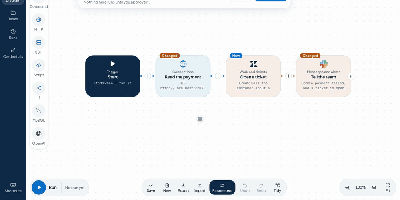
DopplerTask is the control layer where AI agents build your automations and you decide what goes live. You describe the outcome in plain language, and your agent assembles a task from a library of eighty-one ready-made steps spanning messaging, ticketing, sales, operations, documents, databases, queues, and AI models. The proposal lands in a visual editor that people and agents share, with new and changed steps marked and the old value of each field beside the new one. Nothing goes live until you approve it, and the previously approved version keeps running untouched in the meantime. Once a task is live it can start from a webhook, a schedule, a message queue, a manual click, or the agent itself, and every run is recorded with the output of each step, the person who started it, and the person who approved the version. Failed runs resume from the step that failed, with retries and continue-on-failure where you want them. Agents reference your credentials by name only; the values stay encrypted on your server, beyond the agent's reach, and separate tokens for people and agents plus single sign-on keep access tidy. Running on a dedicated VPS on RepoCloud with guaranteed CPU, RAM, and SSD, full root SSH access, and a browser serial console. MIT licensed.
SandBase Harness
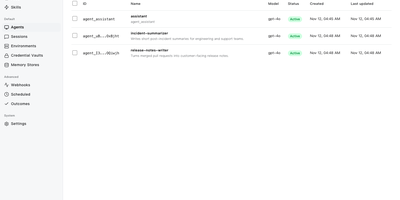
SandBase Harness gives your AI agents a proper home with sessions, tools, sandboxes, and an audit trail instead of a pile of scripts. The console lists agents with their model, status, and version, and an agent page shows its system prompt, attached tools, and skills. Every session keeps a resumable event log, and a transcript view opens any user or agent message as a rendered or raw event. Built-in tools run in a local process, per-session Docker containers, Kubernetes, or a self-hosted worker queue, and permission policies can always allow a tool or always ask a human first. MCP toolsets, credential vaults, and skill packages extend what an agent can reach, with Anthropic's xlsx, pptx, pdf, and docx skills listed next to your own. Memory stores, webhooks, scheduled deployments, and outcome definitions cover longer-running work. Settings include a model provider form, API keys for bearer authentication, and an interactive API reference for sessions, agents, environments, and vaults. A TypeScript SDK and a bundled MCP bridge connect other tools to the same runtime. Running on a dedicated VPS on RepoCloud with guaranteed CPU, RAM, and SSD, full root SSH access, and a browser serial console. Apache 2.0 licensed.
Magic Cloud
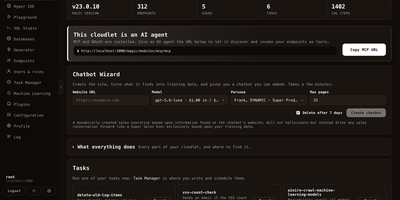
Magic Cloud turns a plain-English app description into a working backend, secured API, and frontend that run on your own server. Point the endpoint generator at a database and it writes CRUD endpoints with roles and validation; paste an OpenAPI or Swagger URL and it wraps any third-party API as documented endpoints. A dashboard shows endpoint counts, users, scheduled tasks, and logs. A built-in MCP URL gives Claude, Cursor, or Codex a way to discover and call every endpoint as a tool. The Chatbot Wizard crawls a website and hands back an embeddable chatbot grounded in that content. Hyper IDE edits any file on the server with an ask-the-AI prompt bar underneath, and Rewind steps through a recorded execution line by line. A visual Web Designer assembles pages from blocks, a Task Manager schedules background jobs, and Chat Ops answers questions about what the cloudlet can do and then does it. Role-based access guards each endpoint, and a SQL Studio handles direct queries. Running on a dedicated VPS on RepoCloud with guaranteed CPU, RAM, and SSD, full root SSH access, and a browser serial console. MIT licensed.
AI Chatbot Framework
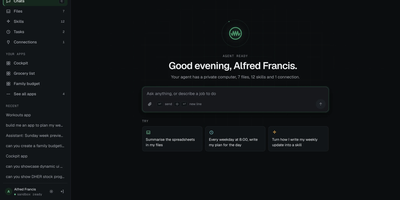
Ask for a job in plain words and an agent with its own private computer does it: it reads files, runs commands, calls connected apps, and reports back in the chat. Every user gets a persistent sandbox workspace, so one person's files and commands never touch another's. Type a new message mid-run and the agent picks it up without stopping, or press Stop at any time. For bigger jobs the agent starts sub-agents that work side by side, each on a model of its choice, and the chat shows what each one is doing. Skills teach it repeatable methods in the open Agent Skills format; upload a zip, write one by hand, or let the agent write its own, and use them from a slash menu. The Connections page links Linear, Notion, Jira, Stripe, and other apps through one-click OAuth sign-in, or any MCP server by address. Scheduled tasks run on a repeating or one-time schedule, and each run becomes a readable chat. Small personal apps like a to-do cockpit or budget view appear in the sidebar, and charts, plans, and forms can render right inside answers. A files browser, an artifacts panel, a command menu, light and dark themes, and a phone layout round out the interface. Running on a dedicated VPS on RepoCloud with guaranteed CPU, RAM, and SSD, full root SSH access, and a browser serial console. MIT licensed.
Manifold
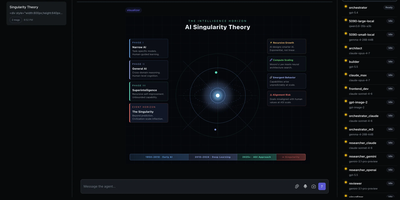
One workspace, a whole roster of AI specialists: Manifold is an agent platform for long-horizon objectives that run through chat, visual workflows, and scheduled tasks. Specialists carry their own model, prompt, and tool allow-list, group into teams, and collaborate across many turns in a chat view that renders HTML visualizations beside text. Models come from OpenAI, Google, Anthropic, or any server that speaks the OpenAI API, such as llama.cpp or vLLM, and image generation reaches OpenAI, Google, or local ComfyUI. The flow editor draws workflows on a canvas, exposes MCP tools as nodes, and turns a saved workflow into a tool that specialists and other flows can call. Pulse schedules specialist tasks at intervals, daily, or once at a chosen time and delivers results to Matrix rooms. Projects isolate agent workspaces to their own folders, load skills from each project's skills directory, and include a file browser with upload, download, and Markdown preview. A Playground versions prompts and datasets and runs experiments that show how a prompt change shifts behavior, while the overview dashboard charts token usage, traces, and logs. Sign-in through OIDC or OAuth2 is optional and adds user and admin roles. Running on a dedicated VPS on RepoCloud with guaranteed CPU, RAM, and SSD, full root SSH access, and a browser serial console. MIT licensed.
Saiku Analytics
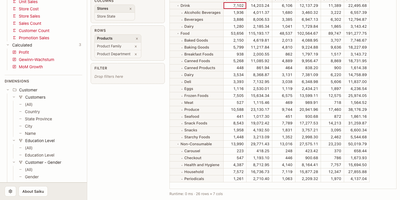
Point Excel, dashboards, and AI agents at one governed cube and Saiku Analytics, an open-source semantic layer, answers all three with the same numbers. The Query Editor writes the MDX as analysts drop measures and levels onto rows, columns, and filters, then shows a pivot grid or 16 chart types such as treemap and sunburst. Dashboards mix KPI, chart, table, text, and image tiles with cross-filtering, drill-down, conditional formatting, and forecast overlays, then export to PDF or PNG, share read-only links, or embed as a web component. An Excel add-in drops governed PivotTables that refresh live, and a Google Sheets add-on inserts cube data as tables that refresh in place. Agents get a typed REST API that lists cubes and measures, accepts JSON questions at /ai/query, and returns the exact field and legal values when validation fails. An MCP server connects Claude Desktop, Cursor, and Cline with a one-click .dxt install, and agent spaces limit each persona to chosen cubes and markdown skills. No semantic model yet? Saiku drafts cubes, dimensions, measures, and joins from a warehouse schema for review. Queries run on DuckDB, ClickHouse, Snowflake, BigQuery, Postgres, and dozens more databases, and model diff flags every saved query or dashboard a schema change would break. Okta and Entra ID provision accounts over SCIM 2.0, and sign-in runs through OIDC or SAML. Running on a dedicated VPS on RepoCloud with guaranteed CPU, RAM, and SSD, full root SSH access, and a browser serial console. Apache-2.0 licensed.